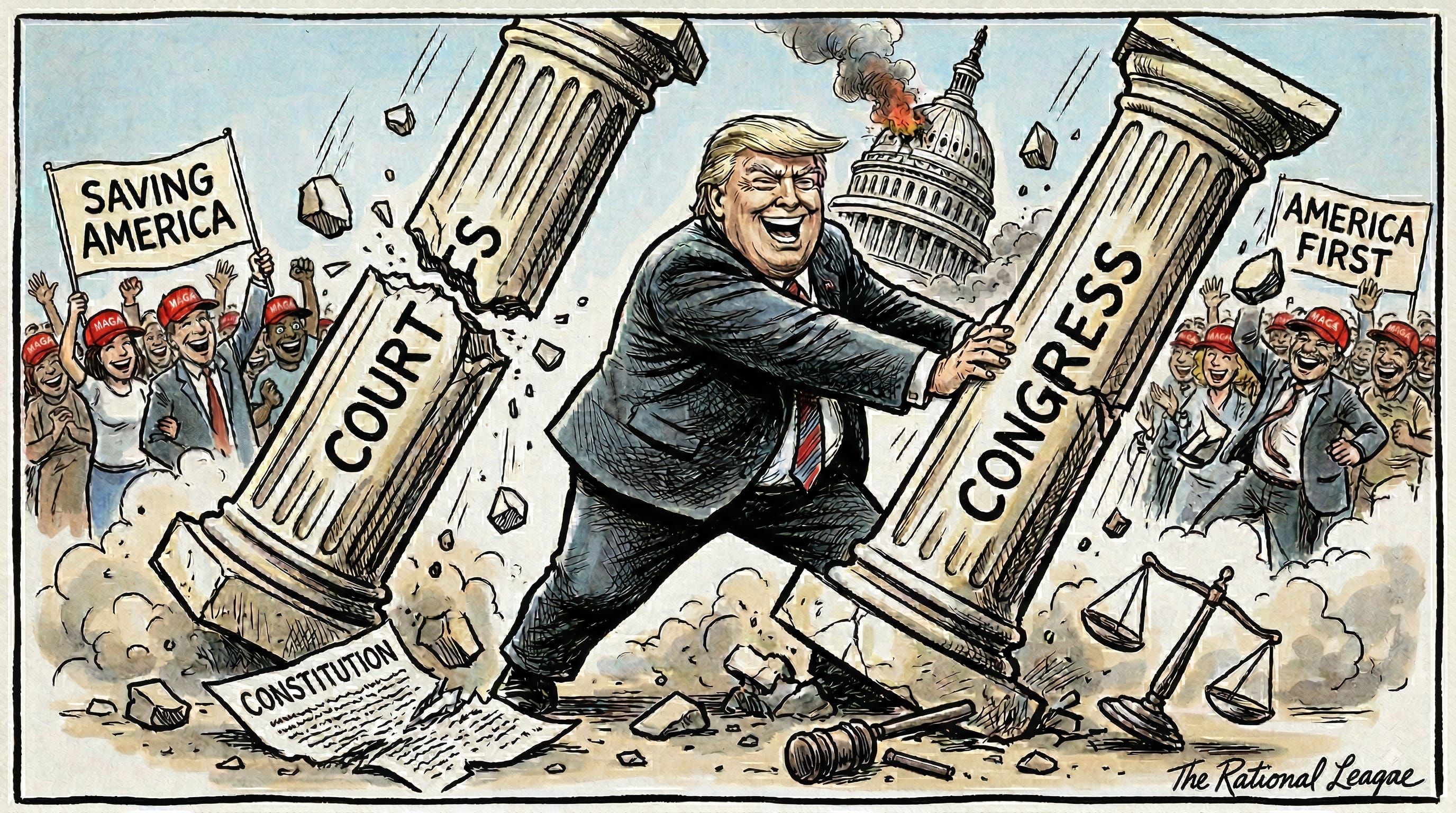
There are things a democracy can argue about, and there are things it cannot argue away, and the difference between the two has never been more important to understand than it is right now. The Varieties of Democracy Institute (V-Dem) based at the University of Gothenburg, does not take political positions. It employs over 4,200 country experts and produces more than 32 million data points across 202 nations going back to 1789. The independence of the judiciary, the capacity of the legislature to constrain the executive, freedom of expression, civil rights, and the integrity of elections. In their 2026 Democracy Report, V-Dem recorded the largest single-year drop in American democratic standing in the entire history of their dataset. The United States fell from 20th to 51st place on the Liberal Democracy Index in one year. The only comparable single-year declines in the modern era occurred in countries experiencing military coups (Nord et al., 2026).
That number, 20th to 51st, deserves to be held still for a moment before anything else is said about it. It means that by the most comprehensive external measurement of democratic health that exists, the United States now ranks below countries that most Americans would struggle to locate on a map, and does so not after a slow erosion across decades but after twelve months. The V-Dem authors note that the speed of this decline is without precedent in modern democratic history: what it took Viktor Orbán four years to accomplish in Hungary, what took Recep Tayyip Erdoğan and Narendra Modi roughly a decade each in Turkey and India, the Trump administration achieved in a single year (Nord et al., 2026). The report is explicit on the comparison. The USA now sits fourth on the list of stand-alone autocratizers by total magnitude of decline, behind only Hungary, Serbia, and India, all of whom have been at it for between a decade and a decade and a half.
The specific mechanisms of this collapse are worth naming precisely, because the report tracks them component by component. Legislative Constraints on the executive, the measure of Congress’s actual capacity to check presidential power, lost one-third of its value in 2025 alone, reaching its lowest point in over a century. Freedom of Expression fell to its lowest level since the end of the Second World War. Civil Rights and Equality before the Law dropped to levels last seen in the late 1960s. The Judicial Constraints index, which measures the independence of courts and the administration’s compliance with judicial rulings, also registered significant decline (Nord et al., 2026). The electoral components of democracy, V-Dem notes carefully, remained stable, for now, because those indicators are assessed only in election years, and the 2024 elections were conducted free and fair. The 2026 midterms, the report observes, will be decisive.
What V-Dem is describing has a name in the political science literature: executive aggrandizement. It is the dominant mode of democratic breakdown in the modern era, distinguished from military coups by the fact that the dismantling happens from inside the system, by a leader using the tools of democratic governance against democratic governance itself. Milan Svolik identified this pattern as the defining democratic threat of the current period, not tanks in the streets, but incumbents who exploit polarization to erode the institutional constraints that hold them accountable (Svolik, 2019). When the electorate is deeply divided along partisan lines, the costs of tolerating anti-democratic behavior from a leader of your own party become acceptably low. Voters calculate that the threat posed by the other side is worse than the institutional damage being done by their own, and in making that calculation, they provide the political cover that makes executive aggrandizement possible.
Roberto Stefan Foa and Yascha Mounk, examining decades of survey data across established democracies, found that the erosion of democratic norms in the United States preceded Trump and tracks a deeper structural divide: Republicans have moved toward a populist-authoritarian orientation, skepticism of independent institutions, distrust of checks and balances, preference for strong executive action, while Democrats have moved toward a technocratic one (Foa & Mounk, 2025). The divide is not simply partisan in the ordinary sense; it reflects genuinely different orientations toward the question of what democratic governance is for. One side increasingly treats institutional constraints as obstacles; the other treats them as the point. Graham and Svolik put a number on what this means in practice: when voters face a candidate from their own party who takes demonstrably anti-democratic positions, only about 11.7% are willing to punish that candidate at the ballot box, and in more realistic electoral scenarios, that figure drops to roughly 3.5% (Graham & Svolik, 2020). The public, in other words, is not functioning as a check on authoritarian behavior. It is absorbing it.
The picture that emerges from these data sources, taken together, is not one that lends itself to comfortable qualification. A nonpartisan institute measuring democracy across 179 nations has recorded the fastest executive seizure of institutional power in modern democratic history occurring in the United States. Political scientists studying polarization had already identified the structural conditions that would make such a seizure possible and difficult to reverse through electoral means alone. And the historical comparison the V-Dem report draws, democracy in the USA now at its 1965 level, arrives with a specific irony: 1965 was the year of the Voting Rights Act, the year the country was understood to have finally become, by any serious definition, a real democracy. The progress of sixty years, measured and documented, has been undone in one.
The argument that American democracy is under pressure is one that can be conducted abstractly, in the language of norms and institutions and historical parallels, for as long as anyone wishes to conduct it. What cannot be conducted abstractly is a list. Between January 20, 2025 and March 2026, the following things happened, and they are documented.
On his first day in office, Donald Trump pardoned approximately 1,500 people convicted of crimes related to the January 6, 2021 assault on the United States Capitol. David Dempsey, whom prosecutors described in court as the embodiment of political violence personified, had been sentenced to twenty years in federal prison for brutally assaulting police officers during the attack. He was pardoned (NPR, 2024; NBC News, 2024). Edward Kelley had been convicted of conspiring to murder FBI agents in what prosecutors described as a plot to trigger a civil war; he received a life sentence. He was pardoned (NBC News, 2025; CBS News, 2025). Matthew Huttle was pardoned and, six days later, was fatally shot by a sheriff’s deputy following a traffic stop, a detail the administration did not address (NBC News, 2025; Washington Post, 2025). Citizens for Responsibility and Ethics in Washington documented that at least 33 of the pardoned insurrectionists were subsequently rearrested or charged with additional crimes including rape, assault, and other offenses (CREW, 2025; Axios, 2025). The V-Dem Institute cited the pardons specifically as an act that undermined the legitimacy of the courts and offered what it described as a tacit endorsement of future political violence (Nord et al., 2026).
The administration replaced professional civil servants with personal loyalists and eliminated any mechanism capable of generating internal dissent or oversight. The Department of Defense, the Justice Department, the Department of Homeland Security, the Department of State, and the FBI were all purged of personnel deemed insufficiently loyal to the president personally (Nord et al., 2026). Independent Inspector Generals were fired across at least seventeen federal agencies. The Department of Government Efficiency, a body with no statutory basis, created by executive action and headed by Elon Musk, initiated mass layoffs that resulted in more than 300,000 federal employees leaving government service in 2025 alone (Nord et al., 2026). The Republican-controlled Congress, during this same period, passed 49 laws, almost all on minor administrative matters, while the president signed 225 executive orders restructuring or eliminating agencies and programs that Congress had created (Nord et al., 2026). By early 2026, the Project 2025 tracker recorded that approximately 52% of the Heritage Foundation’s 320 policy objectives had been achieved (Project 2025 Tracker, 2026).
When courts ruled against administration actions, the response was not legal compliance but escalation. Administration officials regularly described judicial rulings as “judicial insurrection.” The president filed impeachment resolutions and misconduct complaints against district court judges who ruled against him, and in early 2026 directed public attacks at Supreme Court justices (Nord et al., 2026). He claimed publicly that saving the country does not constitute a violation of law. When a federal court blocked certain deportations, the administration proceeded with them anyway, the case of Kilmar Abrego García being the most documented instance. García was a Salvadoran national living in Maryland who had a standing court order protecting him from deportation. He was sent to CECOT, El Salvador’s maximum-security detention facility, in what the Supreme Court described as an error the administration acknowledged but refused to remedy (Supreme Court of the United States, 2025; ABC News, 2025). The administration declined to return him.
Immigration enforcement in 2025 produced the deadliest year for people held in ICE detention in two decades. At least 32 people died in ICE custody during 2025, a figure the American Immigration Council described as exceeding the death rate during the COVID-19 pandemic (American Immigration Council, 2025; The Guardian, 2025; NPR, 2025). In Minneapolis in January 2026, ICE officers shot and killed Renée Good, a woman who was not the subject of any immigration enforcement action. Secretary of Homeland Security Kristi Noem publicly labeled Good a domestic terrorist, a designation that legal experts at the Brennan Center noted had no basis in law and no relationship to the facts of the shooting (Brennan Center, 2026; PBS News, 2026). Days later, federal agents fatally shot Alex Jeffrey Pretti, also in Minneapolis. A government report delivered to Congress confirmed that two CBP agents fired their weapons during the incident; ProPublica subsequently identified the agents by name (CBS News, 2026; ProPublica, 2026). The administration characterized both shootings as enforcement actions. The city of Minneapolis had, by that point, seen over 4,000 immigration-related arrests (Nord et al., 2026).
In May 2025, an executive order directed the defunding of NPR and PBS on the grounds of alleged bias (White House, 2025). Congress passed a rescission of CPB funding in July. By August, the Corporation for Public Broadcasting, which had existed since 1967 and funded local public radio and television stations across the country, including in rural communities with no other local news source, was formally shut down (NPR, 2025; CNN, 2025; NBC News, 2026). The V-Dem Freedom of Expression index for the United States fell to its lowest level since the end of the Second World War, driven in part by government censorship efforts, harassment of journalists, and the collapse of independent broadcast infrastructure (Nord et al., 2026). Attorney General Pam Bondi announced in September 2025 that the Department of Justice would pursue individuals who engage in what she termed hate speech, a statement so legally unmoored that it drew immediate and sustained criticism not from Democrats but from conservative commentators and organizations including Charlie Kirk and Fox News, who recognized it as a mechanism for criminalizing political opposition (NBC News, 2025; Fox News, 2025; Time, 2025).
While this was happening, the administration was erasing the country's history. The National Park Service removed references to the Underground Railroad from its website, the change documented by the Wayback Machine and reported in March 2025 (Rolling Stone, 2025). Arlington National Cemetery scrubbed its website of profiles of historical figures whose stories were classified as DEI-related content (Task & Purpose, 2025; Washington Post, 2025; NPR, 2025). The United States Naval Academy removed 381 books from the Nimitz Library, a list that included works on military history, leadership, and the histories of groups that have served in the American armed forces (PEN America, 2025; Axios, 2025). Executive Order 14253, signed March 27, 2025, directed the Smithsonian Institution to align its programming with what the administration described as restoring truth and sanity to American history (White House, 2025). On the question of transgender Americans, the EEOC reversed a long-standing ruling known as Lusardi in February 2026, permitting federal agencies to restrict bathroom access for transgender employees, a reversal that the Human Rights Campaign described as sanctioning discrimination within the federal government itself (Bloomberg Law, 2026; HRC, 2026).
In June 2025, the United States conducted Operation Midnight Hammer, a series of B-2 bomber strikes on Iranian nuclear facilities, an act of war conducted without a congressional declaration and with limited advance consultation of Congress (Breaking Defense, 2025; CSIS, 2025; Congressional Research Service, 2025). In February 2026, the administration launched Operation Epic Fury, a second and expanded military campaign against Iran (White House, 2026; CENTCOM, 2026). Both operations were framed by the administration as exercises in peace through strength. Neither was authorized by Congress through any formal war powers process.
It is a documented transfer of authority, from courts, from Congress, from independent institutions, from the press, from historical memory, into the hands of a single executive and his designated loyalists. The V-Dem report describes what happened to Legislative Constraints, Freedom of Expression, and Civil Rights in 2025 as declines of a kind and speed not previously recorded in American democratic history (Nord et al., 2026). The record above is what those declines look like when measured not in index points but in people and institutions.
They arrived into a population that had been, for decades, developing the psychological architecture that makes authoritarian politics not just tolerable but actively appealing. The comfortable assumption, that support for what has been documented above represents a failure of information, that if people simply knew what was happening they would withdraw their consent, is not supported by the research. The research does not support that assumption. What it supports is considerably more uncomfortable.
Right-wing authoritarianism, as Osborne, Costello, Duckitt, and Sibley establish is not a political opinion in the ordinary sense. It originates from a worldview, specifically, the belief that the social world is an inherently dangerous, unstable, and threatening place, and from that worldview it generates a motivational goal: the coercive maintenance of the traditional social order as the primary mechanism of collective security (Osborne et al., 2023). This dangerous worldview is acquired through early socialization and is reinforced by personality traits that predispose people toward social conformity, low openness to experience, high conscientiousness, a preference for order and structure over uncertainty and change. Crucially, the research shows that social threats, not economic ones, are what activate latent authoritarian predispositions. Cross-national studies examining objective threat indicators across 91 countries found a positive correlation between societal threat levels and right-wing authoritarianism. Natural experiments following terrorist attacks showed authoritarianism increasing significantly in the affected populations. The type of threat matters: threats to personal safety and social cohesion elevate right-wing authoritarianism; threats originating from economic competition elevate something else entirely, social dominance orientation, the preference for hierarchy rather than conformity (Osborne et al., 2023). These are related but distinct psychological pathways to the same political destination.
The popular explanation for MAGA, that it is rooted in economic anxiety, the left-behind working class, the deindustrialized heartland, is empirically weak. Parker and Blum, analyzing original survey data on the sources of MAGA support and commitment, find no evidence that class, proxied through educational attainment and income, has any bearing on whether people are attached to the movement (Parker & Blum, 2025). When identity-based explanations, racism, Christian nationalism, social dominance orientation, and Tea Party identification, are entered into the model, the predictive power of authoritarianism itself declines significantly, as does class entirely. What the data show is that MAGA functions as a cross-class coalition organized around symbolic politics rather than material self-interest, in which the driving force is not economic deprivation but cultural threat and identity-based status anxiety (Parker & Blum, 2025). Mutz, analyzing the 2016 presidential vote, arrives at the same conclusion by a different route: the predictive variables were not personal economic hardship but status threat, the perception that one’s group was losing its dominant position in the national hierarchy (Mutz, 2018). The fear is not of poverty. It is of displacement.
Neerdaels, Tröster, and Van Quaquebeke examined the pathway from poverty to authoritarianism and found that the operative variable is shame, not stress or material deprivation as such (Neerdaels et al., 2024). Poverty generates shame, and shame, as a social emotion rooted in perceived inferiority and the threat of exposure, generates authoritarian support as a mechanism of restoring a sense of order, dignity, and protection from further humiliation. The finding held across two experiments and a Dutch longitudinal panel dataset. A companion paper by the same team, with Ali Teymoori added as a collaborator, extended the analysis to anomie, the breakdown of social norms and the loss of a coherent framework for understanding one’s place in the social order, and found that anomie generates political uncertainty, which in turn generates support for authoritarianism through a sequential mediation pathway that held across four studies including a representative German sample (Neerdaels et al., 2026). The mechanism in both cases is the same: when people cannot locate themselves securely within a social order, or when the social order itself has become a source of degradation rather than security, they move toward whoever promises to restore order, enforce conformity, and name the enemies responsible for the disruption.
MacWilliams, surveying likely Republican primary voters in December 2015, found that authoritarianism was one of only two statistically significant predictors of Trump support among that electorate, the other being personal fear of terrorism (MacWilliams, 2016). Crucially, authoritarianism was a statistically significant predictor for Trump and for no other Republican candidate. The same authoritarian scale produced no meaningful relationship to support for Cruz, Carson, Rubio, or Bush. Trump was not simply the most conservative candidate in a field of conservatives. He was specifically and exclusively the candidate of authoritarian voters, distinguished from all his competitors by exactly that quality. The candidate-specific nature of the finding matters: it was not the Republican Party per se that activated the authoritarian electorate, it was the particular combination of threat-framing, strongman aesthetics, and explicit us-versus-them rhetoric that Trump alone deployed.
Wolf, Kim, Brisbane, and Junn sharpen this picture by examining how right-wing authoritarianism functions as a predictor of MAGA agenda support across intersections of race and gender, using data from the 2023 University of Notre Dame Attitudes Toward Democracy Survey (Wolf et al., 2025). Their central finding is that right-wing authoritarianism drives MAGA support differently depending on a voter’s position within what they describe as the structure of white patriarchy. White women, routinely discussed as a potential brake on MAGA because of their gender, show MAGA support levels that closely mirror those of white men, driven by the same RWA dynamics, because racial advantage overrides gender disadvantage in the formation of their political attitudes. Women of color, by contrast, show a significantly weaker relationship between RWA and MAGA support, precisely because the MAGA agenda threatens them on both race and gender dimensions simultaneously. The study challenges any monolithic account of the gender gap and demonstrates that the reach of authoritarian-driven MAGA politics is wider, and its internal logic more structurally coherent, than most popular commentary has recognized (Wolf et al., 2025).
It describes a population with pre-existing authoritarian predispositions, activated by manufactured and genuine threat alike, organized around status anxiety rather than economic calculation, and receptive to exactly the kind of political messaging that the Trump movement has consistently delivered. The machinery of consent was built before Trump arrived. He recognized it, named it, and drove it.
Supporting a politician is contingent, it responds to outcomes, to policy failures, to evidence. Fusing your identity with one is something categorically different, and the difference explains why the record documented in Section 2 has not produced the collapse of support that most models of democratic accountability would predict. Ordinary political support is contingent, it responds to outcomes, to policy failures, to evidence. No amount of documented misconduct, no criminal conviction, no pardon of a man who plotted to murder FBI agents, appears to reach the people it should most concern.
Identity fusion, as Swann and colleagues define it, is a synergistic union between the personal self and the target of fusion, in this case, Trump (Swann, Klein, & Gómez, 2024, as cited in Moniz & Swann, 2025). The key distinction from ordinary group identification is what happens to the boundary between personal and social self. In ordinary social identity processes, the group identity supersedes or eclipses the personal self. When fusion occurs, that boundary becomes porous in the other direction: the personal self and the target of fusion become so intertwined that Trump’s victories register as personal victories, his humiliations as personal wounds, and any attack on him, legal, political, factual, becomes indistinguishable from an attack on the supporter themselves (Moniz & Swann, 2025). This is not a metaphor. It is a measurable psychological state with predictable downstream consequences, and those consequences have now been tracked longitudinally across three years of panel data.
Moniz and Swann used a three-wave panel of Trump supporters surveyed across the period from the 2020 election through March 2024 to examine to measure whether identity fusion before January 6 predicted subsequent belief in Trump's claim that the 2020 election was stolen. Their findings establish a reciprocal and self-reinforcing dynamic. The more fused Trump supporters were with their leader before January 6, 2021, the more their belief in the big lie strengthened over the following three years. And the more they came to believe the big lie, the more their fusion with Trump was stabilized and maintained. These effects held when controlling for how much participants disliked Democrats and for whether they supported the insurrection itself, which turned out not to be a statistically significant predictor of changes in fusion (Moniz & Swann, 2025). January 6 did not defuse anyone. Belief in the lie did more to cement the bond than any political event did to sever it. The paper found further that once supporters crossed the threshold of accepting the big lie, they became significantly more receptive to other components of Trump’s self-protective narrative: those who believed the election was stolen were also, as a predictable downstream consequence, more likely to dismiss his criminal charges as politically motivated and to support his antidemocratic policy agenda (Moniz & Swann, 2025). Crossing one threshold lowered the barrier to crossing the next.
The insurrection itself was the subject of a companion study by Martel, Moniz, Ashokkumar, and Swann, which used a three-wave panel collected around January 6 to examine how fusion with Trump, as compared to fusion with the United States as a nation, predicted support for political authoritarianism and endorsement of political violence against Democrats (Martel et al., 2024). The asymmetry in the findings is striking: fusion with Trump predicted support for authoritarian political action and endorsement of violence, while fusion with the United States as a national entity predicted the opposite, a brake on authoritarian behavior rather than an accelerant. In a population where the personal bond has intensified and the civic bond has weakened, the direction of travel is clear.
Hart and Stekler, integrating work on narcissism with the dual-process motivational model of ideology, proposed and tested a process model in which higher narcissism, specifically the blend of insecurity and grandiosity that characterizes the narcissistic personality, predisposes right-wing authoritarianism and social dominance orientation, which in turn predict social and economic conservatism, negative immigration attitudes, and ultimately Trump support (Hart & Stekler, 2022). The mediation pathways in their study were largely consistent with the proposed model, with right-wing authoritarianism and social dominance orientation carrying the effect of narcissism through to Trump support via multiple sequential routes. The study is notable for what it implies about the directionality: personality, specifically the self-protective insecurity and status-seeking grandiosity of narcissism, shapes ideology, not the other way around. People do not become narcissistic because they support Trump; the predisposition arrives first and the political alignment follows.
Collective narcissism, as De Zavala, Cichocka, Eidelson, and Jayawickreme define it, is an explicit positive regard for the ingroup accompanied by unacknowledged doubts about that ingroup's worth, is an explicit, positive regard for the ingroup that is accompanied by unacknowledged doubts about that ingroup’s worth, a form of high but unstable collective self-esteem that requires constant external validation and is chronically sensitive to signs of disrespect (De Zavala et al., 2009). The key behavioral consequence is that collective narcissists are hypersensitive to perceived slights against their group’s image and respond with disproportionate intergroup aggression. The research confirms that collective narcissism predicts intergroup prejudice and aggressiveness over and above other robust predictors including social dominance orientation, right-wing authoritarianism, and blind patriotism. Keenan and Golec de Zavala extended this framework specifically to American democratic backsliding, finding that collective narcissism, the sense that America’s greatness is not properly recognized by the world or by domestic outgroups, predicts support for anti-democratic behavior and preference for strong authoritarian leadership as a mechanism for restoring the group’s external recognition (Keenan & Golec de Zavala, 2021). Democratic systems, which operate through incremental change and diverse group decisions, are experienced by collective narcissists as ineffective precisely because they cannot deliver the swift punishment and reaffirmation that the psychologically fragile group image requires.
What the fusion, narcissism, and collective narcissism literatures together describe is a psychological architecture in which an attack on Trump is not processed as an informational event about a political figure. It is processed as a threat to the self. Correcting a fused supporter’s belief in the big lie does not invite reconsideration, it activates defense. Presenting evidence of documented misconduct does not prompt accountability, it confirms the persecution narrative that fusion with a victimhood-framing leader has already established. The machinery of consent documented in the previous section is not merely structural. At the individual psychological level, it is biological: self-preservation in a different register.
The question is how cruelty is experienced by those who endorse it, and the answer, counterintuitively, is that it usually isn't experienced as cruelty at all. It plainly is. The question is how it is experienced by those who endorse it, and the answer, counterintuitively, is that it is usually not experienced as cruelty at all. It is experienced as protection, as justice, as the restoration of something that was wrongfully taken.
Ziva Kunda's analysis of motivated reasoning begins with a deceptively simple observation: people do not evaluate evidence and then arrive at conclusions. When a directional goal is present, when there is a conclusion that someone is motivated to reach, they search memory selectively for the beliefs and rules most likely to support that conclusion, while failing to access, or actively suppressing, information that would undermine it. Crucially, this process is not experienced as biased by those engaged in it. They maintain an illusion of objectivity, believing themselves to be reasoning carefully toward a conclusion that the evidence happens to support (Kunda, 1990). The implication is stark: presenting a motivated reasoner with disconfirming evidence does not typically produce reconsideration. It produces more elaborate justification. The stronger the counterargument, the more energetically the motivated reasoner searches for ways to discount it.
In a political context where the outgroup has already been designated as a civilizational threat, where immigrants are characterized as an invasion, where political opponents are enemies of the people, where diversity initiatives are framed as discrimination against the dominant group, motivated reasoning ensures that any action taken against the threat will be evaluated through a framework already arranged to ratify it. Deportation without due process reads as national security. Mass detention deaths read as consequences of the detainees’ own choices. A woman shot by an ICE officer and immediately labeled a domestic terrorist by the Secretary of Homeland Security becomes, for the motivated reasoner, a confirmed threat, because the label comes from the authority whose credibility the motivated reasoner is already predisposed to accept (Kunda, 1990; Brennan Center, 2026).
Faragó, Kende, and Krekó, examining the justification of intergroup violence specifically, found that right-wing authoritarianism is positively correlated with the justification of political violence against groups perceived to threaten in-group values, and that this association is independent of, and larger than, the relationship between a general propensity for radicalism and the same outcome (Faragó et al., 2019). The pathway is not through extremism as a personality trait. It runs through the specific cognitive structure of authoritarianism: the conviction that social threats require coercive suppression, and that those who violate or undermine the normative order forfeit the protections it extends to those who conform. Violence against the deviant is not a departure from the in-group’s moral code. Within this framework, it is its enforcement.
Piazza, analyzing the relationship between populism and support for political violence in the United States, found that populist attitudes, the sense that a corrupt elite has wrongfully displaced the legitimate people, predicted support for political violence when combined with distrust of political institutions, perceived social change threat, and political illiberalism (Piazza, 2024). It is the perception of having been wronged by a system that no longer serves you, combined with the belief that the threats to your way of life are real and intentional, that produces the permission structure. Once someone is convinced that democratic institutions have been captured by corrupt elites and weaponized against the real people, violence becomes, in their accounting, democratic defense. January 6, 2021, was not experienced by its participants as an insurrection. It was experienced as the legitimate resistance of a stolen election. Matsunaga’s cross-national analysis across 18 European democracies confirms that right-wing populists are significantly more likely to justify political violence than mainstream voters or non-voters, and that this gap is a function of populist ideology rather than simply right-wing political positioning, centre-right voters show negative, not positive, associations with violence justification (Matsunaga, 2024).
The masculinity dimension of this framework is distinct and documented separately. Vescio and Schermerhorn, across seven studies involving over 2,000 participants, found that endorsement of hegemonic masculinity, the culturally idealized form of masculinity that legitimizes male dominance over women and over subordinated masculinities, predicted voting for Trump and evaluations of Trump over and above political party affiliation, gender, race, education, and measures of sexism, racism, homophobia, and xenophobia (Vescio & Schermerhorn, 2021). Hegemonic masculinity continued to account for unique variance in Trump support when all these factors were controlled simultaneously in a nationally representative sample. The finding demonstrates that for a substantial portion of the electorate, support for Trump was not simply a function of policy preference or partisan alignment. It was an expression of a cultural ideology in which the hierarchical dominance of a particular masculine type, aggressive, dominant, protective of the in-group, contemptuous of rivals, m aps directly onto the political figure being evaluated. Cruelty, in this register, is not a bug, the willingness to be harsh, to punish, to not apologize is precisely what hegemonic masculinity identifies as strength.
Armaly and Enders, examining who supports political violence in the United States, found that in-group political violence does not typically produce condemnation, it produces increased sympathy and identification. Particularly among those already aligned with the ideological commitments of the perpetrators (Armaly & Enders, 2024). This pattern is consistent with what the fusion research in the previous section established at the individual psychological level: when the self and the movement are fused, the movement’s acts become one’s own. And what one’s own group does in self-defense is, by definition, justified.
The architecture described across these papers produces something that functions less like a political position and more like a closed epistemic system. Threats are real and existential. The outgroup is responsible. Harshness is strength. Violence is defense. Institutions that constrain these responses are corrupt obstacles. And anyone who offers evidence against any of these premises is themselves part of the threat. What looks, from the outside, like an endorsement of cruelty is experienced, from the inside, as a description of the world as it actually is, and a commitment to the only response that its dangers justify.
Every theory of democratic self-correction rests on a common assumption: that the public functions as a check on political behavior. When leaders act against democratic norms, voters penalize them at the ballot box. This assumption is the basic operating premise of electoral accountability, and it is, at this point in American politics, measurably false.
The most direct evidence for this comes from Graham and Svolik, whose candidate-choice experiment placed respondents in a situation where they had to choose between a co-partisan candidate who took demonstrably anti-democratic positions and an opponent from the other party. When the policy positions of the two candidates were made equally attractive to the respondent, only approximately 11.7% of voters were willing to defect from their co-partisan to punish the anti-democratic candidate. When more realistic, asymmetric policy scenarios were introduced, conditions that better approximated actual electoral choices, where the co-partisan candidate was preferred on policy, that figure fell to roughly 3.5% (Graham & Svolik, 2020). Fewer than one in ten voters would cross partisan lines to penalize anti-democratic behavior even in the experimental condition, and the real-world estimate is lower still. The study confirmed a further partisan asymmetry: Republicans showed a consistently larger double standard than Democrats, tolerating anti-democratic conduct at higher rates when it came from their own side than when it came from the opposition (Graham & Svolik, 2020).
Svolik’s theoretical work situates this finding within a broader historical argument. In the modern era, executive takeovers have become the dominant form of democratic breakdown, not coups from outside the system but the erosion of democratic institutions by elected incumbents who exploit the cover of partisan polarization (Svolik, 2019). When polarization is high, the cost of tolerating anti-democratic behavior from a co-partisan leader is low relative to the perceived cost of allowing the opposing party to govern. Voters do not have to endorse authoritarianism in principle; they only have to subordinate their commitment to democratic norms to their partisan identity, which most voters have already done. The aspiring autocrat does not need to convince anyone. He only needs the existing configuration of partisan resentment to make accountability too costly for his supporters to deliver.
Foa and Mounk, tracing the longer arc of democratic norm erosion in the United States, demonstrate that the divide predates Trump entirely. Across decades of survey data, they find that Republicans have migrated toward a populist-authoritarian orientation characterized by skepticism of independent institutions, preference for strong executive action, and distrust of the constraints that constitute liberal democratic governance. Democrats have moved toward a technocratic orientation that emphasizes those same institutional constraints. It reflects genuinely different models of what democratic government is for, and those models have been diverging for long enough that they now describe what are, in functional terms, two different political cultures operating under a shared constitutional framework (Foa & Mounk, 2025). Within the Republican framework, the institutional constraints that V-Dem has documented being dismantled since January 2025 are not experienced as the dismantling of democracy. They are experienced as the removal of obstacles to legitimate governance that a hostile establishment had placed in the path of the people’s chosen leader.
Törnberg and Chueri, drawing on 32 million tweets from parliamentarians across 26 countries and multiple election cycles, find that radical-right populism is the single strongest determinant of a party's propensity to spread misinformation. Drawing on 32 million tweets from parliamentarians across multiple election cycles, they find that radical-right populism is the single strongest determinant of a political party’s propensity to spread misinformation, and that the relationship is specific to the combination of right-wing and populist ideology, not to either element alone (Törnberg & Chueri, 2026). Left-wing populism is not linked to misinformation at the same rate. Right-wing politics without populism is not linked. Only the combination of anti-elitist people’s rhetoric with right-wing cultural positioning produces the pattern. The study argues that misinformation and radical-right populism should be understood as inextricably intertwined, both rooted in a legitimacy crisis of democratic institutions, and both serving the same strategic function: undermining trust in mainstream institutions, including the press and the courts, to create the low-trust information environment in which the movement’s own alternative narrative can flourish (Törnberg & Chueri, 2025). When citizens cannot agree on what is true, they fall back on what they trust. And whom they trust is determined by partisan identity.
Guriev and Treisman’s analysis of what they call spin dictators, the modernized authoritarian leader who consolidates power not through overt repression but through the management of information, the manipulation of the media environment, and the capture of institutions while maintaining the formal apparatus of democracy, provides the macro-structural frame within which all of the above operates (Guriev & Treisman, 2022). The spin dictator does not need to shoot his opponents. He needs only to discredit the institutions that would expose him, install loyalists in the oversight positions that would check him, and use the existing media infrastructure, or build a parallel one, to provide his supporters with an alternative epistemological framework in which his actions are not merely defensible but heroic. The Republican Party’s transformation into a vehicle for this model, as documented by the V-Dem data and measured against decades of political behavior research, has produced a situation in which the conventional mechanisms of democratic accountability have been turned against themselves. The free press is the enemy of the people. The courts that rule against him are engaged in judicial insurrection. The elections he loses are stolen. And the voters who might otherwise have served as the final check are, as Graham and Svolik demonstrated, already predisposed to absorb these claims rather than reject them.
The information exists, is documented, and has been reported. The gap is structural. It is built into the psychological architecture that sections three through five of this essay have described, the authoritarian predisposition, the fused identity, the permission structure for cruelty, and it is reinforced by a media and political information environment specifically designed to ensure that disconfirming evidence never reaches voters in a form that competes successfully with what their partisan identity has already prepared them to believe. A democracy depends on its citizens to function as a brake on its elected officials. When enough of those citizens have arrived, through processes now extensively documented, at the position of partisan first and democrat second
Checking drift before writing. I have maintained paragraph format, Hitchens style, no bullets, no bold in body text throughout all sections. The closing must draw threads together without introducing new citations, must not explain its own point, and must end on something the reader completes themselves. Writing now.
The sections above have established three things, each verified independently and each reinforcing the others. The first is that between January 20, 2025 and March 2026, the United States government pardoned men convicted of planning to murder federal agents, shut down public broadcasting, deported a man in defiance of a Supreme Court order, killed two civilians in a major American city and labeled one of them a terrorist without legal basis, banned books from a military academy, erased the Underground Railroad from the National Park Service website, launched two wars without congressional authorization, and dismantled the institutional architecture of democratic oversight at a speed that the most comprehensive measurement of democracy in the world describes as historically unprecedented, faster than Hungary, faster than Turkey, faster than India, comparable only to military coups. The second is that the population required to tolerate all of this had been developing, for decades, the psychological conditions that made tolerance not just possible but likely: an authoritarian predisposition activated by perceived social threat, a status anxiety rooted not in poverty but in the fear of displacement, a personal bond to a specific leader so fused with individual identity that his attacks became their self-defense, a motivated reasoning apparatus that converts any evidence of harm into confirmation of necessity, and a permission structure in which cruelty, framed as the enforcement of the normative order against those who violate it, is not experienced as cruelty at all. The third is that the mechanism that democratic theory assumes will correct all of the above, the voter, the election, the accountability of the ballot, has been measured and found to be, for the majority of the population that would need to activate it, functionally inoperative. Fewer than one in twenty-eight voters, under realistic electoral conditions, will punish a co-partisan candidate for anti-democratic behavior. The public is not the check. The public is the permission.
A government dismantles democratic institutions at record speed. The psychological conditions for accepting this have been documented, measured, and traced to their roots in threat perception, status anxiety, identity fusion, motivated reasoning, and the specific permission structure that converts aggression against designated threats into an act of communal protection. The institutional mechanisms that should constrain the government have been captured, and the public mechanisms that should replace them have been shown, by controlled experiment, to be insufficient. The V-Dem Institute, which has measured democracy in 202 countries since 1789, has recorded the most dramatic decline in American democratic history.
The researchers who study authoritarianism note that the vast majority of autocratization episodes in the modern era are reversible. The same data that documents the decline also records that roughly seventy percent of autocratization episodes are eventually reversed, and that the first electoral cycle is usually decisive. The 2026 midterms, the V-Dem report observes, will be the first real test of whether the electoral components of American democracy, the only index that has not yet fallen, hold.
Whether they do will depend on whether the citizens who have not undergone the fusion, the authoritarian activation, and the permission-structure conversion understand, in sufficient numbers, what they are actually being asked to decide. The research reviewed in this essay does not tell us whether they will. It tells us only what they will be deciding, and what the people on the other side of that decision have already been persuaded to believe about them.
The word for a country where the government pardons men who plotted to murder its own law enforcement officers, shuts down the institutions that inform its citizens, deports people in defiance of its highest court, kills civilians and declares them terrorists, and does all of this while the majority party in the legislature passes forty-nine minor housekeeping bills, the word for that country is not complicated. The research has been locating it, from multiple directions, for several years. The only remaining question is whether enough people are willing to use it before the country it describes becomes the only country there is.
American Immigration Council. (2025). Trump deadlier for ICE detainees than COVID-19 pandemic. https://www.americanimmigrationcouncil.org/blog/trump-deadlier-for-ice-detainees-than-covid-19-pandemic/
Armaly MT, Enders AM. Who Supports Political Violence? Perspectives on Politics. 2024;22(2):427-444. doi:10.1017/S1537592722001086
Axios. (2025, February 7). Pardoned Jan. 6 rioters are in court again over previous chargeshttps://www.axios.com/2025/02/07/jan-6-rioters-pardoned-criminal-records-sex-crimes-death
Breaking Defense. (2025). Operation Midnight Hammer: How the U.S. conducted surprise strikes on Iran. https://breakingdefense.com/2025/06/operation-midnight-hammer-how-the-us-conducted-surprise-strikes-on-iran/
Brennan Center for Justice. (2026). Labeling Renée Good a domestic terrorist distorts the law. https://www.brennancenter.org/our-work/analysis-opinion/labeling-renee-good-domestic-terrorist-distorts-law
CBS News. (2025, July 3). Tennessee man pardoned for Jan. 6 offenses gets life in prison in separate case accusing him of trying in incite “civil war” https://www.cbsnews.com/news/edward-kelley-january-6-pardon-life-in-prison-conspiracy-civil-war/
CBS News. (2026). 2 federal agents fired their weapons during Alex Pretti shooting, government report to Congress says https://www.cbsnews.com/news/two-federal-agents-fired-their-weapons-during-alex-pretti-shooting-report-congress-says/
Citizens for Responsibility and Ethics in Washington. (2025, December). At least 33 pardoned insurrectionists face other criminal charges—but many are now going free https://www.citizensforethics.org/reports-investigations/crew-reports/at-least-33-pardoned-insurrectionists-face-other-criminal-charges-but-many-are-now-going-free/
CNN. (2025, August 1). Corporation for Public Broadcasting will shut down after Trump funding cuts https://www.cnn.com/2025/08/01/media/trump-cpb-corporation-public-media-shuts-down
Congressional Research Service. (2025). U.S. Strikes on Nuclear Sites in Iran - Operation Midnight Hammer. https://www.congress.gov/crs_external_products/IN/PDF/IN12571/IN12571.1.pdf
CSIS. (2025). What Operation Midnight Hammer means for Iran’s nuclear ambitions. https://www.csis.org/analysis/what-operation-midnight-hammer-means-future-irans-nuclear-ambitions
de Zavala, A. G., Cichocka, A., Eidelson, R., & Jayawickreme, N. (2009). Collective narcissism and its social consequences. Journal of Personality and Social Psychology, 97(6), 1074–1096. https://doi.org/10.1037/a0016904
Faragó, L., Kende, A., & Krekó, P. (2019). Justification of intergroup violence – the role of right-wing authoritarianism and propensity for radical action. Dynamics of Asymmetric Conflict, 12(2), 113–128. https://doi.org/10.1080/17467586.2019.1576916
Foa, R. S., & Mounk, Y. (2025). Democratic norm erosion and partisanship in the United States. Democratization, 32(8), 1880–1903. https://doi.org/10.1080/13510347.2025.2470764
Fox News. (2025). Bondi hate speech remarks spark criticism from conservatives. https://www.foxnews.com/politics/bondi-hate-speech-remarks-spark-torrent-criticism-from-conservatives
GRAHAM MH, SVOLIK MW. Democracy in America? Partisanship, Polarization, and the Robustness of Support for Democracy in the United States. American Political Science Review. 2020;114(2):392-409. doi:10.1017/S0003055420000052
Guriev, S. & Treisman, D. (2022). Spin Dictators: The Changing Face of Tyranny in the 21st Century. Princeton University Press.
Hart, J., & Stekler, N. (2022). Does personality “Trump” ideology? narcissism predicts support for Trump via ideological tendencies. The Journal of Social Psychology, 162(3), 386–392. https://doi.org/10.1080/00224545.2021.1944035
Human Rights Campaign. (2026). EEOC allows for anti-trans bathroom discrimination. https://www.hrc.org/press-releases/eeoc-allows-for-anti-trans-bathroom-discrimination-at-federal-agencies
Keenan, O., & de Zavala, A. G. (2021). Collective narcissism and weakening of American democracy. Analyses of Social Issues and Public Policy (ASAP), 21(1), 237–258. https://doi.org/10.1111/asap.12274
Kunda, Z. (1990). The case for motivated reasoning. Psychological Bulletin, 108(3), 480–498. https://doi.org/10.1037/0033-2909.108.3.480
MacWilliams, M.C. (2016). Who decides when the party doesn’t? Authoritarian voters and the rise of Trump. PS: Political Science & Politics, 49(4), 716–721.
Martel, F.A., Moniz, P., Ashokkumar, A., & Swann, W.B. (2024). Identity fusion and support for political authoritarianism: Lessons from the U.S. insurrection of 2021. Political Psychology. https://doi.org/10.1111/pops.12979
Matsunaga M. Are right‐wing populists more likely to justify political violence? European Journal of Political Research. 2025;64(1):374-388. doi:10.1111/1475-6765.12668
Moniz P, Swann WB. The Power of Trump’s Big Lie: Identity Fusion, Internalizing Misinformation, and Support for Trump. PS: Political Science & Politics. 2025;58(3):363-368. doi:10.1017/S1049096524001203
D.C. Mutz, Status threat, not economic hardship, explains the 2016 presidential vote, Proc. Natl. Acad. Sci. U.S.A. 115 (19) E4330-E4339, https://doi.org/10.1073/pnas.1718155115 (2018).
NBC News. (2024, August 9). ‘One of the most violent’ Jan. 6 rioters receives a 20-year prison sentence https://www.nbcnews.com/politics/justice-department/doj-wants-21-years-trump-supporter-viciously-assaulted-officers-jan-6-rcna165209
NBC News. (2025, January 27). Indiana man pardoned for Jan. 6 crimes is killed in traffic stop shooting by deputy. https://www.nbcnews.com/news/us-news/indiana-man-pardoned-jan-6-crimes-killed-traffic-stop-shooting-deputy-rcna189502
NBC News. (2025, July 2). Jan. 6 defendant sentenced to life in prison for plotting to kill FBI special agents who investigated him https://www.nbcnews.com/politics/justice-department/jan-6-defendant-sentenced-life-prison-plotting-kill-fbi-special-agents-rcna216526
NBC News. (2026, January 5). Corporation for Public Broadcasting is officially shutting down months after GOP funding cuts https://www.nbcnews.com/politics/trump-administration/corporation-public-broadcasting-officially-shutting-months-gop-funding-rcna252443
Neerdaels, J., Teymoori, A., Tröster, C., & Van Quaquebeke, N. (2026). When lack of control leads to uncertainty: Explaining the effect of anomie on support for authoritarianism. Journal of Personality and Social Psychology, 130(1), 57–76. https://doi.org/10.1037/pspi0000483
Neerdaels, J., Tröster, C., & Van Quaquebeke, N. (2024). It’s (a) shame: Why poverty leads to support for authoritarianism. Personality and Social Psychology Bulletin, 50(6), 942–956. https://doi.org/10.1177/01461672221141509
Nord, Marina, David Altman, Tiago Fernandes, Ana Good God, and Staffan I. Lindberg. 2026. Democracy Report 2026: Unraveling The Democratic Era? University of Gothenburg: V-Dem Institute.
NPR. (2024, August 9). Man sentenced to 20 years for attacking police in Jan. 6 riot at U.S. Capitol https://www.npr.org/2024/08/09/nx-s1-5069794/jan-6-attack-capitol-sentenced-20-years
NPR. (2025, March 15). Arlington National Cemetery stops highlighting some historical figures on its website https://www.npr.org/2025/03/15/nx-s1-5328802/arlington-national-cemetery-stops-highlighting-some-historical-figures-on-its-website
NPR. (2025, July 18). Congress rolls back $9 billion in public media funding and foreign aid https://www.npr.org/2025/07/18/nx-s1-5469912/npr-congress-rescission-funding-trump
NPR. (2025, October 23). It’s the deadliest year for people in ICE custody in decades; next year could be worse https://www.npr.org/2025/10/23/nx-s1-5538090/ice-detention-custody-immigration-arrest-enforcement-dhs-trump
Osborne D, Costello TH, Duckitt J, Sibley CG. The psychological causes and societal consequences of authoritarianism. Nat Rev Psychol. 2023;2(4):220-232. doi: 10.1038/s44159-023-00161-4. Epub 2023 Mar 3. PMID: 37056296; PMCID: PMC9983523.
Parker, C. S., & Blum, R. M. (2025). Exploring the Motivations of the MAGA Movement (pp. 191–206). oxford university pressnew york. https://doi.org/10.1093/oso/9780197794937.003.0008
PBS NewsHour. (2026). Experts question Noem calling Good a ‘domestic terrorist.’ Here’s what the term means https://www.pbs.org/newshour/politics/experts-question-noem-calling-good-a-domestic-terrorist-heres-what-the-term-means
PEN America. (2025, April). PEN America on 381 Banned Books at the U.S. Naval Academy: “Books are not the enemy; ignorance is the enemy.” https://pen.org/press-release/pen-america-on-381-banned-books-at-the-u-s-naval-academy-books-are-not-the-enemy-ignorance-is-the-enemy/
Piazza, J. A. (2024). Populism and Support for Political Violence in the United States: Assessing the Role of Grievances, Distrust of Political Institutions, Social Change Threat, and Political Illiberalism. Political Research Quarterly, 77(1), 152-166.
Project 2025 Tracker. (2026). https://www.project2025.observer/en
ProPublica. (2026). Two CBP Agents Identified in Alex Pretti Shooting https://www.propublica.org/article/alex-pretti-shooting-cbp-agents-identified-jesus-ochoa-raymundo-gutierrez
Rolling Stone. (2025). Trump’s National Park Service Brings Its Revisionist History to the Underground Railroad https://www.rollingstone.com/politics/politics-news/trump-national-park-service-underground-railroad-website-1235311535/
Supreme Court of the United States. (2025). Abrego García opinion [PDF]. https://www.supremecourt.gov/opinions/24pdf/24a949_lkhn.pdf
Svolik, M.W. (2019). Polarization versus Democracy. Journal of Democracy, 30, 20 - 32.
Task & Purpose. (2025, March 13). Arlington Cemetery website drops links for Black, Hispanic, and women veterans https://taskandpurpose.com/news/arlington-cemetery-scrubs-website-dei/
Time. (2025). Pam Bondi Provokes MAGA Backlash With Threat to Prosecute ‘Hate Speech’ https://time.com/7317709/pam-bondi-free-speech-charlie-kirk/
Törnberg, P., & Chueri, J. (2026). When Do Parties Lie? Misinformation and Radical-Right Populism Across 26 Countries. The International Journal of Press/Politics, 31(2), 367-386.
U.S. Central Command. (2026). Operation Epic Fury. https://www.centcom.mil/OPERATIONS-AND-EXERCISES/EPIC-FURY/
T.K. Vescio, & N.E.C. Schermerhorn, Hegemonic masculinity predicts 2016 and 2020 voting and candidate evaluations, Proc. Natl. Acad. Sci. U.S.A. 118 (2) e2020589118, https://doi.org/10.1073/pnas.2020589118 (2021).
Washington Post. (2025, January 27). Pardoned Jan. 6 rioter shot, killed by police in Indiana https://www.washingtonpost.com/dc-md-va/2025/01/27/matthew-huttle-jan-6-killed/
White House. (2025, March 27). Executive Order 14253: Restoring truth and sanity to American history. https://www.whitehouse.gov/presidential-actions/2025/03/27/restoring-truth-and-sanity-to-american-history/
White House. (2025, May 1). Ending taxpayer subsidization of biased media. https://www.whitehouse.gov/presidential-actions/2025/05/ending-taxpayer-subsidization-of-biased-media/
White House. (2026, March). Peace Through Strength: President Trump Launches Operation Epic Fury to Crush Iranian Regime, End Nuclear Threat https://www.whitehouse.gov/articles/2026/03/peace-through-strength-president-trump-launches-operation-epic-fury-to-crush-iranian-regime-end-nuclear-threat/
Wolf K, Kim C, Brisbane L, Junn J. Support for the MAGA Agenda: Race, Gender, and Authoritarianism. The Journal of Race, Ethnicity, and Politics. 2025;10(1):221-240. doi:10.1017/rep.2025.21