Holy shit.
What a ride. What a fucking ride. What an insane fucking ride this has been.
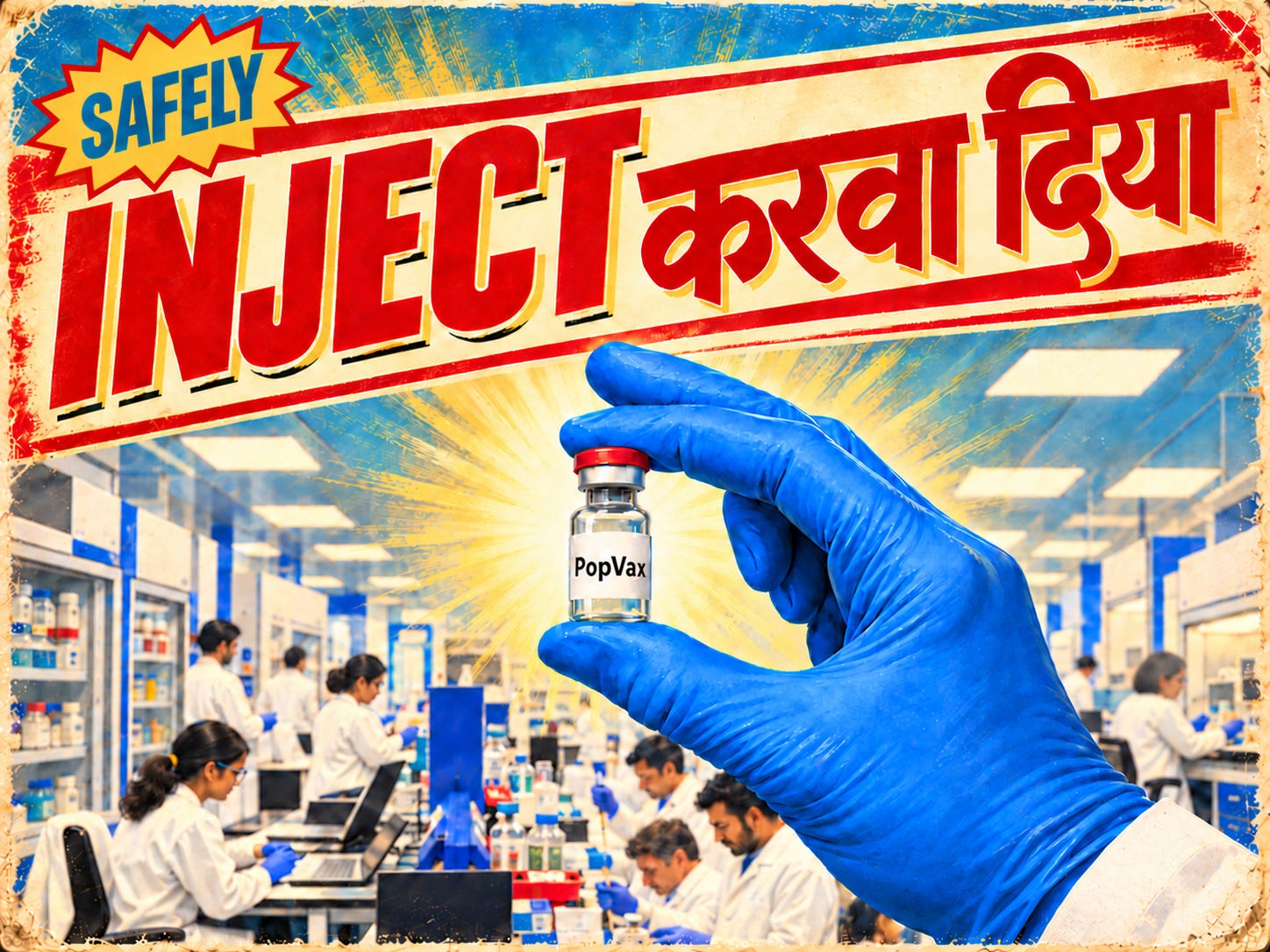
I’ve waited 5 years to write these words: On 31 August 2026, the first two participants each received a dose of PVX-001, our broadly-protective COVID-19 vaccine candidate designed to protect against future variants of SARS-CoV-2 that may emerge, in a first-in-human Phase I clinical trial in Melbourne, Australia (ACTRN12626000891325).
This trial, which will enroll a total of 36 healthy adult volunteers, is intended to assess the safety and tolerability of the vaccine candidate, while also providing early data on the magnitude and breadth of the immune response it elicits against multiple variants of SARS-CoV-2. As of 6 October 2026, we have enrolled and dosed 14 participants meeting our screening criteria, with no serious adverse events (SAEs) reported. Participant follow-up and safety monitoring are ongoing.
This vaccine embodies PopVax’s full-stack philosophy of developing new medicines – we built it on our own computational protein design pipeline, mRNA-encoded VLP display architecture, fridge-stable lipid nanoparticle delivery vehicle based on our novel ionizable lipid PVXL-150, and in-house manufacturing process at our RNA Foundry in Hyderabad, all of which we have constructed from the ground up over the past 4.5 years. Once the Phase I trial is concluded, PVX-001 will be made open-source for others to build on.
The start of this trial is an essential step on PopVax’s path to fulfilling our Million Lives Mission: to develop novel vaccines and therapeutics over the next decade that save 1 million lives each year. Safety and immunogenicity data on our mRNA-LNP platform will allow us to accelerate the translation of our preclinical vaccine programs – including a single-dose rabies vaccine, a multivalent HCV vaccine, an adult & adolescent TB vaccine, and a Strep A vaccine, all potentially first-in-class – into clinical trials over the next 2 years.
I’ve waited 5 years to write these words, from when I first read about AlphaFold 2 and realized that machine learning was the future of medicine – before the company even existed, when it was just the kernel of an idea in my mind, still pristine and not yet popped open by the heat of reality.
I’ve waited 5 years to write these words, from when I took an uncharacteristic run on my beloved Juhu beach, along the sea that’s echoed in my ear since I was born, drenching myself in the pouring rain on my birthday as the pandemic-cursed 2020 was washed away to reveal the virgin sands of 2021, and decided that something fundamental had to change – in our response to infectious diseases, in how we make new medicines, and in the direction my life was going.
I’ve waited 5 years to write these words, from when Harish Iyer at the Gates Foundation took a $100k bet on me – a computer scientist with a minimal biology background – that nobody else thought was a good idea, 5 years from when I first spoke with Ethereum co-founder Vitalik Buterin and the team at his scientific investment fund Balvi and convinced them this was possible and worth funding with the Shiba Inu memecoin money with which he’d been entrusted without his consent, 5 years from every Indian investor I spoke to politely telling me that I was embarking on a fool’s errand.
And yet, and yet, and yet – after I flew all the way to Australia, waited patiently as the first participant was checked, waited for the appointed second to strike, and saw the nurse push in the plunger – after I saw something I’d made be injected into a fellow human being for the first time… I felt nothing. I felt numb to the world. I felt disconnected from reality, as if time was flowing forward without me.
Phew. Let’s take a deep breath. What the hell is going on here?
I started PopVax in large part because I didn’t see Indian companies responding to the threat of new COVID-19 variants fast enough, or even at all – the first COVID-19 vaccines quickly lost efficacy as the virus mutated. We didn’t have variant-updated boosters in India for years after the emergence of the Delta and Omicron variants, which collectively killed millions of my countrymen. From the beginning, we aimed to design vaccines resilient to viral mutation that would continue to provide protection against not the current dominant strain at the time of manufacture, but even future variants yet to come.
For PVX-001, we turned to the virus-like particle (VLP) architecture, used in vaccines such as Gardasil (HPV) and R21 (malaria), which displays many copies of the protein immunogen on a ball-like self-assembling structure, inducing the clustering of B cell receptors on antibody-producing immune cells and eliciting a much more potent antibody response than the immunogen on its own. This clustering also often induces a broader antibody response – one that is able to neutralize a wider set of mutated variants of the pathogen.
The catch is that VLP vaccines are notoriously hard to manufacture in vitro, with each immunogen variant you put on the VLP demanding its own painstaking cycle of optimization for the necessary conditions to successfully assemble and purify it after the individual monomer subunits are produced in cells. Merck’s HPV vaccine Gardasil 9, for example, takes as much as four years to manufacture from start to finish. That is just too long for a vaccine against a virus that births a new dominant variant as rapidly as the seasons change.
Enter RNA, which is produced via in vitro transcription (IVT), a synthesis process performed using enzymes in a largely cell-free fashion, and purified with methods that don’t change all that much from sequence to sequence. We produce mRNA in a ‘one-pot’ reaction that takes a single day, and our whole production process takes a week, a far cry from the many months to years required for conventional VLP vaccines produced today.
PVX-001 is built around messenger RNA (mRNA) that instructs cells in the human body to produce a designed protein that self-assembles within the cell into a VLP that displays an engineered version of the SARS-CoV-2 Receptor-Binding Domain (RBD). We turn the body into the factory for the VLP, and let it handle the difficult parts of the process, combining the manufacturing ease of RNA with the immunological potency of VLP display.
When applied to the design of a wild-type COVID-19 vaccine, our RNA-encoded VLP approach results in a >50x increase in the elicited neutralizing antibody (nAb) titer in mice compared with the same dose of RNA encoding the same immunogen as is, as well as a >20x increase in nAb titer compared to the same dose of the mRNA sequence from a US FDA-approved first-generation wild-type COVID-19 vaccine.
While it’s easy to update the mRNA sequence in our vaccine to target new variants without changing the manufacturing process, we may not need to do so as often as existing vaccines do – our wild-type SARS-CoV-2 RBD-based VLP display construct was able to elicit potent neutralization titers against the Gamma, Lambda, and Omicron BA.1 variants of SARS-CoV-2, while a US FDA-approved mRNA-based COVID-19 vaccine comparator sequence at the same dose was not, demonstrating that the VLP immunogen display approach results in the elicitation of antibodies that neutralize a greater breadth of variants.
We’ve now applied this design approach to a more recent SARS-CoV-2 variant, which we’ve used as the basis for the version of PVX-001 that has now entered the Phase I clinical trial. Our preclinical immunogenicity in mice is competitive with that of mNEXSPIKE, Moderna’s much-improved second-generation vaccine. We hope that this vaccine will require fewer boosters and less frequent variant-specific updates to maintain its efficacy over time, even as the virus mutates rapidly.
Being able to make the vaccine, however, only solves half the problem – you also need to be able to transport it all over the world to all of the people who need it.
Our lipid nanoparticle (LNP) formulation, the key component that allows the mRNA to enter human cells, is based on our novel ionizable lipid PVXL-150. We’re particularly proud of the fact that vaccines using this LNP formulation can be stored at 2-8 °C, regular refrigerator temperatures, for at least 9 months without lyophilization (freeze-drying), rather than the frozen -20 °C or ultracold -80 °C storage required by the first-generation mRNA vaccines approved for COVID-19. This will allow for easy distribution across the world using established refrigerated supply chains for medicines, making our vaccines straightforward to deploy at scale in developing countries.
Every dose of PVX-001 was built at the RNA Foundry, PopVax’s full-stack R&D lab and global Good Manufacturing Practices-aligned clinical dose production facility in Hyderabad. Our computational researchers and protein designers sit just feet away from experiments being conducted by our scientists, who can gaze through the glass to watch the manufacturing process in full swing. This allows for rapid and seamless collaboration that substantially increases the velocity of our engine for translating AI into medicine. In just under 5000 square feet of GMP manufacturing space, the RNA Foundry can produce up to 1 million doses of new medicines each year, from plasmid DNA to formulated mRNA-LNP, including testing every batch against an extensive panel of analytical methods we developed and operationalized at our on-site Quality Control lab. We even make our own GMP-grade ionizable lipids here!
Every dose of PVX-001 is also the product of a global collaborative effort. Our work was initially seeded by the Gates Foundation, substantially funded by Vitalik Buterin’s Balvi fund, and was helped across the finish line by an investment from Meta co-founder Dustin Moskovitz and Cari Tuna’s Good Ventures, advised by the good folks at Coefficient Giving. The vaccine was part of the US National Institute of Allergy and Infectious Diseases’ (NIAID) Project NextGen, which gave us access to vital scientific and regulatory advice, and under which the doses we manufactured at the RNA Foundry in Hyderabad were filled in vials at ABL in Rockville, Maryland. The trial was approved by an Australian Human Research Ethics Committee run by Bellberry, and is being conducted by Nucleus Network at their facility in Melbourne with support from Emerald Clinical.
Before reaching a participant, every single dose journeyed through four continents, from being manufactured in India and filled into a vial in the United States to catching a flight via Germany to the trial site in Australia.
Once the Phase I trial of PVX-001 concludes, we will open-source the design and manufacturing information needed for others to produce and build on it, and we will not enforce any of our intellectual property rights against anyone who uses it to make vaccines against any betacoronavirus – the viral genus that includes SARS-CoV-2, SARS-CoV, and MERS-CoV.
We are doing this because SARS-CoV-2 and its close cousins remain a substantial pandemic risk. In just the past few decades, they have caused one major epidemic (SARS), one close call (MERS), and one global pandemic that killed millions. The designs developed after the original SARS outbreak gave the first generation of COVID-19 vaccines a crucial head start in 2020. We want humanity to have an even better head start next time: a broadly-protective, refrigerator-stable vaccine that any scientist, vaccine producer, or member of the public, located anywhere, can improve, adapt to their needs, and manufacture without having to worry about IP.
We are also doing it because of what we saw during the pandemic. The best and most up-to-date RNA vaccines were largely unavailable to poorer countries, as rich countries secured the bulk of the supply, and vaccine manufacturers in countries like India never updated their products for Omicron and later variants. As Vitalik has argued in his writing on d/acc – defensive accelerationism – the capability to design, develop, and manufacture the next generation of vaccines must be globally distributed. An open-source vaccine, built on an mRNA-LNP platform that can use existing medical supply chains in developing countries, is a concrete step towards making sure that the rising world in Asia, Africa, and South America is never again left waiting at the back of the queue.
PVX-001 is only the beginning. We’re developing six new vaccines, personalized cancer medicines, and targeted autoimmune therapies to fulfill our mission to save 1 million lives each year. Sometimes I lie awake at night and agonize over all the screwups we’ve made – the botched experiments, the missed opportunities, all the fumbles and stumbles that delayed us by a year, or maybe even two, and I wonder whether we can really pull that off in the next decade.
But now that we’ve traversed the thorny path from concept to clinic, we’ll combine our newfound knowledge of how to get something from insight to injection with our full-stack approach to rapidly accelerate these new medicines towards patients, without compromising rigour or safety. This will be the first of many first-in-human trials, each following sooner than the last, with increasing rapidity until we are translating new medicines to patients in weeks, not years.
I’m the prodigal son of two homoeopathic doctors who don’t like vaccines very much, a lapsed computer scientist who moved my Y Combinator-backed robotics software company from San Francisco to Pune at the height of the pandemic, and a certified madman who, on the advice of a high-schooler, turned down multiple term sheets and shut down my software startup to start an AI-powered biotech company without knowing very much biology, in a pre-ChatGPT and Claude Code era when it wasn’t yet clear that AI could do all that much biology, in a city I’d never been to before signing my lab lease, and in a country that doesn’t do – or fund – very much biotech R&D, where most of the local pharmaceutical titans are engaged in a multi-generational game of ‘the floor is lava’, in which any investment in the development of new medicines is the floor. Luckily, their private jets keep their feet off the fast-heating ground.
With me so far?
The charismatic and scarily energetic Nalam ‘Madhu’ Rao at the Centre for Cellular and Molecular Biology granted me 100 square feet of shared lab space in his incubator hours after I landed in Hyderabad in late 2021, still the fastest I’ve ever seen Indian academia move, I bankrupted myself buying lab equipment, managed to recruit excellent scientists who were so bored at Indian generics and biosimilars companies that they responded to a LinkedIn post asking for ‘people to make mRNA’, and convinced Harish Iyer, a Gates Foundation officer who used to run the pioneering Indian vaccine company Shantha Biotechnics, to give us a $100k contract for ‘public awareness’ of global health – that is, the awareness that someone in India could make mRNA vaccines at all.
We couldn’t get our hands on DNA templates fast enough until Stanford’s Rhiju Das recommended Twist Bioscience, but we had to get a friend in an SF lab to trans-ship them to us because Twist didn’t yet have India logistics set up, and it all took so long! – so interminably long! – until Suresh made the mRNA late one night in the lab and, lo and behold, it worked, it expressed (yay!) in cells… but the LNPs didn’t quite work in mice (boo!). So Sourav, our first employee, used a torture device with a manual plunger over and over to squeeze out the invisible particles until they finally got to the consistent size they needed to be. Meanwhile, Maunish, the son of one of my father’s closest colleagues, neither of whom I had seen for over a decade, turned out to be a star student of Pieter Cullis, one of the great pioneers of lipid nanoparticles – on seeing that we had managed to get synthetic mRNA to express proteins in cells in India, Maunish went into some kind of rapturous trance in which he decided to move to Hyderabad and do science with us.
Experimental success bred faster spending, which brought our bank account close to negative territory once more. So, as usual, I wrote an angry op-ed that a Thai gentleman liked enough to connect me with his good buddy who was interested in COVID-19 – a good buddy who turned out to be the uncommonly thoughtful and uncompromisingly ethical Vitalik Buterin. We got fantastic data from our RNA-encoded VLP approach, but when we tried to get someone else to manufacture the vaccine, we realized it would be much too expensive and would take too long, so Thiru and Praveen helped design and build a facility so compact our contractors told us it wasn’t buildable, only to suddenly face-
You get the idea.
The final act of this frantic theatrical production played out early this year. We were part of NIAID’s Project NextGen, with the trial set to happen in Maryland, funded by the US government. Unfortunately, after the change of administration and attendant rearranging of priorities, we were told that the trial would not go ahead. In shock, we scrambled to move the trial to Australia, finding a site and a contract research organization on the fly, with Darshit writing the docs for the ethics committee and Hannah working across two oceans to get the clinical protocol locked down while we juggled the maintenance and shipment of the vaccine vials back from the US to an as-yet-unknown location.
No wonder I was numb.
And yet, against all odds, we persevered and prevailed. The vaccine company that no one thought was a good idea has become a clinical-stage AI-powered biotech that is starting to hit its stride. A few days after the first injection, I stood by the sea on Sydney’s Bondi Beach, I felt it all sink in – both the joyous significance of what we’d just done, and the enormity of what is yet left to achieve.
PopVax is accelerating to match the scale of our vision. From a standing start, we’ve generated millions of candidate proteins using frontier machine learning methods and AI models, designed 1000+ novel lipids, screened over 5000 unique LNP formulations, injected over 1300 distinct vaccine constructs into animals, and conducted 10s of 1000s of functional assays. Each experiment allows us to improve our designs and raises the ceiling of what our medicines can do to help people in need.
We will take many, many shots on goal – more than may seem well-advised. More than are comfortable for a spectator to contemplate, even. We won’t win ’em all – life is stochastic – but we’ve made peace with that. Watch closely, else the future of medicine will happen in the present without you.
If what we do excites you, PopVax is hiring for several critical roles at the moment:
Principal Scientist - Analytical Method Development and Senior Scientist - HPLC Method Development: We design millions of new molecules – proteins, RNA, LNPs, and more. Your job is to figure out how to characterize them at high-throughput without sacrificing rigour, repeatability, and robustness, as well as to help make those methods GMP-grade as part of the handover to QC. We intend to take new medicines into clinical trials in weeks, not years, so we need to build adaptable analytical platforms, not bespoke methods that work for only one molecule. We strongly prefer candidates with the ability to write code to build automated data analysis pipelines for their methods – LLM-generated code is fine as long as you are able to comprehensively validate the logic and output of the pipelines.
Head of Quality Control – We manufacture our own clinical doses at the RNA Foundry, and every analytical method we develop for a new molecule eventually has to become a validated QC method. You’ll lead the team that tests every batch to international GMP standards, take on method transfers from analytical development, and build a QC function that can keep pace with a pipeline aiming to reach the clinic in weeks, not years.
Junior Scientist - Vaccine Immunology – Our vaccine programs halt or advance on the immunogenicity data that comes back from animal and organoid studies. You’ll run the assays that produce that data – ELISAs, pseudovirus neutralization, and bacterial growth-inhibition assays – and coordinate animal studies with our internal teams and CROs, following each study from plan to samples to result. We prefer candidates who can write code for routine data analysis.
Head of Legal – Our first vaccine was manufactured in India, was filled into vials in the US, and has now entered a clinical trial in Australia. We work with dozens of counterparties – funders, governments, universities, CROs, and suppliers – with more added each week. You’ll own the day-to-day of our Indian legal work, from contracts to compliance to labour law, work with the legal teams supporting our UK and Australian operations, and make sure paperwork is never the bottleneck between our new medicines and the clinic.
Chief of Staff to the Chief Science Officer: Our CSO needs a partner who can take experimental planning and coordination off his plate so that he can spend more time thinking hard about our thorniest problems. Your complex scientific hypotheses into clear executable plans, coordinate with scientists to see each experiment through, and analyze the data to help plan the next round of iteration. You’ll need a strong scientific background, a sharp eye for detail, and boundless energy to keep ambitious scientific work moving. To apply, email dhruv [at] popvax [dot] com with a human-written explanation of why you’re the best person for the job.
If none of these are a good fit, take a look at our jobs page or email us at work [at] popvax [dot] com.
I’m Soham Sankaran, the founder & CEO of PopVax. Feel free to email soham [at] popvax [dot] com if you’re interested in discussing the challenges of rapidly turning machine intelligence into medicines.
You can find me on Twitter/X @sohamsankaran. You can also follow PopVax on Twitter/X, LinkedIn, and YouTube, or email us at hello [at] popvax [dot] com.