WARNING: CONTAINS HIGH DOSES OF SELF-CRITICISM WITHOUT A HAPPY ENDING.
WILL DISCUSS THE PROBLEM WITHOUT OFFERING A "10-STEP SOLUTION."
We are used to seeing narcissism as a disease, as if a narcissistic person were someone completely different from what is “normal.” So, we slap a label on this person that separates them from what is considered healthy and standard in society.
It might seem like the goal of this text is to “defend” the narcissist, something like: “Guys, the narcissist is a human being just like the rest of us, they need to be respected.” But no, that’s not the point. Actually, the goal here is to query how we define and treat so-called Mental Disorders.
When we look up the definition of Narcissistic Personality Disorder in the DSM-5 (Diagnostic and Statistical Manual of Mental Disorders), we find the following main definitions:
A global pattern of grandiosity;
A need for admiration;
A lack of empathy.
Along with the following criteria:
A grandiose sense of self-importance;
Preoccupation with fantasies of unlimited success, power, brilliance, beauty, or ideal love;
A belief of being “special” and unique, and that they can only be understood by, or should associate with, other special or high-status people (or institutions);
A need for excessive admiration;
Expectations of especially favorable treatment or automatic compliance with their expectations;
Interpersonal exploitation, taking advantage of others to achieve their own ends;
Lack of empathy: unwilling to recognize or identify with the feelings and needs of others;
Frequently envies others or believes that others envy them;
Arrogant and haughty behaviors or attitudes.
Reading these definitions brings up an interesting thought:
These behaviors are present in all of us, to a greater or lesser extent. It’s not hard to slap the narcissist label on anyone in the world if our view is biased and focused on “finding” those traits. Realizing this is already a huge problem. The DSM (which is kind of the bible of mental disorders) is a powerful tool that, depending on how it’s used, can ruin someone’s life.
Actually, this is nothing new. This pattern can be seen in a good chunk of the mental disorders described in the DSM. This even sparks intense debate in the scientific community. But, when it comes to Narcissism, we can notice an interesting distinction: If you look at the criteria with a “kinder” eye, swapping the original terms for others that are socially seen as “positive,” someone before labeled as a Narcissist could easily be seen as a strong and dominant person.
Don’t believe me? Try this experiment: Reread the quote above with the criteria for Narcissistic Disorder, but pretend you’re a self-esteem and empowerment coach. A good part of the criteria (if not all of them) may now look like tools for empowerment and personal growth.
The way our society currently works pushes us into a dilemma with two extreme poles: We have to learn to be strong, independent, go-getters, and self-sufficient. But at the same time, if we actually commit to doing that, we end up being, at the very least, selfish and potentially narcissistic. It turns out to be a really tough tightrope to walk.
We already have plenty of studies and concepts showing just how individualistic and selfish our modern society is. My point here isn’t necessarily to prove or unpack all of that. The catch is that, because we were raised and shaped by this society, our entire worldview was built on it. Even when we try to be altruistic, less selfish, and break away from this pattern, we came to see ourselves as “Evolved” or “Enlightened”, which automatically puts everyone else in the “backward” or “behind” category. Notice how the words changed, but the underlying pattern stayed exactly the same? We just can’t escape this logic, to a greater or lesser degree.
At this point, it’s crucial that we understand the concept of the “Ego.” It’s a tough job to talk about this stuff without diving into deep, complex philosophical reflections or going on long tangents just to tie the whole context together.
Actually, tangents are a huge struggle for me as a writer. Any couple of paragraphs written here could easily turn into a whole new text of equal length and depth, given how important each of these subtopics is.
I think the best way I can introduce the idea of the Ego is to look at the whole thing as if I were an “alien” observing the human race. This third-person perspective helps us snap out of our “default” mode and notice things that ought to be obvious.
Imagine a being that is born completely merged with its environment, but gradually figures out that, even though it’s part of a whole, it’s actually a separate unit. This is where things get tricky to wrap your head around, and even trickier to explain.
Bringing Freud into the mix, we understand that when a human baby is born, its existence is entirely wired into and dependent on the world around it. A newborn isn’t a being that experiences hunger, cold, or pain. It is the hunger, the cold, and the pain. There’s no boundary between what it is and what it feels, where it is, or what it thinks. So, to that early baby brain, everything around it is just an extension of itself. Little by little, small connections and integrations start to form:
Hunger → Crying → Milk → Satisfaction
Today, as adults, we look at this as a sequence of distinct, connected events involving different people, sensations, and moments. But a baby’s developing mind tends to see this sequence in a much more direct way, as just one or two different states of the same single thing. So, the baby figures that even though all of existence is just one big entity, that can shrink or expand to reach different realities and states.
As time goes by and experiences pile up, the baby starts to grasp and fine-tune the concept of the Ego (the “I”). At this point, it realizes its existence is part of a broader system that includes other beings and external figures. However, as far as the baby can tell, these external figures are completely at the mercy of its own desires, which gives it a pretty justifiable sense of omnipotence. This is exactly what Freud called Primary Narcissism.
The child shall have a better time than his parents; he shall not be subject to the necessities which they have recognized as paramount in life. Illness, death, renunciation of enjoyment, restrictions on his own will, shall not touch him; the laws of nature and of society shall be abrogated in his favour; he shall once more really be the centre and core of creation — ‘His Majesty the Baby’, as we once fancied ourselves. The child shall fulfill those wishful dreams of the parents which they never carried out — the boy shall become a great man and a hero in his father’s place, and the girl shall marry a prince as a tardy compensation for her mother. At the most touchy point in the narcissistic system, the immortality of the ego, which is so hard pressed by reality, security is achieved by taking refuge in the child. Parental love, which is so moving and at bottom so childish, is nothing but the parents’ narcissism born again, which, transformed into object-love, unmistakably reveals its former nature.
Sigmund Freud, On Narcissism: An Introduction (1914).
So, it becomes pretty clear that the emergence of the Ego is tied to the emergence of the Other. At this stage, the Ego is all-powerful, and the Other is basically an inanimate object with no will of its own. This feeling doesn’t last long, but it’s incredibly powerful and completely necessary for a child’s development. It’s the process of investing your own energy—which, during this phase of omnipotence, flows into the external object but never actually leaves the Ego. This energy touches and acknowledges the Other, but the baby still remains the center of the universe.
(Side note: when I use the term “energy,” I’m talking about the psychic energy that drives our desires, actions, and directions—what Freud defined as libido.)
As time goes on, this energy gets invested more and more into the Other, to the point where it’s fully sent out, expecting an immediate return. This is where the tantrum phase kicks in—the uncontrollable crying and sheer frustration. At this moment, that omnipotence starts getting challenged, and the baby begins to realize that the Other actually has its own agency and willpower. The Ego/Other tension hits its peak when the invested energy doesn’t come back, or, in a sense, gets “stolen” without permission.
This whole cycle of projecting and returning energy to and from the outside world is what Freud calls Secondary Narcissism. It’s how we learn to channel and invest our energy into people, ideas, projects, and feelings, and also how we pull it back into ourselves. When we have a killer toothache, we withdraw our interest from work, friends, and studies, and pour all of it back into ourselves. It’s a basic mechanism for defense and self-preservation. When we’re dealing with grief, the energy we once invested in the person we lost returns to us, causing temporary pain until we can process it and reinvest it into a new Other.
Once you grasp these concepts, it’s easy to see that this Ego/Other tension is a fundamental part of all human relationships. How we view and set the roles, definitions, rules, and boundaries between the Ego and the Other is exactly what defines, by extension, those very same things in our society as a whole.
At this point, the idea of a “Narcissistic Society” begins to make a lot more sense. By understanding what narcissism actually is and how it exists inside all of us, we no longer see it as something entirely separate from who we are:
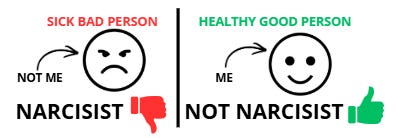
And we start looking at it more like a spectrum:

I know it might seem counter intuitive to think of an selfless person as a Potential Narcissist, but remember those criteria we looked at in the first paragraphs, and how the result depends entirely on the observer’s “lens.” Is a narcissist someone with a super fragile Ego who compares themselves way too much to others and is always trying to convince themselves that he is superior? Or is it someone with an incredibly strong Ego who just bulldozes over people who don’t know how to “defend” themselves against it?
Back to the alien’s view: These so-called human beings just can’t wrap their heads around the basic premise that the Ego and the Other are different parts of the exact same thing. They can only make sense of it when they treat one side as the Subject and the other as an Object. This makes the tension completely relentless, where sometimes they are Subjects objectifying the other, and sometimes they’re the ones being objectified by the other (who has now stepped into the role of Subject). Our society is essentially built on this endless seesaw of swapping roles and redefining knowledge and authority.
An essential trait in this whole narcissistic dynamic is comparison. The narcissism inside all of us makes us constantly weigh our own situation against other people’s. The main catch is that the person labeled as a Pathological Narcissist simply can’t handle the outcome of these constant comparisons, yet they are completely incapable of turning the comparison engine off for even a single second. So, all their relationships are fundamentally built on comparison.
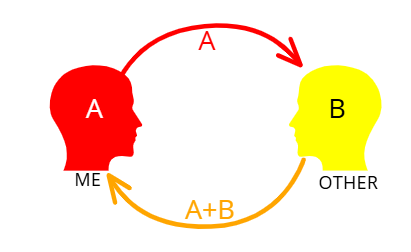
Think about everything we just talked about babies, the Ego/Other dynamic, and investing energy. In an ideal relationship scenario, the Ego’s energy that gets invested into the Other always bounces back as a mix of both—because, obviously, the Other isn’t identical to me. From there, I either absorb (or reject) this initial energy that comes back modified, and I’m affected by it:
What happens with someone at either extreme of the spectrum (whether selfish or altruistic) is that they project a piece of themselves that meddles in every single interaction and energy exchange. This projected piece—even though it’s entirely built on comparison—acts as an external defense mechanism that filters and/or amplifies all the energy going out and coming back. This ensures that every relational exchange tips the scales in Ego’s favor:
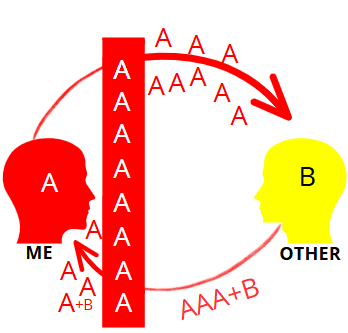
Because of this, it doesn’t really matter if the person’s core Ego is healthy or fragile. This barrier guarantees that the outcome of any relationship will yield a surplus of the original energy returning to the Ego. It functions as a permanent judge, constantly comparing things and benefiting the Ego. Whether this leans selfish or altruistic depends purely on how effectively that surplus energy is digested by both the Ego and the Other. In other words, it depends on how well this barrier manages to convince both the Other and the Ego itself that the lopsided dynamic is completely genuine and spontaneous.
I find it pretty funny how the paragraph explaining narcissistic thinking has an excessive repetition of the word “Ego.” It basically explains itself.
I think it’s important to hammer home a point here: How can a narcissist be altruistic? If a pathological narcissist is someone consumed by an excess of Ego, how could they possibly think about and prioritize others? The answer is that an excess of Ego doesn’t automatically mean selfishness. Let’s break it down:
Selfishness: Prioritizing yourself at the expense of the Other.
Selflessness: Prioritizing the Other at your own expense.
Excess of Ego (Ego centrism): Viewing absolutely every situation exclusively through your own perspective, thereby minimizing and diluting the agency and willpower of the Other.
Let’s look at the example image again:
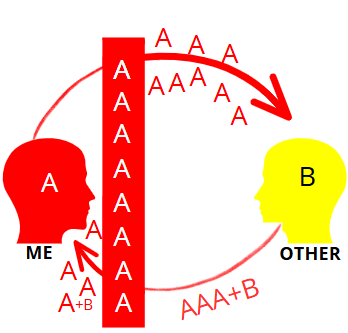
Red and Yellow are debating the same topic where
“A” represents the red individual’s perspective;
“B” represents the yellow individual’s perspective.
An overload of “A” in the image doesn’t necessarily mean the conversation is only about the Red person itself. It just means the discussion is being completely dominated by Red’s opinion on the subject. Let’s say the topic is a car that Yellow is thinking about buying, and Red happens to be a car salesman.
Red comes across as highly altruistic and deeply invested in Yellow’s happiness—so invested, in fact, that Red catches nuances and issues about the whole thing that Yellow hadn’t even noticed. It’s a well-intentioned form of invasion. Yellow’s defenses never goes off because, even though Red is controlling the flow of the conversation, the focus is entirely geared toward Yellow’s best interests.
When Red gets Yellow’s response, it has already been filtered and molded by that external barrier. This spares Red from the initial shock of comparison, allowing them to analyze the situation focusing solely on their own agenda, while Yellow absorbs the shock for both of them. This shock, combined with a lack of defenses, allows Red’s perspective to dominate not just the conversation, but Yellow’s actual psyche.
It’s as if the baby refused to deal with the fact that its invested energy didn’t return exactly as demanded. Instead of crying, throwing a tantrum, and processing the frustration, the baby projects a piece of itself to act autonomously. This projected piece does all the heavy lifting of managing the Ego/Other tension, bringing back to the Ego only the exact validating energy it wanted.
The analogies in the diagrams highlight ideal and extreme situations, but the truth is that, in real life, all of us have a comparison barrier. Big or small, strong or weak, our society encourages it (and is practically built on it). Basically, from childhood, our psyches are trained to compare and seek social validation all the time, at any cost.
What separates a standard individual from someone considered Pathologically Narcissistic is how independent that barrier is from their Ego. For some people, this barrier is so autonomous that it becomes a filter, warping the reality of every single relationship. It isn’t that the Ego is actively making a conscious comparison every waking moment. It’s naturalized, baked right into the person’s default operating system. The outcome of any social exchange arrives at the Ego already filtered.
Just like when we spend all day out in the sun wearing sunglasses and our eyes stop noticing the tint, that filtered view just becomes our default reality. People considered “normal” have this filter running all the time, but we often notice it, take the glasses off, and upon facing the harsh shock of comparison. In this moment we feel shame, frustration, sadness and all kind of unpleasant feelings.
You know that sinking feeling when you try to help someone but realize you just made things worse? Or the awkwardness of noticing you’re the only one who laughed at your joke and no one else related to it? That’s what it feels like to have the realization of the barrier getting off.
A Pathologically Narcissistic individual doesn’t have the capacity to take that filter off, or even knowing it exists. Instead of sunglasses, it’s as if they wear fixed contact lenses that don’t just block the glare, but fundamentally change the color of their whole reality. Information reaches them already scrubbed by a mechanism designed to avoid uncomfortable feelings at all costs. This is exactly why every Pathologically Narcissistic person has a massive talent for convincing people and manipulating conversations: they have an internal mechanism running 24/7 that works overtime to convince themselves that reality is exactly how they want it to be.
Do you see how someone with these traits is seen as strong and resilient in today’s society? We live in a world that praises individualism achieved through dominance. We pull this off through the constant tension of the Subject/Object dynamic. When we slap a label on someone like “sick,” “beautiful,” “innocent,” “ADHD,” or “Narcissist,” we are objectifying a uniquely complex human experience and boiling it down to a conceptual label. That’s the naturalized objectification.
Defining and categorizing people through concepts has its importance for social organization and keeping things in order. But when we create definitions for specific groups of behaviors, we lose sight of the fact that human existence is much broader, interconnected, and multifaceted. It boils complex webs of experiences and behaviors down into static labels.
I get that the term “static label” isn’t entirely fair, since scientific knowledge is dynamic, open to possibilities, contradictions and changes. But, as I mentioned earlier, not only are already-conceptualized human behaviors deeply complex and ever-changing, so is the very process of perceiving and conceptualizing them. They are tied to the Zeitgeist, different regional cultures, family dynamics and subjective perceptions. It’s an incredibly tough job to slap labels on people and apply theories in such a shifting landscape.
This text is basically an attempt to show how not only Narcissism, but the entire spectrum of so-called “mental illnesses,” involve traits and characteristics inherent to every human being. They can even be looked at broadly and culturally, which is exactly what I tried to do with the term “Narcissistic Society.”
While, in theory, scientific knowledge about human behavior sparks debates, new ideas, and perspectives that keep up with this dynamism, our natural human drive for social approval pushes us to constantly try to fit ourselves into boxes and find the “right way to live”.
Just like a pathologically narcissistic person wins any argument by wearing you down with an overload of logic and justification, modern society “exhausts” our minds with an overload of information, contradictions, rules and learnings. And, just like a pathological narcissist, society doesn’t directly punish or silence opposing views. Instead, it welcomes and absorbs the idea, but with one massive string attached: the thought must be diluted into an endless sea of rules and definitions that can be spun as “the truth.”
Like I said earlier, any couple of paragraphs here could easily be spun off into a whole new post. In fact, this text by itself is only half of what I actually wrote. The other half will turn into a deep dive on how this “narcissistic society” actually works. I have a lot to say about topics like the Subject/Object relationship, social reality bubbles, the concepts of “Personal Evolution,” self-awareness and spirituality, family patterns and how to nurture non-invasive relationships. Plus, I’ve been studying Brazil’s Indigenous peoples quite deeply, and their relationship with nature has a lot to teach us about how we might escape this logic of domination we currently live under.
Thanks to everyone who made it this far. My name is Jorge Dias, I’m a Brazilian Clinical Psychologist and an aspiring writer. This is the first time I’ve decided to put my personal ideas out there publicly. Unfortunately, even though I love writing, I can’t dedicate myself to it full-time because it just doesn’t pay the bills yet. Who knows, maybe someday these texts will turn into a book and I can do this for a living. I’ll be back soon with more thoughts. Feel free to leave a comment with your own insights, subscribe, and stay tuned for updates.