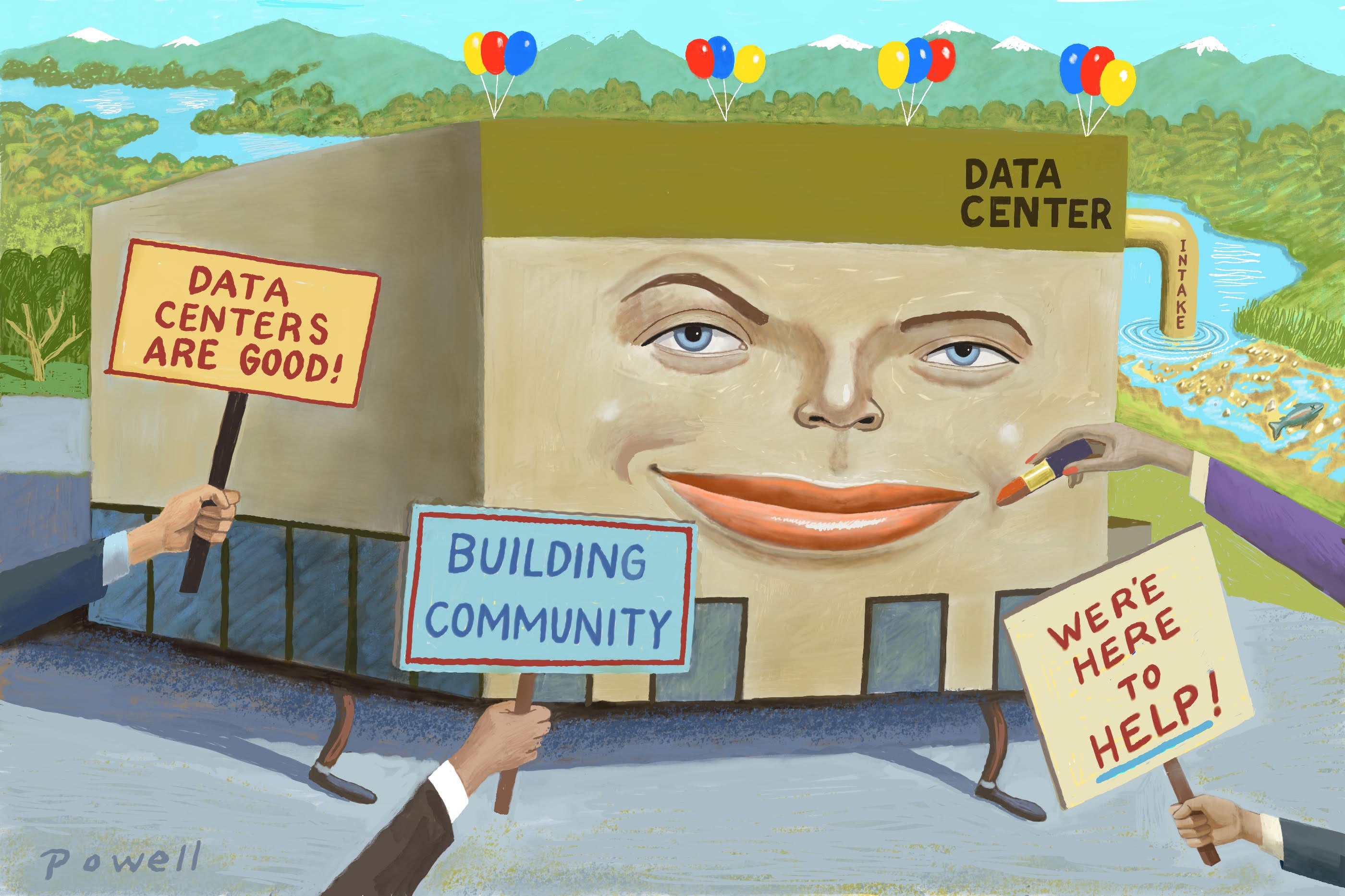
Illustration by Charlie Powell
Won’t Somebody Please Think of the Data Centers?
Almost everyone hates them—and what they represent. I went inside the shadow industry that’s trying to change your mind.
By
One sweltering morning in early August, data center executives gathered in a Northern Virginia conference center to talk about why nobody likes them. The panel, convened by the trade publication Data Center Frontier, featured industry leaders who sat onstage and shook their heads in bewilderment at the anti–data center movement presently engulfing communities across the country. As recently as a year or two ago, they said, a new data center could be quietly constructed without so much as a peep from concerned residents. Now, entire states were passing bans to keep them out.
The panelists tossed out possible reasons for the American public’s disdain: Data center developers have been too secretive and seem shady to the average townsperson. Anti–data center Facebook groups are rife with misinformation about water usage, an issue that’s more complicated than detractors suggest. Companies have made a habit of waltzing into town and executing their plans without listening to community concerns. “God gave you two ears and one mouth for a reason,” chided one energy-industry executive.
At times, the conversation resembled a group therapy session for parents of troubled children. Lacking any reliable playbook for managing the conflicts that had bamboozled them all, they shared halfhearted platitudes about trust and connection. Though nobody left the conference center with a solution, there was one clear takeaway: The anti–data center movement is now the biggest barrier to industry success. “This is a trump card,” warned panelist David McCall, a Jeff Bridges lookalike and “brand evangelist” at QTS Data Centers. “It can stop and will stop everything.”
In some places, it already has. During the first three months of 2026, U.S. data center opponents stopped or delayed 75 projects worth almost $130 billion, roughly equal to those blocked in the entirety of 2025. The 840-plus anti–data center groups across the country represent a new, surprisingly bipartisan national consensus: A Gallup survey conducted in March found that 71 percent of Americans would oppose a new A.I. data center in their area.
This is sobering news for tech executives, but it has opened a new avenue of business in another industry: public relations. A growing number of PR consultants are styling themselves as experts in getting data centers built without provoking opponents. They advertise strategic counsel on responding to community resistance, recruiting landowners to sell their lots for development, and trying to win over residents before opposition groups even have a chance to form. Often, they attempt to intervene quietly, behind the scenes, hoping that once-resistant communities will start to soften, maybe without realizing why.
Until the last year or two, there was no need for this specialty. For decades, data centers were the small, unobtrusive, unlabeled buildings on the outskirts of town, doing the invisible work of keeping the internet afloat without straining the power grid or bearing the weight of our anxieties about technological change. But the advent of A.I. has made the buildings exponentially bigger, louder, and closer to places where people live. They began to serve as the target of our general trepidation about A.I., with its obvious threats to jobs, privacy, art, human connection, brain development, a common understanding of reality, and life itself. Absent the power to rein in tech titans, people began taking a greater interest in something they could control: the permits doled out to companies hoping to build in their backyards.
From one vantage point, the consultants are simply helping their clients succeed in this new landscape, no more or less than what any other PR firm does for any other business. “Everyone deserves representation,” said Keith Woods, the CEO of Phoenix-based firm KB Woods, as if he were describing the ethos of a hardworking public defender.
Woods later clarified to me that true evildoers—the data centers who force their way into communities under the cover of nondisclosure agreements and don’t pay their fair share of utility costs—should be shunned by PR reps. But to a sizable share of the U.S. electorate, that already describes the entire data center industry. The behemoth buildings have led to higher electricity bills in towns across the country. The noise they emit is driving neighbors batty. Their off-the-charts energy consumption is halting the crucial transition away from coal power. To make up for these downsides, data centers promise donations, infrastructure investments, and increased tax revenue. But such pledges aren’t always legally binding, and can languish. If the laid-out vision doesn’t materialize—as in Fayetteville, Georgia, where a data center secretly used far more water than was promised—communities can suffer while tech giants keep lining their pockets. Americans have taken note.
If there is any chance for data centers to overcome the current frenzy against them, it may rest with the professionals fighting to rehabilitate the image of the one villain capable of uniting the nation in 2026. These PR experts are dangling carrots, raising the specter of the stick, and mounting elaborate campaigns to woo skeptical towns. As data center rage grows, firms are finding ever more creative ways to get inside American brains. With the panicked voices of industry executives echoing in my ears, I set out to learn how.
When I called up data center PR experts, I could almost hear their teeth grinding over the phone as they described the status quo. The way they tell it, the public outcry against data centers has been so heated because data center companies have been doing it all wrong. Because they’ve been wary of competitors getting wind of their plans, they’ve come into towns under nondisclosure agreements, which feels like subterfuge to residents demanding information about who’s moving in next door. And after decades of doing business quickly and quietly without the hard work of negotiating with communities, who never gave two hoots about data centers before the A.I. era, tech companies have come to behave like “a spoiled child” who won’t be denied, said Woods. “It’s a wham-bam kind of proposition: They move into a market, they want to be able to build that data center yesterday, and they want to be down the road.”
But this playbook no longer works. According to every firm I contacted, the biggest mistake data center companies make is waiting until there’s a major vote on the table or a heated confrontation to start making connections in an attempt to court the community. “People will come to us and they will say, ‘I need your help! I need community engagement.’ And we’re like, ‘Mmm, you’re past that, honey. You’re into crisis communication now,’ ” Nichole Thomas, a senior vice president at JSA, a global firm with a data center practice, told me. Once residents already feel duped, ignored, or exploited, it’s a tougher sell to get them on your side.
Data centers bear some similarities to other development projects, in which standard promises of job creation and boosted tax revenue are made in response to community concerns about traffic and noise. But Tina Kozak, the CEO of a Detroit-based PR agency, learned the hard way that data centers, the national poster children for everything that’s wrong with contemporary society, require a bespoke approach.
In January, a data center came to the firm for late-in-the-game damage control after community pushback jeopardized a project outside Detroit. The unexpectedly vehement opposition was a sobering challenge, which prompted Kozak and her firm to devise what they thought was a new, winning plan for their next client, who was also trying get a data center built in Michigan. The key, Kozak believed, would be to meet the community with genuine concern much earlier in the process.
Her team members talked about how great it would feel to write an eventual case study about their unbeatable strategy. Certainly, they thought, “just good, proactive, empathetic communication can make the difference.”
Boy, were they wrong. By then, Michigan was saturated with data center proposals from companies lured by the state’s tax incentives, and public opinion was quickly curdling. Before Kozak’s team could even launch their plan, the community where they wanted to build passed a moratorium.
Now, Kozak and her team have a new strategy: “Making sure that a community understands what is at risk” if they say no to data centers, Kozak said. “What happens if we are just not-in-my-backyard, opposed to growth, from now into eternity?” Through op-eds and client interviews with the media, she hopes to paint a picture of a town losing taxpaying families to neighboring communities with better schools that are funded, perhaps, by data centers those communities allowed in.
Kozak’s team recently placed a bit of sponsored content in Crain’s Detroit Business for one client. The article, which argues that “Southeast Michigan’s future won’t build itself,” is coy. It doesn’t mention data centers at all, but it gently nudges readers to approve new development. “We’ve all seen what happens when communities sit on the sidelines,” it reads. “Stagnant or shrinking tax bases lead to declining schools, crumbling infrastructure and public safety shortfalls. Talented workers leave for regions that have figured out how to grow.”
Some communities don’t need all that persuasion. For clients wary of expensive battles with worked-up protesters, several PR firms will search for the towns least likely to whip out the pitchforks at the first sign of a data center sniffing about. At JSA, that starts with a report containing 100 pages or more of analysis on how easy it might be to convince a given municipality to accept a data center. Do residents trust their government? Have previous developers saddled the town with vacant lots and broken promises? How much do people already know about data centers? “We’re going to look at every single Facebook or TikTok or whatever group is in that area,” Thomas said.
Once a data center company has landed on a target community, PR firms will start seeking allies in town. They’ll search letters to the editor in local newspapers, look for prominent fiscal conservatives obsessed with expanding the tax base, and identify leaders who could benefit from something the data center could provide—like the head of the electrical workers union, or the president of a local college that might welcome a data center vocational program. The goal, said Milldam Public Relations president Adam Waitkunas on the Data Center Richness podcast, is to “build a coalition that drowns out or neutralizes some of the noise from the opposition.”
About two years ago, Waitkunas launched a weekly newsletter, Zoning In, that rounds up local news reports on data center pushback to help industry leaders understand what they’re up against. If one of his own clients encounters community protest, his firm brings in a pollster to decipher whether they’re dealing with a few loud naysayers or a formidable groundswell of resistance. The process can resemble a political campaign, he told me: recruiting supporters, holding town halls, sharing talking points with community influencers, and gathering intelligence on their adversaries.
KAOH Media, another firm in this business, maintains a database of civic leaders, retired educators, and other consultants across the country who are enlisted to implement what co-founder Allan Hug calls “a game of 1,000 cups of coffee.” Chosen for a specific demeanor “where you can talk to kings or peasants,” these individuals get paid to have one-on-one conversations with residents—to persuade them, make them feel heard, and to gather intel on community concerns. Hug says the strategy has worked for his clients in other industries, but citing confidentiality agreements, would not provide an example of it working for a data center developer.
Experts say that certain data center PR tactics, like preparing responses for a national day of protest or building a website that allows residents to submit comments, work for any project. But they stress that every community has its own unique soft spots and tension points. The playbook that used to work in small towns and rural areas may not apply to the suburban bedroom communities where increasing numbers of data centers are now popping up.
“You kind of have a more sophisticated residency there—folks with more money, more resources, more time to spend on fighting these developments coming in,” Waitkunas said on the podcast. Years ago, a data center company could donate a quarter of a million dollars to the local school and everyone would be happy. But these days, “given the tax base that these local communities have and the demographics of the community, just simply writing a check isn’t going to make it a seamless process.” Instead, a data center might pledge to start a conservation project or build a new park—things wealthier towns appreciate more than a few hundred thousand dollars.
It’s not just data center developers and A.I. companies feeling the pressure of the data center backlash. Any business with ties to the industry is getting rattled these days. Andrew King is an associate vice president at the Hoyt Organization, a PR agency based in Los Angeles. His biggest client, Shumate Engineering, provides electrical engineering and cooling systems for data centers. For the first time in its history, in response to data center protests and moratoriums, it’s trying to reach everyday people with its PR, rather than just the data center executives who might retain its services.
Shumate Engineering would suffer under a blanket data center moratorium. But the best-case scenario for the company is an interesting one: It could thrive under stricter regulations that still allow data centers to get built, just with the water- and energy-efficient systems Shumate can construct. In Sioux County, Iowa, where a temporary moratorium is in place, Shumate is working directly with officials on a new ordinance that would only permit new data centers that meet the efficiency standards of their patented cooling system.
With this dynamic in mind, King and his team launched a series of Shumate-sponsored workshops in Virginia, the data center capital of the world, to teach residents how to advocate for setting new standards for data center noise, water use, and power consumption in their own towns. The hope is that attendees, comforted and empowered by the mitigating restrictions they helped create—and persuaded by the lucrative community benefits agreements they learn about—will let certain data centers in instead of voting to keep them all out.
At first glance, the sessions don’t look like pro–data center material. They’re marketed as trainings on “environmental justice” activism that “protects vulnerable neighbors,” sponsored in part by a local chapter of the NAACP. The framing is clever: Why try to quash the current climate of protest when you can use it to a client’s advantage? But it’s somewhat disingenuous. Data centers commonly use diesel generators and gas turbines, whose pollution can cause respiratory distress and early death—the very definition of environmental injustice. Genuine concern about these impacts in Virginia might lead someone to one of these workshops, where they’ll be encouraged to support a data center in their hometown—albeit one that might pollute a bit less and use a little less water than its neighbors.
Central to the data center PR proposition is the conviction that a few bad data centers—the ones that install unpermitted gas turbines, guzzle water instead of using closed-loop cooling systems, or send Eric Adams to do their bidding—are spoiling public opinion for the rest. If only Americans could get to know each individual data center on its own terms, PR executives say, they wouldn’t be so hostile. One digital campaign produced by JSA enlisted residents of a town that approved a data center over a decade ago to speak in a video about how the data center has helped keep their taxes low. The ads ran on social media in a city whose residents were “losing their mind,” Thomas said, fighting a proposed data center from the same company. Now, according to Thomas, residents “are not as hateful about it, because they can see people just like them who have lived near a data center, and they don’t have cancer, their cows didn’t die—you know, whatever weird things people say.”
If all of that doesn’t work, there’s one last argument to fall back on. Shifali Erasmus, a vice president at tech public relations agency Crackle PR, suggests framing any potential negative impacts of data centers as unavoidable tradeoffs of 21st-century life. “Unless you’re building a homestead, living off-grid, all of that, you’re consuming and you’re actively participating in the innovation,” she said. “I think that it’s easier to blame someone else than to take accountability for your part in the broader ecosystem.”
For all the confident expertise of data center PR agents, their promise of greater harmony between communities and data center companies is still a hypothetical vision. No one has quite figured out how to engender goodwill toward this new public enemy. And data center executives are still talking about data center opponents with patronizing incomprehension.
During one Q&A session at the Data Center Frontier conference in August, Scott Bergs, the CEO of a company that builds physical fiber networks, suggested that anti–data center demonstrators may be unwitting instruments of an international campaign to sabotage U.S. A.I. development. When dealing with protesters, he advised, companies should heed a lesson he’s learned from parenting his daughter: “When she states a fact and it comes at me with fear, it does not help the situation for me to tell her that she’s wrong.” Another executive said he’ll know the data center industry has finally earned the public’s trust “when they acknowledge our hearts are in the right place and we want to do the right thing for them—when they say, ‘Thank you.’ ”
One room in the conference hall was set aside for displays from event sponsors. In a corner, steps from booths hawking cooling systems and fiber-optic products, stood a structure shaped like an outline of a house. Labeled “The Community Center” and hosted by JSA, it featured a bulletin board that posed the question, “In building community engagement, what matters most?” The answers, posted with thumbtacks by conference attendees, all sounded useful: transparency, collaboration, early notification, honest communication.
These are the very things PR firms encourage developers to prioritize—and what many communities agitating against data centers say they want. Many of the PR executives I spoke to said they only agree to work for companies that do things the right way—the ones willing to sit down and negotiate with residents, not the ones trying to deceive communities for profit. “We’re not Mr. Burns sitting in our high towers with a button releasing the hounds on people,” said James Gerber, a vice president at Crackle PR. “A big part of what we do is listening, and we encourage our clients to listen as well.”
But even a dead-silent, water-neutral, solar-powered data center promising free ice-cream sundaes for life might face a challenge in the current climate. The national turn against data centers transcends any single project. And as public outcry has pushed politicians to install statewide restrictions and moratoriums, data center opponents anywhere have become a threat to data centers everywhere. Companies don’t just have to woo the residents of the towns where they’re building new data centers. Now they have to woo all of us.
You might have already seen them try. Ads praising Meta data centers as all-American job creators have blanketed the airwaves in state capitals and Washington, D.C. Desperate to maintain a breakneck pace of expansion, the company recently announced a $1 billion plan to meet with school superintendents and police chiefs in the towns where its data centers are located, with the goal of writing checks to keep residents happy. Meanwhile, nonprofits with names like Connected Ohio and Oregon Connects—all run by the Data Center Coalition, an industry trade group—are running commercials on TV and social media, promising that data centers are “driving innovation” and paying for their own energy usage. (Low bar, but OK!)
PR shops agree that their work for individual data center clients won’t mean much without this kind of broader effort to shift public opinion. KAOH Media plans to commission a national poll asking respondents if they’ve performed any number of practical tasks on the internet, such as online banking, scheduling medical appointments, or ordering from Amazon. The goal is to get the poll into search results when people look for information on data centers, in hopes that they’ll be assuaged by the reminder of the modern conveniences data centers make possible.
The midterm elections in November could solidify an even tougher future for data center companies. Eager to capitalize on the movement uniting voters across party lines, at least 636 candidates are running ads on YouTube and Meta platforms with negative messages about data centers. Last month, the National Republican Senatorial Committee warned American A.I. companies that if Democrat Sherrod Brown wins his Senate race in Ohio after campaigning hard against data centers, other elected officials will take note and do the same, ultimately destroying any remaining political support.
In the meantime, the way A.I. is showing up in our lives isn’t exactly making data centers look like the good guys. Our social media feeds and sidewalks are clogged with terrible A.I. art; our children are suffering “cognitive stunting”; our immigrant neighbors are being surveilled and snatched away; our loved ones are being nudged into psychosis. Neither climate change nor cancer have been cured by A.I., as tech magnates have promised. Instead, the bots themselves, with a maneuver stemming from deep inside some Loudoun County server rack, may be what kills us all. Given this landscape—and the glaring truth that it’s A.I. driving the data center surge, not our online shopping—it seems unlikely that Americans will be swayed by PR campaigns designed to rebrand data centers as nothing more than helpful elves making the internet work.
Though Waitkunas believes in the power of data center PR—at this point, he’s staked his career on it—he cannot imagine a near future in which the backlash abates. “I have to say,” he said, “I think it’s gonna get worse before it gets better.” That’s a bummer for data centers and the residents forced to battle them. But hey—it may be good for business.