This Month in KDE Linux: August 2026
Welcome to this edition of This Month in KDE Linux, dedicated to KDE’s next-generation operating system.
Here’s how KDE Linux evolved in August:
Data safety
A major data safety project reached a state of usability!
First, Hadi Chokr transformed users’ home folders into Btrfs sub-volumes and turned on automatic Btrfs snapshots for all user files.
Then, Bharadwaj Raju integrated the new kio-snapshot system he’s been working on and added support in Dolphin.
Now you can easily view and roll back to older versions of your files, even without an off-device backup:
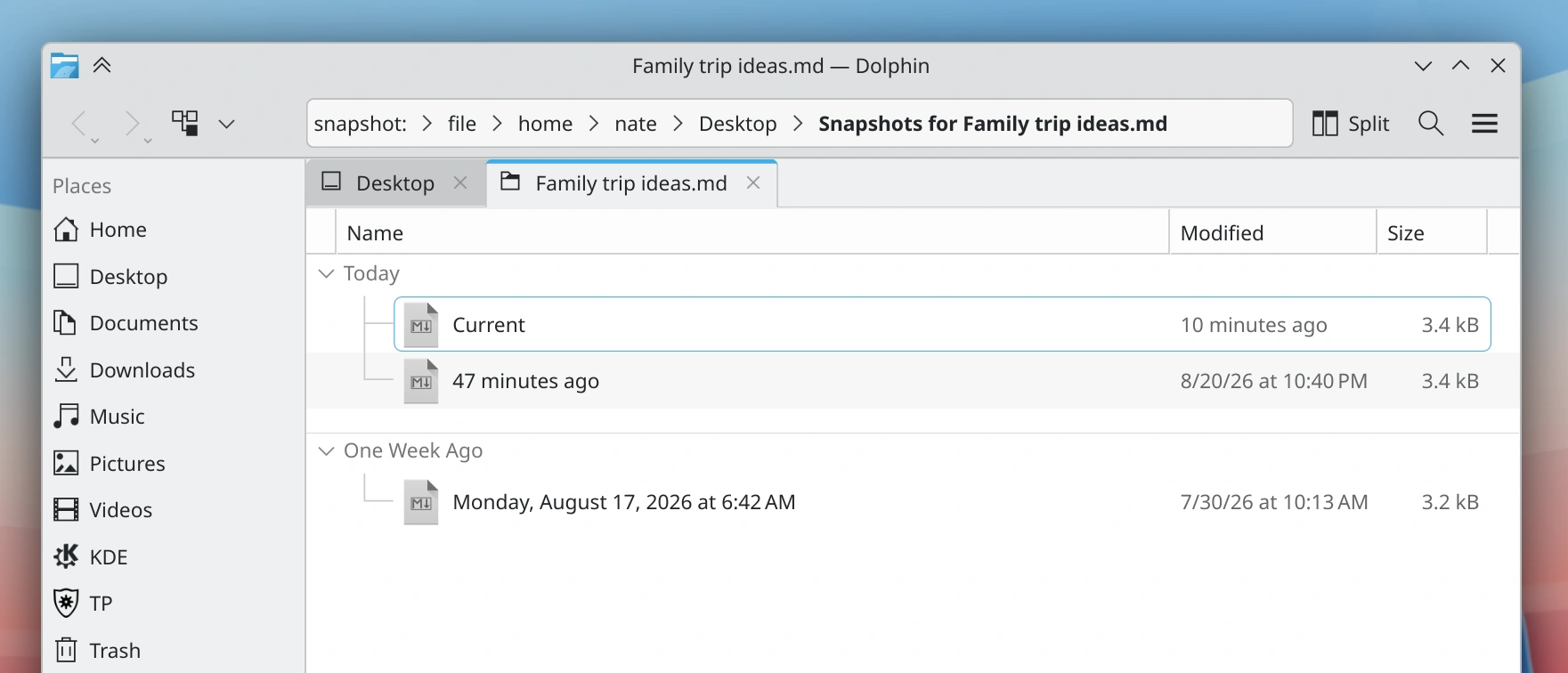
This doesn’t replace a backup, of course! But it does amount to a sort of homedir-level undo feature that can keep your data safe from accidental deletions, or other destructive changes that are less catastrophic than a disk failure or having the device lost or stolen. And these snapshots will be useful to use as backup sources, so you’re not trying to back up a moving target.
Another few layers in the data safety onion, shall we say!
CJKV input support by default
Nate Graham finished the project to make Chinese, Japanese, Korean, and Vietnamese text input work out of the box. Now everything needed to type in these languages is pre-installed, and all you have to do is turn it on.
QA & testing
Thomas Duckworth and Bhushan Shah continued to develop, refine, and maintain KDE Linux’s automatic QA system, which continued to pay dividends this month. The system caught multiple complex integration issues introduced accidentally in commits made to KDE software — all of which are now fixed, so users of other operating systems will never have to experience them.
Security
Yago Raña Gayoso removed an unnecessary override that gave everyone in the wheel group default access to the Docker daemon’s socket.
Nate Graham fixed an oversight that let blacklisted kernel modules into the unified kernel images.
Bugs fixed
Harald Sitter fixed an issue that could make updates fail right after the update was published, or when run on machines with weak CPUs or slow network connections.
Hadi Chokr fixed an issue with user-visible version numbers of KDE Linux builds not including the intended level of precision.
Documentation
Nate Graham added quick links to KDE Linux’s official documentation right there in the launcher menu’s “Help” section.
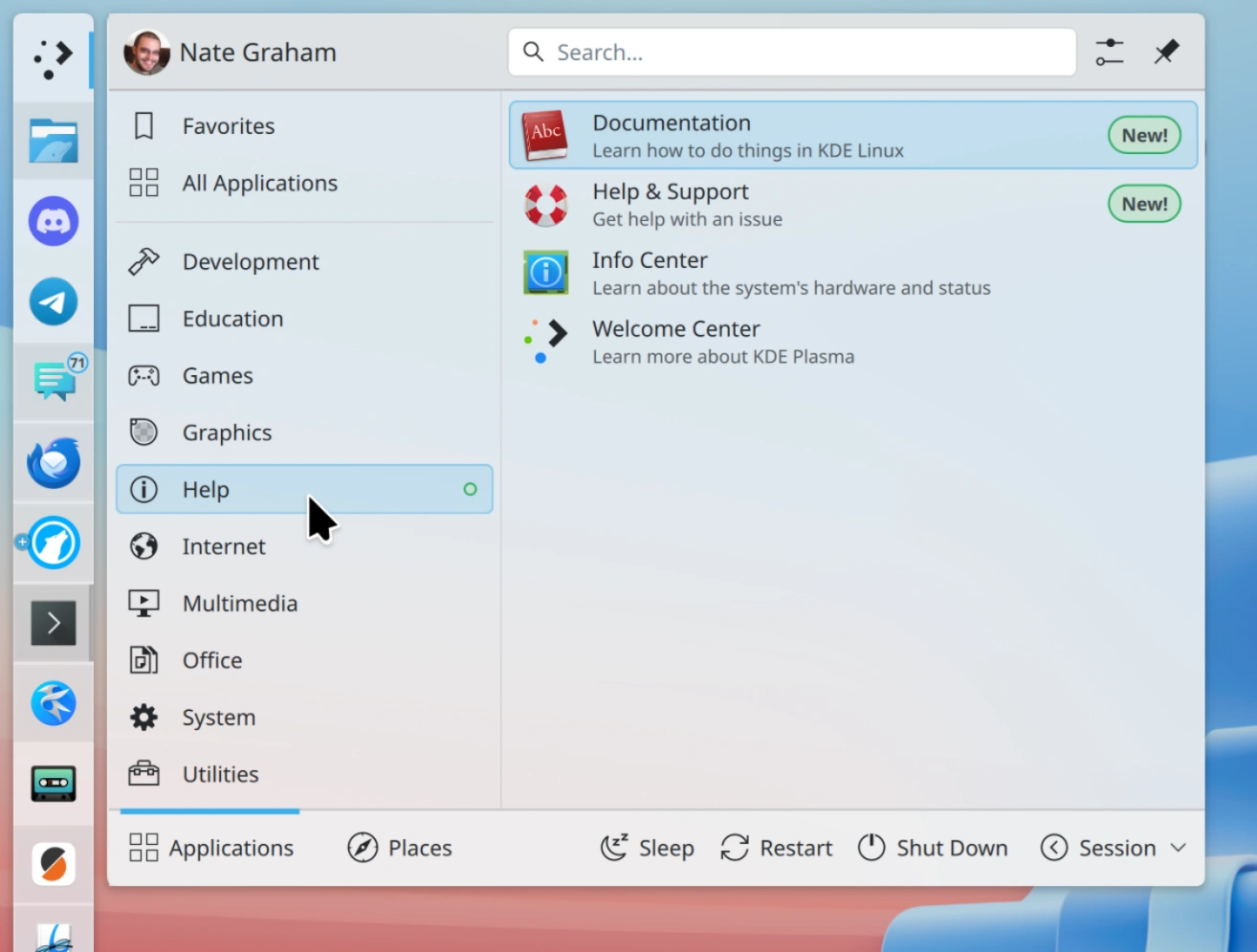
Nate Graham also documented how to free up disk space, added a dedicated “Help & Support” page to the website, and added a link to the project’s news feed.
Philip Grant refined and documented a way to integrate KeePassXC with the Flatpak packaging of Firefox and Chromium (and their derivative browsers).
Julius Künzel fixed the styling of the standard Hugo alert bubbles, and Nate Graham ported the docs to use them.
Grab bag
Paul Brown added a neat feature to the set-up-systemd-extension tool that lets you create new extensions at different locations and with different names.
Hadi made the installer report its progress in a more granular way, so there’s less waiting around and wondering if the installation process got stuck.
Bhushan Shah removed the “UEFI shell” entry from the bootloader menu, since it was useless for practically everyone, and now the menu is less cluttered.
How you can help
KDE Linux is making steady progress towards its Beta milestone, and is now 85% of the way there.
There’s lots to do! If you’re a fan of the project, please help out; there are many ways:
- User support: help support people on discuss.kde.org using KDE Linux.
- Issue reporting: install KDE Linux and report issues.
- Documentation: improve the docs by submitting merge requests.
- Flatpak: fix packaging or code issues in Flatpak-packaged apps.
- OS development: help build KDE Linux! There’s plenty to do.