Sign up for Executive Dysfunction, a newsletter that highlights one under-the-radar story each week about how Trump is changing the law—or how the law is pushing back. You’ll also receive updates on the latest from Slate’s Jurisprudence team.
“Help me!” shouted Marcos “Bori” Alcaraz. “I’m on fire!”
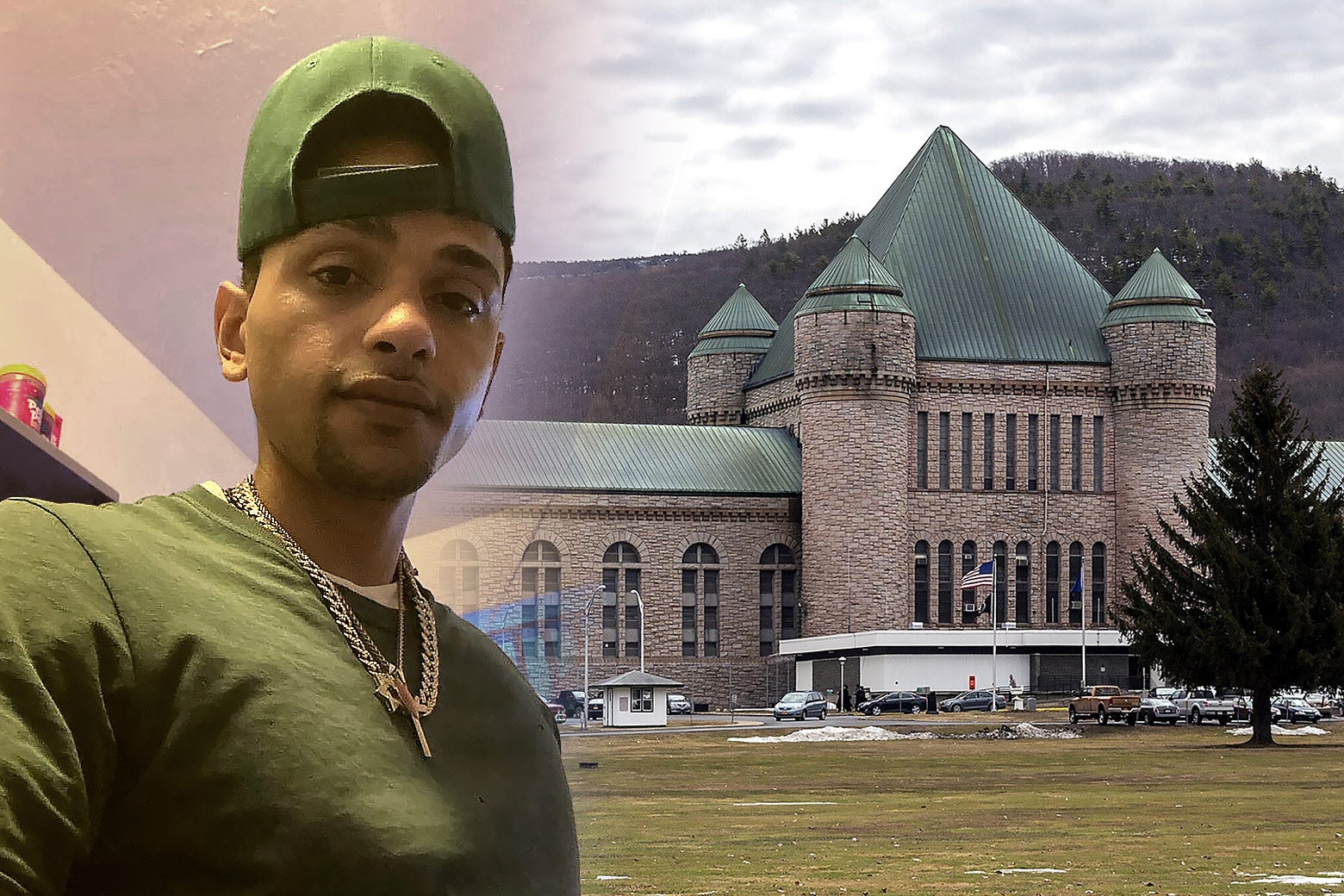
Thirty-five-year-old Alcaraz, a slim kid from the Bronx serving time for manslaughter, stood pressed against the steel bars inside South Hall—an infamous cellblock at Eastern NY Correctional Facility, a maximum-security prison tucked away in Napanoch, New York. It was around 1:40 a.m. on a summer Saturday last month when Alcaraz’s cell ignited into an inferno.
“It looked like the sun was inside his cell,” said Akbar “Block” McClennon, 39, a fellow student in the prison’s college program who was locked up on the same gallery as Bori. Block is a tall, dark-skinned Black man with locs and striking, expressive eyes. Block described staring up at the gallery wall, transfixed by the horror. He saw Bori’s flickering silhouette gripping the bars. “He was shouting for help for, like, 30 minutes. Then there was a flash, and you didn’t see him standing on the gate anymore.”
Fire dominates today’s headlines. The world itself feels like it’s burning. This horrifying story of a man burned alive in one of the biggest states in the union has barely made a blip in the news, though. The details of Alcaraz’s death are truly horrifying. Severe burns trigger immediate, catastrophic nervous shock, and because the skin is the body’s largest organ, few can survive a third-degree burn covering half their frame. Burning to death is universally recognized as one of the most excruciating ways to die. But burning to death inside a prison cell—a concrete tomb—is a distinct nightmare. Once you are ablaze, escape is impossible. There is no room to stop, drop, and roll. In a fire, any person expects to hear the piercing blare of a smoke alarm, yet not a single detector sounded that night. As an incarcerated person, you find that your life rests entirely in the hands of prison employees; you are completely dependent on them to hear your pleas and take immediate, lifesaving action. Given these facts and the situation on the ground in New York correctional facilities, it seems Alcaraz never stood a chance.
I am currently serving my 17th year for manslaughter, and reporting on systemic issues within the criminal legal system from the inside out. To trace the breadcrumbs of this tragedy, readers need critical context. On Dec. 9, 2024, Robert Brooks was fatally beaten by officers at Marcy Correctional Facility. The release of the body camera footage by Attorney General Letitia James on Dec. 27 led to the firing of 13 guards and the indictment of six by a grand jury. That indictment triggered an illegal strike by corrections officers. In response, Gov. Kathy Hochul deployed the National Guard, who now occupy facilities as a volunteer-only, long-term force. New York State Department of Corrections and Community Supervision Commissioner Daniel F. Martuscello III initiated an aggressive recruitment drive, bringing waves of rookie guards into the system. Yet, despite this surge of security personnel, basic living conditions have only decayed.
Over the past year alone, six men have died inside South Hall: overdoses, a homicide, and, now, a horrific death by fire. South Hall is known as one of Eastern’s “dump-off” blocks, where they send rabble-rousers, the outspoken, argumentative prisoners, the ones who have most fallen out of favor with the guards. Most prisons have one; Eastern has two: B-Block and South Hall. Aside from an unlucky draw, there is a short list of reasons a prisoner ends up here. It is also where staff send men they label legitimate troublemakers—those with heavy disciplinary records. Other times, a sergeant holds a personal grudge, or the officers on your cellblock simply don’t like you. They contact Movement and Control, and the next morning, an officer looks down at his clipboard and barks: “Pack your things. You’re moving to South Hall.”
When you first step into South Hall, to your immediate right is “the bubble”—a barred enclosure fitted with chairs, a desk, a telephone, and a microwave. Behind it sits an officers’ bathroom, and tucked behind that is another room, humorously referred to by us prisoners as “The Boom-Boom Room,” for its mattress and all that it might imply. If you turn left, you walk onto Nine Company; directly above it sits 10 Company. The cellblock towers four tiers high, each tier stretching across 28 cells.
Alcaraz was locked on 14 Company—the side facing the parking lot—inside Cell 20, all the way in the back on the third tier.
When the on-duty officers heard the desperate cries for help, why didn’t they jump up and sprint to Alcaraz’s aid? The answer is more sinister and complex than simple laziness or burnout. Over the past few years, staff have become desensitized to prisoners smoking synthetic cannabinoids like K2, often laced with fentanyl, which cause men to have “episodes,” or “eps.” An episode is prison slang for a severe hallucination. (In a previous facility, I watched a man having an ep in which he was convinced he was Spider-Man; when staff arrived to escort him to medical, he was shooting imaginary webs from his wrists.) During these episodes, men collapse or turn violently erratic. When they pass out, they often suffer violent seizures, triggering a code call. A nurse arrives with a gurney, rolls the prisoner to the clinic, and administers Narcan. Once coherent, the man is marched right back to his cellblock.
Eps happen almost daily in South Hall, sometimes three times a day. But Alcaraz wasn’t having an ep. He was burning alive.
One theory is that officers initially assumed it was just another episode and brushed it off. But a witness told me that a male officer moved past mere apathy, actively shouting at the screaming men to “shut the fuck up” and “stop calling.”
Who plays games with fire?
During the day shift, corrections officers like to work in South Hall because it’s the cellblock that’s always locked down, which makes it prime real estate for officers who want to spend their 12 hours chilling. At around 8 p.m., night shift workers shut down every gallery in South Hall, locking every prisoner inside his cell, including the porter, who sometimes acts as an additional set of eyes and ears. If the porter is locked in, however, then that shout might not be heard. Once everyone is locked in, COs get to lounge around inside the bubble: eat, drink coffee, flirt with each other, complain, maybe nap until they have to perform the 10:30 p.m. count. Whatever was going on, nobody responded to Alcaraz’s desperate pleas for help and the shouts of the other inmates.
In an attempt to shift the blame, prison administrators might be trying to focus on the physical cause of the fire. But whether it was electrical, chemical, or whatever, what killed Alcaraz was the negligence of the guards. When a CO hears someone scream for help, it doesn’t matter if they think someone’s having an episode or playing around; they are supposed to investigate it because, as in Alcaraz’s case, the fire could be real.
Witnesses I spoke with were unanimous on one detail: “Only one of the three officers on duty that night tried to do anything.”
There are no fire extinguishers stationed on the company itself. Instead, two fire hose cabinets sit in each gallery, one at the front, and one near Cell 24. When officers finally acted, they pulled only half the hose out, leaving the rest coiled inside the cabinet, and stood there baffled as to why the water wouldn’t flow.
By the time the nurse finally arrived, Bori was so severely charred that she couldn’t find a spot of unburned skin to insert an IV.
I spoke with two South Hall residents, Dario Wynerman and Shevockie Bloodworth, who believed they had suffered smoke inhalation. But when they finally made it down to the clinic, medical staff refused to see them, saying, “We can’t help you.”
Standard procedure mandates that anyone suspected of smoke inhalation receives a bronchoscopic examination of their airways. That examination was never performed. If medical personnel were to officially document smoke-inhalation injuries across the block, the Department of Corrections and Community Supervisionwould be exposed to massive liability, both for medical treatment and for the lucrative civil lawsuits mounting on the horizon.
It is neglect: pure, willful neglect at every level, from medical to mental health. And Alcaraz was not the only victim.
Normally, when a death occurs inside a cellblock, facility executives dispatch clergy, rehabilitation coordinators, and mental health counselors to conduct psychological welfare checks. Men here, some of whom have served decades, are deeply traumatized. Yet no prison staff ever came to speak to a single soul.
The week Alcaraz died, I went out to the yard to work out. The heat felt like 100 degrees radiating off the pavement.
“I can’t get the image out of my mind … him standing on the gate, screaming, ‘Help me! I’m on fire!’ ” said Richardo “Rick” Daniell, 35, who is serving over a decade for attempted murder. Shirtless, he paced relentless circles on the blacktop. His mind, like his feet, refused to slow down.
Alcaraz was one of Daniell’s closest friends. They ate their meals together and walked laps around the yard talking about life. Alcaraz had lived a hard, brutal road, Daniell told me. He had lost his mother during this sentence, but he had finally begun to put his life together before this nightmare struck. Daniell fondly described his friend as “stand-up,” “caring,” and fiercely “loyal.” He pulled out a worn Polaroid of the two of them, side by side, leaning against a concrete wall, Alcaraz facing the camera with the quiet bravado of a man used to taking life’s blows head-on. Ever since the fire, Daniell had carried that photo everywhere in his pocket.
“He was a good father too,” Daniell added.
When he mentioned that Alcaraz had left behind a 16-year-old daughter, the weight of his death struck me like a blow to the chest. I’m a father to a teenage girl myself, and my heart went out to his family. Missing your daughter’s youth while behind bars is a crushing weight, but knowing she’ll never see her father again is a far darker reality. I couldn’t stop thinking about the devastating grief that young girl is carrying.
Daniell stared at me, his eyes burning with indignation. “They told his baby’s mom he felt sick earlier in the day and died in medical.”
“That’s fucking crazy,” I said, stunned into silence.
The administration’s attempt to stonewall Alcaraz’s family comes as no surprise. His hair was burned off, his clothes fused to his flesh. Alcaraz was unrecognizable. No administrator wants to handle a political crisis this explosive.
Two weeks later, I noticed the fire and safety team walking through the prison, holding clipboards, testing alarms, and inspecting extinguishers. Out in the yard, the fire hydrants received a fresh, bright coat of yellow paint. Men in West Wing, the block visible from my window, were even given a fire drill. In my five years across three different prisons, I cannot recall a single authentic fire drill. Usually, staff stage them as a tactical bait and switch: Once the block is cleared under the guise of safety, K9 units and search teams move in to tear through the empty cells.
I am thoroughly unimpressed by this sudden, performative show of fire safety. I cannot erase the image of that scorched cell from my mind. All the walls are black. The toilet and sink are black. The bed frame, black. The ceiling, black. Crispy. It doesn’t even look like a cell anymore. It looks like a bomb went off inside.
Sign up for Executive Dysfunction
Delivered every Thursday morning.