commentary
The global romance with America turned sour years ago. Now the world's ready for a divorce
Published
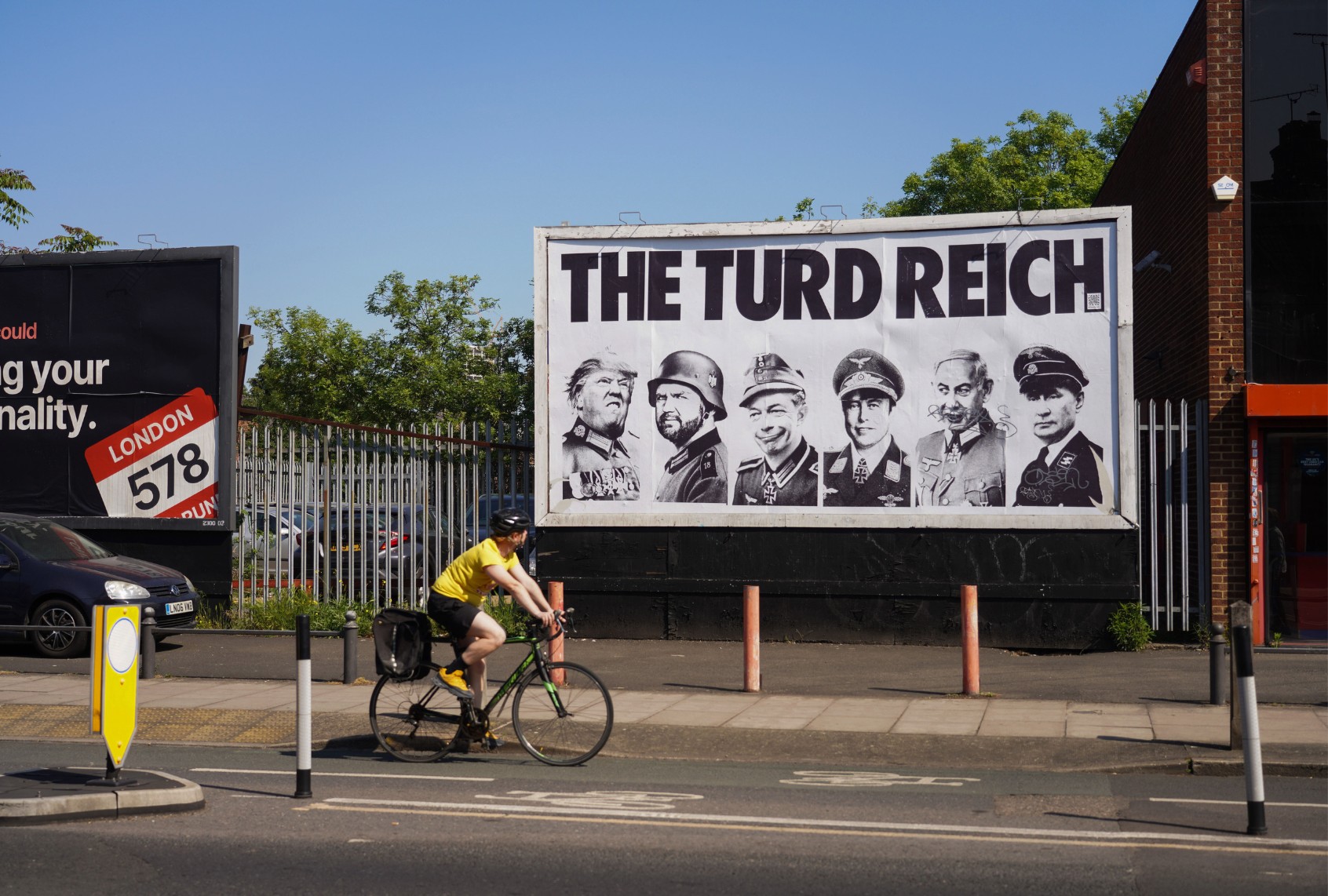
Billboard created by Grow Up Art in London, May 13, 2025. (Kristian Buus/In Pictures via Getty Images)
A few days ago, I put one of my college-age children on a plane to Berlin, on the way to a month-long theater intensive. It was a wistful and exciting moment, a rite of passage for many privileged middle-class parents around this time of year. It felt like the kind of experience that’s supposed to remind you, amid the relentless passage of time and the chaotic info-jumble of contemporary life, to try to be fully present wherever you are. (I wouldn’t say that’s my very best skill.)
I mention the obvious class privilege behind that moment not to cover myself in sackcloth and ashes, but on the way to a different observation. During our slow drive through heavy traffic to JFK, we talked about the ironies of international travel at this dire historical moment, when the U.S. has come visibly unstuck and the world’s long-running romance with America is well and truly over. I’ll be joining both my kids in Europe later this summer, and we half-jokingly suggested, while breathing the foul air of a clogged subterranean highway in Queens that seemed to embody entirely too many metaphors, that maybe we wouldn’t be coming back.
That kind of anguished, not-funny witticism is another commonplace of the American educated classes: OMG, what has happened to this country? I’m moving to Canada or Iceland or the south of France; I need to find my grandmother’s birth certificate and apply for dual citizenship. Most people don’t follow through on these threats or fantasies, which could uncharitably be described as feeble protests or efforts to evade responsibility for the current state of America: Don’t blame us, we voted for Kamala! #NotAllYanks! Et cetera. I am old enough, unfortunately, to remember the cringeworthy “Sorry Everybody” videos after John Kerry lost to George W. Bush in 2004.
If being an American of approximately liberal inclinations in the 21st century seems to require constant public apologies, some disgruntled Yanks actually are exploring their escape options. Applications for foreign citizenship have reportedly exploded over the past couple of years, for reasons I hardly need to explain. Nearly 20,000 Americans applied for Irish citizenship in 2025, while about 9,000 applied for British citizenship, a considerably more difficult and expensive process. Both were record highs. (No judgment here: I’ve held Irish citizenship most of my life, and my kids now have second passports as well.)
Italy’s right-wing government recently introduced new restrictions to its previously generous citizenship laws, potentially slamming the door on millions of Americans with relatively distant Italian ancestry. Canada, on the other hand, has done exactly the opposite: If you have a direct ancestor born across the northern border, no matter how far back, you probably qualify. In January of this year alone, nearly 2,500 Americans reportedly filed applications for Canadian citizenship; by some estimates, one in four residents of the New England states may be eligible, along with millions more across the U.S.
David Lesperance, an immigration adviser based in Poland, told Al Jazeera last year that his Trump-era American clients seeking an exit strategy often include LGBTQ folks, left-leaning political donors and “people concerned by what they perceive as authoritarian trends” in the U.S. “I’ve never been busier,” he said. In the same article, London School of Economics sociologist Kristin Surak described such people as “Armageddon Americans,” a term that requires no explanation.
Millions of people around the world wanted blue jeans and McDonald’s and road movies and Manhattan skyscrapers and California beaches, or at least they thought they did. Little by little they found out that some of those things weren’t worth having and all of them came with asterisks.
It isn’t news to anybody reading this that America’s massive internal fracture, which shows no signs of healing in any of our lifetimes, is leading an increasing number of people with adequate resources and flexible lives to ponder their options. At least three former colleagues of mine have uprooted their families, changed jobs and moved overseas within the last few years. More to the point, I don’t know anyone who hasn’t thought about it.
But what’s really happening, I suspect, is much bigger than a minor demographic shift among a handful of educated libs. It’s more that the deeply ingrained toxin of American narcissism — the conviction, long shared across nearly the full range of political opinion, that this is an exceptional or “indispensable” nation, endowed by God or history or Thomas Jefferson with a unique destiny — has begun to fade.
That creed is certainly still part of the ideological atmosphere in this country, but multiple generations of Americans since the 1960s have grown up surrounded by contrary evidence. Despite the defensive proclamations of country music stars and the willful naïveté of mainstream Democrats, I have a hard time believing that anyone under 60 really, truly believes that anymore. (Or at least believes it for non-terrifying reasons.) The entire premise of the MAGA movement, after all, is that America used to be awesome, and that some version of a primitive fascist dictatorship can bring that back.
Only a small minority of Americans are likely to acquire “Armageddon” passports and bail out, but more and more of us have gotten the memo: The world’s just not that into us. Yeah, there were quite a few decades when millions of people all over the planet were way too invested in the American dream, if mostly at a distance. They wanted blue jeans and McDonald’s and road movies and Manhattan skyscrapers and California beaches, or at least they thought they did. Little by little they found out that some of those things weren’t worth having and all of them came with asterisks.
One of my Irish cousins, a middle-class professional who has visited the U.S. many times, texted me after Trump took office last year to say that for the first time she found America and Americans actively frightening. (“Pardon my generalization,” she added.) I didn’t have much to say in response. More recently, she forwarded me a report from the Irish Times about Irish students deciding not to apply for the J1 visa this year, which allows them to work summer jobs in the U.S. (My cousin did that herself, some years ago.) “Trump has probably done me a favor by making me rethink the idea of going to the U.S.,” one 19-year-old told the paper, “because Europe is so much better in every way.”
Anecdotes are not data, of course, but we’ve got plenty of that too. Tourist visits to the U.S. were originally projected to rise from 72 million to 77 million in 2025, but instead fell to 68 million, with dramatic declines in the number of visitors from Canada, France and Germany. On a global scale, meanwhile, it was a record-breaking year for international travel. Even with the FIFA World Cup largely taking place in the U.S. this June and July, the summer travel season looks even worse: After modest gains in February and March, visitor numbers in April were down 14 percent compared to last year. As one travel publication diplomatically put it, there’s no single reason for the decline, but it “appears to be a mix of politics, perception, policy confusion, higher costs and global instability.”
Many readers of Salon may feel an understandable desire to reduce all those factors to one five-letter proper noun that starts with T and rhymes with “lump.” That’s not entirely wrong, but it’s also not remotely adequate: What we’re living through right now is the long-term decline in world opinion about the United States, reaching back at least as far as the George W. Bush years and arguably all the way to the Vietnam War, hitting a kind of critical mass. Donald Trump has magnified, focused and channeled all that nasty American mojo in his own inimitable fashion, but I would argue he didn’t cause any of it.
What we’re living through right now is the long-term decline in world opinion about the United States, reaching back at least as far as the George W. Bush years and arguably all the way to the Vietnam War, hitting a kind of critical mass.
Polling data on how people around the world view America inevitably makes for dry reading, but still exposes startling differences between how Americans see themselves and external perceptions. Almost half the U.S. citizens surveyed for a Politico poll in February agreed that “the U.S. protects democracy,” while only 18 percent of respondents in Germany, 21 percent in France and 25 percent in Canada agreed. A semblance of shameful reality began to creep in with a question about whether “the U.S. is mostly a force for stability in the world”: Just 36 percent of Americans agreed, while the number was below 20 percent in Canada, France, Germany and the U.K. But 57 percent of Americans still agreed that “the U.S. can be depended on in a crisis,” which seems like a psychotic delusion fueled by Hollywood action movies. Fewer than half that proportion agreed in Canada, France or Germany.
If you want it darker, to quote the late Canadian shaman Leonard Cohen, consider this year’s Democracy Perception Index, a massive survey of 94,000 people in 98 different countries conducted by the Alliance of Democracies Foundation, a Danish think tank founded by former NATO Secretary General Anders Fogh Rasmussen. It was released in early May and largely ignored by U.S. media, possibly because it found that “net perception” of the U.S. around the world has fallen by an astonishing 38 percentage points in the last two years, from a plus-22 rating to minus-16. According to all those people surveyed, the self-described Land of the Free was ranked as the third-greatest threat to world peace, after Russia and Israel. And I mean, what’s the counterargument?
Want more sharp takes on politics? Sign up for our free newsletter, Standing Room Only by Amanda Marcotte, also a weekly show on YouTube or wherever you get your podcasts.
That precipitous collapse in global perception is, without question, an aspect of the Trump effect. But if we understand anything at all about the last traumatic decade or so, it should be that the rise of Trump — not once but twice — is itself a symptom of the catastrophic decline of America over the last five or six decades, both as a coherent, functional democracy and as an intermittently constructive force in the world. (Assuming, for the moment, that it ever was either of those things.) Whether that trajectory can be altered this late in the day, and whether Americans are ready to stop lying to themselves about how the rest of humanity sees our country, is hard to say.
I always spend the Fourth of July with my kids. When they were younger, we did fireworks, BBQ, a summer night alive with fireflies and bullfrogs, all that stuff. Not this year: We’re going to an Oscar Wilde play in Dublin, no doubt followed by a couple of pints in the pub. It’s just a momentary escape. We’re still a bunch of Yanks, despite the passports. I’m pretty sure we’ll be coming back, but not that night.