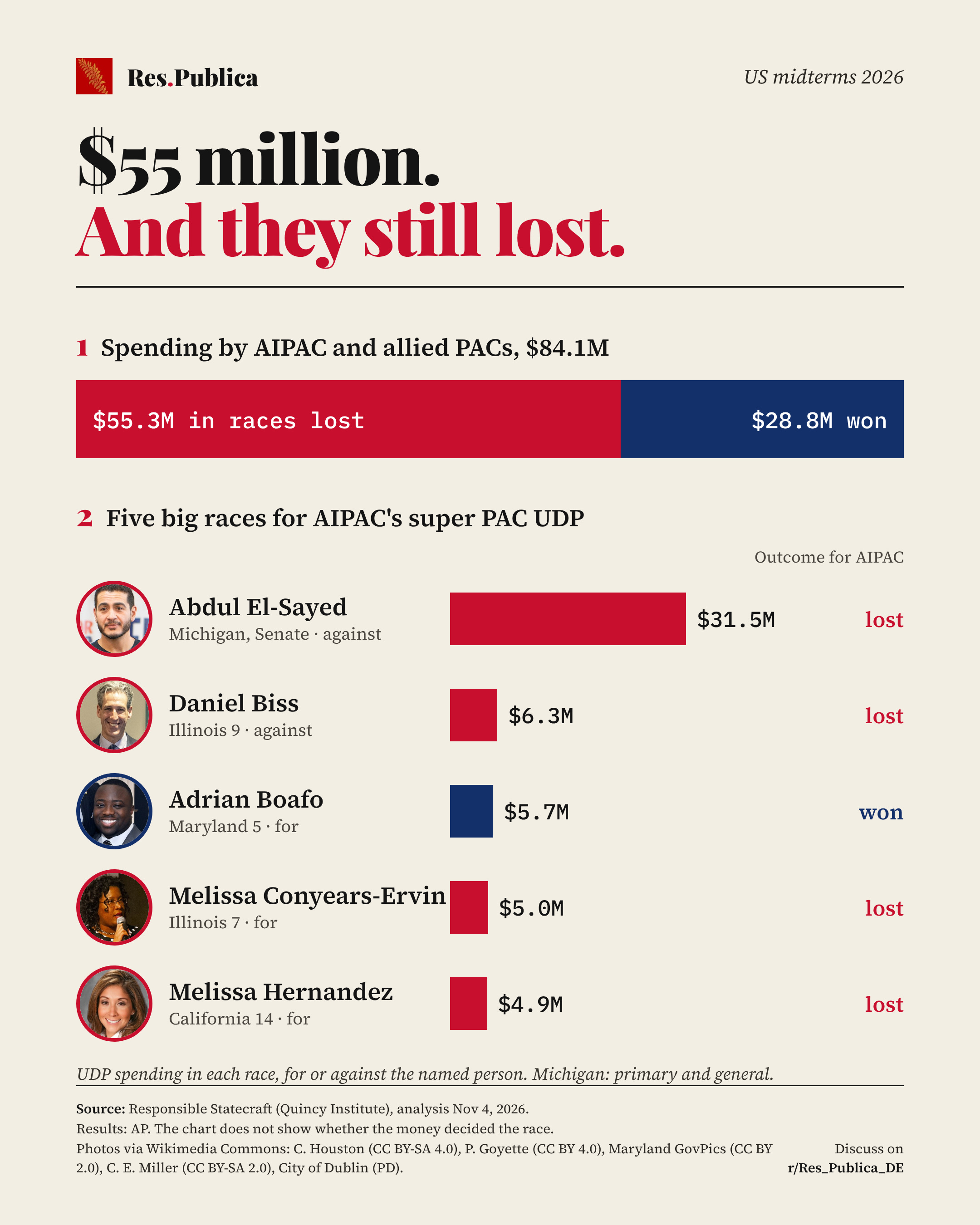
AIPAC spent about $84M on the 2026 elections through its super PAC United Democracy Project and allied PACs, according to an analysis by Responsible Statecraft (the magazine of the Quincy Institute, a long-time AIPAC critic). About $55M of that, nearly two thirds, went into races its side lost.
The biggest example is Michigan. In the Democratic Senate primary AIPAC backed Haley Stevens with close to $30M, more than it had ever spent on a single candidate. Abdul El-Sayed still won narrowly, and on Tuesday he beat Mike Rogers in the general. Daniel Biss (Illinois), Brad Lander, Darializa Avila Chevalier (both New York) and Melat Kiros (Colorado) also won against pro-Israel money, the last three by unseating sitting members of Congress.
For context: counted by number of races, AIPAC's side still came out ahead most of the time. According to WhoFundsMyRep, 356 of 394 backed candidates won, though mostly safe incumbents. What AIPAC lost were the expensive, high-profile fights. And whether the money decided anything is impossible to say, since Democrats had a strong year anyway.
The graphic going around on X ("$55.3M against candidates who won") mixes two things. The $55M also includes money spent FOR candidates who lost. The per-candidate figures in that table only count money spent directly against someone, so they are on the low side.
Why this is bigger than AIPAC: In the US, money can flow into campaigns almost without limit. Since Citizens United (2010) and a follow-up ruling, super PACs can raise and spend unlimited sums from individuals and corporations, as long as they don't coordinate directly with a candidate. According to OpenSecrets, the 2026 midterms were the most expensive ever at close to $12bn. More than $1.5bn of that is expected to be dark money, meaning nobody knows where it came from. Elon Musk alone gave $445M to Republicans.
That has consequences. Members of Congress spend a large part of their day raising money: in 2013 the Democrats' House campaign arm advised new members to spend four hours a day on fundraising calls and three to four on committee work, votes and constituents. A widely cited study by political scientists Gilens and Page (2014) found that economic elites and organized interest groups shape US policy substantially, while average citizens have little independent influence. The study is contested, but the pattern is familiar: whoever pays gets access. And a single super PAC can turn a primary in a safe district into a referendum on one issue, in this case Israel.
For comparison: in Germany, any party donation above €35,000 must be reported to the Bundestag immediately and is published. There is no equivalent of super PACs with unlimited budgets.
All sources here:
https://www.reddit.com/r/Res_Publica_DE/s/tx6fC8hTLm