The Gyutoization of Knives
Welcome to Buffet Magazine, an independently owned digital food magazine. Our Tuesday editions are where we feature great writing about food. Thursday is for recipes.
IN THIS ISSUE: Our inaugural reader survey and a faux-carcinogenic dessert.
Appetizers
A Penny for Your Thoughts
For the past year, each issue of Buffet has been shaped exclusively by our rough-and-tumble fivesome of worker-owners. We use this platform to pursue our pet passions, plumb the depths other publications leave unplumbed, and generally make the food magazine we want to see in the world. In the process, we make a lot of guesses about what you, our beloved readers, actually want from the newsletters you get each week, and it occurred to us that we could…just ask lol? To that end, we’ve put together a short survey about how you fine folks engage with Buffet, what gets you going, and what you’d like to see more (or less) of. It takes about four minutes, there are no wrong answers (well, there is one secret one we won’t tell you about), and every response will be read by an actual editor. What you tell us will help shape the future of Buffet. Take the survey here. Merci! —Amiel
[Rufus Wainright Voice] Cigarettes and Mascarpone
Even better than eating at restaurants is eavesdropping while eating at restaurants. So it was quite a treat this past weekend when I overheard a server at an unnamed Brooklyn restaurant mention that she had made “cigarette tiramisu” for staff meal that night. Cig-amisu? I had to know more. It turns out this spot has become well-known for its version of the Venetian sweet, and the staff just adore taking smoke breaks. This server, Maya, decided to combine all of the above. She soaked the ladyfingers in mezcal, infused the mascarpone crème with lapsang souchong, and topped it all off with a mixture of Tajín and powdered sugar. I embarrassingly asked if I could take a little nibble. She made me pay the bill first—her dish was an off-menu affair—and then kindly offered me a square. The tiramisu was good: the mezcal and tea both provided a delicate but potent smokiness, and the Tajín gave the back of my throat the right little tickle. I may try to vice-maxx more desserts in the future if this can be the result. —Cale

The Gyutoization of Knives
By Jesse Raub
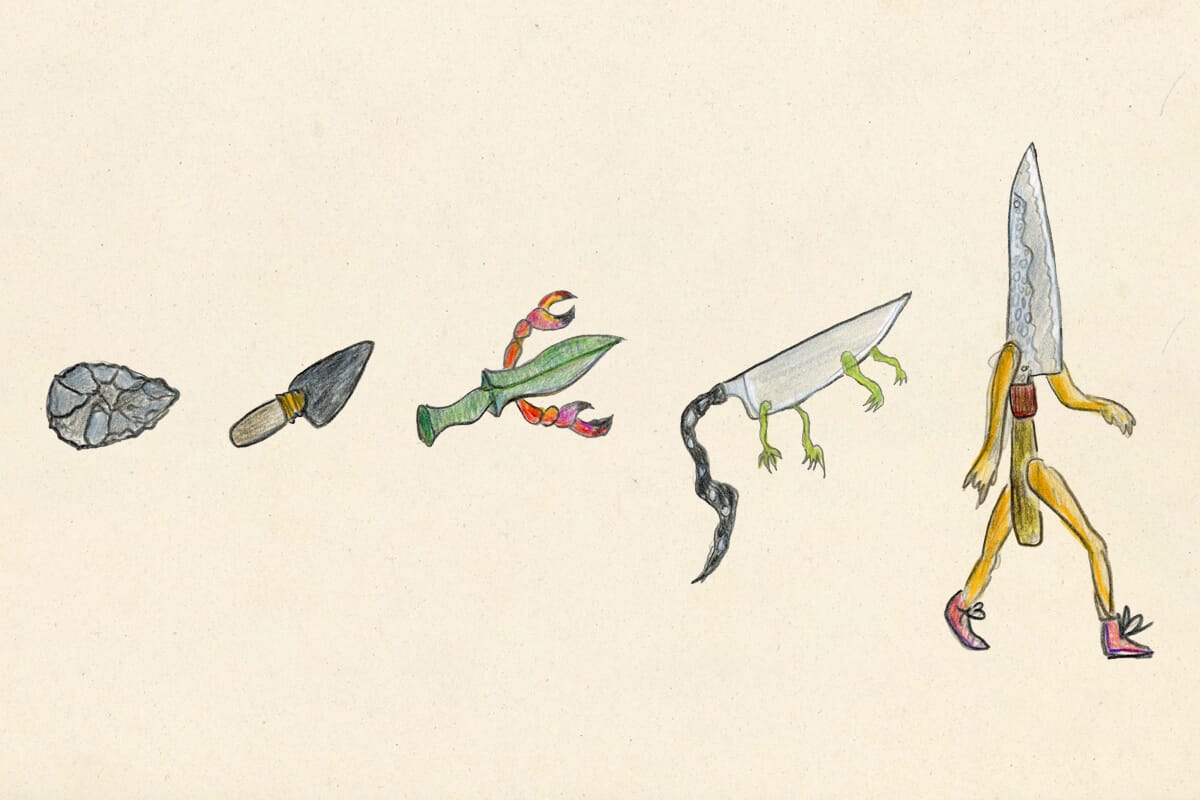
A knife reviewer digs deep to find out why chef’s knives all kind of look the same.
In a garage out in Chippewa Falls, Wisconsin, knifemaker Jesse Burgin showed me his workshop. There’s a drill press for punching holes in steel, a band saw for cutting out rough shapes, and a belt grinder for shaping, smoothing, and polishing each blade. It’s hot in the garage—around 85ºF when I visited this summer—but I’m ready to sweat it out, because this modest workshop is part of the answer to a question that’s been bugging me for years:
Why is an apron company trying to sell me a Japanese-inspired chef’s knife?
Maybe you’re looking for a sturdy but stylish kitchen apron, or a carbon steel pan. Maybe you just wanted a cutting board. Chances are, within a few seconds of loading up a kitchen brand’s website, you’re going to be directed to their latest knife collection.
These days, you can find knives from Hedley & Bennett (who started by selling aprons), Made In (who started by selling pans), Material (who started with a base set of kitchen utensils), Misen (who started with knives, but expanded to pans), and more. Unlike the flimsy, dull knives you find hanging on the rack at a big box store, these knives from direct-to-consumer (DTC) brands (which generally sell directly from their website or their own brick-and-mortar outposts) have all the markings of a good knife—look up any knife review, and chances are these knives will be praised for cutting like a legacy brand without the hefty price tag.
As a kitchen product tester and reviewer, these knives kinda drive me nuts. Knives used to be treated like a chef’s legendary sword: a beautiful tool to be treasured, built to be used in battle. When I was sixteen, working in a country club’s prep kitchen, the chef pulled me over to the toolbox near his office and popped the lid. “This,” he said, pointing to a satin gray blade attached to a sturdy black handle, “is the Wüsthof. It’s about as good as any knife can get.” When I picked it up, I could immediately feel the difference in its build quality. Compared to the shiny stainless knives with chunky white plastic safety handles issued to prep cooks like me, the Wüsthof felt balanced, its weight otherworldly. It was like picking up a meteorite—something that looked like a rock, but with a foreign density. When I cut with it, it fell through the onion with zero resistance, as if it were cutting through air.
Legacy European knife manufacturers like Wüsthof, Henckels, and Sabatier were beloved by chefs and food writers alike for decades. These brands helped pioneer the shift from rust-prone carbon steel to a high-carbon stainless steel alloy that performed well and required much less maintenance. I, of course, bought into the hype—the Wüsthof set I received as a wedding present outlasted my decade-long marriage by seven years. That set defined everything I thought I needed to know about a good-quality kitchen knife: drop-forged steel, full-tang construction, and proprietary alloys that made them sharp, durable, and well-balanced. Things started to shift when J. Kenji Lopez-Alt reviewed the Misen chef’s knife for Serious Eats in 2015. It looked more like a Japanese chef’s knife, sliced food delicately, and had the high-quality construction of a legacy brand for under $100.
I began reviewing kitchen products for Bon Appétit in 2021 and experienced the wonder of these new knives for myself. They sliced better than they should for their price point—usually $100 to $120 for a chef’s knife, around $50 to $70 less than their legacy counterparts. All of a sudden, my wedding Wüsthofs felt old-fashioned.
But the strange sameness of these DTC knives struck me as a mystery. Almost all of them resemble a Japanese chef’s knife, rather than the European style of the classic brands, even though all of these companies are based in the United States and most manufacture their knives in China.
Their particular shape, inspired by a classic Japanese gyuto, seemed to be key to their performance—and somehow, their affordable cost, too. For years, I’d always considered the Japanese chef’s knife as a fetish object on knife forums, not the all-purpose knife of the discerning masses. What changed?
Korin, or the history of Japanese knives in the United States
To answer this question, I went to the source for Japanese knives in U.S. kitchens. Saori Kawano started Korin, her New York City-based Japanese tableware company, in 1982 with just $2,000 she’d made in tips. “At that time, I had only worked as a waitress in a Japanese restaurant,” Kawano told me. “Since I was familiar with the tableware used in Japanese restaurants, I thought I could make a living selling it door-to-door.” Demand dropped when a recession hit just after the Gulf War, and Kawano started looking for a way to break into the mainstream restaurant market.
Korin’s showroom in Manhattan is now legendary for its array of Japanese knives, and its early adoption of e-commerce meant that Korin’s website was one of the first places where U.S.-based shoppers could buy a Japanese knife online. In 1991, however, American chefs were used to the Western-style knives they used in culinary school. “Chef Jean-Georges [Vongerichten] came to me because he was opening Vong, a French Thai restaurant, and he was looking for Asian tablewares. But other restaurants were only interested in Western tableware. So I thought: maybe knives,” said Kawano. Her mind immediately went to the gyuto.
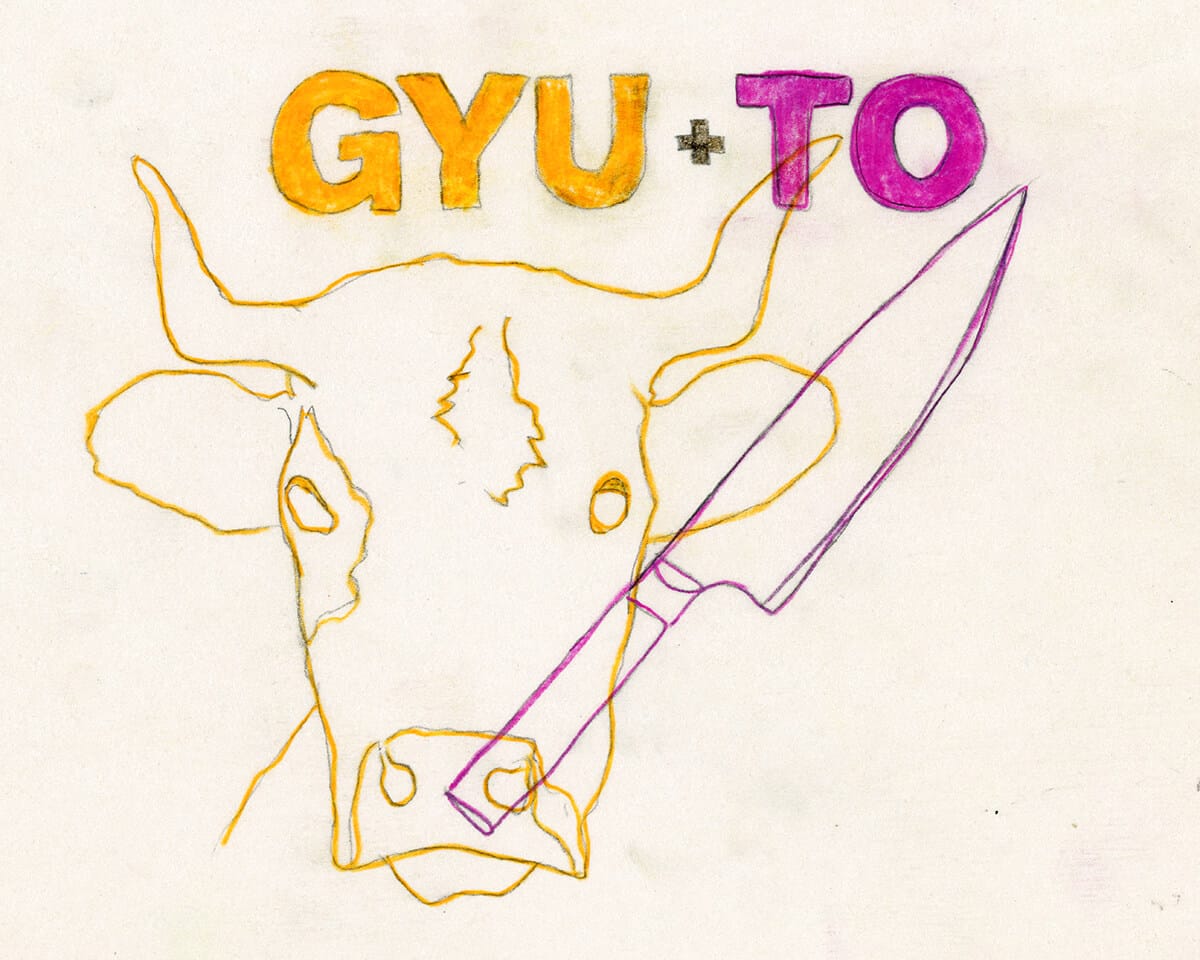
The gyuto was born more than a century earlier as Japan’s answer to a Western chef’s knife. In the Meiji era (1868–1912), Japan rapidly industrialized and opened up to global trade. An emerging professional class embraced French cooking as a mark of sophistication and electric steelmaking techniques created a boom in steel production, allowing knife-making on a much larger scale than before. The gyuto was specifically modeled after French and German knives—the word in Japanese, 牛刀, is made up of the characters for “cow” (牛) and “blade” (刀), likely due to the increased amount of beef preparation that came with the new haute cuisine. Japan has a long history of specific knife shapes for specific tasks, so when French cooking became more standardized, it was common sense that Japanese chefs needed their own Western-style knife.
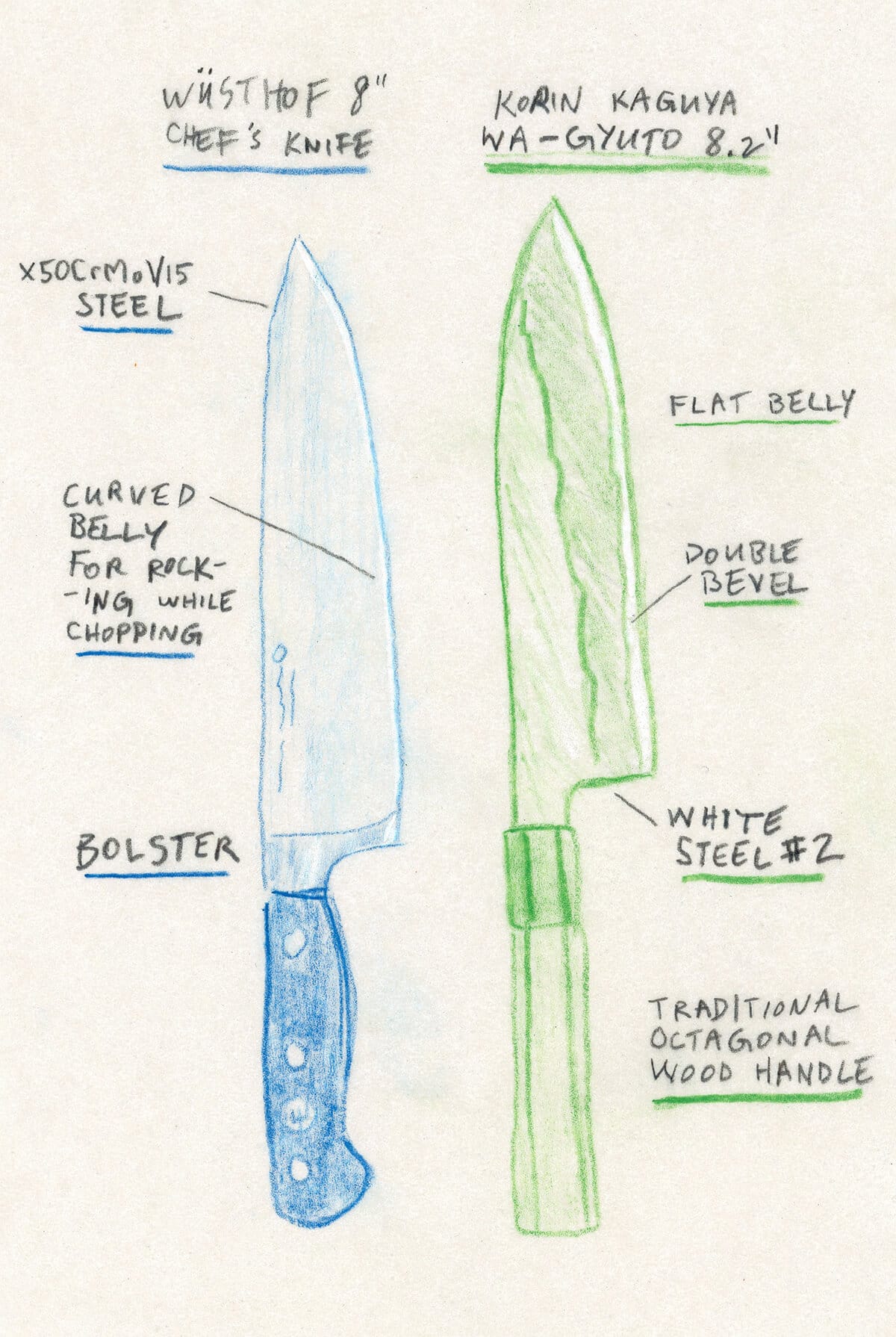
Traditional Japanese knives, such as the deba (used to fillet fish), usuba (used for cutting vegetables), yanagiba (used for preparing sashimi), and funayuki (traditionally used by fishermen to butcher fish), all feature a mostly flat edge with a single bevel, meaning they’re sharpened on only one side, which makes them great for push cuts and pull-through slicing. The Western chef’s knife, however, has a pointed tip for fine cuts, a curved belly that rocks back and forth on a cutting board for rapid chopping, and a double bevel that stays sharper for longer. The gyuto took the best attributes of both worlds, assuming the general shape of a Western chef’s knife, dropping the point into a sheep’s foot shape, flattening the belly, and embracing the double bevel. The result was a knife with a finer tip for precision point work, a flatter edge for push cuts and slicing, and just enough belly curve to rock-chop fine herbs.
Japanese knifemakers started making two versions: a traditional gyuto, with an octagonal wood handle, and a hybrid version, with a Western-style full-tang handle. In both versions, the knife has a narrow neck between the handle and flat of the blade, giving users versatility in where they grip it. The gyuto quickly became a popular all-purpose knife in Japan for any chef or home cook. Its adoption outside of Japan, however, took nearly a century.
Kawano saw that the hybrid gyuto, made in Japan but with a Western-style handle, could work for chefs in the U.S. She started ordering knives from both longstanding knifemakers like Misono and smaller knifemaking studios, and used her Vongerichten connection to get him one of them, hoping that he might be so taken that he would become the West’s gyuto ambassador.
It worked. Vongerichten liked the knives, and word of mouth spread in New York chef circles. Kawano added fuel to the fire by setting aside 1,200 knives a year to donate to students in culinary schools and chefs at charity events like Citymeals on Wheels. The initial response was incredible—chefs loved how the Japanese knives sliced through food much more efficiently than the Western knives they were used to.
But an issue kept popping up: the knives were chipping from heavy use in professional kitchens. “We constantly dealt with refunds and replacements, which were extremely difficult,” said Kawano. After getting on the phone with the manufacturer, she figured out the problem. “While the overall shape is quite similar, the [Japanese] blades are thinner, harder, and can achieve an exceptionally sharp edge. However, because they are less flexible, the edge can chip very easily if the hand twists or wobbles while the blade is inside the ingredient.” It wasn’t just the shape of the blade itself; it was the actual steel that the knives were made from.
Think of wood versus glass. Wood bends under pressure and cannot be sharpened into a cutting edge. Glass, however, shatters easily, and its shards are razor-sharp. The difference between traditional Japanese and European knife steel isn’t quite that dramatic—on the industry-standard Rockwell hardness scale, a Wüsthof’s steel is a 58, while Japanese steel is a 61—but it’s a big enough difference in a busy kitchen, where a chef might use their knife to hack through a chicken’s breastbone, open a can, or chop onions with repeated whacks on a hardwood cutting board. “I realized that what American chefs truly needed was not only Japanese knives themselves, but also sufficient information and education about the characteristics of Japanese knives so they could use them properly,” said Kawano. “That realization led me to create our knife catalog.” Initially only eight pages, the first Korin catalog in 1995 featured Vongerichten comparing the use of a Japanese knife to driving a Ferrari: once you master the different cutting techniques, the joy of using it is unparalleled.
By 2010, demand in the U.S. had increased so much that one of Kawano’s regular orders was delayed—the knifemakers she bought from now had brisk business with multiple retailers. During that time, Korin also invested in in-house sharpening and repair services and eventually launched two in-house brands, their eponymous Korin line and the more affordable Togiharu line.
The Korin and Togiharu brands work almost exclusively with a handful of small, four- to five-person Japanese knife studios, but in the U.S., those knives are grouped together under just two labels. That detail popped for me—perhaps this was a precursor to the DTC knives made in China?
A tale of two steels
The history of OEM (original equipment manufacturer, an industry term for white-label) knife-making in Japan is quite deep—and it all feeds into the steel. In the 1970s and ’80s, Japan was a low-cost manufacturing hub due to the favorable exchange rate between the dollar and the yen, so American knife companies started contracting work to a cluster of factories in Seki City, just north of Nagoya. Most of these knives were pocket, folding, and hunting knives made for brands like Gerber, Kershaw, and Spyderco. Serving just the American market didn’t fulfill their production capacity, so they needed domestic buyers. But there was a hitch: thanks to a series of high-profile knife attacks, Japanese authorities were cracking down on knives. So these newly built-out factories turned to the kitchen to increase their domestic sales.
I spoke with metallurgist and knife steel enthusiast Larrin Thomas, the founder of Knife Steel Nerds, the author of The Story of Knife Steel, and a developer of new knife steel alloys. The metal itself seemed key to understanding how these new DTC knives had taken over the world. If Japanese steel was typically harder than the stuff being used in the classic European knives, was it more expensive? And if that were the case, how did these DTC knives cost less?
The burgeoning Japanese kitchen knife industry worked closely with steelmakers to develop the right material for the job. Knife steel alloys are tricky, Thomas explained. Steel itself is a simple alloy of carbon and iron, and the higher the carbon content, the easier it is for the steel to harden. But traditional carbon steel, as it’s often called, is susceptible to rust and corrosion. The addition of chromium gives stainless steel its rust- and corrosion-resistant properties, and also makes it more difficult to harden. That makes your standard 18/10 stainless steel (18% chromium, 10% nickel, which is also added for corrosion resistance) a great option for flatware but a poor choice for a kitchen knife.
Modern kitchen knives use alloys known as “high-carbon stainless steel,” which sometimes include minerals such as molybdenum and vanadium to boost hardness and rust resistance. There are just two Japanese steelmakers creating the most popular versions of these alloys: Aichi Steel makes a blend called AUS-10, and Takefu Special Steel makes VG-10. Both steels have similar formulas: 1% carbon offset by around 15% chromium, with minuscule amounts of molybdenum and vanadium added for hardness.
“That’s an interplay between the knife companies and the steel companies coming up with something that they’re both happy with,” Thomas said. Compared to the steel used in most German knives—an alloy with the extraterrestrial name of X50CrMoV15—VG-10 and AUS-10 have higher carbon content and hardness, but lower corrosion resistance. In short, these Japan-made steels are fairly easy to sharpen and hold an edge over time, and are more brittle and require more care.
All in all, however, these steels are all comparable in production costs—meaning the German-Japanese divide was more of a judgment call than a question of expense. “The Germans were maybe more worried about people breaking the knives rather than optimizing performance,” said Thomas. “Those German kitchen knives don’t cut very well. They have very heavy grinds, or they’re very thick behind the edge. And so when you first get them, they cut reasonably well because they’re sharp, but no one sharpens their knives.” Having a thicker blade with softer steel requires much more frequent sharpening, but it also shields brands like Wüsthof from fielding complaints about chipped edges, cracks, and broken blades, as Korin did in its early days.
As Thomas writes in The History of Knife Steel, Japan remained the top exporter of inexpensive knives until the value of the yen spiked in 1987 and again in 1995. American knife companies moved manufacturing to China, where labor costs are cheaper.
“China will go and purchase VG-10 because VG-10 is already popular. So they can make a Japanese-style knife with Japanese steel, and everybody’s happy,” Thomas said. This was the smoking gun. By buying name-brand steel from Japan, factories in China could offer instant credibility to people who associate steel types with quality, while cheaper labor let them cut costs by 30 to 50%.
Of the most popular DTC brands, Misen’s chef’s knife is made with AUS10, Hedley & Bennett’s is made with AUS10, Material’s is made with an unnamed high-carbon stainless steel alloy from Japan that is likely AUS10, and all three knives are made in China. Businesses like Korin helped create demand for Japanese knives in the American market, and Chinese OEM manufacturers for American DTC companies supply affordable versions to meet that demand.
That mostly explains how an apron company can sell a Japanese-inspired knife for cheap, but it doesn’t fully get to the why. What’s the point of throwing a knife on your website if you’re mostly selling pots, cutting boards, or culinary couture?
Throw a knife on it
Jake Kalick launched Made In in 2017 with a tri-ply stainless steel pan as its core product. He had grown up around his family’s restaurant equipment company, and thought home cooks would be interested in commercial-grade cookware, too. Just a year after opening, the company started designing a chef’s knife. Made from X50CrMoV15 German steel at a factory in France, Made In’s original chef’s knife doesn’t quite align with other Japanese-inspired, OEM-made Chinese knives from American DTC companies. Still, if you look at the design, there are specific choices in its shape that fit with the trend. Like a gyuto, it retains a Western-style curve to its belly for rock chopping, with a drop-point tip and a slightly flatter edge than a traditional European knife. The one nod to German tradition, besides the steel, is the bolster—a chunk of metal between the handle and the blade that adds some heft—but it doesn’t extend to the heel of the blade, as it does on a classic Wüsthof.
When I asked Kalick how intentional his hybrid shape was, he had a very practical answer: “I don’t think we knew how big our knife category could get.” Made In has since launched a whole suite, including Japanese knives made in Seki City, but their first knife launched in 2019—four years after Misen’s initial Kickstarter, around the same time as Material, and four years before Hedley & Bennett took the plunge.
At the time, Kalick didn’t know if Made In would have the opportunity to produce a second chef’s knife. In that case, why not take the best of both worlds with easy-to-maintain German steel and Japanese-inspired design elements? If you’re keeping track, that makes the Made In chef’s knife an American-designed, French-made, German-steel knife that takes its design cues from a Japanese-designed version of a German knife used in French cooking. The snake eats its tail.
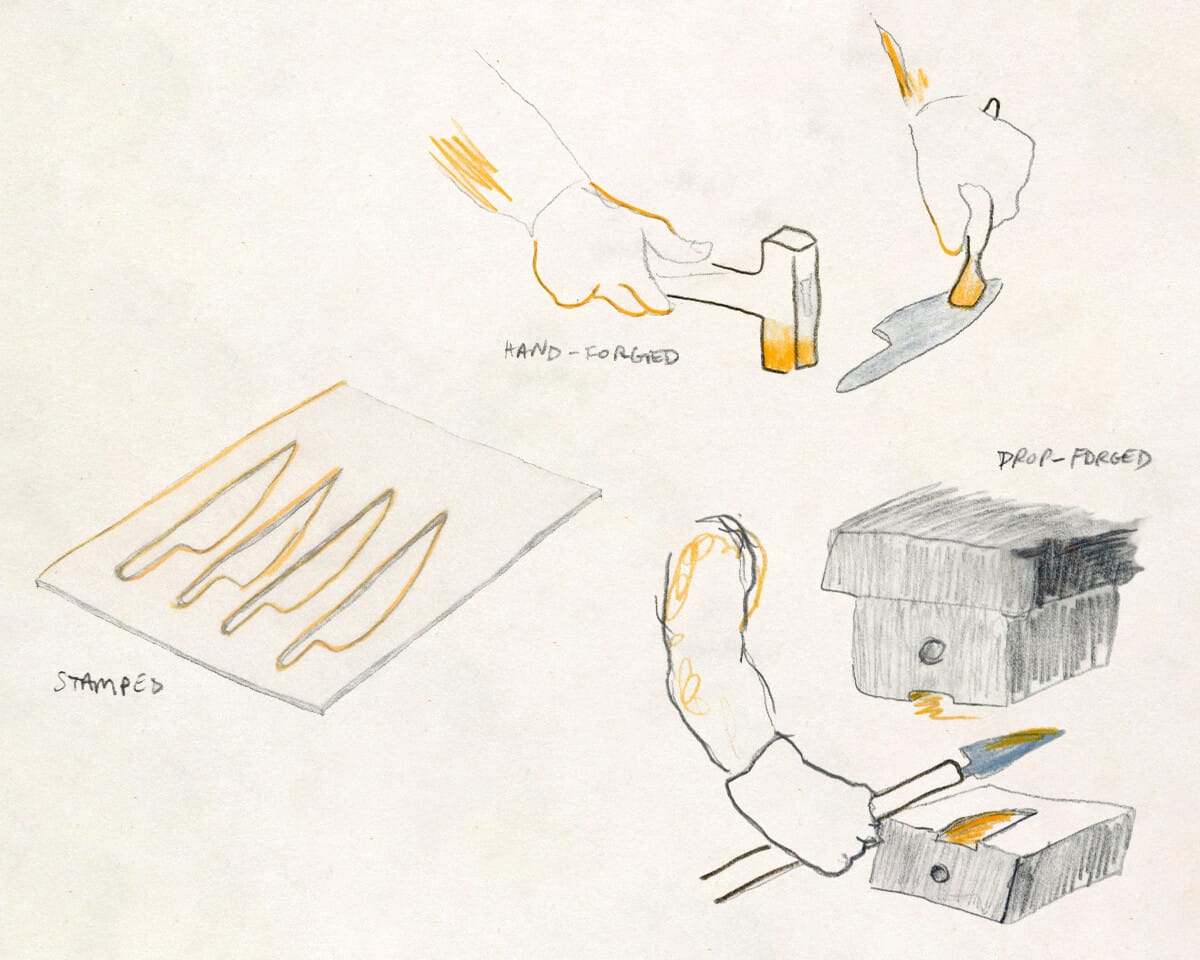
Traditional bespoke knives are hand-forged, meaning a block of steel is heated until malleable and then hammered by hand into shape. Made In’s knives are drop-forged, in which a heated bar of steel is placed into a mold, and a pressurized hammer machine presses it into the desired shape. Most Chinese knives and less expensive Japanese knives are stamped—imagine a giant sheet of steel and an industrial knife-shaped cookie cutter. Knife enthusiasts value the craft and labor behind hand-forged knives, though any well-designed, sharp knife will cut just as well, no matter how the steel was shaped.
Talking to Kalick dropped the last puzzle piece into place. With demand for quality knives at an all-time high and the costs of modern knifemaking at an all-time low, why wouldn’t a DTC company want to expand its lineup? A kitchen company can call up a Chinese factory that uses Japanese steel and have it manufacture a solid knife line to spec. In the past, this was the kind of project that would produce low-quality kitchen knives made from poor steel—like when Chicago Cutlery moved its manufacturing overseas after being acquired in 1988, and its entire product line descended into the dumps. Now, China’s thirty-year track record of knifemaking makes it an easy addition to a product line.
I tried imagining how my old chef would react to all these new DTC knives after being so loyal to Wüsthof, and realized he wouldn’t care. If it cut, it cut. He liked his personal knives because they cut better than the cheap restaurant supply options that the food and beverage manager would shell out for: performance above everything. So why would anyone ever spend more money on a high-end, handcrafted knife?
Carving out knives, one at a time
That’s how I ended up in Jesse Burgin’s garage workshop in Chippewa Falls. I originally met Burgin when I was a full-time espresso trainer and he was a barista at a café in Eau Claire. A decade or so later, Burgin owns and operates a design business and makes knives on the side in his free time. I needed to see the process in person.
Burgin’s house isn’t far from Lake Wissota, and in the middle of the summer, the water is lousy with weekenders taking their pontoons out to the sandbars. When I pull into Burgin’s driveway, he greets me with a boyish grin. Knifemaking was a Covid hobby that got a little out of hand, he tells me. I assure him that I know the feeling—my kitchen has turned into an accidental cottage bakery.
“It all started with a smaller knife and no power tools,” he says, showing off his first product, a two-inch blade with a broken tip. He shaped the entire knife by hand with a file, and before the blade broke, he says the simple carbon steel knife “held an edge like crazy.” Now it’s relegated to a package opener, as a reminder of where everything started.
When he brings out his latest full-sized chef’s knife, the difference in build quality is striking. The handle is made of three different materials—burled wood, then stripes of teal and orange material that blend into black near the blade. The blade itself is around eight inches long and features a very slightly curved belly, a ground-in bolster, and an angular tip reminiscent of the sword-shaped Japanese kiritsuke knife.
Burgin’s knife-making isn’t too different from that of an OEM factory in China, minus the automation. He uses a process called stock removal, in which he buys rectangular pieces of steel, cuts them to shape with a bandsaw, and then refines them with his belt grinder. It’s essentially a manual version of stamped knife production. Burgin outsources the process of heat treating the shaped knives—the process of heating steel and then rapidly cooling it to harden it—to a factory in Pennsylvania. Once he gets them back, he further shapes the blade to reduce weight, then grinds the bevel into the steel before sharpening the edge. After handle construction, the final step is hand-sanding and polishing the blade. The last batch of ten knives he made took him ninety-five hours, spread over a few months. He mostly sells to friends and acquaintances, and he doesn’t take orders unless he knows he has a knife in progress that he’s able to sell, which allows for a leisurely pace.
“I’ve been drawn more to Japanese-style knives because the edge is mostly flat, and I do more push cuts when I’m cooking,” said Burgin. “Basically, I just design knives that I like to use myself. And then with each knife, I just refine it a bit further.” His theory of knife design is simple: if he makes a knife he loves to use, other people will like using it as well.
Burgin invites me into his kitchen to test his latest knife. The knife feels great in my hand. Even though the handle has full tang construction with handle scales for grip, its simple shape is more inspired by a Japanese handle, encouraging the user to choke up on the knife for a pinch grip. And that’s when I get my first surprise: the spine is fully rounded. Most knives have ninety-degree angles on the spine, making them mildly uncomfortable to press against when cutting something with resistance, like a sweet potato. The spine on Burgin’s knife, however, feels great against my palm as I press down to split a carrot. I’m also taken aback at how thin the edge is—for a knife with some decent heft to it, the edge is quite delicate. I can matchstick carrots into perfect rectangles only a few millimeters wide with ease.
“This one’s made from AEB-L steel,” a Swedish-made alloy, Burgin told me as I wiped the blade dry. “I’ve been pretty happy with its sharpness and corrosion resistance.” He also makes smaller knives with MagnaCut steel, an alloy developed by Larrin Thomas that’s a favorite among bladesmiths, though he adds that it is a lot harder to work with on his home setup because of the steel’s hardness. “It took forever to grind to shape,” said Burgin. “I had to do a lot of those knives by hand, still.”
The difference between what Burgin produces and what you can buy online from DTC companies truly comes down to the details. Right now, he’s able to invest as much time as he wants into every blade because he’s not hustling to fulfill orders. There’s also the cost—Burgin can’t buy steel and handle material in bulk just yet. He’s hoping to tool up with a more powerful grinder and a kiln to allow him to produce more blades and heat-treat the steel in-house, but the shop is going to stay small. Burgin’s price points are higher than most mass-produced knives— around $300 to $400 per knife, very reasonable in the world of bespoke blades.
Burgin could choose any shape for his knives, but they’re still in the realm of the gyuto. The way that modern kitchen knives have been shaped by industrialization and globalization makes me think about the process of carcinization, the phenomenon by which multiple sea creatures slowly evolve into a crab form. (It’s a popular meme online, where the idea is extended to crabs being the ideal form for all life on earth, even though the only sea creatures that have assumed a more crab-like shape were already decapods and the process has only been documented maybe five times in all history of life on earth. Still, that’s a lot of crabs). The past forty years of knife manufacturing have produced a kind of gyutoization. Undoubtedly, any new knife you buy will carry some design inspiration from the Japanese gyuto—it’s just up to you to decide how you want it made and how much you’re willing to pay.
I think back to my daily-use knives from Tojiro, a Japanese knife company known for affordable knives with razor-sharp edges. Tojiro makes a stamped gyuto with a VG-10 core, stainless-steel cladding to protect the more brittle inner steel, a Western-style handle, and a price point similar to that of most DTC American brands. I love those knives. They’re easy to care for and feature some of the sharpest factory edges I’ve ever tested. And yet, most surfaces on those knives have residual burrs and sharp angles that dig into your hand if you’re not careful. The finishing details aren’t quite there, and that’s all part of the trade-off. Sure, most DTC knives cut well, but none of them are as sharp and nimble as Burgin’s chef’s knife, and no mass-market knife has his rounded top edge. To match that quality, I’d likely have to go back to Korin for one of their high-end knives handcrafted in a small studio in a small city in Japan.
I find it comforting that there is still an advantage to slow, steady work that produces exquisite quality. But I also remember being a kid, watching my mom prep dinner with a beat-up wood-handled stainless steel paring knife. It struggled to even cube chicken breast for a casserole, and she still dutifully powered through because it’s what she had and what we could afford. With modern food culture promoting chef-designed recipes, I can’t imagine the average twenty-six-year-old budding home cook nailing the reverse sear on a Denver steak only to pull out a paring knife to slice it. And I suppose, with DTC knives readily available, I won’t ever have to.
Jesse Raub is a writer, product tester, and coffee professional living in Madison, Wisconsin.
NEXT ISSUE: Decades of making pie crust, synthesized.