Five hunter-gatherers and their dog ventured into a cave in Italy 14,000 years ago using small pine branches to light their way
A multidisciplinary team discovers that large torches were impractical and that Upper Paleolithic humans chose thin twigs to enter the depths of the Italian cave
A group of researchers has managed to unravel one of prehistory’s best-kept secrets: how humans who lived more than 12,000 years ago illuminated caves. The study, published in Quaternary International, focused on the Bàsura cave, located near Toirano in northwestern Italy, an archaeological site of exceptional importance that preserves the fossilized footprints of a small group of humans who walked inside accompanied by a canid.
For decades, scientists believed that the prehistoric people who explored this cave used large torches made from thick branches. However, new research, carried out as part of the The Bàsura Revisited project, has revolutionized this theory. The findings indicate that, in reality, these explorers of the past used small pine twigs, barely one or two centimeters in diameter, to light their way in the total darkness of the underground galleries.
The Bàsura cave, also known as Witch’s Cave, is one of the most important karstic systems in northern Italy. With a total length of approximately 800 meters and a subhorizontal orientation, this cavity has preserved extraordinary evidence of human and animal activity for millennia. Among its most valuable treasures are an impressive deposit of cave bear bones (Ursus spelaeus) from the Middle Pleistocene and a fossilized trail of human footprints accompanied by those of a domesticated dog or wolf.
These footprints, which in the past were mistakenly attributed to Neanderthals, were later dated to the Epigravettian, an Upper Paleolithic culture that developed approximately between 14,000 and 10,000 years ago. Carbon-14 dating carried out in the 1970s placed the footprints at around 12,300 years before present (uncalibrated), confirming their origin in anatomically modern humans.
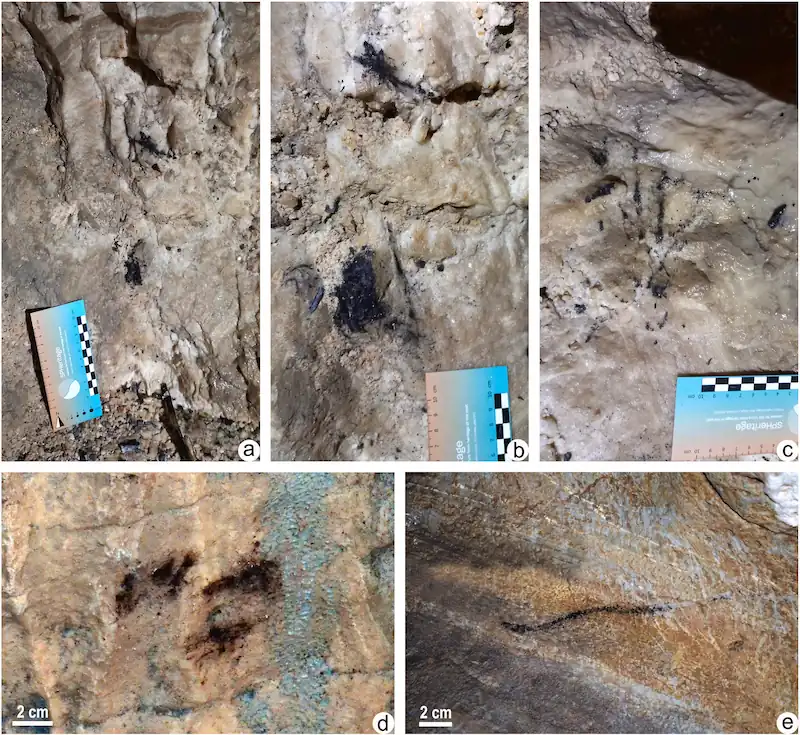
But, how did these prehistoric men and women manage to enter the depths of the cave, where darkness is absolute? The answer was found by researchers analyzing the remains of charcoal scattered on the ground and the soot marks on the walls and ceiling.
The key was on the floor of the “Hall of Mysteries”
In 2016, the excavation team opened a test trench in the Sala dei Misteri (Hall of Mysteries), one of the cave’s innermost chambers where numerous human footprints are concentrated. There, with extreme care, they manually excavated about 40 centimeters deep, sifting all the sediment to recover even the smallest remains.
The result was revealing: only in the surface layer, called Stratigraphic Unit 1 (SU1), with a maximum depth of five centimeters, did they find charcoal remains. The lower units (SU2 and SU3) contained no carbonized remains. In total, the researchers recovered 56 identifiable fragments of burnt wood. Of these, more than half (55.4%) corresponded to pines of the Pinus sylvestris/mugo group, that is, Scots pine or mountain pine.
The analysis of these remains showed something surprising: 80.8% of the fragments came from young branches with a diameter of less than 2 or 3 centimeters. Only a minimal amount (3.8%) came from branches or trunks over 10 centimeters thick.
The use of twigs is inferred from the traces of small-diameter branches obtained from Pinus sylvestris-type, used individually or tied in small bundles, the authors note in the article.
A mistaken idea since the 1950s
For decades, scientists had imagined a very different scene. A drawing made by Neave Parker and published by Blanc in 1953 showed prehistoric people exploring the cave with huge torches made of thick logs. This interpretation, which seemed convincing, remained until new dating in 1972 attributed the footprints to the Epigravettian.
But the objective data from charcoal remains found in the systematic 2016 excavation proved that this image was incorrect. The measured apparent diameters of the growth rings preserved in the charcoals clearly indicate that they were young twigs, not large branches.
Only a modest amount (3.8%) came from stems with a diameter greater than 10 centimeters, from which easily flammable splinters usable as small torches could have been obtained.
The experiment that changed everything
To confirm their hypothesis, the researchers decided to test the theory with controlled experiments. Using Scots pine (Pinus sylvestris) branches collected in a forest of the Maritime Alps at about 900 meters of altitude, they prepared three types of material: twigs of 1 centimeter in diameter, twigs of 2 centimeters, and radial splinters obtained from 2-centimeter twigs.
The experiments were carried out in the Santa Lucia Inferiore cave, adjacent to the Bàsura cave and connected to it by a tunnel built in 1967. This cavity presents similar characteristics in terms of size, shape, and wall color, but it was never used in prehistoric times, so there was no risk of contaminating the original archaeological site.
The environmental conditions during the tests were similar to those of the original cave: 98% relative humidity and an average temperature of 16 degrees Celsius. A group of six people participated in the experiments, five of whom represented the group of individuals identified by the previous ichnological study (footprint analysis) in the cave.
The result was that the small twigs worked perfectly as a lighting system. The experiment demonstrated that despite their small size, burning twigs produce enough light to ensure a longer stay in the depths of the cave and a safe way back, while minimizing glare and rapid wood fuel consumption.
How a cave was lit 12,000 years ago
The researchers carefully measured the performance of each type of improvised torch. The 1-centimeter twig burned at a rate of 2.8 centimeters per minute. The 2-centimeter twig, a bit slower, burned at 2 centimeters per minute. The radial splinter, in turn, burned at 2.5 centimeters per minute.
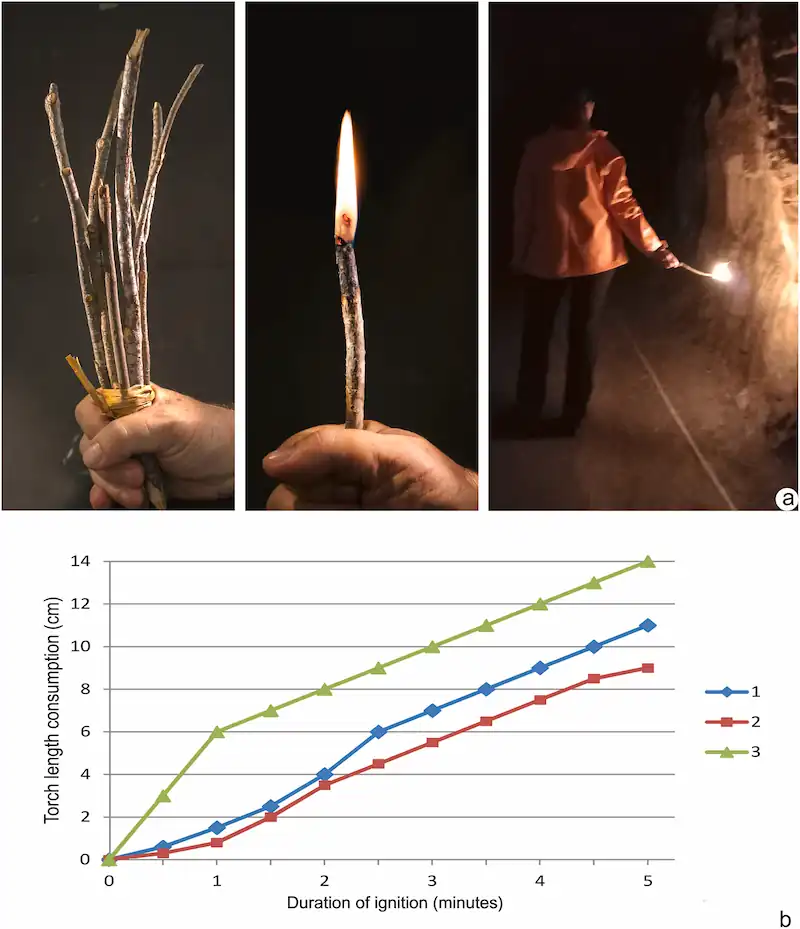
These data allowed the scientists to calculate the needs of the human group that traversed the cave. The total route, from the entrance to the deepest halls and back, was approximately 800 meters. According to their calculations, the group would need about 20 torches of about 30 centimeters in length to light the way for at least two participants throughout the journey.
To cover 100 meters along a moderately uneven path, a torch that burns about 18 centimeters in 4 minutes and 30 seconds is sufficient, the authors conclude.
The experiments also revealed very interesting practical aspects of how the group was organized. The researchers observed that the optimal position to light the march was for the second person in line to carry a torch and the last person another. This way, the one in front was not dazzled and could see the path correctly. Maintaining physical contact, with one hand on the shoulder of the person ahead, helped ensure safety and detect any irregularities or obstacles on the ground.
The landscape surrounding the cave
But the investigation not only focused on the lighting system. Scientists also analyzed the pollen preserved in the sediments to reconstruct the vegetation landscape that surrounded the cave at the time humans visited it. To do this, they took eight samples along the stratigraphic profile, separated by about five centimeters each.
The pollen analysis revealed that the landscape consisted of a sparse pine forest of the Pinus sylvestris/mugo type, interspersed with herbaceous steppe formations. Among the herbs, elements typical of arid environments dominated, such as artemisia, centaurea, and thistles. The proportion of tree pollen was relatively low, averaging 11.3% in the deeper layers and 24.9% in the surface ones.
Most interestingly, researchers were able to determine how this pollen reached the interior of the cave. The answer came from the sediment samples themselves, which preserved fossilized bear hair. The exceptional finding of bear hair remains in SU1 reaffirms the role of this animal’s fur as an important vector for the transport of micro-remains, the scientists explain.
In other words, bears that hibernated and occasionally died in the cave carried pollen grains on their fur from the outside during the favorable season. This pollen would later shed inside the cavern, becoming incorporated into the sediments. In addition to pollen, these fossilized hairs also contained fragments of plant tissues and phytoliths (mineralized plant remains).
Dates revealing multiple visits
Radiocarbon dating on the charcoals found in different parts of the cave revealed a more complex story than previously thought. The charcoals recovered in the Hall of Mysteries yielded a date of approximately 12,310 years before present (with a range between 12,720 and 12,110 calibrated years), consistent with the age of the human footprints.
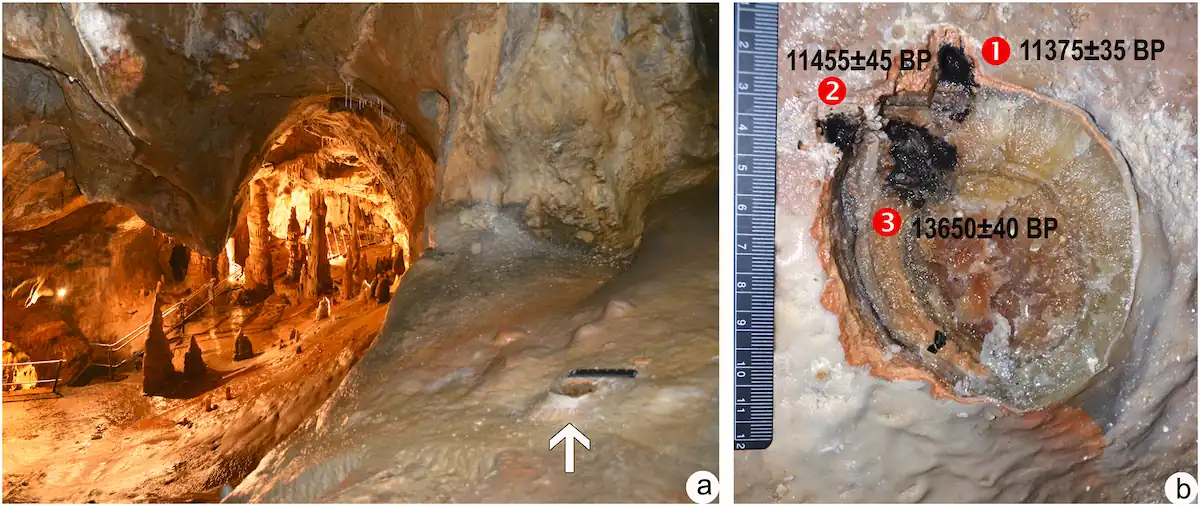
However, three charcoals found at the base of a small stalagmite in the Hall of the Fasces yielded different dates: one of 13,650 years before present and two of around 11,400 years. This indicates that there were at least three distinct episodes of human presence in the cave, not just the one corresponding to the group that left the footprints.
Nevertheless, the researchers warn that it cannot be completely ruled out that these charcoals were transported by water flowing over the surface of the stalagmite from the outside or another branch of the cave.
Why pine and not other woods
The absolute predominance of pine among the charcoal remains is not accidental. Pollen analysis showed that this was the dominant tree species in the surrounding landscape during the Pleniglacial, the cold period prior to human presence in the cave. Therefore, the prehistoric people used the material most readily available to them.
Moreover, pine has properties that make it especially suitable for making torches. It contains resins that facilitate combustion. Something Upper Paleolithic humans already knew and exploited. Researchers at the Chauvet-Pont d’Arc cave in France had already observed a similar predominance of pine in the lighting systems used in earlier times.
A revealing detail is that no fungal hyphae were found in any of the analyzed charcoals, indicating that the branches used came from living trees and not from dead branches collected from the ground. This suggests that prehistoric people actively selected fresh branches, which they then dried to use as fuel. After being collected, the branches were dried for lighting purposes, excluding opportunistic collections of dead branches from the ground, the study concludes.
An 800-meter journey into the past
The combination of all these data allows researchers to reconstruct with remarkable precision the visit of that small human group to the cave. A group of five individuals — men, women, and youths — accompanied by a canid, ventured into the absolute darkness using as their only source of light small pine twigs about 30 centimeters long.
The group of five ‘Epigravettian adults and youths,’ whose footprints have been found in the cave, is presumed to have traveled a distance of 800 meters in approximately 2 hours (round trip from the current cave entrance to the SdM), using about 20 torches 30 cm long to light the path for at least two of the participants, the authors calculate.
The footprints show that the group walked in single file, hugging the cave wall—a strategy also used by bears or wolves when moving through dark and unfamiliar underground environments. In these conditions, even dim lighting is enough to ensure the visibility and safety of the entire group.
The experiments demonstrated that small torches are suitable for dynamic movement along the path, and splinters proved more functional than round twigs. Neither solution showed spontaneous extinguishing, despite the air movements generated by the group’s advance. In addition, both types of torches produce little smoke compared to bundles of tied branches, which does not particularly bother during the journey.
A discovery with multiple implications
This research solves the mystery of how prehistoric humans illuminated caves and has broader implications for understanding human behavior during the Upper Paleolithic. The ability to explore completely dark underground environments transformed these inhospitable and potentially dangerous spaces into accessible places for exploration and possibly symbolic activities.
The experiment revealed that, despite the small size, burning twigs produce enough light to ensure a longer stay in the depths of the cave and a safe way back, the authors reiterate as one of the study’s most important conclusions.
The study also demonstrates the value of multidisciplinary approaches in archaeology. The combination of botanical analysis (charcoals and pollen), sedimentology, soil micromorphology, radiocarbon dating, and controlled experiments has provided a much more complete and accurate picture of how those humans of the past lived and moved.
The Bàsura cave therefore remains an exceptional site that continues to surprise scientists. Future research, including new stratigraphic surveys and analyses of other areas of the cave, promises to continue expanding our knowledge of the complex relationships between prehistoric humans, animals, and the underground landscapes they explored more than twelve millennia ago.
SOURCES
Daniele Arobba, Rosanna Caramiello, et al., Archaeobotanical investigations and experimental activity performed at Bàsura Cave (Toirano, NW Italy) reveal clues on Epigravettian cave lighting systems. Quaternary International, Volume 772, 1 August 2026, 110335. doi.org/10.1016/j.quaint.2026.110335