Tiny shrimp-like creatures are moving 110 pounds of sand per meter of California beach every day, scientists say they may be reshaping the coast
Have you ever stood on the damp sand of a California beach? If yes, then you must have assumed the sand beneath your feet is being moved mainly by waves, wind and tides. Scientists have discovered that sand hoppers, tiny shrimp-like crustaceans found along the California coast, can excavate up to 50 kilograms (110 pounds) of sand per meter of shoreline per day, according to new research from University of California, Santa Barbara scientists. The findings, published in the Journal of Geophysical Research: Earth Surface, highlight how animals can influence the physical landscape around them on a much larger scale than previously understood.
Sand hoppers, including species in the Megalorchestia group, are only about a few centimeters long. They commonly feed on kelp and other organic material washed onto beaches. During the day, they can remain hidden beneath seaweed or inside the sand. After dark, they emerge to feed and create burrows. “They have one of the highest rates of bioturbation of anything on the planet,” said UC Santa Barbara marine scientist David Hubbard. Bioturbation refers to the way living organisms disturb and move sediment.
ALSO READ: Social Security payments worth up to $5,181 are going out this week
Here's what researchers found
Researchers found that the activity of sand hoppers can result in an enormous amount of sand being shifted every day. The researchers studied sand hoppers at Isla Vista Beach, a stretch of coastline next to the UCSB campus. The animals do not simply burrow anywhere. They prefer a particular zone where the moisture in the sand is just right.
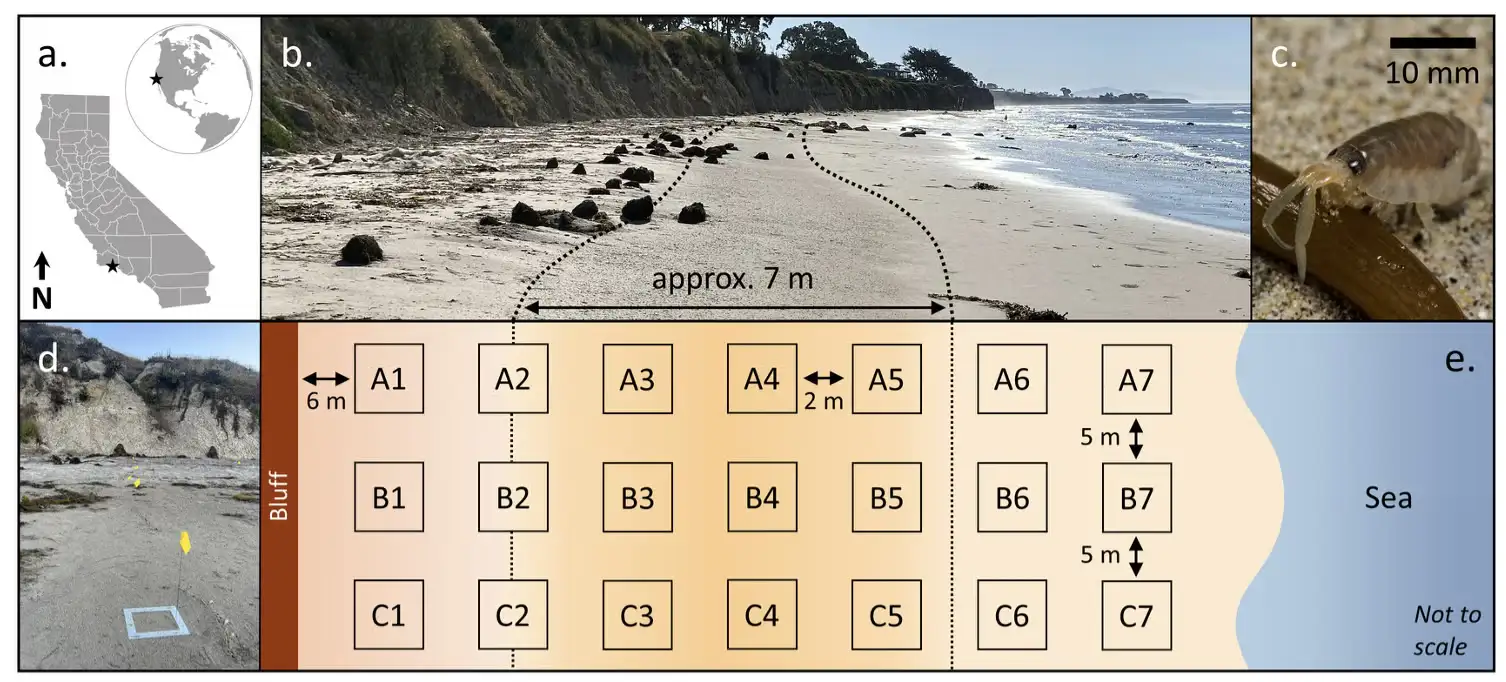
Figure 1. Burrowing talitrids create a well-defined bioturbation zone on gently sloping sandy beaches in southern California. (a) Location of study site. (b) The burrowing zone (black dashed line) on Isla Vista Beach on a typical summer’s day. (c) Photograph of Megalorchestia spp. provided by Nicholas Schooler. (d) Rectangular metal frames used to estimate the mounding rate of burrowing talitrids. (e) Diagram showing the spatial arrangement of the 21 sampling plots (not to scale).
“They don’t like saturated sand that’s like liquid and their burrows collapse immediately,” Hubbard explained. “They don’t like the powdery dry sand above the high tide line. They like the Goldilocks sweet spot in between where the burrow will stay intact because the moisture in the sand is just right.” The scientists placed metal frames around sections of the beach after high tide and returned the following morning to see how much sand had been excavated.
What they found surprised them. The sand was almost buried overnight. The team expected to find evidence of burrowing, but the amount of sand moved was much greater than anticipated. “When we came back in the morning, we couldn’t even see some of the frames,” Hubbard recalled. “They were completely buried, and we were so glad we had put flags next to them just in case.”
After collecting and weighing the piles of excavated sand, researchers calculated that sand hoppers had moved as much as 50 kilograms of sand per meter of shoreline in a single day. “It was quite impressive and we weren’t really expecting that,” Baxter said. “I think for me that was the biggest shock.”
Sand hoppers could influence California beaches
The discovery is important because beaches are not static stretches of sand. They are constantly changing as waves, wind and currents move sediment along the coast. Sand hoppers appear to be another part of that system. Their burrowing can loosen sediment, potentially making it easier for wind and water to move the sand elsewhere.
“It potentially increases the roughness of the surface of beaches, which has implications for the formation of landforms such as coastal sand dunes,” Baxter said. That could be significant because coastal dunes are increasingly being considered a natural defense against flooding and rising sea levels.
The sand hoppers' impact goes beyond physically moving sand. Their burrows can carry organic material deeper into the beach and introduce oxygen into the sediment.
“There’s a huge churn,” Hubbard explained. “If food like kelp or carrion gets deposited on the beach, it’s going to get buried by them, which makes it available to a different group of organisms.” The creatures also form an important part of the coastal food chain, eating kelp and becoming food for shorebirds and fish.
Researchers estimated what the sand hoppers' activity could mean across about 25 kilometers (15.5 miles) of Southern California coastline. The amount of sediment they potentially move is comparable to the daily sediment loads of some major Southern California rivers and to longshore processes that transport sand along beaches.
That puts an unexpected spotlight on animals that are usually overlooked when scientists study coastal erosion and sediment movement.
“I think part of that is the influence of animals on these processes is seen as quite temporary, quite localized and small,” Baxter said. “What we are trying to show in this study is that actually these activities and interactions are operating on a lot larger scale and that their impacts are really worth highlighting.”