What happens when you do minimal screening before hiring agents, arming them, and sending them into the streets? We’re all finding out.
Sign up for the Slatest to get the most insightful analysis, criticism, and advice out there, delivered to your inbox daily.
The plan was never to become an ICE agent.
The plan, when I went to the Immigration and Customs Enforcement Career Expo in Texas last August, was to learn what it was like to apply to be an ICE agent. Who wouldn’t be curious? The event promised on-the-spot hiring for would-be deportation officers: Walk in unemployed, walk out with a sweet $50k signing bonus, a retirement account, and a license to brutalize the country’s most vulnerable residents without consequence—all while wrapped in the warm glow of patriotism.
At first glance, my résumé has enough to tantalize a recruiter for America’s Gestapo-in-waiting: I enlisted in the Army straight out of high school and deployed to Afghanistan twice with the 82nd Airborne Division. After I got out, I spent a few years doing civilian analyst work. With a carefully arranged, skills-based résumé—one which omitted my current occupation—I figured I could maybe get through an initial interview.
The catch, however, is that there’s only one “Laura Jedeed” with an internet presence, and it takes about five seconds of Googling to figure out how I feel about ICE, the Trump administration, and the country’s general right-wing project. My social media pops up immediately, usually with a preview of my latest posts condemning Trump’s unconstitutional, authoritarian power grab. Scroll down and you’ll find articles with titles like “What I Saw in LA Wasn’t an Insurrection; It Was a Police Riot” and “Inside Mike Johnson’s Ties to a Far-Right Movement to Gut the Constitution.” Keep going for long enough and you might even find my dossier on AntifaWatch, a right-wing website that lists alleged members of the supposed domestic terror organization. I am, to put it mildly, a less-than-ideal recruit.
In short, I figured—at least back then—that my military background would be enough to get me in the door for a good look around ICE’s application process, and then even the most cursory background check would get me shown that same door with great haste.
The ICE expo in the Dallas area, where my application journey began, required attendees to register for a specific time slot, presumably to prevent throngs of eager patriots from flooding the event and overwhelming the recruiters. But when I showed up at 9 a.m., the flood was notably absent: there was no line to check in and no line to go through security. I walked down nearly empty hallways, past a nearly empty drug testing station, and into the event proper, where a man directed me to a line to wait in for an interview. I took my spot at the end; there were only six people ahead of me.
While I waited, I looked around the ESports Stadium Arlington—an enormous blacked-out event space optimized for video game tournaments that has a capacity of 2,500. During my visit, there couldn’t have been more than 150 people there.
Hopeful hires stood in tiny groups or found seats in the endless rows of cheap folding chairs that faced a stage ripped straight from Tron. Everything was bright-blue and lit-up and sci-fi-future angular. Above the monolithic platform hung three large monitors. The side monitors displayed static propaganda posters that urged the viewer to DEFEND THE HOMELAND and JOIN ICE TODAY, while the large central monitor played two short videos on loop: about 10 minutes of propaganda footage, again and again and again.
After about 15 minutes of waiting, an extraordinarily normal-looking middle-aged woman waved me forward. I sat across the black folding table from her on one of the uncomfortable black chairs. She asked for my name and date of birth, then whether I am over 40 (I am 38). Did I have law enforcement experience? No. Military experience? Yes. Did I retire from the military at 20+ years, or leave once my enlistment was up? The latter, I told her, then repeated my carefully rehearsed, completely true explanation for why the résumé I’d submitted had a large gap. “I had a little bit of a quarter-life crisis. Ended up going to college for part of that time, and since then I’ve been kind of—gig economy stuff.”
She was spectacularly uninterested: “OK. And what location is your preference?”
After some dithering, I settled on my home state of New York. That was the last question; the entire process took less than six minutes. The woman took my résumé and placed the form she’d been filling out on top. “They are prioritizing current law enforcement first. They’re going to adjudicate your résumé,” she told me. If my application passed muster, I’d receive an email about next steps, which could arrive in the next few hours but would likely take a few days. I left, thanked her for her time, and prepared to hear back never.
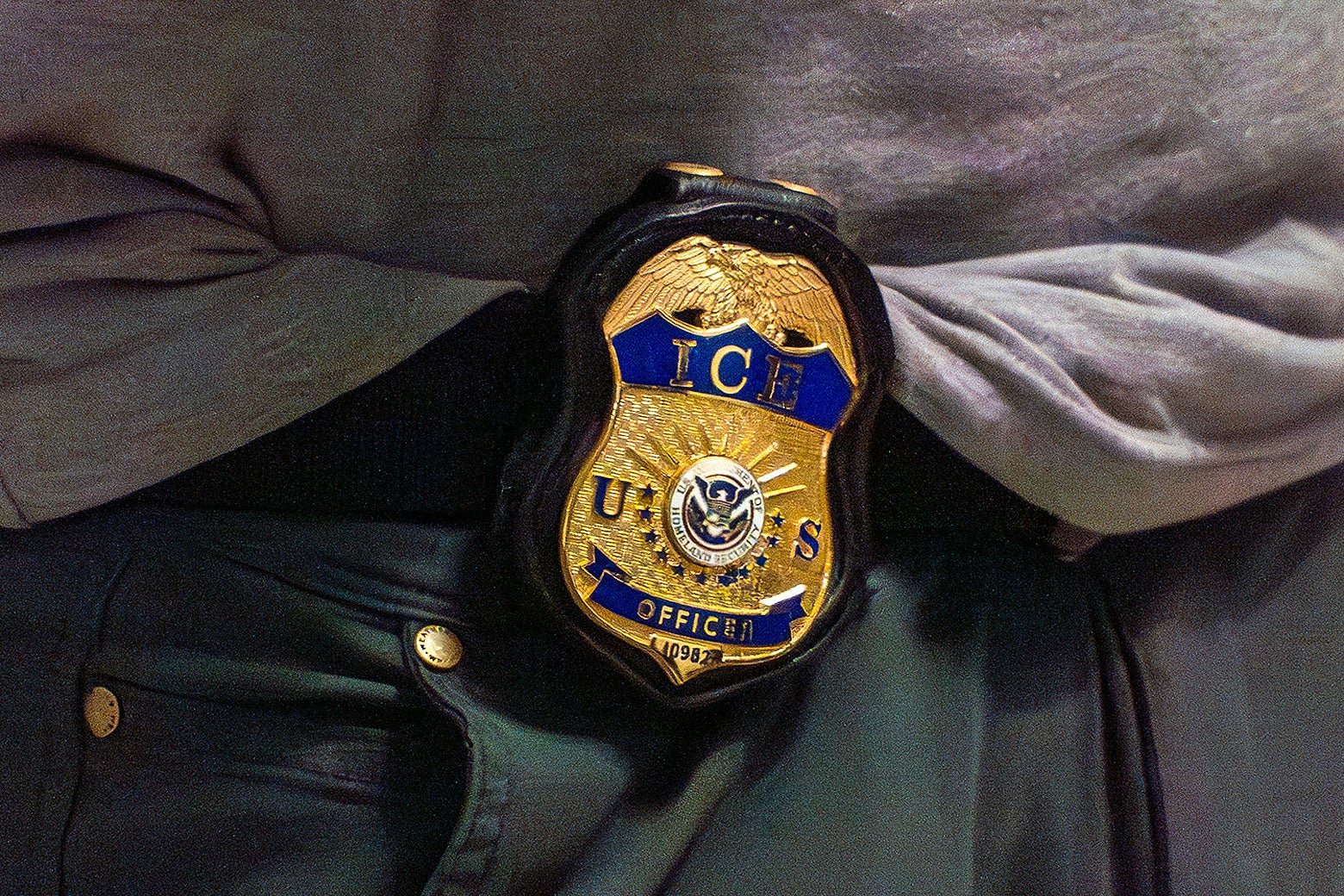
The expo event was part of ICE’s massive recruitment campaign for the foot soldiers it needs to execute the administration’s dream of a deportation campaign large enough to shift America’s demographic balance back whiteward. You’ve probably seen evidence of it yourself: ICE’s “Defend the homeland” propaganda is ubiquitous enough to be the Uncle Sam “I Want You” poster of our day, though somewhere in there our nation lost the plot about the correct posture toward Nazis.
When Donald Trump took office, ICE numbered approximately 10,000. Despite this event’s lackluster attendance, their recruitment push is reportedly going well; the agency reported 12,000 new recruits in 2025, which means the agency has more new recruits than old hands. That’s the kind of growth that changes the culture of an agency.
Many of ICE’s critics worry that the agency is hoovering up pro-Trump thugs—Jan. 6 insurrectionists, white nationalists, etc.—for a domestic security force loyal to the president. The truth, my experience suggests, is perhaps even scarier: ICE’s recruitment push is so sloppy that the administration effectively has no idea who’s joining the agency’s ranks. We’re all, collectively, in the dark about whom the state is arming, tasking with the most sensitive of law enforcement work, and then sending into America’s streets.
And we are all, collectively, discovering just how deadly of an arrangement that really is.
At the end of my brief interview, the recruiter mentioned I could talk to a current deportation officer about what the job would be like. There was no line to talk to a deportation officer (did I mention how empty the place was?) and so I walked up, introduced myself to one of them, and asked about day-to-day duties.
I shouldn’t expect to hit the streets right away, the agent told me. Odds were good I’d get a support position first—something like the Criminal Alien Program office. “Let’s say a local police officer arrests someone out in the field for a DUI. Extremely common. Or beating their wife or whatever—all the typical crimes they commit,” he said. (The “they” here being “undocumented immigrants,” and while it’s extremely difficult to measure, evidence suggests that “they” actually commit crimes at a lower rate than U.S.-born citizens.)
If the cops suspect they’re dealing with an immigrant who doesn’t have permanent legal status, they alert ICE, whose agents conduct interviews and run record checks.
If this preliminary investigation suggests that status, the person ends up in the Criminal Alien Program office for processing—which is where I would come in. “What you see on TV, with us arresting people and doing all kinds of crazy things, that’s maybe 10 percent. The other 90 percent is essentially doing a bunch of paperwork,” the agent said. “It takes a lot to remove somebody from the United States. Some people are subject to due process.”
The officer ran down other departments I might end up in: Prosecutions, Removal Coordination Unit, or Detention. The point being that I should not expect to be a badass street officer on Day 1. “I have so many guys that come over to me, they’re like, ‘I’m gonna put cuffs on somebody. I’m gonna arrest somebody.’ Well, you need to master this first and then we’ll see about getting you on the field.”
I told him that I was fine with office work—with my analyst background, it seemed like a better fit for my skill set anyway. His attitude shift was subtle, but instant and unmistakable; this was the wrong attitude and the wrong answer. “Just to be upfront, the goal is to put as many guns and badges out in the field as possible,” he said.
The agent then told me a bit about his own background. Like me, he enlisted straight out of high school, then got out and vowed to get as far away from the violence of the military as possible. Like a lot of veterans, he had trouble assimilating into the civilian world. “After about six months, I was like, ‘These people aren’t like me. I want to be around like-minded people.’ ” He found his way into law enforcement. That was well over a decade ago—he’s on his way to a very comfortable retirement, and he enjoys the work. “I like that instant gratification of Hey, that guy committed this crime, these X, Y, and Z, he’s not even supposed to be here,” he said.
I do not agree with his framing, but have no trouble understanding the appeal. Hell, it’s why I enlisted in the first place. Thankfully, Afghanistan beat it out of me. If I believed what he believed, I would surely do the same thing he’s doing.
I thanked him for the information and time, shook his hand, and took a seat on one of those uncomfortable folding chairs. I had a few hours before my flight back to New York City, and it made more sense to hang out than to flee the building and get good and airport drunk, regardless of how desperately I would have preferred the latter. Instead, I settled in to do what everyone does at the DMV: check my phone and people-watch. The aspiring officers fall broadly into three categories: thick-necked law enforcement types who look like they do steroids but don’t know how to work out, bearded spec-ops wannabes who look like they take steroids and do know how to work out, and dorks. Pencil-necked misfits. I couldn’t tell whether there were more white or Hispanic people waiting for their email, but it was close. A few Black applicants rounded out the overwhelmingly male group.
I’d been sitting around for about an hour when the video suddenly stopped and a bearded man in a black suit stepped onto the stage. He did not introduce himself—we were, I gathered, supposed to already know who he was—but it became clear he’s a senior agent of some sort. “I figured it would be best if I break up the same video you’ve been watching for the last four hours,” he said, and offered to answer any questions we might have.
One person asked about work/life balance, which the agent said is possible but not the route he’s chosen. Someone else wanted to know about travel opportunities and he talked about the many places he’s gone as part of the job.
Every other question during the 45 minutes the agent stood onstage pertained to the hiring process or what we could expect in training. Law enforcement types seemed especially concerned about the painful parts: Would they have to get pepper sprayed again? Would they have to get shot with a taser if they’d already qualified? Yes and probably not, respectively. The agent took the opportunity to gush about ICE’s new state-of-the-art semi-automatic tasers and brand-new pepper-ball guns. “It’s mostly very liberal cities—San Francisco, Los Angeles—where groups will come and try to stop ICE officers from arresting somebody. They’re like, ‘We’re going to form a human wall against you,’ ” he said. “When they do that, you can just pop ‘em up. Let them disperse and cry about it.”
When, during a moment of protracted silence, the agent threatened to put the video back on if no one had questions, I asked about harassment and doxing. “We will prosecute people to the fullest extent of the law,” he assured me, “and then people like myself will go on TV and publicly talk about how that person is now in prison to dissuade other people from doing it.”
As empty as the place had been when I’d arrived, it was even emptier by the time the senior agent ended the Q&A. Somebody vastly overestimated the number of Americans willing to take a job brutalizing and disappearing hard-working men and women—even with a potential $50K bonus, even in this economy.
That may have something to do with what happened to me next.
I completely missed the email when it came. I’d kept an eye on my inbox for the next few days, but I’d grown lax when nothing came through. But then, on Sept. 3, it popped up.
“Please note that this is a TENTATIVE offer only, therefore do not end your current employment,” the email instructed me. It then listed a series of steps I’d need to quickly take. I had 48 hours to log onto USAJobs and fill out my Declaration for Federal Employment, then five additional days to return the forms attached to the email. Among these forms: driver’s license information, an affidavit that I’ve never received a domestic violence conviction, and consent for a background check. And it said: “If you are declining the position, it is not necessary to complete the action items listed below.”
As I mentioned, I’d missed the email, so I did exactly none of these things.
And that might have been where this all ended—an unread message sinking to the bottom of my inbox—if not for an email LabCorp sent three weeks later. “Thank you for confirming that you wish to continue with the hiring process,” it read. (To be clear, I had confirmed no such thing.) “Please complete your required pre-employment drug test.”
The timing was unfortunate. Cannabis is legal in the state of New York, and I had partaken six days before my scheduled test. Then again, I hadn’t smoked much; perhaps with hydration I could get to the next stage. Worst-case scenario, I’d waste a small piece of ICE’s gargantuan budget. I traveled to my local LabCorp, peed in a cup, and waited for a call telling me I’d failed.
Nine days later, impatience got the best of me. For the first time, I logged into USAJobs and checked my application to see if my drug test had come through. What I actually saw was so implausible, so impossible, that at first I did not understand what I was looking at.
Somehow, despite never submitting any of the paperwork they sent me—not the background check or identification info, not the domestic violence affidavit, none of it—ICE had apparently offered me a job.
According to the application portal, my pre-employment activities remained pending. And yet, it also showed that I had accepted a final job offer and that my onboarding status was “EOD”—Entered On Duty, the start of an enlistment period. I moused over the exclamation mark next to “Onboarding” and a helpful pop-up appeared. “Your EOD has occurred. Welcome to ICE!”
I clicked through to my application tracking page. They’d sent my final offer on Sept. 30, it said, and I had allegedly accepted. “Welcome to Ice. … Your duty location is New York, New York. Your EOD was on Tuesday, September 30th, 2025.”
By all appearances, I was a deportation officer. Without a single signature on agency paperwork, ICE had officially hired me.
Perhaps, if I’d accepted, they would have demanded my pre-employment paperwork, done a basic screening, realized their mistake, and fired me immediately. And yet, the pending and upcoming tasks list suggested a very different outcome. My physical fitness test had been initiated on Oct. 6, it said: three days in the future. My medical check had apparently been completed on Oct. 6.
The portal also listed my background check as completed on Oct. 6. Had I preemptively passed? Was ICE seriously going to let me start training without finding out the first thing about me? I reached out to ICE for an explanation, but never heard back.
The only thing left for me to do was press the green “Accept” button on the home page. And maybe I should have. Maybe no one would have ever checked my name and I could have written the story of a lifetime. Or maybe the agency infamous for brutalizing and disappearing people with no regard for the law or basic human rights would have figured out exactly who I am while I was in one of their facilities with no way to escape. I’m not actually a domestic terrorist sent straight from Antifa headquarters, but to a paranoid fascist regime increasingly high on their own supply, I sure look like one on paper. Self-preservation won out.
I hit “Decline,” closed my browser, and took a long, deep breath.
What are we to make of all this? To be clear, I barely applied to ICE. I skipped the steps of the application process that would have clued the agency in on my lack of fitness for the position. I made no effort to hide my public loathing of the agency, what it stands for, and the administration that runs it. And they offered me the job anyway.
It’s possible that I’m an aberration—perhaps I experienced some kind of computer glitch that affected my application and no one else’s. But given all of the above, it seems far more likely that ICE is running an extremely leaky ship when it comes to recruitment.
With no oversight and with ICE concealing its agents’ identities, it’ll be extremely difficult for us to know.
There’s a temptation to take some comfort in ICE’s sloppiness. There’s a real argument here that an agency so inept in its recruitment will also be inept at training people and carrying out its mission. We’re seeing some very sloppy police work from ICE, including an inability to do basic things like throw someone down and cuff them. On some level, all of this is a reminder that their takeover is neither total nor inevitable.
But if they missed the fact that I was an anti-ICE journalist who didn’t fill out her paperwork, what else might they be missing? How many convicted domestic abusers are being given guns and sent into other people’s homes? How many people with ties to white supremacist organizations are indiscriminately targeting minorities on principle, regardless of immigration status? How many rapists and pedophiles are working in ICE detention centers with direct and unsupervised access to a population that will be neither believed nor missed? How are we to trust ICE’s allegedly thorough investigations of the people they detain and deport when they can’t even keep their HR paperwork straight?
And if they’re not going to screen me out, what hope is there of figuring out which recruit might one day turn into a trigger-happy agent who would forget that law enforcement officers are trained not to stand in front of vehicles, get jumpy, and shoot a 37-year-old woman to death on the streets of Minneapolis?
That’s exactly what happened last week, and why Renee Good will never have a 38th birthday, and why her children will never again be hugged by their mother.
By all appearances, the only thing ICE is screening for is a desire to work for ICE: a very specific kind of person perfectly suited for the kind of mission creep we are currently seeing. Good’s murder is not an isolated incident; the American Civil Liberties Union reports a nationwide trend of ICE pointing guns at, brutalizing, and even detaining citizens who stop to film them. A Minneapolis pastor who protested ICE by chanting “We are not afraid” was detained at gunpoint by an agent who reportedly asked him: “Are you afraid now?”
I am. We all should be.
Update, Jan. 13, 2026: This article has been updated to clarify the location of ICE’s Texas hiring expo in August.
Get the best of news and politics
Sign up for Slate's evening newsletter.