Music makes different people imagine surprisingly similar stories
Brain scans link music and imagination the way speech does, and strangers hearing the same tune pictured much the same scene.
Put on a piece of instrumental music and the mind tends to start making things up – forest creatures, knights in armor, someone falling asleep as the snow comes down.
For years researchers left those daydreams alone, on the assumption that they were arbitrary, unrelated to the sound, and too personal to study.
Then twenty people did their daydreaming inside a brain scanner. Most came back with a version of the same story.
Matching patterns of brain activity were found across listeners as well, and not only in the parts that do the hearing. The two scan days were exactly a week apart, and on the other one the group heard those stories read aloud with no music at all. Either way, the regions that handle meaning responded alike.
On the authors’ reading, the daydream is part of listening rather than something separate from it. Elizabeth Margulis, who directs the Music Cognition Lab at Princeton University, supervised the work with Uri Hasson of the Princeton Neuroscience Institute. “What we’re seeing here is this whole other dimension of meaning making in music,” she said.
Strangers imagined the same forest scene
For one excerpt, the story most listeners told was about small animals. “Tiny forest creatures emerge, tiptoeing, into a meadow,” the shared version begins, and then they start chasing each other.
One person in the scanner described a family of cartoonish foxes standing upright like humans, taking turns dancing each time the melody changed. Another described two mice walking out of a forest into a meadow to play tag with the sun up.
Human raters marked each report as a match or a non-match for that excerpt’s story. Averaged over the ten pieces, 71% of the reports matched. On a subset scored twice, the raters agreed on 86% of the calls.
Plenty of listeners went their own way. For that same excerpt, one described a peasant girl from the Victorian era or the Middle Ages, going about an ordinary day.
Each excerpt was matched to a spoken story
The team put one story into two very different forms. Participants came in for two scan sessions, and half of them got the two conditions in the opposite order.
In one session they heard ten unfamiliar music excerpts, a minute each, with instructions to treat the sound as if it were telling a story. In the other they listened to ten spoken stories.
Each one was a version of what earlier listeners had reported imagining, read aloud by an undergraduate on the team and cut to the same minute.
After every excerpt they had sixty seconds to say out loud what they had pictured. The twenty produced 200 spoken reports in each session. When a story arrived in words, 94% of the reports matched.
Two excerpts started so softly that the scanner’s own noise covered their openings. The team dropped both, which left eight.
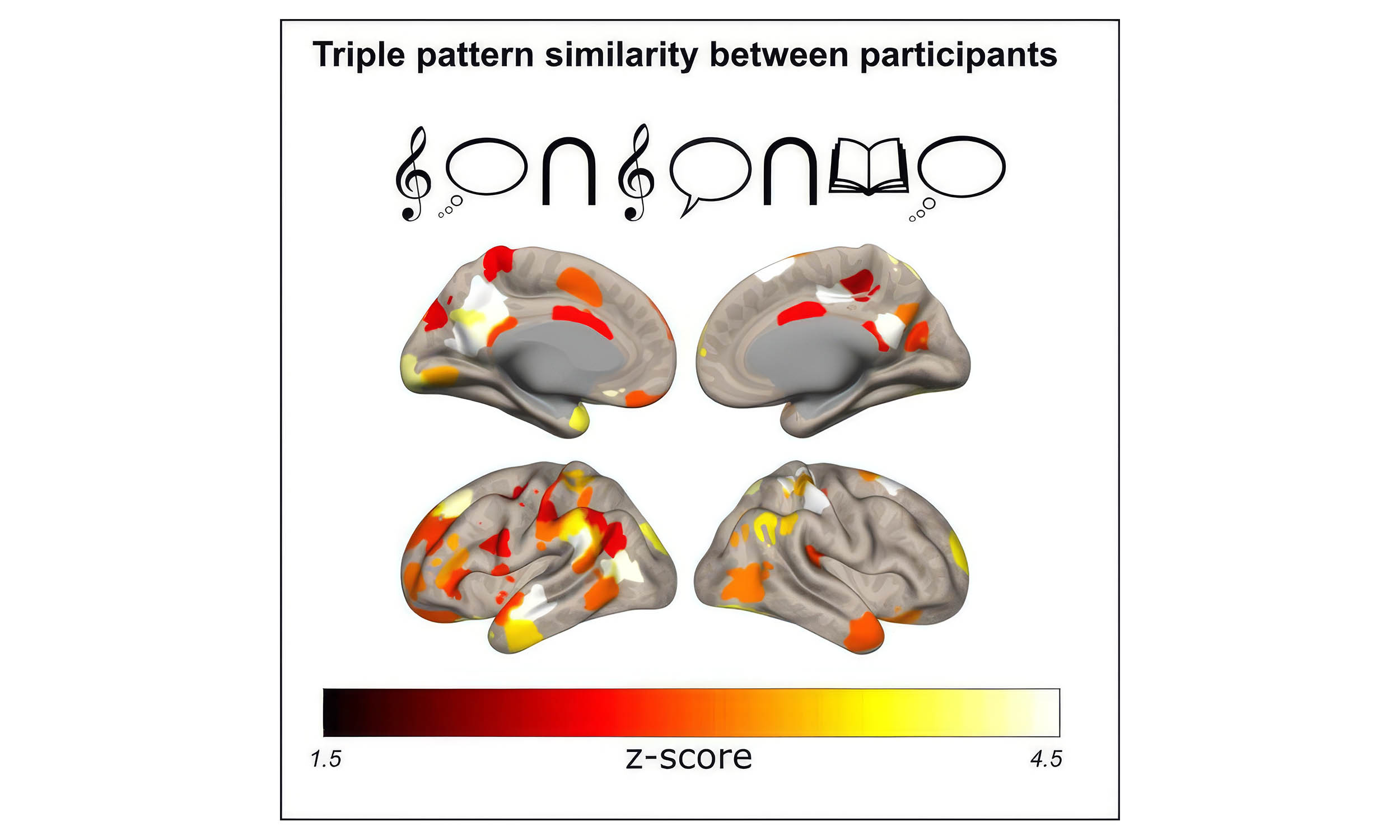
The match extended past the hearing regions
Inside any one condition, the patterns that told one excerpt from another showed up mostly in the auditory cortex and the areas beside it, where sound gets processed.
Then the team compared each listener’s pattern in one condition against the group’s in the other two. Those shared patterns turned up somewhere else, along the sides and back of the brain.
Regions there become active when a person remembers something, pictures a scene, or thinks about what someone else is thinking. Neuroscientists call the set the default mode network, and it does much of the work of imagination. Language regions showed up in the map as well.
To test that reading, the team checked its own maps against maps built from hundreds of earlier brain-imaging studies. Only the across-condition map matched the default mode map.
Hasson’s lab had already shown that people watching one movie produce similar brain responses. Wordless music now joins that list.
The authors propose a musical dictionary
Listeners rated every excerpt for anger, calmness, happiness, sadness, and energy. A piece of music and its spoken counterpart drew similar emotion ratings, closer than mismatched pairs did.
Ratings of how vivid, immediate, easy and clear each imagining felt showed no such pairing. So the feeling was part of what the two versions shared. How gripping the daydream got was not.
Itamar Jalon and his co-authors propose a dictionary of sorts, linking musical figures to concepts. A gentle, rippling passage connects to words like slumber and fantasy. Rolling drums and brass connect to the whole look of ceremony and regalia.
Emotion may do some of that linking. Earlier work has tied music to color, to what a film score does to a scene, and to human connection.
But the feeling can’t be the whole mechanism. In the speech sessions people only heard a story, so the emotion had to follow the meaning.
Earlier researchers had read default mode activity during music listening as ordinary mind wandering. This team makes the opposite case, that the sound itself is cueing the wandering.
The sample was small and screened
Twenty people, the authors wrote, can establish that these shared patterns exist, and not how much they vary from person to person. They settled on twenty for practical reasons rather than by calculating it in advance.
Everyone was a Princeton student fluent in English, and the screening had already filtered out anyone who rarely imagines or doesn’t get absorbed in music.
Culture is a second boundary. A 2022 study of 622 listeners in three locations found that people who share a background imagine highly similar stories, and that others overlap far less.
The team worked with eight one-minute clips, which is not much music. The authors have heard from people who build elaborate stories across a whole concert, and nothing here reaches that.
Nobody knows how big the proposed dictionary is, dozens of entries or thousands, or how much music a listener needs before a clear image forms.
A scanner is too slow for that second question, since it tracks blood flow instead of firing cells that imagine. Faster recordings, longer pieces, and a group from more than one campus would each answer a different part of it.
The full study was published in the journal Nature Communications.
—–
Like what you read? Subscribe to our newsletter for engaging articles, exclusive content, and the latest updates.
Check us out on EarthSnap, a free app brought to you by Eric Ralls and Earth.com.
—–