So You’re Saying There’s a Chance
When Gina Hinojosa started running for governor in Texas, few people thought she could unseat the GOP incumbent. But the polls say the race is close. What is happening here?
Sign up for the Slatest to get the most insightful analysis, criticism, and advice out there, delivered to your inbox daily.
Texas Gov. Greg Abbott sounded like a new man in late August during an interview with ABC News. After spending years luring tech companies to Texas—following a deal with Google last year, he proclaimed Texas would be the “epicenter” of A.I. development—his state instead became the epicenter of a red-hot backlash as frustration with data centers peaked with the public. Their message had been received, at least for the remainder of election season: Abbott was pressing pause on data centers.
“They basically dug their own grave,” Abbott said to ABC, blaming tech companies for moving too fast without consulting local stakeholders. “That’s why they got the backlash they deserve.”
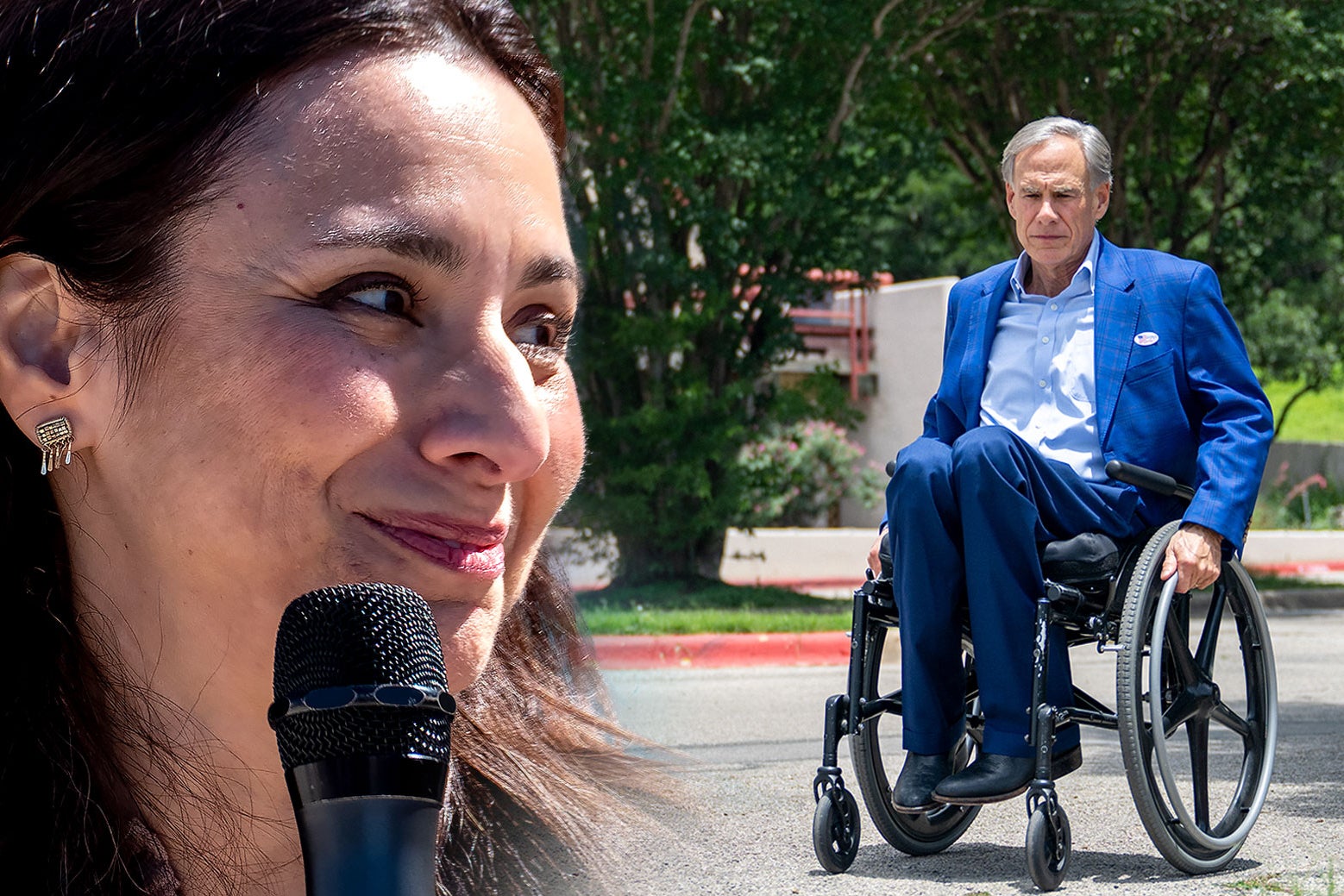
If Abbott sounds like a new man, it is because he finds himself in a new circumstance: a competitive election. Over the course of the three gubernatorial races, three attorney general races, and the single state Supreme Court election Abbott has run in, he’s never won by less than 11 points. Now, in his run for a fourth term against Austin Democratic state Rep. Gina Hinojosa, Abbott’s lead has been trimmed to a couple of points in polling average, while election analysts continue to move their ratings of the race in Democrats’ direction.
What gives? Certainly the atrocious political environment for Republicans across the board this year serves as the foundation for a close race. But as the data center walk-back demonstrated, some of Abbott’s usual methods just aren’t landing in this more populist environment. Abbott, like Gov. Rick Perry before him, has hung his hat on corporate relocations, offering incentives for companies to move from stiflingly regulated states like California to Texas. No doubt, it has generated quite a bit of wealth and growth for Texas this century. But with voters furious over the state of the economy, Hinojosa has taken up a coherent message for these prime political conditions: What has all this done for me?
“The exact thing that he brags about is now an indictment on him,” Hinojosa told me in an August interview. “People do not think corporations should be getting tax breaks to come here to hire people from outside the state.”
“Nobody had called him out on that stuff before,” she added. “I’m calling him out on it, and saying this is the problem.”
Hinojosa frames the message around corruption: “The only thing that gets done at the Capitol is the bidding of moneyed interests that are [Abbott’s] donors. So I’m calling that out. I’m linking it to people’s pocketbooks.”
For all of Texas’ wealth, it’s got problems. It has the highest number of uninsured people in the country. Maternal mortalities have risen alongside its near-total abortion ban (with a state report on maternal mortalities just delayed until after the midterms). Hundreds of schools in the state are now only operating four days a week as rural schools struggle to compete with higher-paying urban districts for teachers.
And while Abbott passed a substantial increase in funding for public schools in 2025, he did so only after the Legislature approved a vouchers bill that culminated a yearslong battle over whether public tax dollars could be used for private school or homeschooling.
Abbott spent a substantial amount of his political capital on that vouchers bill. A similar effort of his in 2023 had failed, as numerous rural Republican state legislators joined Democrats to block it. Abbott’s political operation—funded heavily by billionaire TikTok investor Jeff Yass—responded by primarying many of those legislators, giving him the numbers to finally pass vouchers two years later. The jury is still out on how popular the program will ultimately prove, but Abbott’s approval took a noticeable dip after the push in early 2025.
Between the voucher fight, data centers, and national factors like tariffs and the Iran war’s effect on the cost of living, it’s rural voters who’ve frequently borne the brunt. And the potential attrition among the MAGA base is a story the national media is missing, Hinojosa tells me.
This is where her theory of populism comes in. “Prevailing wisdom amongst the political class is that the Republican vote that Democrats might have a chance with is the kind of country-club Republicans,” Hinojosa said. “But there are also MAGA Republicans who are inspired by the populist undercurrent of MAGA messaging. They were attracted to Trump because he said the system is rigged. And the thing about that is, he was right.” Hinojosa said she started making alliances with MAGA populists on school-related issues, including on ending vendor contracts with tech companies that were bringing too many screens into the classroom.
“But the data centers is another level of that,” she added. “It’s MAGA who’s mad about that. It’s not your country-club Republicans who are mad about data centers.”
The idea is not that a mass of MAGA voters will suddenly vote for a Democrat to run their state. But those voters might not be motivated to turn out in force for Abbott in this climate. If there’s a severe drop in enthusiasm or an undervote, it might allow Hinojosa to squeak by.
In response, Abbott’s campaign is doubling down on the culture wars.
“GENDER BENDER GINA WANTS MEN IN YOUR DAUGHTER’S LOCKER ROOM,” a Sept. 15 press release from the Abbott campaign read. Two days later: “ ‘MAD MOM’ GINA PUSHES RADICAL INDOCTRINATION OF TEXAS KIDS.”
Hinojosa responded to this line of attack with an ad of her own, in which she said that while Abbott will focus on how she’s “too woke,” her campaign is about how “working people are too broke.”
“I’m Gina Hinojosa,” the ad concludes. “My pronouns are mom, Texan, and soon-to-be governor.”
Another social media post from Abbott depicts Hinojosa in a Lotería card (from a Mexican game of chance) with the caption “La Payasa” (“The Clown”). Sure enough, Hinojosa is dressed like a clown, standing alongside a great number of transgender pride flags and a poster of the 1619 Project.
This Spanish-language depiction of her as a crazy woke woman is more than a random grab bag of stereotypes. As Sergio García-Ríos, Univision’s director of polling, highlighted to me from his recent survey of Texas races, Hinojosa—despite being a Latina—wasn’t performing as well with Hispanic voters as the Democratic Senate candidate, James Talarico. And as the crosstabs showed, that difference was almost entirely among Latino men.
But Abbott isn’t entirely pursuing a cultural attack, either. His most recent ad buy, for $12 million, assails Hinojosa’s voting record on property tax increases. This, too, has prompted an immediate response ad from Hinojosa.
The most important part of that ad buy is the number itself: $12 million. Because the biggest obstacle Hinojosa faces down the final stretch, beyond the general difficulty of winning Texas as a Democrat, is money. Texans for Gregg Abbott had $67 million on hand as of the last filing deadline in mid-July, while Hinojosa had $3 million. While the latest filings due soon are expected to show a jump for Hinojosa given the boost in attention to the race, Abbott will almost certainly maintain a stark advantage. As with the Texas Senate race, it’s a tricky situation for national Democratic groups to decide whether to get involved, as investing meaningfully in Texas is an expensive proposition.
What Hinojosa is doing, facing that large deficit, is reminiscent of how Abdul El-Sayed worked to overcome a similarly large spending gap in the Michigan Democratic Senate primary: making the fundraising gap itself part of her message that Abbott is bought and paid for by special interests.
“He has been able to get away for a long time with just doing the bidding of special interests,” Hinojosa told me. “He has been amassing a campaign war chest that comes through a very pay-to-play environment around the governor’s office now. And that is in anticipation of a presidential run. That is the word at the Capitol, that he has had his sights set on running next year for president, and that is why he’s focused so much on fundraising.”
The Abbott campaign, which didn’t respond to emailed requests for an interview or for comment, probably isn’t too worried. It’s a tough year, but it’s still Texas, and Greg Abbott is no Ken Paxton. Texas hasn’t elected a Democrat statewide in 32 years, and he has all the money in the world to ensure that it won’t be the governor’s race that breaks that streak. It wouldn’t just take a wave election for him to lose, but a tidal wave.
Only one question remains, then. Will there be a tidal wave?