
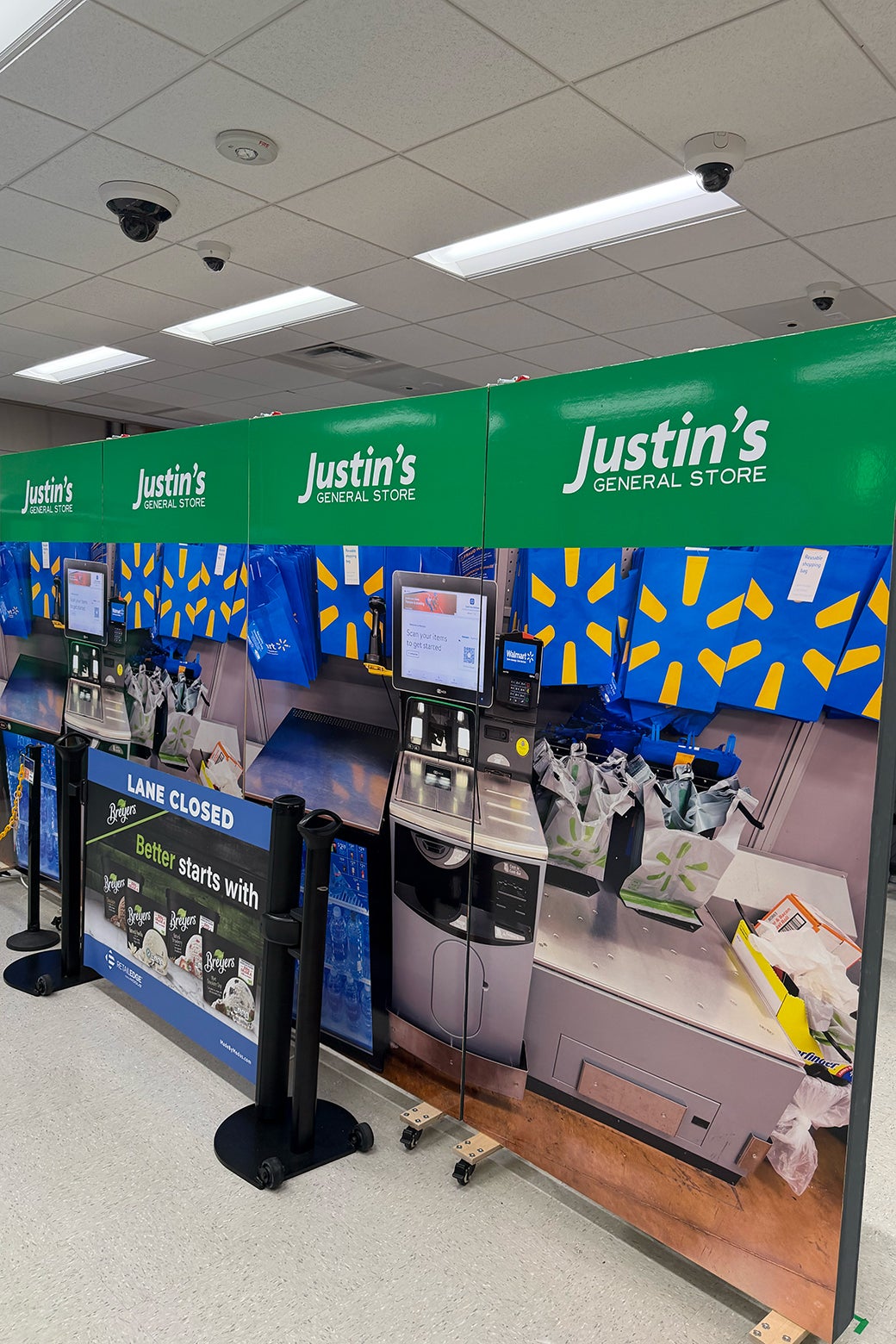
They call it “Justin’s General Store,” and in theory, there is no place on Earth harder to steal from. Every item sits beneath a chandelier of cameras. The clothes are tagged with sensors that screech or squirt ink, the baby formula sits on shelves that actively monitor weight fluctuations, the razor blades hang on kinked display hooks, and the Tide Pods are incarcerated behind various plexiglass cases, under lock and key. It is the future of retail, and it’s all in one place at the University of Florida.
“Nobody in the world has this complete of capability,” Dr. Read Hayes told me.
Dr. Hayes is the executive director of the Loss Prevention Research Council and the steward of America’s leading lab to prevent shoplifting, located in muggy Gainesville, Florida. It’s not just Justin’s, the simulated store, with its unparalleled density of anti-shoplifting technologies. Dr. Hayes has made all of campus’s Innovation Square into a live testing ground. Even the surrounds are landscaped with solar-powered towers running cameras, detectors, and more. Also, there is Spanish moss.
I parked in the lot and marched to the second floor of Innovation Square’s Innovate Hub. Lest I get any ideas, I was told that the facility had license-plate scanners—parking lot design is one of the many concerns of the LPRC—so staffers would’ve seen the arrival of any criminal element from far away. I was driving a rental, but point taken.
Dr. Hayes is best known as the man who brought the scientific method to shoplifting studies—no ideology, just cold, hard facts and figures. Nowhere is there a higher concentration of theft-thwarting tech and thief-busting research. The LPRC does it all: It gathers the reports, it tests out the technology, it grills the criminals, and it recommends the solutions. It even produces the data that says there’s a problem in the first place.
All this not a moment too soon, because America, as we all know, is in the midst of a shoplifting crisis.
As such, it was hard to find a quiet moment in Dr. Hayes’ schedule to meet. Soon enough, he’d said, he would be off to Bentonville, Arkansas, for the LPRC’s Supply Chain Protection Summit, hosted by Walmart, and then to a virtual product protection summit, and then to a summit on violent crime.
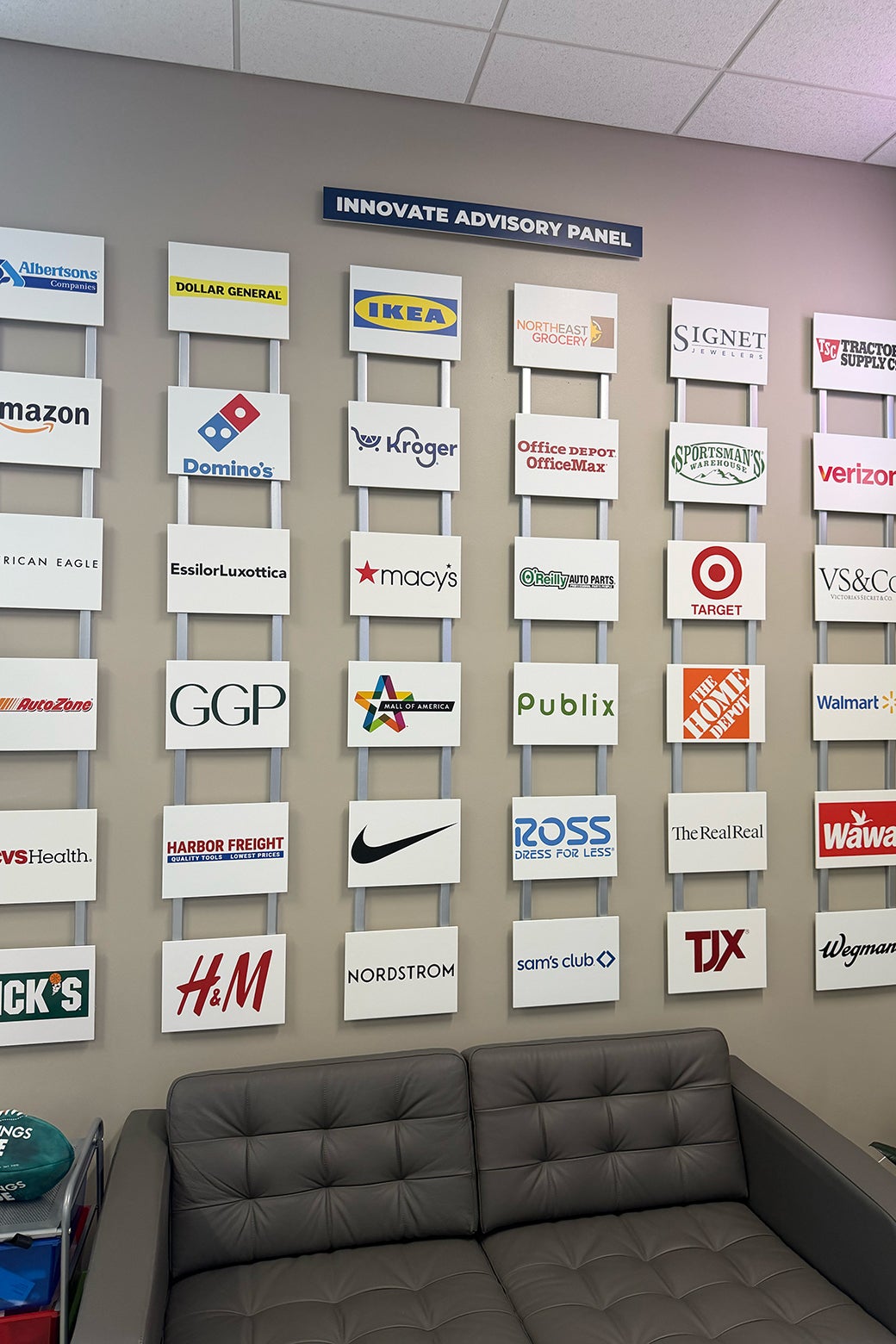
For now, we were in the LPRC conference room, where a U-shaped conference table faced a television screen. On it appeared the logos of seemingly every retail company in the country: Walmart and Amazon and Ikea and Dollar General and Kroger and Tractor Supply Company and Publix and Verizon—190 in all. They are dues-paying members of the LPRC, Dr. Hayes told me, and all of them pony up thousands of dollars a year. “It’s a bargain for them,” he joked, given the depth of information he and his team provide.
On one wall hung the names of the “Innovate Advisory Panel,” the most active retail participants. On the adjoining wall hung the names of the “solution partners,” the companies that make the loss-prevention tech on display in the lab, the new-age weaponry in the war on “shrink,” the industry’s preferred coinage for the problem. There were 171 of those, also dues-paying. Plus, now, restaurants. At last count, there were over 200,000 stores in the LPRC’s fast-growing private-policing network.
In the conference room, the brain trust meets. The vice president of Sam’s Club and her team had just been in. The retailers bring their problems, their grainy footage, their upsetting tales. The solution partners convey their wares. Dr. Hayes and team ingest it all, and science commences. In-house loss-prevention teams from various retailers can come and test out the technologies in a judgment- and sales-free zone and decide how best to arm themselves to stop loss.
Of course, like any eager upstart, I was hankering to get into the high-powered hardware. Even the conference room overflowed with it. But before I was ready for that, before we could talk numbers, we needed to talk coinages. I had to learn the language of stopping lifting. Many were Dr. Hayes’ own inventions.
First was the Bowtie Model. A bow-tie sticker was placed handily at each conference table seat. The model was hugely important, I was told. The left side of the bow tie was blue, split into vertical quadrants, each section a lighter shade, left to right, as it approached the knot. The right side was red, trending darker through all four vertical stripes.
Dr. Hayes walked me through the bow tie: Shoplifters, on the road to stealing, progress through a color-coded countdown to crime. Zone 5, he told me, the far left of the bow tie, represented “the parking lot, or even online.” That was midnight blue. Zone 4 was in front of the store. It was navy or so. Zone 3 was inside the store. Cerulean, let’s say. Zone 2 was in the aisle, soft blue. And Zone 1, that was crime time. It was gray. It was also called “at bang.” The right side of the bow tie—Reds 2, 3, 4, and 5—were the same stages in reverse, as the criminal takes the item from shelf to aisle to store to the parking lot and home.
5, 4, 3, 2—1, crime, bang—then 2, 3, 4, 5. The left the approach, the right the escape. Nine zones in all. “Affect. Detect. Connect,” read the bow tie sticker, which I was encouraged to keep. I would be quizzed on this later, in the field. There would be more coinages to come.
On one wall hung a neon sign that read “WHAT IF?”
Where did that come from? I asked. “That’s just us,” Dr. Hayes said. “I bought it online.”
There was a rack of white lab coats, in sizes ranging from small to XL. Dr. Hayes’ father was a medical doctor; he holds a Ph.D. in criminology from the University of Leicester, in England. There was no medical research going on in the LPRC, Dr. Hayes told me, and no medical doctors on staff, but the dues-paying visitors liked to wear the coats when they visited, just to get in the spirit of scientific research. “We take photos with the lab coats on,” Dr. Hayes said. “The young energy, wearing lab coats—they love it,” he said of the retailers. It was tradition. Also, one time, an intern took to wearing one in the office because he was cold.
More colorful language critical to know: red/green. A civilian shopper, infraction-free, was green. But once they snatched something: red. This was easy enough to remember—on the red side of the bow tie, someone was “red.” On the blue side, “green.”
Dr. Hayes helped found the LPRC in 2000 to attempt to solve many problems afflicting loss prevention. One such problem was the lack of distinction in the space. While the top criminologists were being spirited away by the allure of cracking white-collar crime, which paid more, no one wanted to do the yeoman’s work of stopping boosters, which, at least at the entry level, married life-threatening risk with near-minimum-wage pay. The establishment of the LPRC was a big first step toward going legit. A year later came Loss Prevention Magazine—now celebrating its 25th anniversary—and a whole industry was on its way to the big time.
Another problem to tackle was the lack of organization. Each company had its own shop cops, its own loss-prevention strategies, all balkanized, all alone.
Meanwhile, the criminals were organized. This was no Jean Valjean and his loaf of bread, I was told. These guys were hitting all different stores, selling on the world’s largest pawnshop, aka the internet, raking it in. The LPRC was the first chance to get all those corporations—victims—in one room together and level the playing field. Organization is a game two can play.
Dr. Hayes isn’t just a scientist; he is a student of history. In one corner of the conference room, in fact, was the Loss Prevention Museum, glass display cases featuring the quaint technologies of yore. Handcuffs, and security-agent badges, and a polygraph kit in a briefcase. Stuff from back when there were store detectives and they would chase and detain suspects. These days, few companies would pay for that labor, or for the insurance necessary to allow staff to rough up a suspect. Also, there was Dr. Hayes’ seminal first book, Retail Security and Loss Prevention. But that was then. Now everything was high-tech and accelerating quickly. A.I. was all over this field already, and soon to be more.
The Bowtie Model wasn’t all that Dr. Hayes had come up with, nor were zones of influence, nor the red/green assessment. He also coined the mantra “See, Get, Fear,” for when shoplifters don’t shoplift because they are scared by a surveillance technology that may or may not work. Which also counts, he told me, as deterrence, even if there isn’t much proof that it deters. “You can’t prove a negative,” he reminded me, which is true.
And even if you’ve never heard the name Dr. Hayes, maybe you know his most famous contribution by far: He was the guy, he told me, who came up with organized retail crime, a pervasive and influential term that explains a lot of what you see in your local drugstore these days. Organized retail crime was on the lips of retailers and cops and politicians everywhere, a menace, unstoppable. (A 2008 New Yorker piece on retail crime seems to attribute the concept to King Rogers, a former head of loss prevention at Target. Did Dr. Hayes boost it? Well, the two men worked together in the past, so let’s not get hung up on specifics.)
The University of Florida was impressed with Dr. Hayes’ work, conferring administrative support and office space. The retailers were impressed, their ranks growing. One city west of the Mississippi whose name Dr. Hayes wasn’t licensed to disclose was impressed—it was about to seal a deal with the LPRC to do some sort of private policing initiative. International surveillance firms, from exotic lands like Ireland, were setting up in Florida to get close to the LPRC’s lab. Dr. Hayes had grown the staff from just a few researchers to two dozen.
Next to the museum was a giant white box, with the dimensions of a changing room or a porta potty. “Experience the future of retail,” it read across the top.
It was an A.I.-infused sales tool with hologram technology, Dr. Hayes explained. When it powered up, a hologram of Howie Mandel would spring to life, and we would be subject to the cutting edge in salesmanship. But Dr. Hayes wasn’t sure how to turn it on.
No need—I was already sold. I was conversant in the language. Now I was ready to see the lab.
From the moment I arrived at the LPRC, it was clear that I would not be walking out with anything. I would not be boosting, lifting, swiping, nicking, pinching, jacking, pocketing, rack-raiding, or any of the like. Certainly, I would not filch, would not pilfer, would not purloin. There would be no five-finger discount, and my fingers would not become sticky. Even if I were feeling British, which I was not, beneath the unstinting sun of Gainesville, I would not be trousering or half-inching. I would not graze, and I most assuredly would not be engaged in organized retail crime.
Shoplifting: a major issue. There wouldn’t be so many words for it if there weren’t a lot of people doing it. And in these United States, the American people are doing it a lot and more than ever, or so it is said. Shoplifting losses are up a staggering 93 percent since before COVID-19, according to one report that some would dispute. American corporations lost $112 billion to shoplifting in 2022, according to another report that some would dispute. These are record figures. It is an epidemic, say retailers. Nay, it is a social collapse.
So bad is the problem that we don’t even know how bad the problem is, in fact. Prosecutors—woke, hemmed in by criminal-justice reform—won’t prosecute it. The police—underfunded, understaffed, discouraged—are so powerless to stop it they don’t show up when the calls come in, which means retailers have just stopped calling. So there isn’t a legal record of the extent of the issue, which is nevertheless worse than you can imagine.
Politicians of both parties, who agree on nothing else, know this is so. One of the only bills to pass through the current, most bitterly divided House of Representatives is something called CORCA, the Combating Organized Retail Crime Act, which 144 House Democrats joined 203 Republicans to greenlight. It grants the Department of Homeland Security and Immigration and Customs Enforcement vast new powers to collect Americans’ personal information to stop retail theft. This just happened in May.
California Gov. Gavin Newsom’s flagship 2024 legislative achievement was a 10-bill superpackage to crack down on shoplifting. “Governor Newsom signed into law the most significant bipartisan legislation to crack down on property crime in modern California history,” led the press release. The package doubled probation length for shoplifting and for petty theft crimes, among other things. The state boasted it now has the 10th-harshest threshold nationally for prosecutors to charge suspects with a felony, which is $950 worth of stolen goods—and prosecutors can add up items from separate shoplifting incidents to hit that number.
Not only are retailers losing money and goods; they are losing hearts and minds. Writer Jia Tolentino and streamer Hasan Piker got on a New York Times podcast and celebrated the allure of “microlooting,” another coinage. A major Hollywood film about shoplifters recently debuted. Its name? I Love Boosters. Love! In the annals of TikTok are countless videos of people shoplifting, doing “flash robs” and smash-and-grabs and ripping off the returns department. From the comments: “No different from what the Corp and big business do to us. LOL No difference.” Numerous people I spoke to about this article confessed readily to shoplifting—particularly from the self-checkout at Whole Foods. There is no shame.
The social contract has been abrogated, such people argue. Corporate profits are at the highest levels in seven decades, now accounting for 12.1 percent of gross domestic income, per the Wall Street Journal, the highest level since 1950, up 50 percent over pre-pandemic levels. According to research from the St. Louis Fed, retail trade has accounted for more corporate profit inflation post-COVID than any other sector. Still, prices keep going up, and the billionaire class lives above all law and regulation and yearns for the trillionaire class. The American citizen was once happy to be a paying customer, but no more.
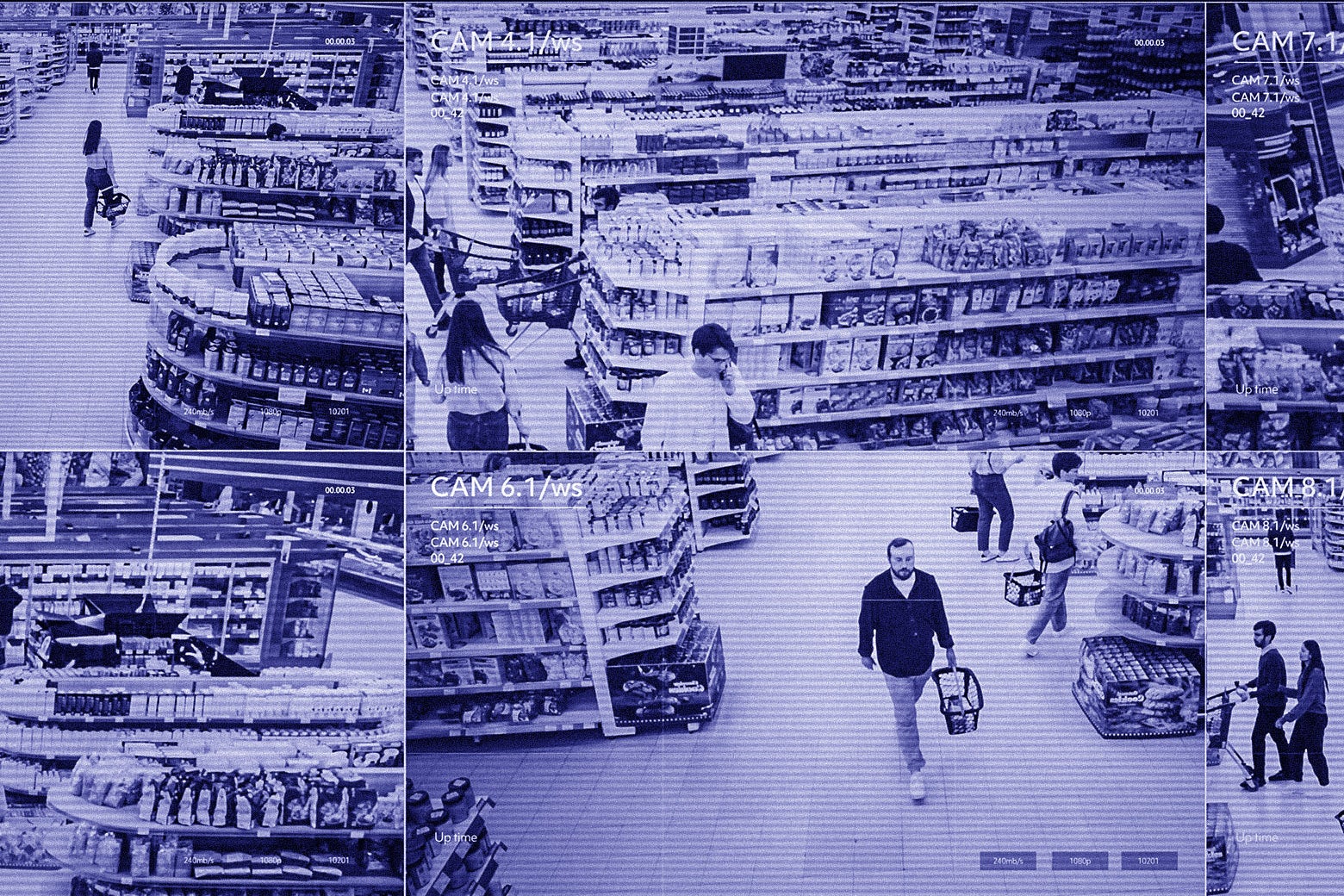
But you don’t need hearts and minds when you have vanguard technologies of social control and surveillance to fight the epidemic of shrink. Enter the LPRC.
“A lot of what we decided to do, LPRC was asked to research for us,” Dave Magersupp, senior manager in loss prevention for Verizon corporate security, told Florida Trend magazine after the company instituted a new time-delay policy that slowed customer access to products that were stored in a vault at the back of the store. If you’ve ever been inconvenienced by waiting forever for access to a routine item—a toothbrush, perhaps, or baby formula, or a cellphone—well, don’t blame the LPRC. Blame your fellow man, who has been stealing.
“They’re the only organization I know of doing actual scientific research. I’m not aware of anyone else doing that,” said Stefanie Hoover, editor in chief of Loss Prevention Magazine.
But on the matter of verifiable data, not everyone I spoke to was so impressed.
“I would be very skeptical of the LPRC’s statistics and studies. Most if not all of them are funded by the big shrink-reduction companies,” said Rachel Shteir, author of The Steal: A Cultural History of Shoplifting. “And it’s in those companies’ interest to exaggerate the problem of shoplifting.”
Really, the only gold-standard study on shoplifting came out of Columbia University in 2008. It found that about 10 percent of Americans have a history of shoplifting, and that those people are also significantly more likely to engage in other illegal moneymaking activities like “scamming” and “gambling.” (This was before those things were legalized.)
But since then, the research has come from industry groups. The top survey, historically, for shoplifting stats came from the National Retail Security Survey, published by the National Retail Federation. Dr. Hayes helped found that survey in 1989. The NRF is a lobbying firm that advocates for harsher criminal penalties, and sometimes for lower taxes.
Well, wait just one second, you might say: Were these retailers paying for honest data they couldn’t get elsewhere, or were they just paying this group to gin up numbers to cover for years of profiteering and an ideological campaign against the poor? A good question to ask, it turns out.
In 2023 the NRF was deep in a lobbying blitz to persuade state and federal lawmakers to pass legislation that cracked down on the profit-threatening boosters. After all, all those state and federal legislators hadn’t just come up with the idea simultaneously on their own. In April of that year, the NRF had published a report full of hard facts and data and logic. One of those hard facts: “Nearly half” of the $94.5 billion in inventory losses reported by retailers in a 2021 survey “was attributable” to organized retail crime.
That was a shocking number. But then independent trade publication Retail Dive published an investigation that called that alarming figure into question. Soon enough, the NRF was forced to retract that statement, which the group explained had errantly come from 2-year-old testimony from Ben Dugan, the former president of the advocacy group Coalition of Law Enforcement and Retail, another one of those industry organizations. The data actually contradicted the NRF’s own annual shrink survey, which showed that all external theft accounted for just 37 percent of losses in 2021. You can see how these things begin to get a little circular.
A year later, perhaps hoping to avoid such embarrassing scrutiny, the NRF announced that for the first time in more than three decades, it wouldn’t publish its annual shrink report at all. Instead, the group decided on a new approach, “The Impact of Retail Theft & Violence 2024,” which featured the LPRC logo right next to the NRF’s on the cover page. It also included a change in methodology. Instead of getting data from retailers themselves, the report went to “senior loss prevention and security executives” for the goods. Which was where the group got the startling information that there had been a 93 percent increase in the average number of shoplifting incidents per year in 2023 compared to before the pandemic, and a 90 percent increase in dollar loss.
This time, it was the journalist Judd Legum who wrote: “This contradicts all the NRF’s previous reports, based on actual data.” And: It “contradicts outside estimates of shoplifting trends between 2019 and 2023.” It also contradicted the Council on Criminal Justice’s findings that the shoplifting rate in 2023 was actually 10 percent lower than in 2019.
The NRF declined to make anyone available to me to discuss the report.
One thing about the panic over shoplifting is that the retractions became a recurring feature. “Maybe we cried too much,” confessed Walgreens Chief Financial Officer James Kehoe on a quarterly earnings call after the company shuttered stores in crime-ridden cities like San Francisco and incarcerated not just its shoppers but also all its products. (You know the kind: “Assistance needed in the deodorant department.”) The company also found private security guards to be “largely ineffective” in deterring theft. Walgreens is a dues-paying member of the LPRC.
Meanwhile, basically every local newspaper that investigated the crime sprees in their own urban hometowns—the Los Angeles Times, the San Francisco Chronicle—found that local police data said the opposite. For example, one of the shuttered San Francisco Walgreens stores had only seven reported shoplifting incidents in all of 2021 and a total of 23 since 2018.
Well, multiple members of the LPRC told me, that doesn’t show the whole picture, because retailers aren’t even calling the cops, remember, because it’s so bad. It’s hard to measure these things for certain.
Did it matter if the data wasn’t perfectly solid? The industry was ascendant, the lobbyists were in motion, and the politicians were amenable. According to “loss and safety intelligence platform” ThinkLP: “Retail loss detection is not just about preventing theft anymore; it’s a sophisticated market projected to reach $43 billion by 2031, as per Business Research Insights.”
The NRF continued its lobbying, and helped get CORCA through the House. Florida Gov. Ron DeSantis signed a bill toughening penalties. California Gov. Newsom allocated $267 million to stopping organized retail crime in 2023. In 2025 state officials claimed to have recovered nearly $17 million in stolen merchandise.
And then: The Wall Street Journal noted that shoplifting was going down in New York City. Of course, basically all crime was at record lows. But you’re going to tell me that’s not working?
When I finally entered the first chamber of the LPRC’s famed shoplifting lab, it turned out to be made to look like a parking lot, with printouts on the wall. There was a cardboard cutout of a nearly full-size male security officer. We were in Zone 5.
A tree of surveillance cameras was perched on one side. With the introduction of A.I., this particular installation, atop a lamppost, would unlock all sorts of shoplifting prevention. As the cameras monitored the lot, they would be able to detect loiterers, ne’er-do-wells, and the like. Spending too long in Zone 5 could be an indication that one was on the path to crime, and an A.I.-generated voice could call down to the would-be boosters with specificity, meant to strike fear with a human touch. “The red sedan, please leave,” for example, said Josh Bush, research project coordinator. “It can give the impression of active monitoring.”
There were other flourishes as well. The contraptions could use their speakers to play the infamous mosquito ringtone, the high-pitched noise that adults can’t hear but is loud and grating to teenagers. Blaring that in the parking lot was another way to ward off the criminal element. Shoplifting, after all, was a young person’s game.
Not all of it was so high-tech. A road sign reading “Law enforcement welcome here” was explained to me in great detail for its potential impacts. Perhaps law enforcement would be there; perhaps law enforcement would not be there. But a thief would think law enforcement could be there.
From there, we passed into some of the staged aisles of Justin’s General Store, where various high-theft items were displayed on fake shelves. Cereal, baby formula. I looked at a shaving kit locked inside a plastic box, which was referred to as a “freedom case.” There were various kinked hooks and plastic buffers and knobs, plexiglass shields that had to be slid one way or another, all inconveniences that caused shoppers friction, which happened to be good at stopping crime. The problem, of course, is that they are also good at stopping sales altogether. Sometimes you cure the disease and lose the patient.
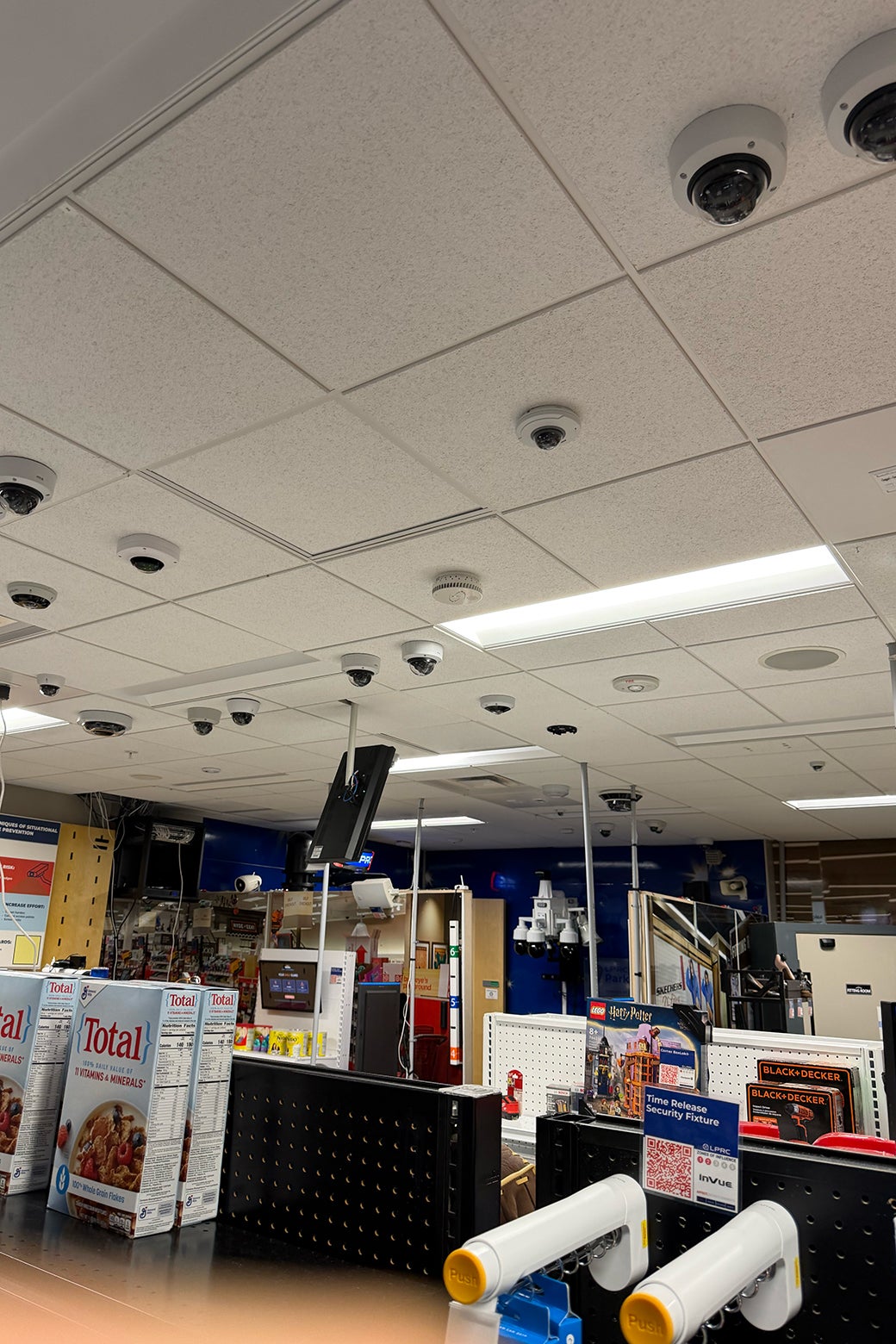
Bush pointed to a pile of plaster in our aisle. “We’re never getting our security deposit back on ceiling tiles,” he joked. That was because they had affixed so many ceiling-mounted surveillance cameras to the drop ceiling of the lab that the panels routinely buckled beneath the weight and came crashing to the ground. I marveled at the number of obsidian half-domes mounted overhead. I couldn’t marvel for too long, though, because advanced cameras would alert a store’s loss-prevention staff if someone was seen lingering in an aisle or mulling items in a criminal-y manner. Some of these, A.I.-enabled, would even quote you how much potential revenue a customer was worth walking through the door.
Next to each item in Justin’s, there was a QR code, a manufacturer logo, and a brand name. It was a rare opportunity for retailers to browse the many loss-prevention options, all of the brands in the same place, without a pesky sales associate peering over their shoulder. Some of the tools had cool names. The Alarming Rhino Wrap, for instance, made by ISS, was protecting the laundry detergent.
But in the lab, they were cooking up more than just neologisms. Dr. Hayes also invented “public view monitors,” video screens that show people on surveillance cameras so they know they’re being watched. He had them built, tested them in the lab, and proved their worthiness. What he did not do was patent them—he just gave them away—so now they’re made and sold widely, which won him a stern meeting with the University of Florida’s commercialization department.
I noticed a clicking noise in the background. One of the LPRC’s scientific studies had determined that one thing shoplifters do not like is noise. I asked if that was one of the higher-tech sensory deployments.
“There are over 500 solutions in here,” said Bush, using the preferred term for the technologies. “What you’re hearing is the battery slowly dying on a solution. It’s hard to do maintenance on them all.”
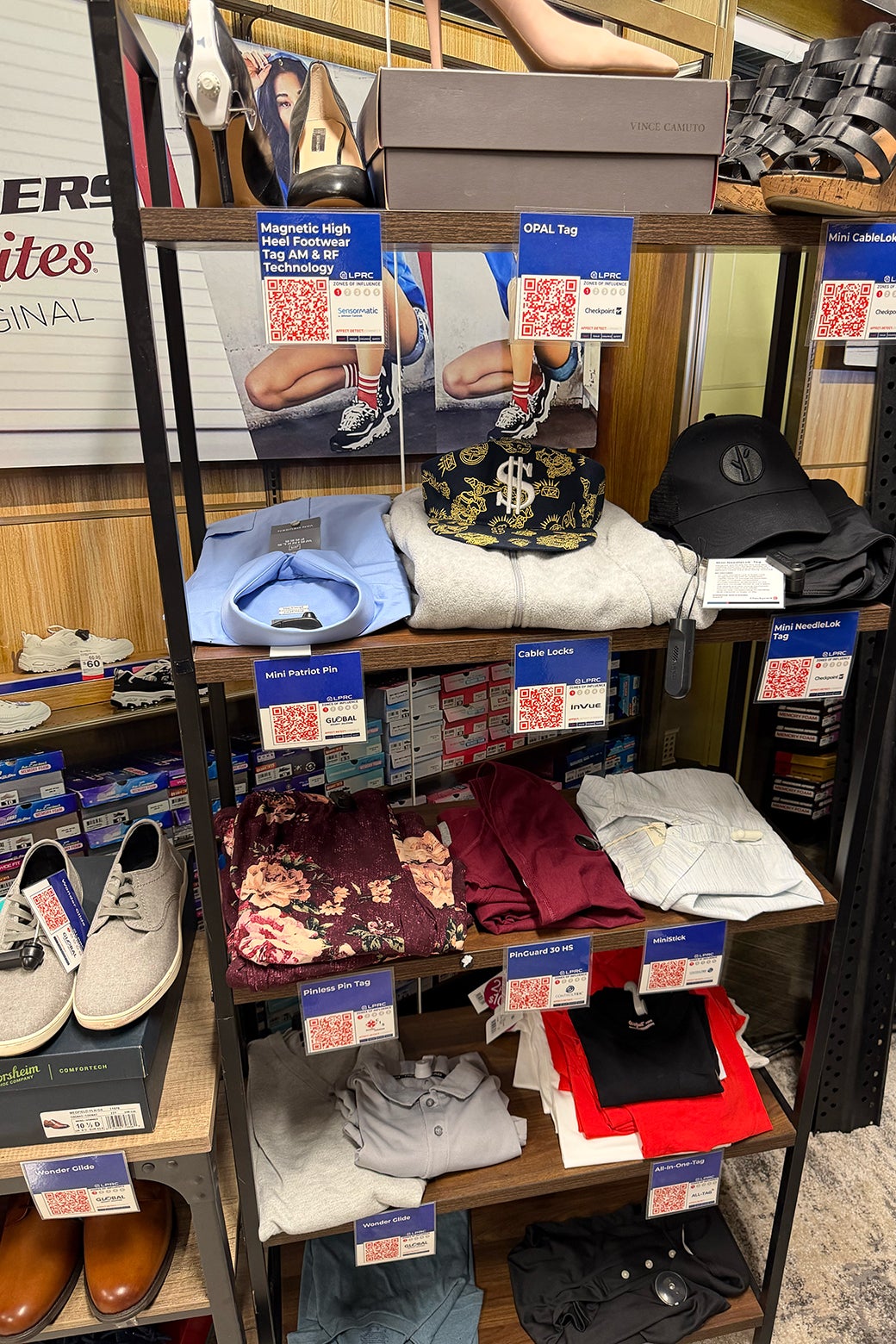
We progressed from household items, through toys, through top-shelf booze—Grey Goose is a top target and could be contained with lid caps—and on to clothing. Everyone knows that shoplifters love clothing, because they are often teenage girls. The clothing section featured a combination of the analog and the digital. Wired changing rooms that didn’t record video but tracked chips upon entry. Dye tags large and small.
Some of this stuff was familiar but smaller. RFID chips, an invention on par with the barcode in terms of impact on retail that rolled out widely in the early 2000s, could now be as small as a speck of glitter. But their uptake for loss-prevention purposes has been slow. There were explanations for this—it was expensive and required manufacturers, which were scattered all across the globe, to buy in. Still, in the general store, there were little RFID stickers affixed to items like perfume and clothes, next to the Shrink Buster Mini, for instance, or the Pinless Pin Tag.
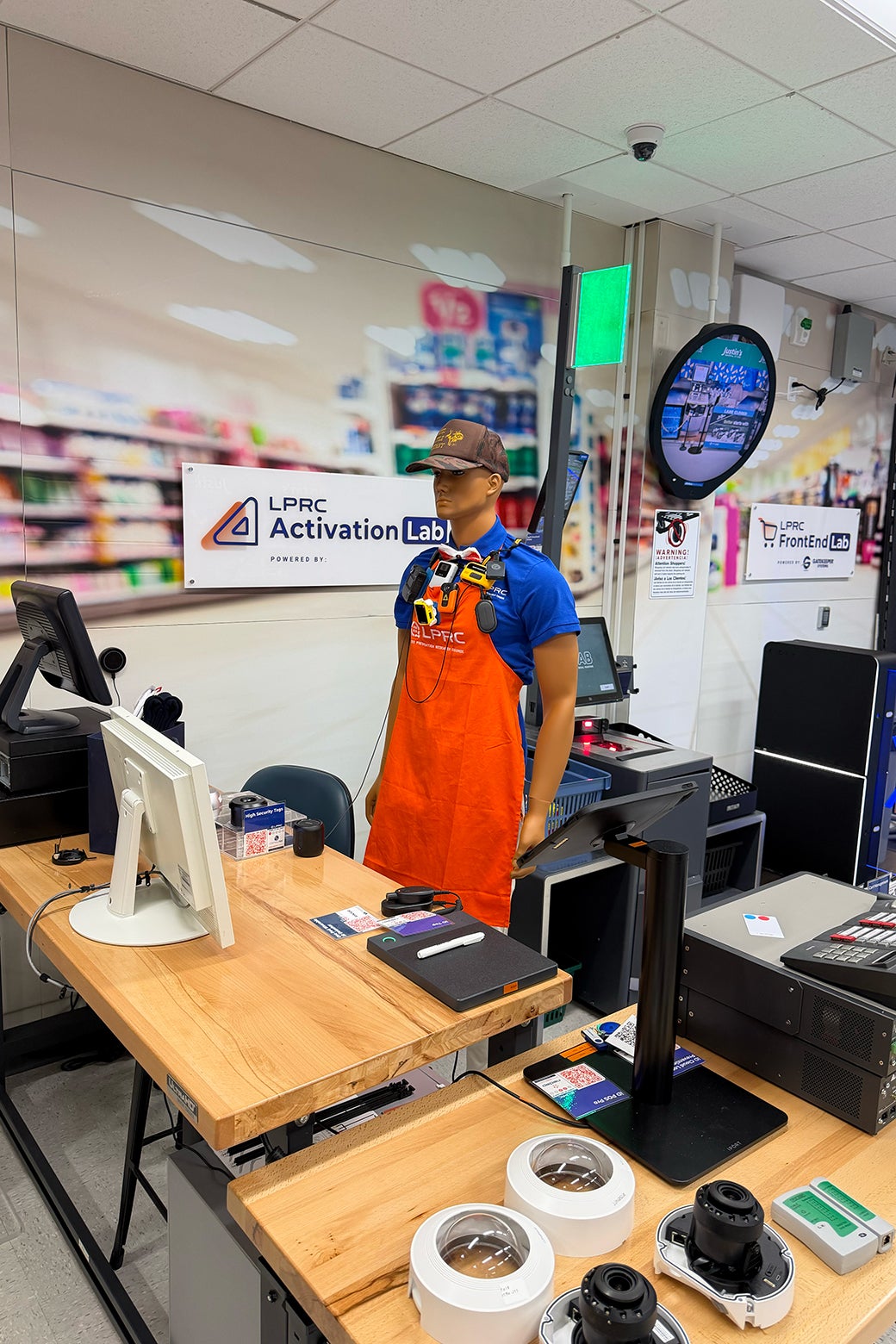
Finally, we arrived in the grocery department. Here was the Holy Grail of corporate loss-prevention failure. I slid by a retail employee mannequin bedecked in body cameras—loss-prevention strategists are enthusiastic about this approach, which has already launched—and approached the self-checkout machine.
Self-checkout has been a disaster, a massive hole in the boat, totally self-inflicted. “Retailers were super excited about this, right? They rolled it out, and it was pushed by operations,” said Hoover, the editor of Loss Prevention Magazine. “At the time, loss-prevention teams were like, ‘Hey, hang on, let’s just test this, see how it goes.’ But the genie was out of the bottle.”
Self-checkout was supposed to be a bottom-line boom: Out with labor, in with machine. Customers seemed to like it. But then it became clear that at least part of what they liked was stealing from it. Some companies have since scrapped it altogether. But here was an integrated, top-of-the-line system, with sliding doors that would open only after a receipt was scanned confirming one’s purchases. There were video cameras high and low, watching us, watching our hands, making sure that there was no funny business.
With Bush’s help, we set out to scan two items, put them in the bagging area, and exit. The peanut butter rang up and was placed in the bagging area. We were green. The instant coffee sailed across the scanner and did not ding. An eyebrow arched. The item was placed in the bagging area, and still no alarms were triggered. We were trending red.
We took the items, took the receipt, and proceeded to the double doors. We scanned the receipt. The doors swung open, and we were on the bad side of the bow tie, 4-3-2-1, and we could see the exit to Justin’s, out into the hallway, and we would be free. The receipt reader would need some adjusting.
“Live by the demo, die by the demo,” said Bush.
My last stop was a room where the research is done. A table was stationed with two folding chairs on one side, and one on the other. Projectors lit up the walls with video feed of a Home Depot aisle, then a Walmart self-checkout. Bush asked me for impressions—what was I drawn to in this scene? What might discourage me from stealing? The one Walmart employee, it seemed to me, was texting and would be easy to rip off. Actually, he told me, she was monitoring some digital-surveillance tool and that should have deterred me.
Some of the research involved “scraping social media,” which meant watching TikToks in which brazen boosters filmed themselves in the act. Reading Reddit. The lab had relationships with the Gainesville Police Department, which recommended that people who had been arrested for shoplifting reach out to the lab for interviews. Beyond that, they pounded the pavement. Posted on Craigslist and Facebook. Parole hearings and halfway houses could be good. “Homeless centers,” said Bush. They would offer a $50 Visa gift card for convicts, criminals, the indigent masterminds to offer up their best tactics and tricks. They would stand immersed in this simulated aisle and give impressions; they would sit at this table and divulge. The researchers would encourage them to recommend their pals.
This was called the snowball method. I’m not sure who made that one up.
In 1970, in jail, Abbie Hoffman, a leading figure of the American counterculture movement, penned Steal This Book. Loss prevention seems to have been on the back foot ever since. The book’s section on shoplifting lays out pretty much all you need to know, despite it predating much of the technology.
Of the system:
“Inflated prices guarantee large profits while shoplifters are punished.”
Of the history:
“We have been shoplifting from supermarkets on a regular basis without raising the slightest suspicion, ever since they began.”
And of its tactics:
“When you enter a store, you should already have cased the joint so don’t browse around examining all sorts of items, staring over your shoulder and generally appearing like you’re about to snatch something and are afraid of getting caught.”
All of that, still true. But I have some addendums based on what I’ve learned for this article.
1. Do Not Shoplift From Target
Working in LP is one of the more dangerous jobs in America—nearly any confrontation can turn deadly, in our land of arms and outrage. Naturally, it is poorly paid.
The legal liability, the cost, is great. Too great now for most. The vast majority of stores in our esteemed marketplaces have “no touch” policies for LP personnel. Not allowed to get physical, not allowed to chase. The insurance cost of someone getting hurt or killed just isn’t worth it. Also, it’s bad for morale.
But not at Target. Perhaps because of the legendary King Rogers, the retailer has long been reputed to be the fiercest and least sparing of the loss preventors. Target runs multiple top-of-the-line forensics laboratories, in Brooklyn Park, Minnesota, and Las Vegas, Nevada, which both specialize in solving “organized retail crimes committed at Target stores through video and image analysis, latent fingerprint, and computer forensics.” It is, by many accounts, a private police department more technologically adept than most local PDs. It will work across stores, across state lines. It’s like the FBI without the politics.
At Target, they do use facial recognition technology. They do build a profile on their boosters over time. They will trail thieves to homes, to fencing locations. They will build a case. They will bide their time. They will wait until you’ve stolen enough to exceed felony thresholds—in California, it’s a whopping $950. They will even do in-store apprehensions. They also, allegedly, have apprehension quotas.
Is there one place he wouldn’t shoplift from? I asked Justin Smith, one of the LPRC’s researchers: “Target.” (Target didn’t respond to a request for comment.)
2. Bring Your Own Bag
In the early 2000s, Walmart issued a mandate that changed retail forever, implementing RFID chips across its supply chain. This allowed the company to track its products all throughout the chain. When shipments arrived at warehouses or stores, the chips would automatically scan, giving the company unparalleled visibility into where any of its items got off to at any given time.
In the 2020s, the company renewed the mandate. RFID chips had gotten smaller and cheaper, to the point that it made sense to put them basically everywhere and on everything. Apparel was the first to be subject to RFID tagging in 2020. Now the company requires its suppliers to place RFID chips on all major merchandise, including once untaggable fresh categories like meat, bakery, and the deli.
One would think this would spell an end to all shoplifting. According to one industry publication, only “Seasonal items,” “Horticulture items,” and “Celebration items” are RFID-free. But RFID tags rely on tiny electromagnetic fields that can be thwarted by certain packaging, items with high liquid content, and bags with metal linings, called “booster bags.”
Eventually, RFID may hold the key to ending shrink. It could even realize the eternal dream—unattended stores. Not yet, though.
3. PLU 4011
You know about PLU 4011? The banana trick? Where you enter the price-lookup code for a banana—4011—on self-checkout and you take something real nice. Well, everyone in loss prevention knows about this too. They’ve got a camera on your face and an overhead camera on your hands. What if you cover the thing you want with a banana? Could work.
4. Whole Foods
New York magazine made waves when it recently revealed that there was a detention center for thieves at the Whole Foods in Manhattan’s Union Square. One person, who will remain nameless, revealed to me that the Downtown Brooklyn store is positively teeming with undercover fake shoppers who are watching your antics in the aisle and trailing you to the self-checkout. He got caught and was marched back to the self-checkout to pay in full. It depends on the store.
5. Caveat
How do you know the Target stuff isn’t made up? What if that’s just what they want you to think? All they want is to stop you from taking their stuff, after all. You think they wouldn’t post information online to deter you? You think they wouldn’t spin me, a lowly journalist?
I went down into the Reddit annals myself for some research. A self-proclaimed former Target LP worker posted that the store used to be all that, sure. But it’s fallen off now. “Can confirm, target tech used to be insane. Having TSS on my resume got me jobs elsewhere. Nowadays it’s all theater.” Another self-identified LP from Target, when asked whether it was facial recognition or phone numbers that tipped off in-store agents to tail shoplifters, responded: “race.” He wrote: “If you are white. find at least two black friends, have them go in the store and split up, then you go in 5 minutes later, then you can take whatever you want. LP will be focused on the black ppl.” Then again, maybe that’s what they want you to think. Remember the deterrence. How do we know what we know?
Finally, it was time to put all my knowledge to the test. I knew the language and I knew the technology, and I was in the presence of an expert—LPRC research scientist Smith—and so we went into the field: Walmart Gainesville.
I got my guidance: Be cool. No photos. Walmart didn’t know we were coming, and we didn’t want them to see us casing the joint.
Zone 5, the parking lot. On the overhead lights there were cameras, in clusters. On the building facade there were cameras. In front of the entry were bollards that I had always assumed were for cart guidance in and out of the store. Novice. Those were to prevent getaway cars from pulling up front.
A black SUV drove past us from Allied Security.
Zone 4, in the vestibule. On the wall, overhead, were cameras. There were electronic article surveillance pedestals on both sides, covered in Walmart colors and branding, that would sound if any active tags passed by them. There was a small metal swing gate that a cart could push open. “Smart,” commented Smith. Anything that could slow you down was the architecture of loss prevention. You think Walmart’s signature greeters were there just to put a smile on your face? No. Loss prevention. (Though the chain got rid of greeters in 2019, allegedly to focus on loss prevention.)
Keep an eye out for blind spots, he told me. We started with the big-ticket items.
Zone 3. TVs with “spider tags,” replete with aircraft-grade cables that extend from a central hub to wrap all six sides of a box. Tough to beat those, given that they start screaming when the cables are cut. But the way to do it, Smith advised me, would be to take the item to the bathroom, force the tag off, and flush it down the toilet. The watery depths of the plumbing system would stifle its cries.
The stuff behind lock and key, which an associate had to access for you, seemed impossible. But there were work-arounds with that, said Smith. If we called the associate, and got him to open it, and he handed us the item and left, well, then, what did it matter that it was under lock and key? If he took it up to the counter, then, yeah, no stealing that.
We worked through the aisles. There were overhead cameras, obviously. Public view monitors, Smith pointed out, Dr. Hayes’ own invention. There were cameras showing us looking, though more than a few of them seemed to be out of commission—cracked screens. It was likely, though not certain, that they weren’t even recording, despite reading “Recording in Progress.” There were also big convex mirrors, which provided the same functionality but looked less forbidding.
The cheaper electronics—mouses, headsets—were detained on hooks with stoppers on them, which also had to be unlatched from their perch by an associate. But, Smith pointed out, the weakness with those was that you could simply detach the whole hook from the back of the pegboard mounting.
We crossed over to the cosmetics, which are frequently stolen and hard to lock down. Some of them had tiny RFID chips. There were dome cameras placed at eye level here, though again, were they actually on? Plus, it depends where they’re pointing, Smith mentioned.
We progressed on to the alcohol section. Here was a hotbed of criminality. The overhead cameras were more pronounced, dangling lower from the ceiling, plus there were PVMs. Sometimes, Smith told me, off-the-wagon alcoholics would come in, desperate, and just start glugging away. For that, there were protective caps that could be affixed to certain bottles, keeping them from being opened. We investigated the bottles and found none.
For the non-problem drinkers, or the problem drinkers who were planning ahead, it was not uncommon to see shelf sweeps, in which the bad guys would push all the bottles into a bag and run off. For this type of strike, stores often installed weighted shelf detectors, which would alert someone if the weight on a shelf dropped dramatically. Zone 2. We scrutinized but did not see that either.
It turns out basically anything can be beat. “A rare-earth magnet will remove 95 percent of tags,” Smith mentioned.
We crossed to the produce department. Food is one of the top things that are stolen, Smith informed me. I already knew this, but he explained that this is in part because it is difficult to tag. Also, in recent years, food prices have skyrocketed. After recent cuts to the Supplemental Nutrition Assistance Program, 10 percent of families have reported missing meals for lack of food, and nearly 16 percent rely on food donations. We did not discuss this last part.
One person Smith had interviewed told him about how she would steal steaks and then sell them around her building. It wasn’t all personal consumption.
One funny thing about self-checkout. After the retraction of some of those bombastic claims about organized retail crime, available studies returned to identifying store employees themselves as the biggest individual source of shrink, as has been the case for decades, at least according to one report. So even though self-checkouts don’t seem to work that well, and get raided all the time, they did allow retailers to fire a bunch of staff, which indeed curtailed their biggest source of loss: the stores’ own employees. “You’re asked to spy on your fellow coworkers, coworkers who are underpaid and done wrong by a company that steals their labor,” posted one Redditor in the loss-prevention forum upon quitting a job in asset protection for Target. “This probably won’t be overly well received here, but I regret working in LP.”
I proceeded through the checkout area—we weren’t buying anything. Then I heard the chimes of one of the EAS systems going off. I turned to see a man shuffling through the exits with his hands in his pockets, his gait unsteady. It is rude to guess about a person’s appearance, but he did not seem … organized. He had no bags, he did not look back, he did not break stride. No one chased him. Seemingly no one reacted at all. There weren’t that many employees anyway.