Engineers have developed a jacket that captures and stores drinking water directly from the air
Most devices that pull water from air share one trait: they sit still. A new water harvesting jacket breaks the habit, pulling moisture from the air while you walk around in it.
The usual setup is a box on a rooftop, a panel in a yard, a damp bin in a corner, each a fixture you set up and leave running. This one has no box and no panel. You just wear it.
Water harvesting jacket

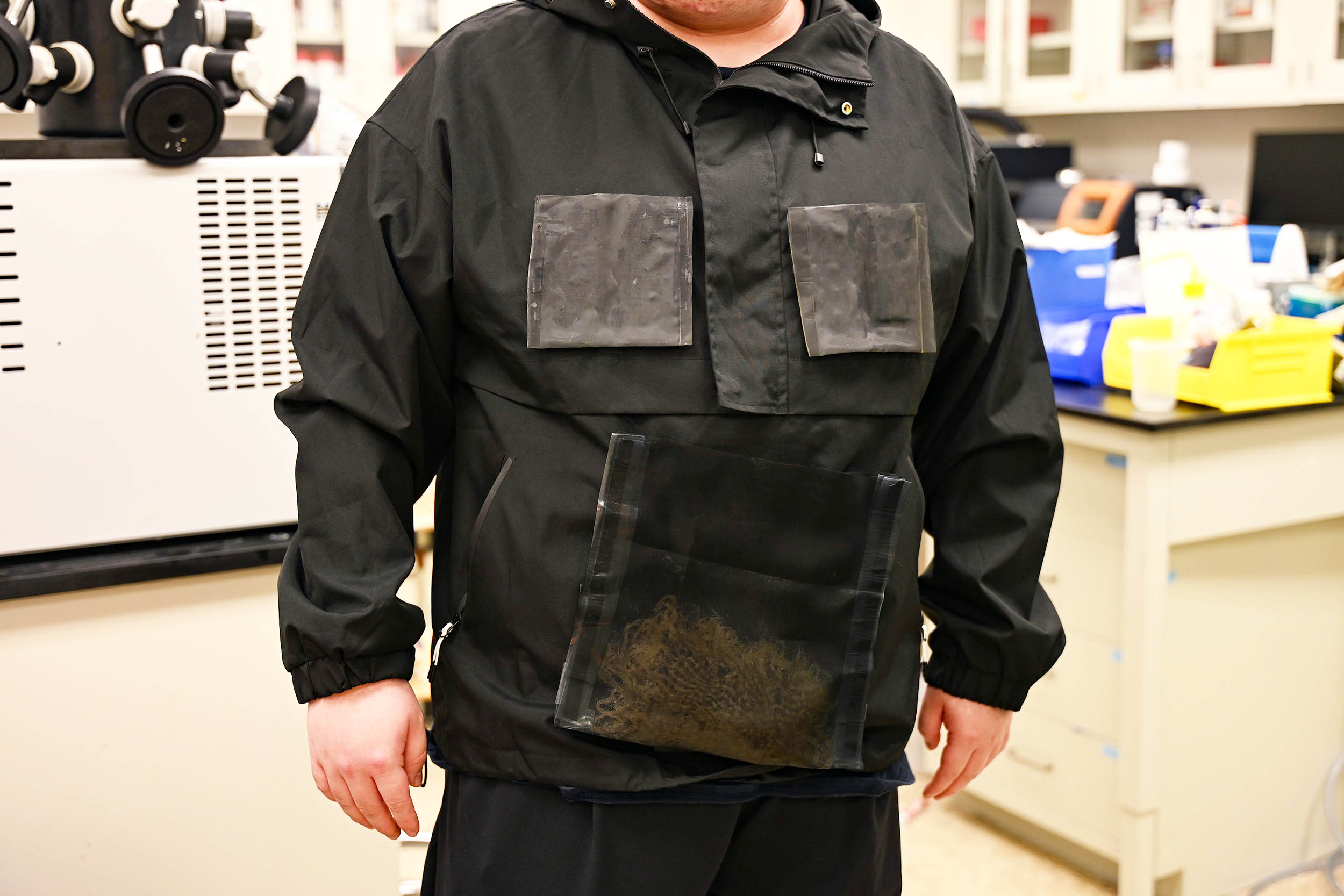
Behind it are engineers at the University of Texas at Austin (UT Austin). Its fabric draws moisture from the air as you move, the kind of water harvesting that once needed a standalone machine.
Guihua Yu, a chair professor of mechanical engineering at UT Austin and a leader of the project, has spent years on the problem. The standard approach leaves the material sitting in one place.
Yu’s team wanted the opposite: a water source that moves with the person. “It opens a new direction for personal and portable water access,” said Yu.
Where scale breaks down
The trouble started long before this jacket. Small samples pull water beautifully. Blow them up to device size and the performance drops off a cliff.
Bulk is the enemy. A big block of the material catches plenty of vapor on its outer skin, then chokes when moving that water deeper inside. Doubling the size never doubles the catch.
Other groups have chased this goal from other angles, including a recent study that wove moisture-pulling fibers into cloth. Scaling those gains to a usable size has been the recurring stumble.
Rethinking the fiber
Yu’s group went after the fiber itself. Ordinary spun fibers wrap a sealed skin around a cramped core, which slows both the catch of vapor and its path inward.
The redesign opens that skin and threads branching channels inside to pull water in faster. It worked: in tests, the best fibers soaked up more than their own weight in water within about 20 minutes.
Underneath is a hydrogel, a soft gel that soaks up water. It is made from plant-based material and paired with lithium chloride, a salt that pulls moisture from the air.
Speed was the real gain, the team says: water moved through the fabric faster than older designs allowed.
The design held up at size, the exact place earlier materials had failed. A swatch about 8 inches (20 centimeters) on a side kept three-quarters of the pulling power of a fingernail-sized sample.
That is three to ten times better than older materials at that scale, and it was made on standard equipment.
How the jacket works
Wearing the fabric is only the first step. Four capture units sit on the jacket – two larger panels and two smaller ones, front and back.
Once a unit has soaked up its fill of moisture, you detach it and drop it into a foldable collector. A small heater drives the trapped water back out as vapor.
That vapor cools, turns to liquid, and runs into a channel where it gathers as drinkable water. The loop runs on a simple rhythm of soaking and heating. No fixed plumbing.
Out in the field
Lab numbers are one thing. Real weather is another. The researchers took the jacket outside, running trials in Austin and at two sites in China, including a dry, remote spot far from any tap.
Across those sites, the jacket made 14 to 30 ounces (400 to 900 milliliters) of drinkable water a day, depending on humidity. Call it one to two bottles, all pulled from nothing but air.
The water came out clean. It carried only a trace of leftover lithium and cleared World Health Organization standards for drinking water, the kind you could pour and drink on the spot.
Beyond the jacket
Clothing is just the start. The same fabric could go into backpacks, tents, and emergency shelters, turning ordinary gear into something that quietly tops up your water supply.
It fits into a bigger effort. A separate device from the same lab, described in another paper, pulled over a quart (about 1 liter) of clean water a day in a New Mexico desert and humid Texas.
That desert result hints at where this could do the most good. The technology should work best in many of the world’s driest, most water-stressed regions, where pipes and tanks are hard to build.
What changes now
What the jacket settles is straightforward. A moisture-grabbing material can be woven into breathable, wearable cloth and still pull drinkable water at the scale of a real garment.
That opens a different way to think about a stubborn problem. Water scarcity hits hardest in the dry, remote places this gear is built for.
Close to two-thirds of people on the planet feel water scarcity at least part of the year, by some estimates.
None of this turns a prototype into a finished product. Not yet.
What it changes is the target. Designers can stop chasing ever-bigger blocks and start building water collection into the gear people already carry.
The study is published in the journal Science Advances.
—–
Like what you read? Subscribe to our newsletter for engaging articles, exclusive content, and the latest updates.
Check us out on EarthSnap, a free app brought to you by Eric Ralls and Earth.com.
—–