Last week, I wrote about a category of softwares engineer companies should be seeking: masters of context— the people who know when to slam the gas, when to tap the brakes, and how to shift their entire approach without being asked.
The response to that post was significant. I received quite a few comments proclaiming how rare it was to find an engineer that fit the bill.
That’s fair!
But it’s not because only a tiny sliver of engineers are capable of working this way. They’re rare because very few engineers are ever taught to optimize for these skills, and even fewer companies reward them during the initial hiring phase. So the market ends up under-producing exactly the kind of talent it desires.
This post is for the engineers who want to be in that “rare” bucket.
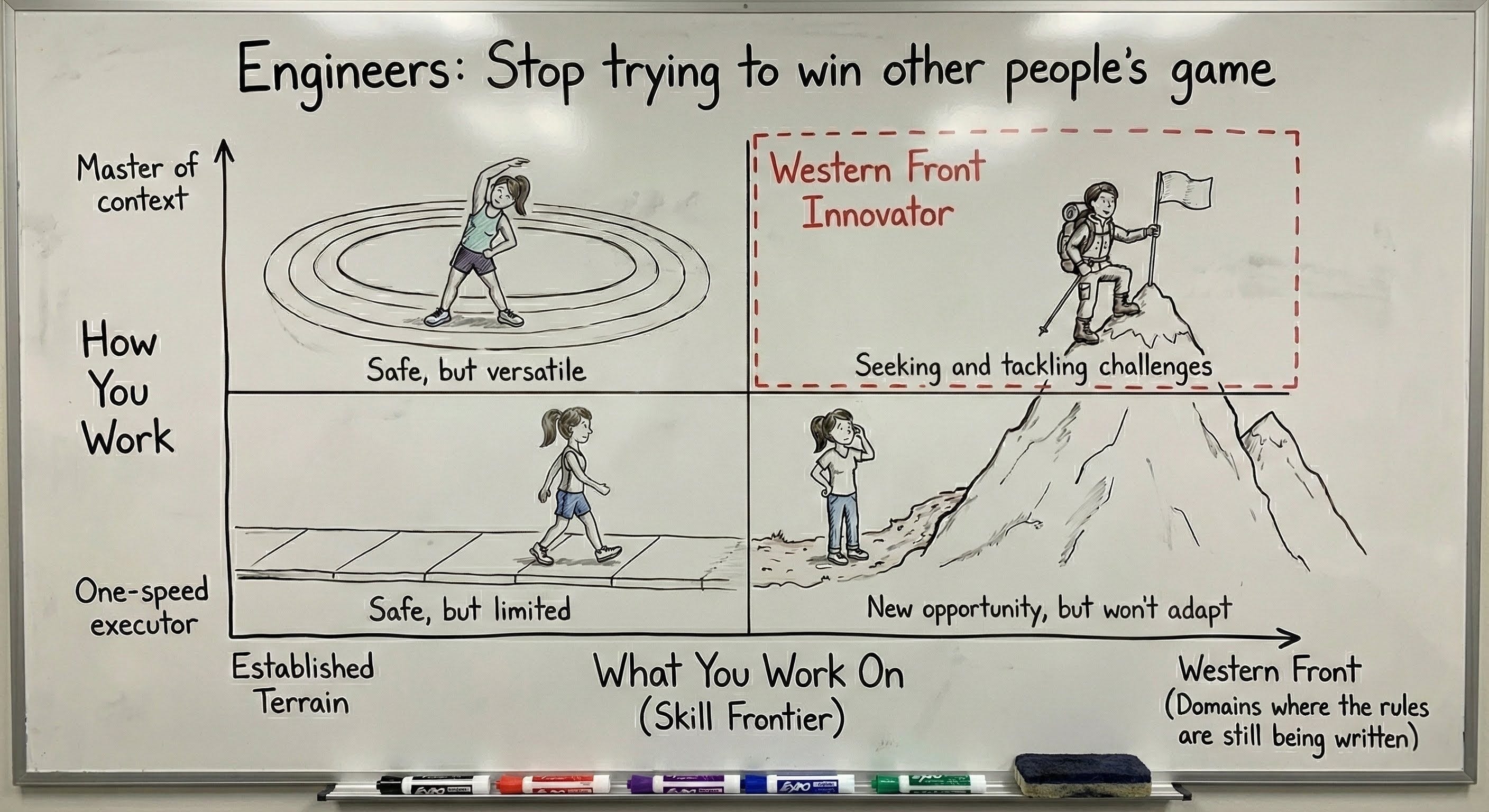
Think about your career along two simple axes:
How you work
One-speed executor: Same energy everywhere, vs.
Master of context: Being willing to change gears
What you work on (the skill frontier)
Established terrain: Mature, saturated technologies, vs.
Western fronts: Domains where the rules are still being written
While these axes describe the mechanics of your work, there is also an operating system underneath: product thinking and customer centricity. This operating system determines whether those mechanics actually translate into meaningful outcomes.
The engineers who advance fastest today live in the top-right corner of that map:
They deliberately choose frontier domains; they work on the right stuff.
They’re masters of context in how they work, and guided by a clear understanding of customer outcomes.
That combination is what I call the Western Front Innovator.
Today’s post is about how engineers struggling to progress professionally can intentionally steer their careers toward that top-right corner.
If as part of your journey, you find yourself asking questions such as:
“How can I progress with learning React?”
or
“How can I become an expert with Kubernetes?”
Stop right there!
Swarms of others have been developing expertise with technologies that emerged last decade for… at least a decade. It’s already their superpower. It’s unlikely to become yours, too.
When you chase mature stacks as your primary differentiator, you’re signing up to compete with people who have a massive head start. You’re playing their game on their field, by their rules.
This is no way to become “rare.”
Ask yourself:
“What is emerging right now? Where are the rules still being written such that nobody has an insurmountable head start?”
Today, that’s a few areas, including but not limited to AI engineering – specifically the intersection of data pipelines, backend systems, and LLM-driven product development. I’ll focus on this example.
Now, let’s be clear. Despite what many job requirements and LinkedIn titles would have you believe, there’s no such thing as an “AI Engineer” in any deeply meaningful sense. There simply can’t be. A junior engineer who spends six months learning this stuff today is approximately as “experienced” as almost everyone else on the market (assuming they understand the CompSci fundamentals that underpin it).
In other words, being an AI Engineer doesn’t mean having a wealth of specialized experience. How could it, possibly?
It means being hungry to experiment. Quickly. And consistently. It means you’re willing to live on a moving frontier where the docs are incomplete, patterns are still solidifying, and nobody can pretend to have a decade of authority.
This is the first half of the Western Front Innovator: you choose to live on the frontier.
This is the area where the first post went deep.
Being a master of context boils down to a simple principle: You adjust your engineering approach based on the stakes and the outcome you’re trying to achieve, not your habits.
This isn’t a separate “step” or a bonus skill sitting off to the side of the model. It’s the operating system that makes both axes work.
Without product thinking and customer centricity:
Context switching turns into over‑engineering or reckless hacking.
Frontier work turns into hype‑chasing.
With them:
Context switching becomes deliberate: you know when speed matters and when reliability matters because you understand the customer outcome you’re aiming for.
Frontier work becomes meaningful: you’re not just playing with new tools — you’re using them to solve real customer problems in ways that weren’t possible before.
This is why Western Front Innovators behave differently once they reach a frontier domain. They:
Start backwards from customer outcomes, not just stories and tasks.
Ask, “What is the actual job‑to‑be‑done here?”
Push on why a feature matters and what success should look like.
Are willing to reshape the solution when the outcome demands it.
Now mix that mindset with frontier tech and the whole picture changes:
Instead of saying, “Give me tickets,” they say, “If our customers struggle with X, there’s probably a way to combine this new AI capability, this data we already have, and this workflow to solve it in a way that didn’t exist a year ago.”
These engineers don’t just ship features. They ship novel outcomes. And those outcomes get noticed fast.
Unfortunately, you may find yourself saying:
“I can’t find opportunities that give me the space to do what you’re suggesting.”
Make your own opportunities. Use some downtime to wow your colleagues with a new direction. Work on side projects and/or start your own freelance to build up a portfolio. Do absolutely anything but blame your job or the market. Ultimately only you are responsible for ensuring you grow the way you want. Remember that.
Also, good news…
Historically, companies haven’t hired nearly enough Western Front Innovators. They optimized for narrow speed (ship tickets) or narrow craftsmanship (polish small, stable areas) rather than people who could steer and adapt.
AI-assisted development is already changing the landscape. As the raw mechanics of coding get easier, the premium is quickly moving toward:
Deciding what to build.
Deciding how fast to move.
Deciding where new tools can reshape the problem altogether.
In this world, Western Front Innovators aren’t only nice to have on a team. They’re absolutely critical. And this means companies will soon have no choice but to begin more purposefully seeking them and fostering their growth.
If you’re a software engineer looking for an edge, don’t just collect tech buzzwords and hope that translates into some vague idea of “senior.”
Design for the top-right:
Avoid building your whole identity around stacks that are already saturated.
Move closer to frontiers where experience is in short supply.
Lean hard into customer centricity and product thinking.
Practice context switching on purpose: prototype here, craftsmanship there, and be explicit about why.
There always has been inherent demand for engineers who can do this (even if job postings don’t overtly advertise it). And moving forward, I believe this inherent demand will quickly turn explicit.
So in a world filled with engineers sprinting toward other people’s superpowers, opt out. Create your own. Be a Western Front Innovator.