By
,
a columnist for The Cut covering modern family life.
She is the author of the newsletter series "Brooding." She has written about domestic life and digital culture for the New York Times, The Nation, The Guardian, and Jezebel, among many other publications. She got a PhD in Sociology from Concordia University in 2022.

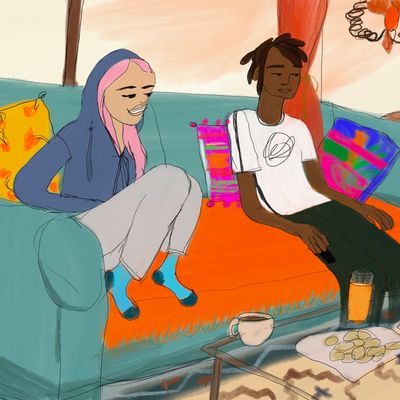
Illustration: Hannah Buckman
New York subscribers got exclusive early access to this story in our Brooding newsletter. Sign up here to get it in your inbox.
The other evening while biking home through the park I came upon a young woman sitting on a bench. I noticed her from a ways off because she was wearing a nice fall coat and looked like she was waiting for someone, and then as I was approaching, looking at her still, I watched her face light all the way up in a grin. I turned to see what she was reacting to, and it was a young guy approaching on a bike too, and when he saw her, his face lit up just like hers did. Two friends, or maybe more than friends, just so excited to see each other. I swear I could have wept.
Maybe I was so moved by the sight of them because of something I’d been ruminating about all day, a particular detail in the reporting of Jane Doe’s process of piecing together what happened to her on the night of October 19, 2024. A few days after the incident at Chi Phi, she learned that she’d been banned from the fraternity’s Halloween party, which she appeared to have planned to attend, perhaps in the hopes of repairing the damage that her reputation was undergoing as rumours about her were spreading. “Yall aren’t my friends,” she texted Matthew Ingalls, one of the alleged assailants with whom she had been exchanging conciliatory texts since the night of the incident. “Yall are covering your asses.”
Was Jane Doe wrong to have thought they were ever friends? What are bonds of friendship when sex is part of the mix? These questions have haunted me. Would real friendship have helped prevent the assault? What does real friendship between college-age men and women actually look like?
I have long thought of female friendship as a magical protection against pretty much everything bad that can happen to, or be enacted by, my sons. I don’t think girls are responsible for civilizing boys, but I do think that boys and girls who are comfortable together have an easier time, in general, moving through life. Friendship across genders is a skeleton key that makes the world feel less mysterious and hostile, but the tricky part is that you can’t force it to happen. I’ve been thinking lately about what inhibits friendship across genders and what encourages it.
It was easy when my sons were tiny: Toddlers will play with whomever they are plopped down next to, at least for a little while. As they got older, my friends and I continued to contrive opportunities for gender-agnostic hangs: a day trip to the apple orchard, a picnic at the park, a trip to the movies. It felt for a little while like we were creating a utopian environment for them — everyone all together, no questions asked. All the way through primary school, my sons hung out with girls pretty regularly.
By high school, though, the typical path for college-bound kids seems to lead to gender segregation. The enormous time demands of competitive sports are a big part of why this happens, but there’s also the generally wrenching process of status sorting in high school that both girls and boys endure, which tends to isolate them from each other except in certain contexts like homecoming (happy hoco to all who celebrate, by the way) and group projects at school.
There’s also the cumulative effect of social media, leading many boys and girls to speak in what are essentially different dialects. Some boys I know are so socialized into the world of streamers that they speak in a patois of memes and references that actively repels girls. Meanwhile most young women’s social feeds are heavily dedicated to beauty products, with a sprinkling of parsing the subtleties of problematic personalities and spotting green and red flags. Compatibility does not seem to be on anyone’s agenda. There emerges a sort of heteropessimism among preteens, and it seems to linger.
Recently on George Civeris and Sam Taggart’s excellent podcast, Straightiolab (dedicated to “unpacking the rich, multicolored tapestry of straight culture”), there was a discussion of the “boyfriend chair” that stores like Aritzia have outside the ladies’ changing rooms. The comic Ru Anderson, a guest on the show, remarked, “Why are you there? It’s like bringing a bad vibe to what’s supposed to be a positive shopping experience. The boyfriend is sitting, head down, on their phone. And it seems like the girlfriends don’t want them there either!”
“Here’s the really sad thing,” replies Civeris. “You think the Aritzia errand is a place where the man and the woman have nothing in common. What if I told you it’s one of the things that’s least dramatic for them to do together? Everything else they each want to do is actually even more alienating to the other partner. At the very least, the man can understand the concept of retail. And he can be like, Okay, we’re going to go there. She’s going to try on a few things. And I’m going to be like, ‘You look great, babe.’ And then we can move on. It’s so bleak. Think of the things that the man would be doing. Sports betting. He’s cheating on his girlfriend. He is online organizing a variety of paramilitary organizations with other men.”
Obviously this is comedy not anthropology, but they describe a dynamic we’ve all seen many times: a young couple enacting togetherness while seeming to occupy completely different worlds.
After an adolescence of gender isolation, everyone is thrown together in college and expected to interact like adults, comfortable with social norms and codes of behavior that are supposed to be equitable. Meanwhile sexual assault is a brutal fact of life almost everywhere. If kids’ social lives were less gender-segregated through high school, would this situation change for the better? To me, it’s an obvious conclusion.
High school and college should be prime time for making friends outside of your gender. That was certainly true for me. I’m lucky to count many straight men as friends today, but in every case, I’m also friends with their wives, and when we hang out, the women tend to pair off and talk about their own stuff. The last time I made friends with a man whose wife or girlfriend I wasn’t also friends with was before I had kids. Once the cogwheels of family life start turning, it gets harder to relate to each other across the gender divide. Grievances pile up, eyerolls, impatience. But in high school and college, we are blissfully ignorant of all ways our friendships can be undermined in the future. In that way, this era of friendship might be among the most important we’ll ever have. But it’s fragile.
The two young people in the park sent me back in time as I recalled the guy-friends of my past: housemates I’d eat midnight grilled cheese with, guys I studied with, guys I’d gone out for lunch with in high school, all of us piled in my friend Ryan’s enormous old Lincoln Continental. Guys like Liosha with whom I wrote an entire screenplay spoof of Forrest Gump when we were 13. Noah, whom I met freshman year of high school and whom I last saw just a few weeks ago, when he brought his parents to a book event I was doing.
A few days after I biked past the two in the park, I was interviewing dads about how they’re talking to their sons about Cornell. One of the many dads who replied to my callout on social media was a guy I’d been friends with in high school and hadn’t seen or heard from in 20 years. He’s married with four kids now, I learned. I called him up, and we ended up talking for over an hour, reminiscing, catching up about our families, comparing notes on kids and work and life. I had the sense that we are both basically the same people we were at 16, before all the responsibilities of life began to accumulate and shape our identities in new ways. This realization made me feel lighter than air.
The friendships we make across genders when we’re young help shape us, and these friends can demystify the world a little bit. They can prepare us for long-term relationships that aren’t based on fantasies, and they can help us break out of the prisons of gender itself by giving us rare access behind the scenes. Maybe most importantly though, they humanize us to each other. Jane Doe was mistaken in considering those guys her friends, but I hope there are other men in her life she can lean on if she wants to.
- Why Can’t Parents Give Each Other Permission to Make Mistakes?
- The Fantasy of the Free-Roaming Child
- What Do Kids Want Us to Talk About With Them?