The true horror of Edgar Allan Poe’s stories lies in their confessions
How to Talk About Murder
Edgar Allan Poe’s stories are full of ghastly crimes, but the true horror lies in their confessions.
In the summer of 1841, Edgar Allan Poe was a man on the rise. At the age of thirty-two, he was living in Philadelphia, where he worked as an editor at Graham’s magazine. Back then, Philadelphia was the magazine-publishing capital of the United States, and Graham’s was one of the nation’s most important illustrated monthlies. With a peak circulation of forty thousand—enormous for its time—Graham’s included tales, light essays, colored fashion plates, and reviews. As a literary editor, Poe provided reviews and, for an extra fee, tales as well.
In those days, Poe was a respected reviewer and a fiction writer of growing reputation. He had published three poetry collections of small circulation, as well as a sea novel, The Narrative of Arthur Gordon Pym of Nantucket (1838). His first collection of stories, Tales of the Grotesque and Arabesque, had come out in 1839.
Although Poe was a sought-after writer, it was not easy for him to make money. The idea that writing was a profession from which one could make a living was still new. It would not have seemed unusual to Poe’s contemporaries that the publishers of Tales of the Grotesque and Arabesque retained all profits from the seven hundred and fifty copies they printed. Poe got to keep the copyright and twenty free copies. Graham’s was one of the first places to compensate its editors and contributors well, and magazine publishing in general was beginning to pay better than book publishing. Poe had set his sights on magazine work.
Reaching the relative eminence of Graham’s staff had not been easy. Orphaned at a young age, Poe had been raised in Richmond, Virginia, by a foster father who later disinherited him. Thrown back on his own resources, Poe struggled. At times, he was so impoverished that he could not clothe himself. Before he finally got into the magazine business, his checkered career included stints as a common soldier, as a student at West Point, and (rumor has it) as a bricklayer. Editing suited him better than other work he had tried, but even so, Poe was prone to imperiling his previous magazine positions through self-sabotage—and drinking. Now, at Graham’s, Poe had a steady job and a promising future. His friends must have been praying he’d be able to keep it.
But Poe grew restless. He wanted to found his own magazine, as he had tried and failed to do before taking the job at Graham’s, a magazine he considered middlebrow. He particularly detested its fashion illustrations. In April 1842, after working at Graham’s for a little over a year, he quit, then carefully choreographed the launch of a new magazine he called The Stylus. By early 1843, he had secured a partner with capital to invest and had arranged for a lengthy biography of himself and a prospectus of The Stylus to run in the Philadelphia Saturday Museum, a local newspaper.
The biography used truths, half truths, and lies to paint Poe as a poetic genius, an entrepreneur, and an athlete. Poe either wrote the biography himself or closely supervised its writing; his fingerprints are all over its most colorful incidents, such as a Byronic voyage to Greece to fight in the revolution (a fabrication) and a six-mile swim in the James River as a teenager (a true event and, as Poe or his ringer wrote, longer than Lord Byron’s more famous “paddle” across the Hellespont). The biography also exaggerated Poe’s magic touch as a periodicals editor. It claimed that he had drastically increased the circulation of The Southern Literary Messenger, a Richmond-based magazine where he had previously worked. This wasn’t true; the scholar Terence Whalen has shown that Poe was “essentially an irrelevant variable” when it came to the Messenger’s circulation. But Poe wanted to paint himself as a man with as much business acumen as taste, the ideal editor for the new Stylus. The piece concluded with a bulleted list of glowing blurbs on Poe from Nathaniel Hawthorne and other well-known authors, some of which came from private letters.
Even as he devoted his energies to his magazine venture, Poe also needed to replace his Graham’s salary. His meager freelance fees would not cut it for long; as a matter of fact, he was already in debt. He hoped for a government sinecure, a light-duty political post that would cover his salary while he devoted his time to The Stylus. Such things were not unheard of; Hawthorne would later hold a position of this kind at the Salem Custom House, a position he immortalized in the preface to The Scarlet Letter. Poe had patiently worked his connections to President John Tyler, and in 1843 he went to Washington in hopes of meeting Robert Tyler, the president’s son.
It was an unfortunate decision. Things went wrong from the beginning. Poe’s friend, who was to secure an introduction to Robert Tyler, was sick and could not take him around. Poe drank too much and made a fool of himself in public. He behaved so badly that one of his hosts, Jesse E. Dow, wrote to Poe’s business partner to say he’d better come get Poe and take him home. Dow didn’t think it was safe to put his friend on the train alone. The letter is strikingly compassionate toward Poe. “He does not understand the ways of politicians,” Dow wrote; “how should he?” Poe, he reflected, “has the highest order of intellect, and I cannot bear that he should be the sport of senseless creatures who, like oysters, keep sober, and gape and swallow everything.”
In the end, Poe made it back on his own, but he never got the sinecure, and he failed to launch The Stylus. He later sent a letter of apology to his hosts in Washington. “Express to your wife my deep regret for the vexation I must have occasioned her,” he wrote to Dow, also asking him to stop at the barbershop and “pay for me a levy which I believe I owe.” Evidently, he had stooped so low as to insult someone’s facial hair: he instructed another friend to give his best to a person “whose mustachios I do admire after all.”
Alcohol clearly played a role in Poe’s disastrous Washington trip. When Poe was drunk, and sometimes even when he was sober, he would find himself acting against his own interests for reasons that were opaque to him. Poe could have been thinking of frailties like his own when, in his short stories “The Black Cat” (1843) and “The Imp of the Perverse” (1845), he wrote about what he called perverseness: the “unfathomable longing of the soul to vex itself”—the mysterious desire he felt, and believed we all feel, to get in our own way.
Perverseness, Poe thought, was as fundamental a drive as hunger or libido, with its own dedicated region of the brain. When we are perverse, we turn not only against our better judgment but also against what are apparently our desires. “The Imp of the Perverse” begins with an essay defining the concept and giving examples that range from the harmless to the unsettling; Poe classes as perverse both procrastination and the impulse to kill oneself by jumping from a great height.
One of his illustrations is particularly telling: talking too much at a party. The incessant talker dreads angering his listener, and “yet, the thought strikes him, that by certain involutions and parentheses, this anger may be engendered. That single thought is enough. The impulse increases to a wish, the wish to a desire, the desire to an uncontrollable longing, and the longing (to the deep regret and mortification of the speaker, and in defiance of all consequences,) is indulged.” Simply because he can imagine destruction, the perverse person feels compelled to bring it about. He knows he shouldn’t—he sees what he is doing—but he does it anyway. It is tempting to use Poe’s anatomy of perverseness to understand his self-sabotage in Washington. He saw the destructive consequences of his actions. But he couldn’t stop.
Central to the experience of perverseness is this sensation that our own actions are out of our control. Either we are in the middle of a destructive action we can’t seem to stop, or, illogical though it may seem, we are still trying to stop, or undo, the self-defeating thing we already did. The physical sensation of the perverse, as Poe notes, is an icy chill in the blood.
I have felt this chill. When I realized, several days after the fact, that I had left my wallet on top of the car, then driven away, I could not quite recognize myself as the person who would have made this mistake, who did make it. The chill in my blood seemed to want to turn back time, to replay the moment and fix it, by seizing me with a horror so concentrated and so intense that I wouldn’t ever make the mistake again.
what poe called perverseness is akin to what another explorer of the world of our dreams, Sigmund Freud, would, some seventy years later, call the death drive. The two concepts circle around the same mystery: Why do we frustrate ourselves? For both Poe and Freud, dreams and dark fantasies were the key to understanding those desires we have in spite of ourselves. In Beyond the Pleasure Principle (1920), Freud observes how his one-and-a-half-year-old grandson throws away the very toys he values. Freud calls the game fort/da because the little boy yells what sounds like fort, or gone, when he disappears the object, then cries da, or there, when it reappears. Freud puzzles over this self-defeating gesture until it occurs to him that, with his toys, the boy might be replaying his mother’s absence—an absence that threatens his survival—in order to master it. Such a compulsion to repeat unpleasurable experiences can “give the appearance of some ‘daemonic’ force at work,” Freud notes—something persecuting the self from outside. In fact, it’s only the ego, trying to gain ascendancy over what can harm it.
The avenues to the abyss are always opening on either side.
But Freud is not fully satisfied with his own explanation; he cannot shake the sense that the infant is elementally drawn to the destruction of himself and of his pleasure. A part of us wants not exactly to die, he theorizes, but to disorganize ourselves to the point of becoming mere matter: we carry in our very structure a memory of how, before there was life, there was only inanimate stuff. An imp in us wants to take apart our projects, our lives, our living molecules, until only atoms remain. We are perverse, Poe says, when “we stand upon the brink of a precipice.” As we stand there, a “cloud assumes shape.” And “out of this our cloud” comes a demon, or something more terrible than a demon, “and yet it is but a thought.” The thought is of ourselves falling forever and breaking. Conceptualization gets confused with desire: if I can think of jumping, it is as if I want to jump. The thought “chills the very marrow of our bones with the fierceness of the delight of its horror.” There at the bottom, we will be matter again, without the work of holding ourselves together. Freud’s idea is a strange one, hard to get right: the death drive is not so much a wish as a potential for dropping back down from animal to mineral, for becoming nothing again.
Our perverseness is one way to explain a fact that has surprised thinkers at least since Aristotle: what would horrify human beings if it appeared in reality gives them pleasure if it appears in art. Everyone’s threshold is different; not everyone has the stomach for a gory movie. But it is sufficiently remarkable that many people do and that almost none of them are serial killers in real life. I watch vertigo-inducing scenes in movies, even though (or because) I am afraid of heights. When Cary Grant and Eva Marie Saint cling to the faces of the fathers in the Mount Rushmore scene in North by Northwest, my palms sweat. Do I like these scenes? I don’t find them pleasing, but I do find them desirable; they draw me powerfully, even as they also make me want to look away. I am doing something here with my wish to jump—doing something other than acting on it or resisting it. But what? Aristotle’s famous answer is that painful emotions need to be purged from the body and that tragedy achieves this catharsis. Freud might have ventured that, by viewing horrifying art, I repeat and thus assimilate past injuries. He might say that what first appeared as trauma, experience I could not process, I now give to myself to reexperience in a less overwhelming form.
As for Poe, he never directly answered the question of why a person would enjoy calamities in art. But he gave hints. One implication of the argument in “The Imp of the Perverse” is that human beings want destruction, plain and simple, just like they want food or sex. As with food or sex, the desire can be complicated with aversions; it can follow some extraordinarily winding roads. But at the last, there it is. One part of Poe wanted to destroy his Washington chances—not because he thought he deserved to lose the opportunity, not because he had some hang-up he had never worked out, and not even because he was drunk. He wanted to destroy his chances because destruction is, fundamentally and irremediably, one of the things that human beings like. Poe might say that we always want destruction—in life and in art—and in art we find that it is often allowed.
Allowed, but not necessarily good for us. Poe did not demand that our play with destruction make us better people. He was staunchly opposed to the moralization of poetry. Poe was a sensationalist. He thought that art should put our bodies through their paces. It should remind us of what, for good and ill, we are.
Once Poe’s “The Imp of the Perverse” has defined its central term—perversion is the impulse that drives us to work against our interests and desires—the impersonal, theorizing voice becomes a narrator with a story of his own. The narrator, as he tells us, is a murderer who has committed the perfect crime. He killed his victim with a poisoned candle, a murder weapon that left no trace. When the investigation subsided and the case was closed, the narrator went out for a walk. He thought, “I am safe—I am safe—yes—if I be not fool enough to make open confession!” No sooner had this thought occurred to him than he felt compelled to shout his crime to everyone in earshot on the street. He was arrested and tried and, we now learn, will hang; the narrator is speaking to us from his cell, on the eve of his execution. The crime itself was not perverse, in Poe’s sense of self-sabotage, but this confession is: having nearly gotten away with the murder, just as Poe had nearly gotten away with his sinecure, the narrator will soon die for his crime. Perverseness will kill the theorist of the perverse.
The comparison between a murder and a lost job may seem far-fetched to us, but I don’t think it seemed that way to Poe. He was capable of taking off from the point of his own minor perversities—procrastination, prolixity—and supplying a far darker setting for them than anything that, so far as we know, he ever experienced. Poe, like his narrator, destroyed his chances by speaking—insulting his companions, rambling drunkenly—when he ought to have remained silent. The voice of Poe’s gallows narrator is much like his voice in his letter of contrition to his Washington friends: part bravura, part panic, urgently demanding the reader’s belief. He seems to have felt that the cold palms of the acrophobe were essentially the same as the cold palms of the murderer. Horror might touch him at any time through these ordinary sensations. He would remember that life was not right, he was not good, and the shim could slip out from under the table leg for no reason at all. The avenues to the abyss are always opening on either side. The difference between Poe and most of us is both small and gigantic: he took these avenues, again and again, in his stories. To him, the gallows felt close.
when poe gave up his steady job at Graham’s to try to launch The Stylus, his young wife, Virginia, was dangerously ill. Just a few months earlier, in January 1842, she had been singing when blood suddenly began to dribble from her mouth. It was a pulmonary hemorrhage, an early sign of what was then called consumption and what we now know as tuberculosis.
Consumption was the cause of about one-fifth of deaths in early nineteenth-century America—the same percentage as heart disease today. Consumption sometimes killed quickly, but in most cases its progress was slow and insidious. Doctors commonly saw a pattern of recovering, relapsing, and recovering again, often over years and sometimes over decades, before the patient finally succumbed. Consumptive patients might have felt fairly certain that they had been handed a death sentence without being able to guess when the sentence would be executed. And unlike heart disease, consumption typically struck the young. Virginia was nineteen.
It is not clear whether Poe was there when his wife began to bleed. If he was, it would have been traumatic for him, as it surely was for Virginia. Hemorrhages came with little warning beyond a tickle in the throat. Virginia may not have seemed ill before it happened—or if she had any symptoms, such as coughing, they could have masqueraded as a common cold. The arterial blood would have been vermilion, a shock of bright red. Like nearly all Americans at this time, she and her family would have known that coughing up blood portended death.
In the aftermath of the hemorrhage, death hounded Virginia; she recovered and relapsed multiple times. Poe grieved deeply, even as he continued to pursue his risky professional dreams. At the end of May, he told a friend that she was much better. In June, when he wrote to another, she was worse: “Mrs. Poe is again dangerously ill with hemorrhage from the lungs. It is folly to hope.” Then, in July, she was taking an expectorant that improved her cough and stopped her night sweats. He allowed himself to be annoyed with her after he went on a bender in New York, disappearing for several days. “Because she did not hear from me twice a day,” he wrote to his cousin Elizabeth Tutt, “she became nearly crazy…she would neither eat nor sleep.…What it is to be pestered with a wife!” If the proximity of death did not perfect him morally but left him mired in everyday worries and petty complaints, then he was like most of us.
About this time, Poe wrote a story called “Life in Death” (later retitled “The Oval Portrait”). It was published in Graham’s in April, the same month that he resigned. In this gothic tale, a mortally wounded traveler, injured in a scrimmage with banditti, takes refuge in an empty château. Inside, the traveler sees an arresting portrait of “a young girl just ripening into womanhood” and finds the story of its making in a book in his bedroom. A young girl is married to an artist, and “evil was the hour” when she fell in love with him. They are terribly matched. “He, passionate, studious, austere, and having already a bride in his Art: she a maiden of rarest beauty and not more lovely than full of glee…frolicksome as the young fawn…hating only the Art which was her rival.”
The frolicksome girl in “Life in Death” agrees to be painted by her husband. She dreads every motionless moment. Every day, they ascend to the garret studio. Every day, the portrait glows with a brighter approximation of life. Every day, she grows sicker. It’s a consumptive illness, probably—a force seems to devour her life from the inside. The artist either doesn’t notice or doesn’t care, so absorbed is he in his work. At the last stroke of his masterpiece—it is perfect!—she expires. She is transformed into the work with which she can no longer interfere. Poe’s story invites us to blame the artist for the fulfillment of a cruel half-conscious wish: that his wife would get out of the way and die.
In another story Poe wrote for Graham’s that May, a plague called the Red Death ravages the countryside. The victims of this disease ooze blood from every pore until they die: “Blood was its Avatar and its seal.” To avoid the pestilence, Prince Prospero walls himself up in a castle with all his friends. It’s a constant party; his wealth provides for everything. The revelers move through a suite of colored rooms: blue, purple, orange, white, green, black. A clock stands in the black room. When the clock chimes the hour, its sound is “clear and loud and deep and exceedingly musical” but with so “peculiar a note and emphasis” that, as the narrator recounts, the musicians paused, the dancers stopped, “the giddiest grew pale, and the more aged and sedate passed their hands over their brows.” For a moment, they feel their true condition: they are mortal, and plague or no plague, their lives will at some point come to an end.
Then the chiming ceases, and the spell breaks. They shake it off, promising one another not to be so silly the next time. A cloud passes between them and their blinding knowledge, much to their relief. They go back to dancing.
If we like to feel ourselves on the edge of a cliff or if we like to read stories that frighten us, it is in part because with these sensations we remember that we must die. It isn’t pleasant to think of dying—at least, I don’t find it so—but there is a certain relief that comes when the subtle discord of our ordinary state of denial is lifted. Poe, who pursued his professional dreams even while Virginia struggled for her life, must have known from experience how tempting it is to distract oneself from death. What used to be called the earthly vanities—ambition, money, power, and pleasure—can push the inevitable out of view. The distraction is welcome, in a way, but the dread is still there. Because even when we feel like we’ve forgotten death for a time, we actually do remember, deep down. And keeping up our resistance is an effort.
Poe’s stories offer what, perhaps, he also needed: they let us live for a while in our knowledge of the worst. He gives us that weird and dark reprieve. Poe’s “The Masque of the Red Death” could, in this sense, be called a memento mori. No prince, it tells us, is powerful enough to defeat the plague. Every pleasure, no matter how sumptuous, will expire. To remind us of death is one of Poe’s services in his horror stories. He can’t hold death at bay, nor does he have any particular spiritual discipline to recommend. But what he can do for us is pry open a gap in our wall of denial. He can help us remember, for the duration of the story, that we really will cease to be—just like everyone else.
edgar allan poe died in 1849. Nearly a century later, he found a reader who needed the dark company his stories provide: the Argentine novelist Julio Cortázar, still one of Poe’s best critics. Cortázar first read Poe’s stories as a child in the 1920s, in a suburb of Buenos Aires. He came from a family that took evil seriously; they sent him out walking alone at night so that he would become immune to fear. No immunity, however, could protect a person against the basement of their house. As Cortázar wrote, “Nobody had the nerve to descend—ever.” His mother gave him supernatural stories to read but forbade him to read Poe. And she had been right to do so, he later commented: when he managed to find and read the stories anyway, at the age of nine, he fell ill for three months. Even though, or because, these stories terrified the young Cortázar, he also adored the American author; at twelve, he composed an ode to Poe whose rhyme scheme was based on “The Raven.”
More than two decades later, in 1951, Cortázar was living in Paris and working as a delivery driver for a bookstore when he received a commission from the University of Puerto Rico Press to translate Poe into Spanish. Cortázar was delighted with the offer. For one thing, Poe’s influence on him as an artist had been profound. It was Poe, Cortázar always maintained, who taught him to cross over into the “territory of lo otro”—the domain of dreams and funny turns that his fiction occupies. And for another, he needed money. Cortázar had published his first collection of stories, Bestiario (1951), and was working on a new collection, which would be titled Final del juego (1956). The generous commission would allow him to live for months in Rome, where he could work on his own stories while he translated Poe.
Cortázar had imagined an Italian holiday lightly seasoned with translation work. Instead, he spent as many as nine hours a day in the fall and winter of 1953 to 1954 working on nothing but Poe. Cortázar joked that, through him, Poe had decided to write his greatest fantastic tale, “the one about the writer who will not allow his translator to finish translating him.” But finish he did; his final draft ran to fourteen hundred typewritten pages, including all sixty-seven of Poe’s tales, Eureka, Arthur Gordon Pym, and some essays.
Wishing to live can be a horror. That is why Poe was also so interested in what it is like to die.
His translation was finally published in 1956, prefaced by an essay that is a masterpiece of Poe criticism. Cortázar clearly admired Poe yet struggled with his sense of his predecessor as an unfinished personality, an “egotistical weakling” who never assumed the adult responsibility of seeing other people as people. Because Poe could not see others whole, Cortázar argued, his literary characters could never stand at the ethical remove from which we ought to view other human beings; they were either versions of himself or thought experiments that he treated coldly.
“On the one hand,” Cortázar wrote, the characters “are Poe himself, creatures of his depths, known to him as he knows himself. On the other hand, they are only characters, that is, others, alien to him, and at the end of the day insignificant to him.” Needless to say, someone with this particular form of blindness could not write about love. His stories completely lacked normal eroticism; sexuality in them could appear only, Cortázar noted, in “larval or aberrant forms.”
When I am tired of Poe, he wears this guise: stunted and puerile, an egomaniac who could not represent anyone in his art because no one but himself counted for him in life. But I also know—and Cortázar, in the end, knew this, too—that to think this way is to apply the wrong standards. Poe was not trying to represent people in his art; that is not what his characters were for. Poe was not a realist. It isn’t that his characters are poor models of people; it’s that they are not models of people at all. They are more like voices in one’s head or figures in a dream. With each character, Poe models not a person but a drive. The drive might be to obliterate a source of shame, to get to the bottom of things, or to take revenge. It might be, as in “The Imp of the Perverse” or “The Black Cat,” the drive to frustrate oneself. Or it might be more elemental still: in stories such as “The Premature Burial” and “The Fall of the House of Usher,” the drive is simply to live, as an infant or an animal feels compelled to live. The living thing must get back up out of the grave. In Poe’s stories, adult human beings return to that part of ourselves that would, like a fox, gnaw off its leg to escape a trap—or that did, as an infant, wail for succor from the abyss of helplessness. Poe tries to describe what it is like to be prey to one’s wishes, what it is like to be driven into motion. If his subject can also be described as life, it is life experienced as the infliction of activity: only life itself, not yet life as a social or ethical or political matter. It is not always pleasant to wish to live. Wishing to live can be a horror. That is why Poe was also so interested in what it is like to die.
Cortázar sometimes grew exasperated with Poe’s personality, but when his patience returned, he was also among the best at describing his artistry. If Poe remained in touch with his most primitive impulses, Cortázar thought, it meant he could strip characters down to those impulses as well. When reading one of his stories, Cortázar wrote, we feel much the way we do when we look into “aquariums or crystal balls where, in the unattainable center, we see a limpid and petrified scene.” The scene reveals our own drives at their most archaic. We see ourselves as atavistic creatures of the deep, predators and prey. Or we see ourselves as children—larval, aberrant, adolescent. Cortázar hailed Poe as “our night watchman,” a storyteller who spoke for the world of our dreams.
if there is one genre above all others that captures the sensation of a self-destructive impulse arising from within, part of us and yet against us, it is the fantastic, a genre that both Poe and Cortázar spent their careers perfecting. A fantastic tale is one in which the magical intrudes into the everyday without completely taking it over. The fantastic has little to do with the machinery of the supernatural—with witches or magical creatures or disembodied hands. For Cortázar, such stories may not include any marked supernatural event. Rather, the fantastic is a feeling-tone that seems to arise out of nowhere—a premonition, a sudden understanding, a sense of dread or even of joy. As Cortázar wrote, its eruption comes “in a markedly trivial and prosaic fashion.” We feel that a different and more sinister world has flickered into momentary view. As a child, I had funny turns. They might be described as episodes of sharpened perception. Voices, including my own, would at those times sound amplified and unnatural, like the voices of people controlling their anger. That I could see we were all trying to act normally was the most horrible thing about it. The fantastic is true to experiences like these. It’s as if, past the limits of what we are prepared to hear and believe from one another, there exists a whole other realm of common knowledge: the realm of the perverse. The question is whether we can find the words to tell anyone about this other world we all visit from time to time.
Because the fantastic came from elsewhere—from the territory of the other—composition felt, to Cortázar, a little like demonic possession. In his essay “On the Short Story and Its Environs,” he recounted how he could suddenly be taken over by a story without warning, and then nothing—neither wife, nor friends, nor the need to eat, nor the sounds of the outside world—could interrupt the battle with the creature until it was done. He thought it had been the same for Poe. Poe’s stories, Cortázar firmly believed, were not entirely safe to read; they could have a “traumatic, contagious, and, for some, diabolical effect.” Sometimes, speaking the worst out loud came as a relief; other times, the terror of doing so was too much. In a pattern that went back to his first childhood reading, Cortázar remained strongly ambivalent toward Poe. The stories thrilled Cortázar. In equal measure, they made him sick.
If simply reading Poe on our perversions could be “traumatic,” translating him must have been a headier experience still. Of all Poe’s stories, “The Black Cat,” the tale of a man who kills his cat, then kills his wife, too, seemed to bother Cortázar the most. In it, the narrator, who has already partially blinded his cat, is one day filled with remorse, tired of being watched by the cat’s one remaining eye. Prompted by “the spirit of PERVERSENESS,” he hangs the cat “with the tears streaming from my eyes, and with the bitterest remorse at my heart.” He insists it was the cat’s innocence that provoked him to this act—the cat’s innocence and his certainty of his own damnation. He does it to spite himself.
The not-saying, the not-accepting, has left us in secret despair. Saying is the only way to end it.
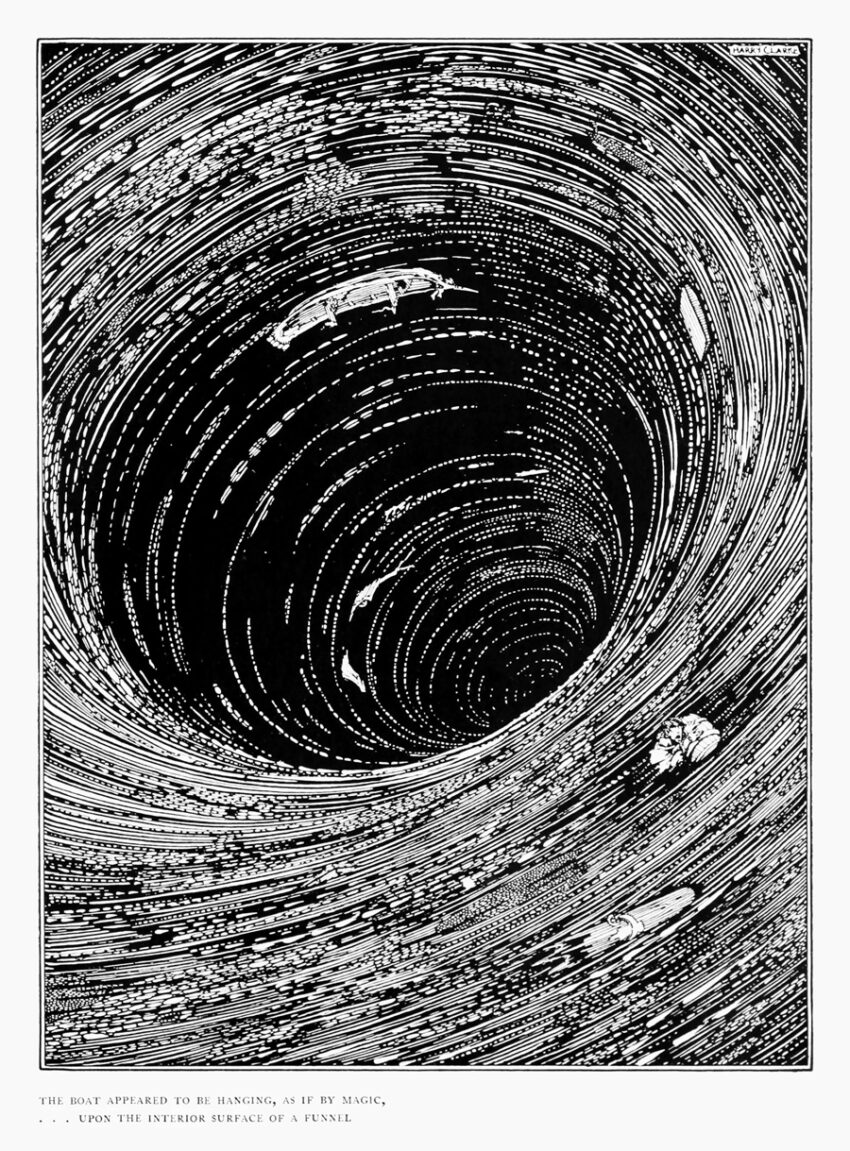
Like the narrator of “The Imp of the Perverse,” the narrator of “The Black Cat” tells us his story on the eve of his execution; he will hang for his crimes. He speaks as if compelled to unburden himself. Putting this crime into words was a compulsion that Poe, too, had shared in his way. Cortázar tried to picture the moment when Poe, more than a century earlier, had conceived of the sadistic scenes that Cortázar’s commission now obligated him to re-create in Spanish. He imagined Poe at night, seated at some table, dirty or clean, in one of the many houses he inhabited. Poe’s mother-in-law brought him a coffee. Contemplating this calm domestic setting, Cortázar asked himself: “What process, what silent cyclone of the literary act, what vortex is in the pen Poe rests at this instant on the page?”
As the Czech writer Bohumil Hrabal, who wrote a book in which he describes beating half a litter of kittens to death in a mailbag, once commented: “I came to understand why artists love suffering, and why poets and painters drink themselves into a stupor. It’s because they need to suffer in order to see more clearly, so that when they reach the bottom, they might catch a glimpse of what others do not see, something that touches the very essence of a human being and the world around him.”
This is a version, I think, of what Cortázar realized Poe was trying to do in his most shocking tales: to touch the essence of human beings. Suffering is not our whole truth as a species; Poe did not think that. But it may be the very last truth we admit, when we have tried admitting to everything else. We then find that something in us still has not met with acceptance; something in the world still has not been said. The not-saying, the not-accepting, has left us in secret despair. Saying is the only way to end it.
more than murder itself, what obsesses Poe is how to talk about murder—how to confess. Can we put our worst impulses out there somewhere, separate from ourselves? Can we bear to speak, and can anyone bear to listen? Poe knew what it felt like to sabotage himself, as the surviving correspondence about his ill-fated Washington trip vividly attests. Judging by his stories, he was also able to imagine what it would feel like to at once wish and not wish to tell someone else his darkest secrets. Poe’s stories of crime and horror are most often narrated in the first person by the criminal, who urgently, even madly, solicits our ear.
Charles Baudelaire rendered “The Tell-Tale Heart,” what is perhaps Poe’s most famous story of this kind, as “Le Cœur révélateur.” Révélateur does mean “telltale” but also “revealing,” “unveiling.” In French you can’t miss what you might miss in English: that the tell-tale heart is the narrator’s, not the victim’s. In this story, the narrator kills an old man because he can’t bear to be watched by his “vulture eye,” his “pale blue eye, with a film over it.” He hides the body under the floorboards. No trace of his crime remains. But when police officers come to search his house, madness overtakes him. He hears the old man’s heart beating beneath the floor, and he believes they hear it, too. He panics: “They heard!—they suspected!—they knew!—they were making a mockery of my horror!—this I thought, and this I think.” He is wrong; the police suspect nothing. They sit there conducting a required interview, suppressing yawns. But for the murderer, the heart’s drumbeat is deafening. “Tear up the planks,” he cries.
Because Poe’s tales are more about confession than crime, they feel familiar even when they are at their most bizarre. It is this quality that makes Poe Poe. Vanishingly few of Poe’s readers have ever buried a body under the floorboards. But all of us have done something we are not proud of. All of us have felt the weight of the words that, if spoken, would reveal our wrongdoing. We have all decided whether to speak those words or swallow them. We know what confession is like and also what it is like to get away with murder, an expression that startles us less than it should.
We first confess in childhood, and perhaps these early shames set the pattern for our later decisions. To confess or to be found out is, one hopes, to be reconciled. These days, I know what is forgivable and what is not. But as a child, I had no idea where this line might be drawn. The transgressions I got away with lodged like splinters in my soul. I could not tell how serious they were; possibly they were infinitely terrible. I could think of no other solution than to forget them.
As Freud knew, memory is a delicate matter. On the one hand, it is sometimes best to forget unbearable facts, as Poe’s dancers forget death between the chilling moments when the iron-lunged bell tolls the hour. We can’t function while constantly calling to mind what is frailest, cruelest, and worst about ourselves. Repressions, as Freud reminded his students, are not always best removed.
But on the other hand, most of us find that, at one time or another, the troubling facts resurge, whether as symptoms or as intrusive thoughts. What to do then? At such times, we need company. We might choose the company of a psychoanalyst. But we might also choose the company of a writer who, often at great cost to himself, could not forget what the rest of us succeed at setting aside.
Poe’s self-destructiveness, his death obsession, and the cruelty of his characters all arose from a peculiarity of his temperament that was also a key to his genius: he tended to stare at the dark side well past the point when the rest of us would turn our backs on it with a shudder. Even Poe’s greatest fans can, as Cortázar did, find this quality maddening and morbid at times. But we’re exasperated at those moments when we’ve managed to forget the unbearable—when our repressions are working. When they fail—when we can’t forget—we may come to feel that we owe Poe an infinite debt of gratitude for offering us his own peculiar kind of talking cure. In this exchange, it’s the narrators who talk, and we, the readers, who listen. They tell us the worst things they’ve thought and done. They show, through the quality of their speech, that they are madness maddened. In some secret corner with a book, witnessing the confessions Poe imagined so many years ago, we can take comfort in this thought: however dark the place in which we find ourselves, Poe has already been there.
“How to Talk About Murder” is drawn from Emily Ogden’s Darkness Becomes Bright, which will be published on September 29, 2026, by Viking, an imprint of Penguin Publishing Group, a division of Penguin Random House, LLC.
Emily Ogden is the author of On Not Knowing: How to Love and Other Essays. The recipient of a Guggenheim Fellowship and a Whiting Creative Nonfiction Grant, she is a professor of English at the University of Virginia.