Steam Client is now faster than Epic's new vibe coded launcher
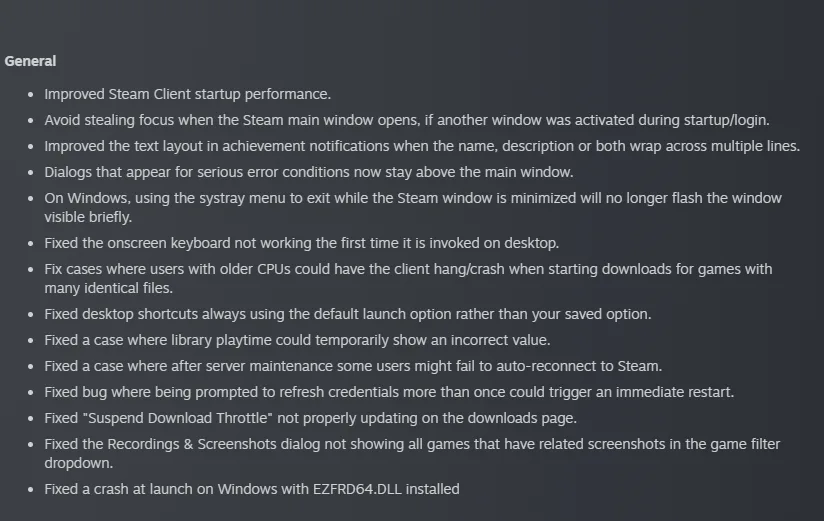
Yesterday, Epic Games announced and launched in preview its new vibe-coded launcher. The main marketing pitch was a jab at Steam’s slow loading speed compared to the new Epic launcher. Well, that didn’t last too long. Only 24 hours after Epic dropped its faster launcher, Steam pushed a small update to make its client faster than Epic.
| Client Version | Startup Time (Cold Boot) | Tray Restore Speed | Architecture |
| Epic Games Launcher V2 (Preview) | ~5.47 seconds | ~0.36 seconds | AI-Assisted (“Vibe Coded”) |
| Steam Client (Post-Patch) | ~5.23 seconds | ~0.42 seconds | Optimized Modular CEF |

On basic test systems, Valve’s client boot time dropped to 5.23 seconds, beating Epic’s new launcher and neutralizing its primary performance claim.
While Epic Games Launcher V2 remains, a massive step forward compared to its notoriously sluggish legacy build, Valve demonstrated how quickly it can react to competitive benchmarks. Epic may have “vibe coded” a faster client, but Valve proved that targeted optimization on a decades-old ecosystem can still beat out AI speedruns.
But the issues with Epic’s client go far deeper than vibe coding. Years later, and now with a brand-new client even, Epic lacks basic features that should have been added a long time ago.
- No Discussion forums and community hubs
- No User-written text reviews
- No Community-created guides and walkthroughs
- No Screenshot, clip, and artwork sharing
- No Community groups and curator recommendations
- No Profile customization (badges, showcases, backgrounds)
- No Community marketplace for in-game items
- No Direct player-to-player item trading
- No Digital trading cards, levelling, and points shop
- No Universal controller remapping and gamepad support
- No Big Picture mode for TVs and handheld PCs
- No Remote Play and Remote Play Together
- No Integrated game broadcasting and streaming tools
- No Family library sharing across accounts
- No Platform-wide mod hub (Steam Workshop equivalent)
- No Personalized discovery queues
- No Local network game file transfers
- No Game version rollback options
La tienda de EPIC hecha completamente con inteligencia artificial parece ser un DESASTRE en cuanto a bugs… Quien lo dirIA 💀 pic.twitter.com/tZF244XZ49
— eXtas1s 🎮 Noticias & Rumores (@eXtas1stv) October 14, 2026

I’m Sikandar Mahmood, a gaming journalist and content strategist with over a decade of experience covering video game news and crafting in-depth guides. I began my career at SegmentNext as a news reporter and editor from 2014 to 2019, before founding RespawnFirst in 2019. I currently serve as Head of Content Production on RF, where I manage writers, shape editorial direction, and focus on accurate, high-quality gaming news and guides.