Vikings really did reach North America a thousand years ago — and now we know exactly when: A story of stars, trees, solar bursts, and Vikings.

Two medieval Icelandic texts, the Saga of the Greenlanders and the Saga of Erik the Red (often grouped together as the Vinland sagas) describe Norse voyages to a land they called Vinland. Leif Erikson is one of the central figures in these accounts and is traditionally credited with leading an expedition to North America.
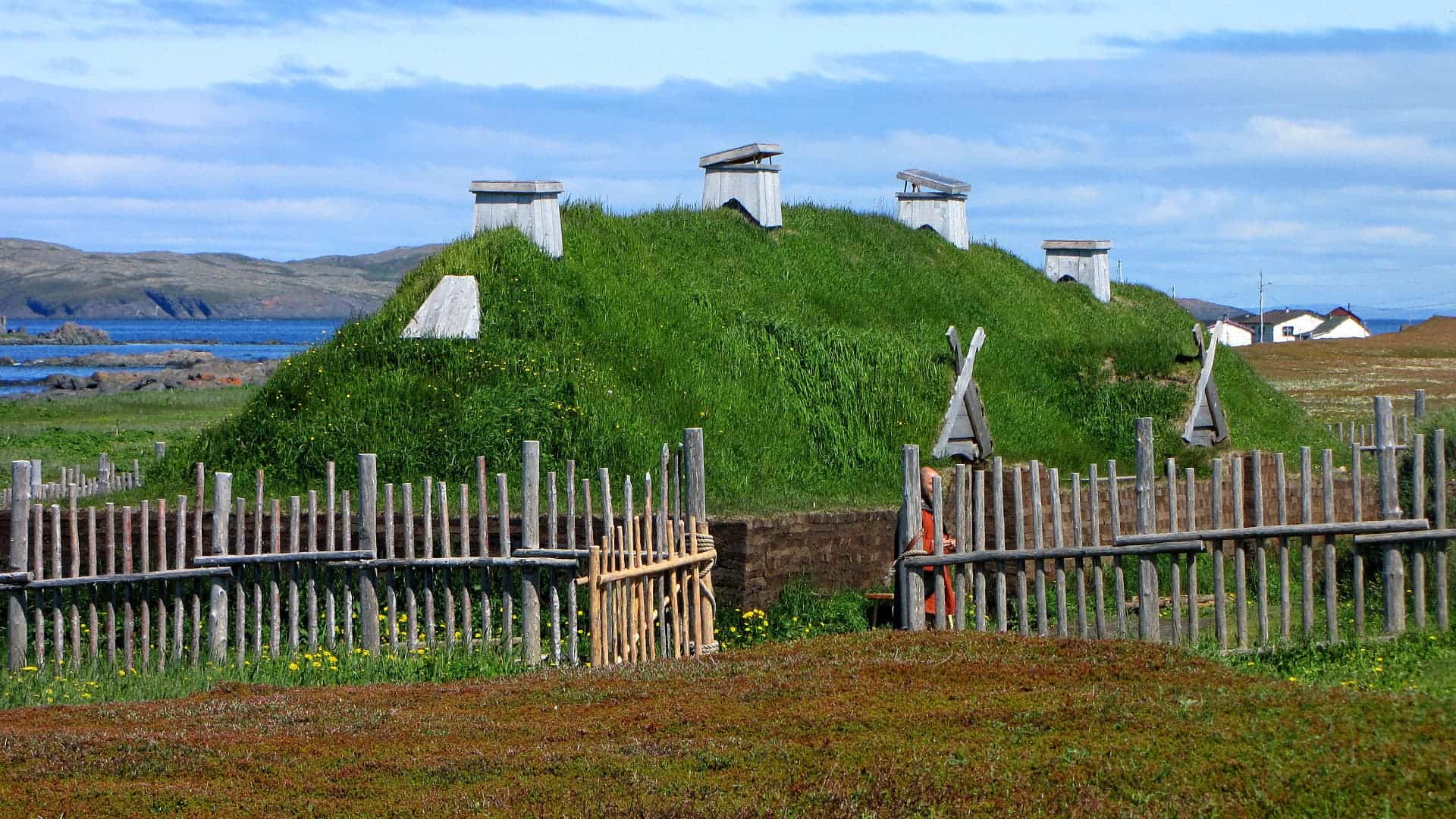
Centuries later, archaeologists discovered a Norse settlement at L’Anse aux Meadows, on the northern tip of Newfoundland. It fits perfectly with the Vinland Saga. L’Anse aux Meadows features several distinctive Norse-style buildings, as well as iron nails, a bronze pin, and several other Viking artifacts. There’s even more tantalizing evidence: a collection of wooden chunks whose chops suggest that they were cut with Viking metal axes and not the tools commonly used by the indigenous population who were inhabiting nearby areas.
But as tempting as it is to connect the site directly to Leif and his voyages, there’s no clear archaeological evidence proving that L’Anse aux Meadows was specifically his camp.
The archaeologist working on the site, Birgitta Wallace, showed remarkable foresight and froze the chunks of wood. For decades, the artifacts waited in a freezer until finally, their time had come. That timing was a new research that presented a detailed analysis of these chunks, drawing a detailed timeline of when the Vikings arrived: exactly 1002 years ago.
1021 CE: the year the Norse arrived in North America
Earlier archaeological evidence and radiocarbon dates already placed the Norse occupation around the turn of the first millennium, but conventional radiocarbon dating couldn’t isolate a single calendar year. Then came a breakthrough from the most unlikely of places: cosmic-ray physics.
In 2012, Fusa Miyake and colleagues reported an abrupt carbon-14 spike in tree rings dating to 774–775 CE. Another sharp excursion was subsequently identified around 993 CE. These events are now generally attributed to extreme solar energetic-particle events and are known as Miyake events.
The 993 event produced a sharp increase in atmospheric carbon-14 that appears in tree-ring records around the world.
If archaeologists find that distinctive radiocarbon pattern in a piece of wood and the tree’s outer growth surface is still preserved, they can match the sequence to an absolute chronology and then count the remaining rings outward to determine when the tree was felled.
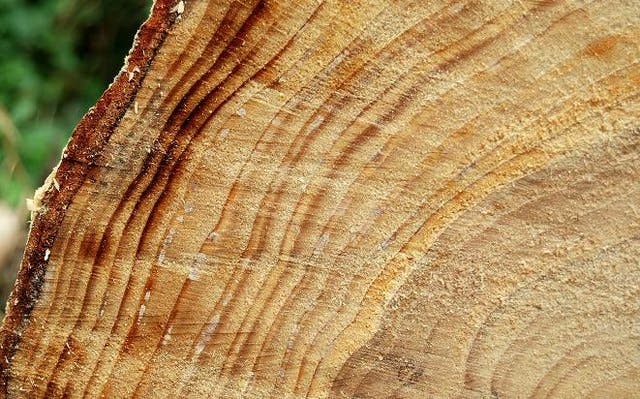
This groundbreaking method, named after its discoverer Fusa Miyake, has become a revolutionary tool for archaeologists. The science has only grown stronger; in late 2023, researchers confirmed the largest Miyake event ever recorded, a massive solar storm that occurred 14,300 years ago. Further research in 2024 and 2025 has continued to precisely date other events, reinforcing the reliability of these ‘cosmic clocks’ and confirming their power to pinpoint dates for historical events.
For L’Anse aux Meadows, researchers Margot Kuitems, Michael Dee and their colleagues made 127 radiocarbon measurements across 83 tree rings from four wooden objects. One object contained only nine rings and did not preserve the AD 993 anomaly, so it could not be precisely dated. The other three came from different conifer trees and retained their outer growth edge.
For all three trees, 1021 CE produced the optimal statistical match for the felling year. There is some nuance: nearby years passed individual goodness-of-fit tests for some samples, but 1021 was the best fit in every case.
It’s also unlikely that the Norse simply picked up old driftwood. The outermost growth surface was still present on the pieces and would probably have been stripped away during water transport. Fresh timber was abundant, and three scavenged pieces independently carrying the same amount of “inbuilt age” would be extremely unlikely.
Overall, the study tells us that Norse people were actively cutting wood at L’Anse aux Meadows in 1021 CE. They may well have arrived earlier. In fact, the researchers explicitly wrote that how 1021 fits into the wider sequence of Norse transatlantic activity remains a question for future research.

A cosmic clock, with caveats
Since this article was published, researchers have added an important warning about just how literally we should treat tree rings as recording devices. A 2026 study found that trees do not all incorporate atmospheric carbon-14 in exactly the same way. The timing of photosynthesis, wood growth and the reuse of carbohydrates stored from previous years can blur a sudden Miyake-event signal across multiple rings.
The effect is expected to be larger in many deciduous trees, but the researchers’ modelling suggests that even evergreen conifers can show some carryover. That is relevant because the three precisely dated L’Anse aux Meadows samples were conifers.
Yet overall, the study strongly suggests that by 1021 CE, the Vikings were already in North America. They could have been there earlier, possibly at a different site; but at L’Anse aux Meadows, they already started building structures over a thousand years ago.
It’s remarkable that archaeologists can pinpoint the year when Vikings started building a settlement in North America, and using a cosmic burst of all things. It’s just as remarkable that Vikings reached the continent, over four hundred years before Columbus “discovered” America.
And L’Anse aux Meadows may not be the only site. As of 2024 and 2025, researchers are increasingly using new tools, such as high-resolution satellite imagery, to scan the coasts of Newfoundland and Labrador for tell-tale signs of other potential, short-term Norse settlements that may have been missed by traditional archaeology.
A 2024 study analyzing ancient walrus-ivory trade routes has shown that Vikings ventured deep into the High Arctic and were engaging with Indigenous Arctic peoples, rather than being completely isolated explorers. The study found DNA evidence tracing walrus skull fragments from remote Northwest Greenland to European markets, revealing a complex trade network spanning thousands of kilometres. The Vikings also traded with Native Americans in some instances, though relations between them were usually icy.
Contrary to popular myth, Vikings weren’t simply raiders. They were sophisticated in navigation, maritime architecture, resource acquisition (timber, ivory) and long-distance connections. Increasingly, more and more evidence also suggests they were the original European discoverers of America.
The study was published in Nature.
This story originally appeared in 2022 on ZME Science and was updated with new information.