The Internet Is Becoming a Dark Forest – and AI Is the Hunter
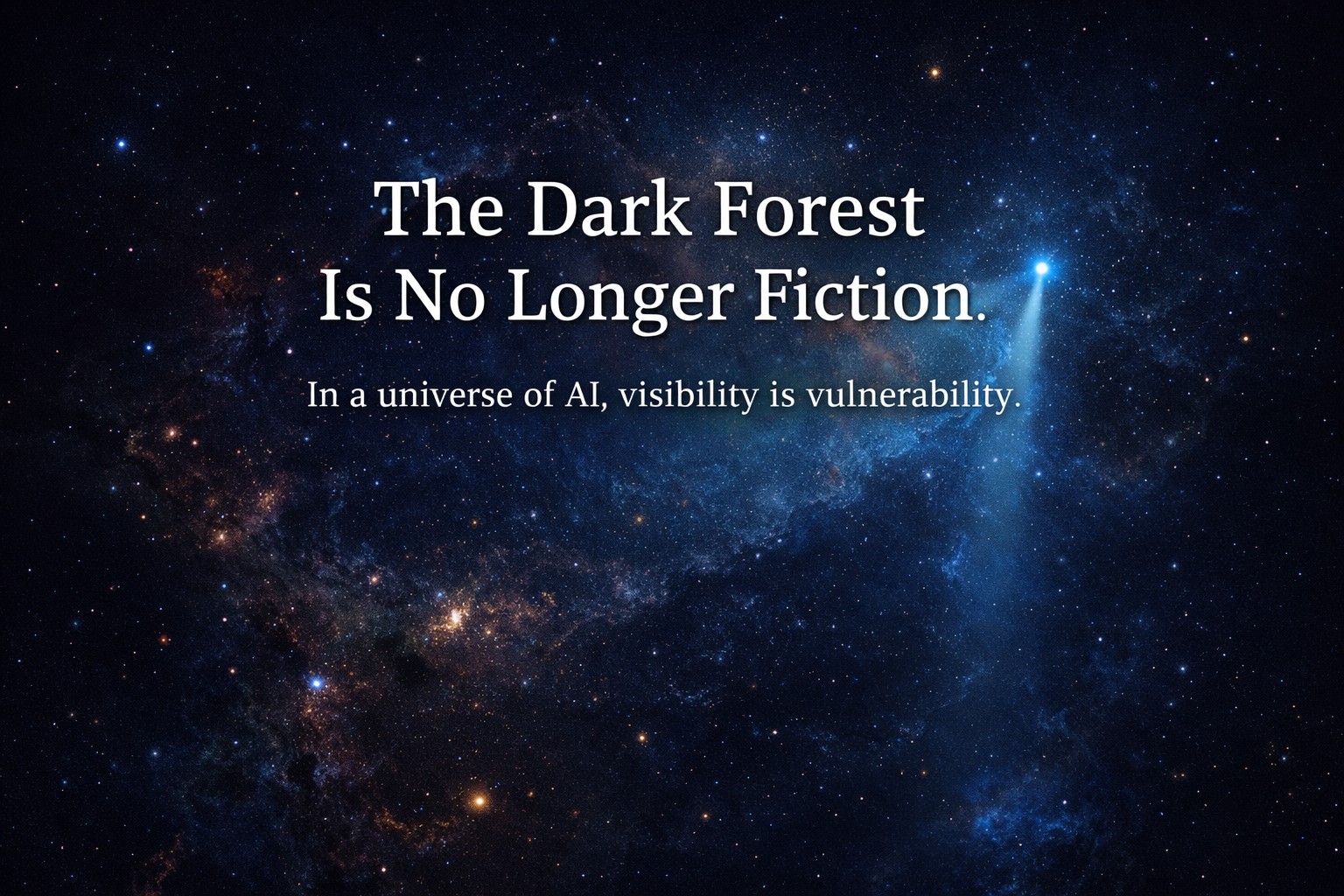
In Liu Cixin's sci-fi novel The Three-Body Problem, the universe operates by a single terrifying rule: any civilisation that reveals its location will be destroyed. The safest strategy is silence and invisibility. The universe is a dark forest — and increasingly, so is the Internet.
🕒 A 4-Minute Breach
02:13 — Your server is scanned. 02:14 — An AI model fingerprints it. 02:15 — An exploit chain is generated. 02:16 — The breach begins.
No human was involved.
This is not science fiction. This is the AI security era.
🚨 The Signals Are Already Here
Two recent developments mark a turning point:
PentAGI — Autonomous Penetration Testing for Everyone
PentAGI is an open-source AI agent that conducts full penetration tests with no human in the loop. Deploy it with a single docker-compose up. Point it at a target. Walk away.
- Orchestrates 20+ integrated security tools — Nmap, Metasploit, SQLmap — running up to 16 parallel sub-agents simultaneously
- One sub-agent maps the attack surface while another crafts payloads — reconnaissance and exploitation in parallel
- Works with any LLM backend: OpenAI, Anthropic, Google Gemini, or local models via Ollama
- Already 5,300+ GitHub stars and 10,000+ Docker pulls — the attack capability that once required a specialist firm is now a free download
Claude Code Security — 500+ Vulnerabilities Found in Weeks
Anthropic's Frontier Red Team — 15 researchers — used Claude Opus 4.6 to audit production open-source codebases. The results were stark.
- 500+ high-severity vulnerabilities discovered and validated in production software
- Bugs had survived years of expert human review — some undetected for over a decade — in projects like GhostScript, OpenSC, and CGIF
- Finds memory corruption, authentication bypasses, and logic flaws that pattern-matching tools miss entirely, by reasoning across hundreds of files at once
- The same capability is now available to any developer — meaning threat actors have access to the identical reasoning power
AI is now embedded in the full security lifecycle: reconnaissance, vulnerability discovery, code analysis, attack simulation, and exploit generation.
If defenders can automate testing, attackers can automate exploitation.
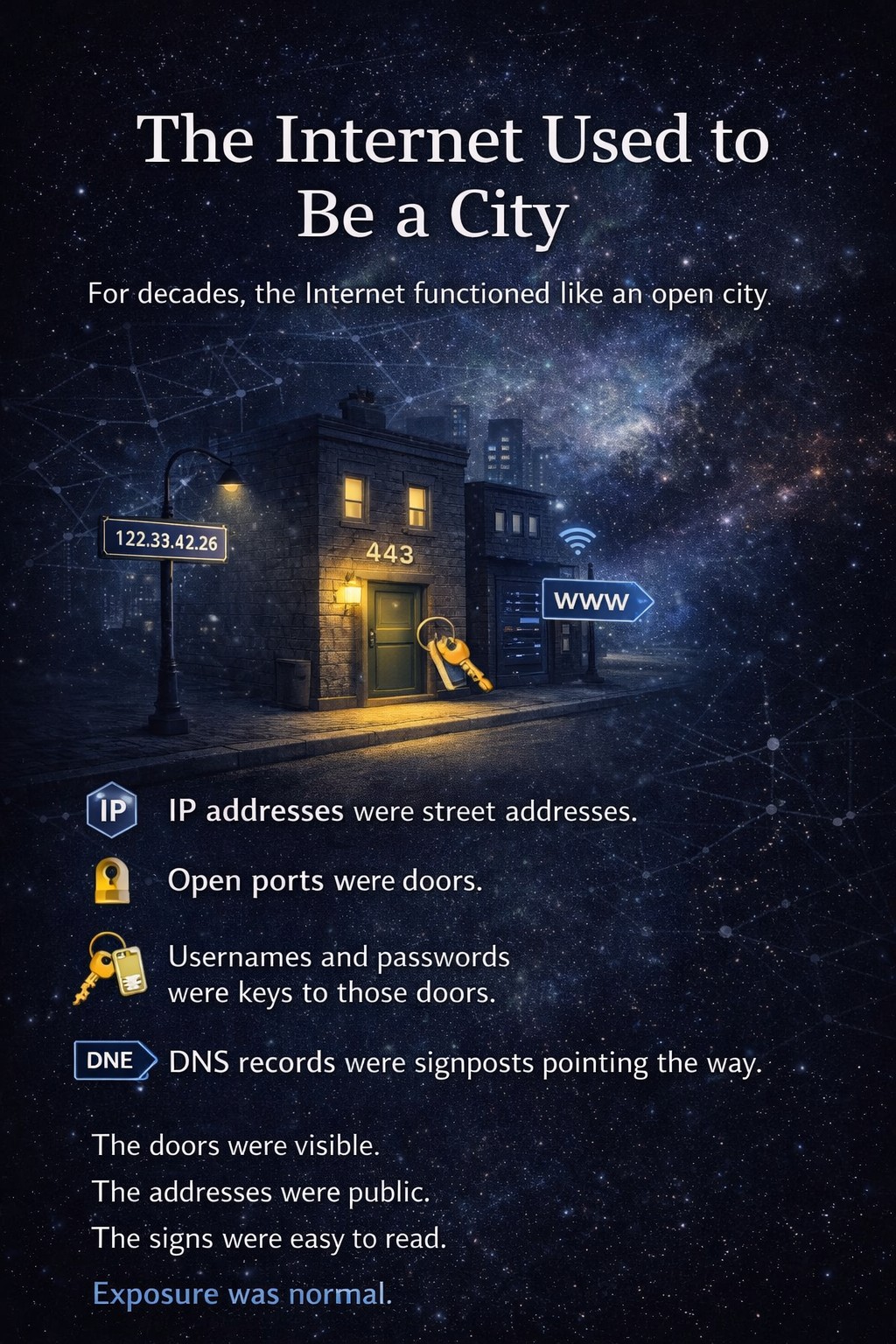
🏙️ The Internet Used to Be an Open City
In the early days, the Internet was like an open city:
🔒 No Lock Stops Aerial Reconnaissance
For decades, security meant better keys and thicker walls. Traditional security assumes:
- Attackers will reach you.
- You will detect them.
- You will respond fast enough.
That worked when attackers were human. In the AI era, attackers have air superiority.
- They are no longer constrained by time, cost, or human fatigue.
- They operate at machine speed.
AI doesn't stand at the entrance. It scans the entire building from above, mapping structural flaws long before anyone notices. Vulnerability exploitation allows it to bypass authentication logic without ever presenting credentials. Neither assumption holds when the attacker is an autonomous AI agent running 24/7 at near-zero cost.
In a world of autonomous reconnaissance, stronger locks and thicker walls are not enough.
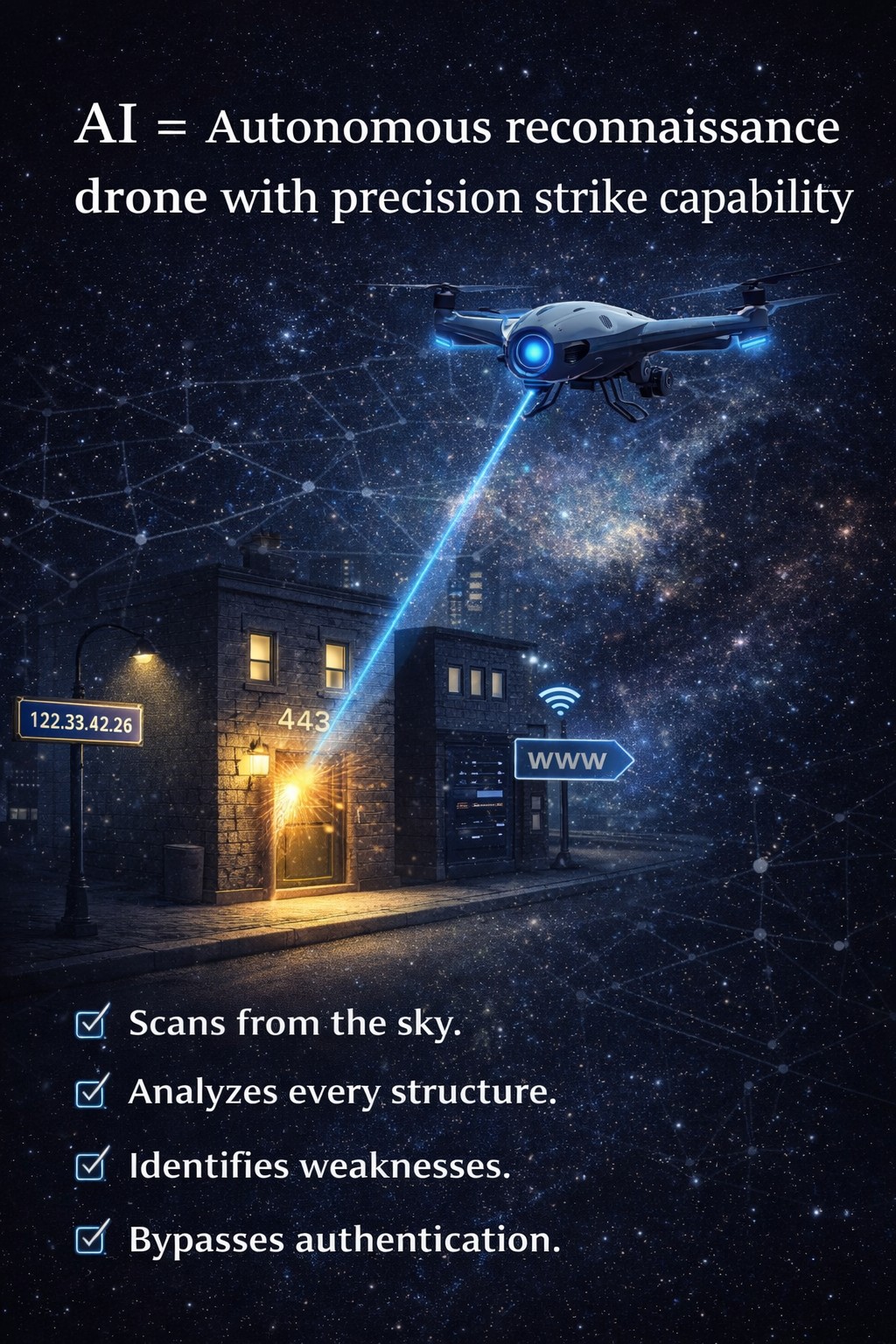
The real question becomes: Why is the building visible at all?
🌲 The Dark Forest Internet
In a Dark Forest:
- Every sound reveals location.
- Every light attracts hunters.
- Silence increases survival.
| Dark Forest | Internet |
|---|---|
| Light | Open Port |
| Sound | IP Address |
| Signal | DNS Record |
| Hunter | AI Agent |
In the AI era: Visibility equals vulnerability.
🆕 Beyond Zero Trust: Zero Visibility
Zero Trust says: Never trust. Always verify. It was the right answer for the human-speed threat era.
But most Zero Trust systems are still reachable, scannable, and enumerable. They authenticate after contact — which means attackers can probe, fingerprint, and enumerate before a single credential is checked. In an AI-driven world, that order matters enormously.
Zero Trust reduces implicit trust. But it doesn't remove visibility. Zero Visibility goes further. Imagine infrastructure that offers:
- ❌ No exposed IPs
- ❌ No open ports
- ❌ No DNS discoverability before authentication
Only this:
✔ Cryptographic proof of identity → Then connectivity
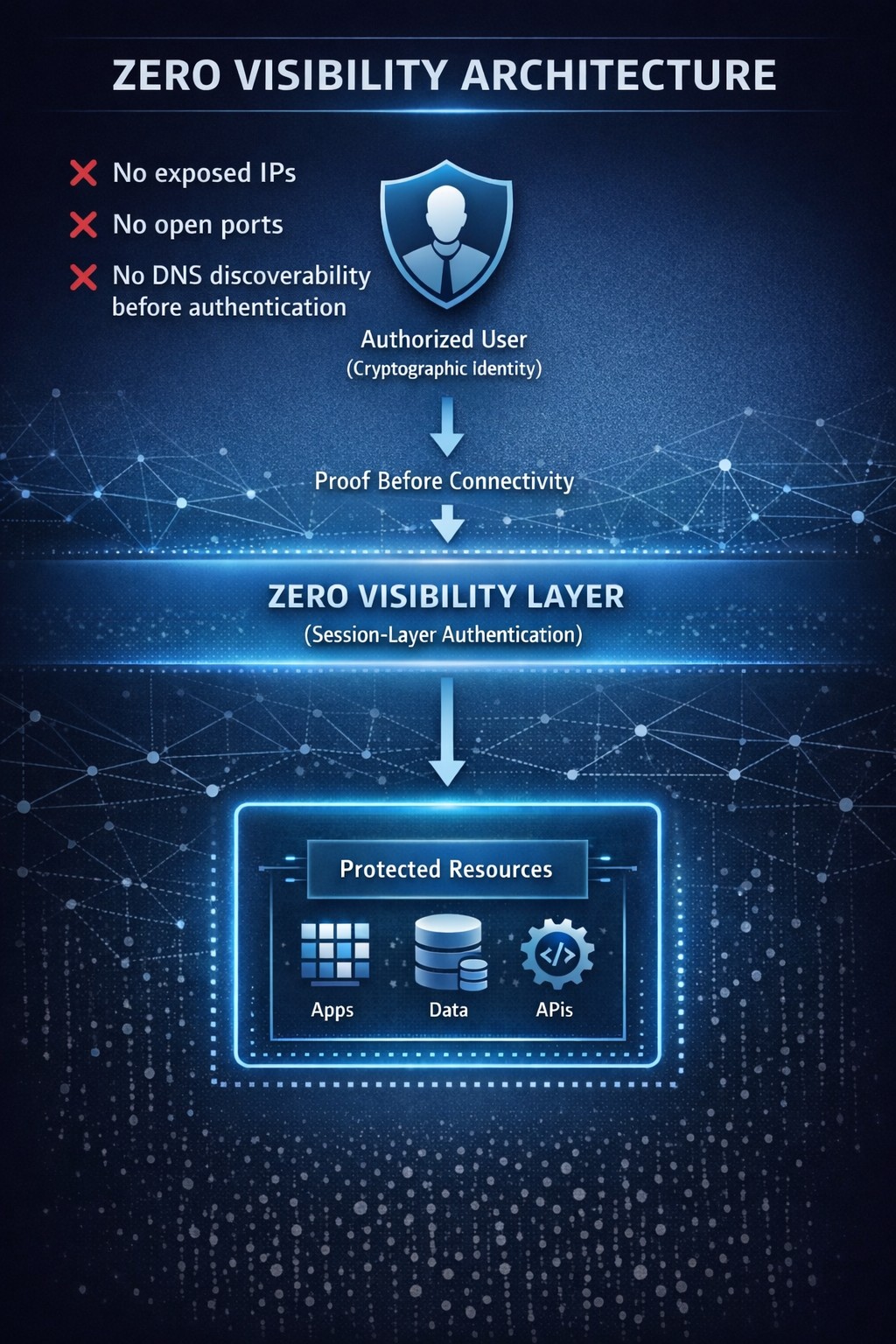
Zero Trust verifies identity. Zero Visibility eliminates exposure. The attack surface is not hardened — it is removed.
🔁 Strategic Shift
Instead of asking "How do we detect attacks faster?" security leaders are beginning to ask:
How do we make attacks computationally irrelevant?
Network hiding is not a feature. It is an architectural shift. This shift includes infrastructure hiding, session-layer cryptographic negotiation, default-deny networking, and attack surface elimination.
OpenNHP is the open-source implementation of this approach — backed by the Cloud Security Alliance and being standardised at the IETF.
🧭 A Philosophical Realignment
For decades, openness was strength. In the AI era, uncontrolled visibility becomes fragility.
The Internet may not become brighter. It may become darker — but it may also become safer.
The future belongs to systems that are:
- Invisible until authenticated
- Accessible by proof, not discovery
- Secure by architecture, not reaction
❓ Final Question
How many times was your infrastructure scanned today?
Not by humans.
By machines.
If AI can see everything,
it will study everything.
What would happen
if it saw nothing?
AI is the hunter.
And the Internet is becoming a Dark Forest.
The future of security is not better locks.
It is disappearing doors.
OpenNHP makes your infrastructure invisible by default —
no surface to scan, no service to exploit.