'Horrified to see that number': AMA study finds pedestrians in school crosswalks almost hit 4.5 times daily
To Brandon Kwong, an Edmonton advocate for safer roadways, school zones are where drivers are supposed to be at their most diligent.

Subscribe now to read the latest news in your city and across Canada.
- Exclusive articles by David Staples, Keith Gerein and others, Oilers news from Cult of Hockey, Ask EJ Anything features, the Noon News Roundup and Under the Dome newsletters.
- Unlimited online access to Edmonton Journal and 15 news sites with one account.
- Edmonton Journal ePaper, an electronic replica of the print edition to view on any device, share and comment on.
- Daily puzzles, including the New York Times Crossword.
- Support local journalism.
Create an account or sign in to continue with your reading experience.
- Access articles from across Canada with one account.
- Share your thoughts and join the conversation in the comments.
- Enjoy additional articles per month.
- Get email updates from your favourite authors.
Create an account or sign in to continue with your reading experience.
- Access articles from across Canada with one account
- Share your thoughts and join the conversation in the comments
- Enjoy additional articles per month
- Get email updates from your favourite authors
Sign In or Create an Account
A new study from the Alberta Motor Association, then, is hardly encouraging.
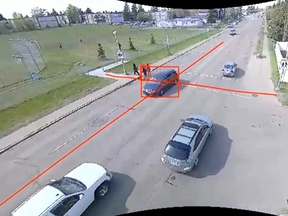
AMA on Thursday released the results of a national study of 30 school crossings across Canada, including six in Edmonton.
The study found that on average, there were 4.5 “near-miss” collisions between vehicles and pedestrians every day.
“I’m entirely not surprised, and entirely saddened, horrified to see that number,” said Kwong, board chair of Edmonton’s Paths for People.

Get the latest headlines, breaking news and columns.
By signing up you consent to receive the above newsletter from Postmedia Network Inc.
A welcome email is on its way. If you don't see it, please check your junk folder.
The next issue of Headline News will soon be in your inbox.
We encountered an issue signing you up. Please try again
The study, commissioned by AMA and the Canadian Auto Association, monitored select school crosswalks in 11 Canadian cities over five school days, using video cameras and AI analysis to monitor vehicles and pedestrians.
The study does not identify which specific intersections or crossings were monitored, though the study’s designers consulted municipal staff to help select locations “that reflected a range of road types, intersection layouts and traffic controls” along established school routes, AMA said.
Nationwide, the study recorded 660 vehicle-pedestrian “conflicts” in which a motorist came close to hitting someone. One in every 84 pedestrians in the monitored cross walks experienced a near-miss with a vehicle, AMA said.
In Alberta — where AMA monitored six crossings in Edmonton, six in Calgary — there were a total of 72 vehicle-pedestrian near misses during the five-day period. Most (79 per cent) were vehicles travelling straight through an intersection where pedestrians were crossing, while just under 21 per cent were vehicles making turns.
The worst time window for near misses was 3-4 p.m.
Jessica Lamarre, the City of Edmonton’s director of safe mobility, said in a news release that the findings back up the city’s efforts to make intersections safer, including by adding zebra crossings, stop signs, pavement markings, flashing beacons and speed-check signs.
Miovision, a Canadian traffic data company, conducted the study.
‘Design to forgive’
Kwong said based on the AMA data, “we can extrapolate hundreds of near misses, if not thousands of near misses, across our city every day.”
Dangerous school zones create a vicious cycle, he said. When school drop off zones don’t feel safe, parents decide it’s better to drive their children rather than letting them walk, bike or scoot. That means more vehicles on the roads, “contributing to the very danger and congestion and chaos that is creating the hazard in the first place.”
Studies have found parents of school-age kids walked to school at twice the rate of modern kids, he added.
Kwong said Paths for People argues for improvements to road design that limit conflict between drivers and other road users, rather than demanding perfection from people behind the wheel. Too much road infrastructure is “overbuilt,” encouraging motorists to drive faster, he said.
“We don’t believe that it’s the social deviants or the bad apples that are the only ones sort of creating dangerous situations on the roads,” he said. “Humans do make mistakes, and we want to design to forgive that, not to result in serious injury or death when those mistakes are made.”
Traffic fatality rates in Edmonton increased 73 per cent between 2021 and 2025, according to AMA, with speed playing an increasing role.
Bookmark our website and support our journalism: Don’t miss the news you need to know — add EdmontonJournal.com and EdmontonSun.com to your bookmarks and sign up for our newsletters.
You can also support our journalism by becoming a digital subscriber. Subscribers gain unlimited access to The Edmonton Journal, Edmonton Sun, National Post and 13 other Canadian news sites. The Edmonton Journal | The Edmonton Sun