The Birth of the American 12-string Guitar (2013)
Back to our story:
February 12, 1898: TMTR: �The Grunewald Harp-Guitar�
What�s going on?
Not a month later, the trade journal again highlights the new instrument,
with the same woodcut and 2 columns of hype, claiming that it is �attracting
considerable attention in trade and musical circles.�
In fact, �all who have examined it are unanimous in proclaiming it to
be a radical and practical improvement upon the time-honored guitar.�
True? There doesn�t seem to
be reason to totally discount the report, yet where are all the surviving
instruments? Perhaps all south of
the border, as the company�s activity there is again specifically mentioned?
This time, in the tone department, they�re having
their cake and eating it too, describing the �quality of tone (that) resembles
that of the mandolin and guitar, or more particularly that of the harp��
Personally, I consider a mandolin and harp very different (!) - the
mandolin being steel strung, high and bright
with short sustain, while available harps were all gut strung and meant to
ring. Note that the �autoharp or
mandolin� clues have informed us from the beginning that Brown�s original
instrument and the two manufacturer�s were almost certainly all strung in
steel (or silk & steel), which at the time was intended for amateurs and not
�serious� guitar players.
This piece ends with another reminder that the
�ordinary guitar�is an instrument upon which�comparatively few can
play.� It sounds like the
Grunewald harp-guitar may indeed soon supersede it!
April 16,
1898:
TMTR: A
short blurb tells of a Grunewald agent�s success in Mexico and soon South
America with the harp-guitar.
September 10, 1898: TMTR: �Rene Grunewald Forging Ahead�
Now things are getting serious. First, they�re already talking about the �now famous harp-guitar.� We then learn that Grunewald is planning to aggressively market the instrument (along with his mandolins) throughout the United States, but also in Cuba and Puerto Rico (America�s �new possessions�). Further acclaim of the still-10-string instrument and much name-dropping regarding Grunewald mandolin testimonials follows.
October 15, 1898: TMTR: �The Harp-Guitar�
A month later and TMTR is really taking this
seriously, insisting that �The new American harp-guitar�is considered by
experts, soloists and amateurs as the acme of perfection.�
For the first time, we are told exactly how the melody will be played in
first position via the paired octave strings: �The air will sound in
a clear treble, bass, or plainly in octaves, with great volume, by simply
engaging the treble of the parallel strings with the thumb and its larger
companion with the first finger.� Man,
can you imagine a beginner doing that with a few days practice?
They�re telling me I can pluck just the skinny string of the pair and
get a melody with �great volume�? How
many modern 12-string players can do that?!
December 3, 1898: The Houston Daily Post: Display Ad
A separate C. Grunewald store in Houston, Texas at 310 Main St. lists �Harp-Guitars� among its inventory. "C" must be Clifford, brother of Rene.
April 8, 1899: TMTR: �The Harp-o-chord the Latest�
This tells of Carl Brown�s second invention, the
�Harp-o-chord.� Clearly, the
TMTR editor is a Brown fan!
September 10, 1899:
The Sacramento Record-Union:
News Announcement
A short entry announces Brown�s new Harp-o-chord invention, and includes �who made such a success of a ten-stringed harp guitar, which he brought out some two years ago��
December 23, 1899: TMTR: �A New Guitar�
An interesting little press release (with a typo of �1889� in the heading, so don�t get confused) from Brown�s firm in Columbus, Ohio, that mentions the �new 10-string guitar recently invented�manufactured by the �New Orleans branch of the Columbus Harpochord Co.�
Curiously, the address given (West Bond St.) is different than the Grunewald�s factory (Conti St.), so the question is: Is this a new facility unrelated to Grunewald, or simply a department of, or new location of, Grunewald�s original factory? It�s curious that Grunewald � surely the bigger �name� � isn�t mentioned, nor have we heard anything of him in TMTR for over a year.
If Grunewald was indeed still the manufacturer,
this would indicate that at the very end of 1899, Grunewald still had not come
up with the 12-string version. However,
if Grunewald was out of the picture,
could he have been now creating his 12-string?
And if he broke off from Brown, could he still call his 12-string version
�the Harp-Guitar�? What�s
missing is a 12-string specimen showing the label, which would presumably be
under the original Brown patent. Or
would it? None of the next
Grunewald ads mention a patent.
December, 2015: A surviving 12-string finally appeared, but it only has
the Grunewald stamps, no label.
Irrespective of this puzzle, note the key sentence
of this notice: the claim that �The New Orleans house is sending them out by
the hundreds, and the sales are enormous.�
Again, if true, where are the surviving instruments?!
August 19,
1900: The Houston Daily Post:
Display Ad
The Houston C. Grunewald store announces
�Have just received new lot Harp Guitars
of�$10.50.� There is no way to know whether these were 10-strings or
12-strings.
1901-1902: Here is where our trail grows cold, as nothing further on the 10- or 12-string Brown or Grunewald (to say nothing of Gordon) harp-guitar appears in The Music Trade Review (that I have found through searching. Someone next needs to carefully read all pages of all weekly issues).
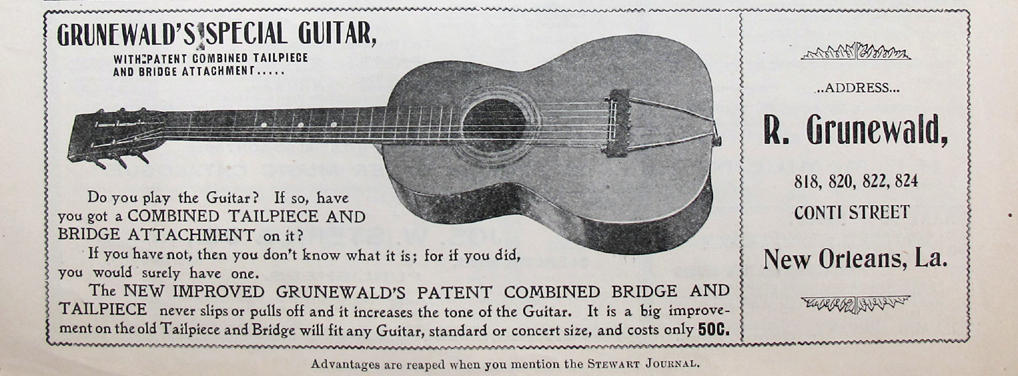 There is
an ad in the S. S. Stewart Journal issues of April and May, 1901 for Grunewald�s new �Special Guitar," but this is only a 6-string guitar with
their "new improved patent combined bridge and tailpiece" (the patent
does not appear to have granted). There is
no mention of their 10- or 12-strings.
There is
an ad in the S. S. Stewart Journal issues of April and May, 1901 for Grunewald�s new �Special Guitar," but this is only a 6-string guitar with
their "new improved patent combined bridge and tailpiece" (the patent
does not appear to have granted). There is
no mention of their 10- or 12-strings.
The Cadenza
After the end of the Music Trade Review 10-string write-ups above and the 1901-1902 �lost years,� Grunewald came back blazing with full page ads in The Cadenza for a couple years running. These were seen by most every �serious� guitar player in America, and various levels of amateurs. While TMTR catered to the trade, The Cadenza catered to the customers � the players.
To
re-cap:
Evolution
and Rise of the American 12-String Guitar
as postulated
by Gregg Miner
-
Feb 8, 1896: Carl E. Brown, a musical instrument inventor, submits a patent for a new 10-string guitar he dubs �the Harp-Guitar.� It has a pear-shaped body; the 4 low courses are strung in octaves, while the 2 high strings are single. There is a lever to grab the 4 high extra strings and move them out of playing position. He already has a prototype hanging in a local music store.
-
Sep 22, 1896: The patent is granted.
-
Fall of 1896: Brown engages two different firms to build it � the Hamilton Gordon Company and the Rene Grunewald Company. Gordon will make theirs in the shape of the patent design; Grunewald will make the body with a traditional guitar shape. Each is called �The Harp-Guitar,� licensed and protected under Brown�s patent.
-
1896-to-1899: In The Music Trade Review, Brown�s invention is mentioned 3 times, the Gordon version is shown once, and the Grunewald is featured at least 6 times.
-
c.1900-1901:
-
Sometime between late 1898 and late 1902, Grunewald has doubled the two remaining high strings, creating a production 12-string guitar, still called �The Harp-Guitar,� and possibly still under the original Brown patent (this still remains unanswered).
-
During this same period (by the end of December, 1900), Holzapfel & Beitel have begun building similar (though larger-bodied) 12-string guitars. They may have gotten the idea from first building double-course harp guitars.
-
Meanwhile, C. Bruno & Sons has also introduced a 12-strings-on-the-neck harp guitar, though not a simple, single-neck 12-string.
-
In addition, Bohmann builds a custom 10-strings-on-the-neck harp guitar by c.1900, and possibly as early as c.1895. Bruno also built at least one 10-strings-on-the-neck harp guitar seemingly patterned after Grunewald�s 10-string headstock design.
-
-
The 12-string Grunewald harp guitar continues to be advertised (in The Cadenza) and marketed through at least 1904. Meanwhile, Joseph Behee in Kansas had introduced his 12-string lyre guitars.
-
This continual visibility of the Grunewald instrument (first 10-, then 12-string version), through both The Music Trade Review and The Cadenza (the main �business� and �consumer� periodicals, respectively) feeds the awareness and interest of both musicians/customers and other manufacturers.
-
Independent of the Brown/Grunewald double-course �harp-guitars in name only,� builders of true harp guitars incorporate doubled courses in their extravagant creations (and perhaps only later transitioning this stringing over to single-neck guitars).
-
Holzapfel�s instruments and potential Italian �one-offs� inspire inspire the eventual Oscar Schmidt 12-strings, while Lyon & Healy (and others) make instruments like the parlor-size Grunewald but eschew the old �harp-guitar� naming gimmick, taking 10 and 12 strings on the neck into the mainstream. The American 12-string guitar is established!
| Early
American 12-String Guitar Timeline TMTR = The Music Trade Review weekly periodical |
|||||||||
| Month/Year | Brown | Gordon | Wurlitzer | Grunewald | Joseph Behee, Sr. | Holzapfel & Beitel | Bruno | Bohmann | Mexican? Italian? |
| Feb, 1896 | Files patent for his 10-string "harp guitar" |
Somewhere presumably within this period,
Wurlitzer produced a 10-string instrument nearly identical to
Gordon's woodcut and incorporating the string hook mechanism from
Brown's patent. It had the "Eugene Howard Maker" label . Either they licensed the patent or, alternatively, they could have built this after the patent expired. |
Somewhere in this timeframe, he built a harp guitar with 10 strings on the neck (in Brown/Grunewald configuration) | Provenance
to be determined
v v v |
|||||
| Apr, 1896 | An instrument is on display in a music store | ||||||||
| Aug, 1896 | TMTR publishes an extensive explanation of the invention | ||||||||
| Sep, 1896 | His patent is granted | ||||||||
| Jun, 1897 | TMTR announces "The Gordon Harp-Guitar" (licensed from Brown's patent) | ||||||||
| Oct, 1897 | TMTR announces the Grunewald harp guitar, licensed from Brown's patent | ||||||||
| Jan, 1898 | TMTR pictures the instrument, seen to be figure-8-shaped | ||||||||
| Apr, 1898 | TMTR reports that the harp guitar is successful in Mexico and South America | ||||||||
| Sep, 1898 | TMTR reports that the harp guitar will be marketed in Cuba and Puerto Rico | ||||||||
| ?, 1900 | Presumably still producing, and at some point in this timeframe, they switch from 10 strings to 12 | Behee applies for his lyre guitar patent in April and receives it in December. His first instrument may have been a 12-string guitar. It definitely was by 1905. | TMTR article about a 24-string harp guitar (with a likely 12-string neck) | ||||||
| c.1900 | Built a 12-string (single neck, 6 course) guitar in 1900 and c.1900 built at least 2 harp guitars with 12 strings on the neck | Built a 10-stringed neck harp guitar | |||||||
| late 1901 | The 1901-1902 catalog introduces the "1901" harp guitar with 12-string neck | ||||||||
| Feb, 1902 | Rented a new or used 12-string guitar | Continued to produce it until at least 1914 | |||||||
| Dec, 1902 | Cadenza ad now shows 12-string version | 12-strings from this period are known | |||||||
| Feb, 1904 | Brochure postmark shows that the 12-string is still being marketed | ||||||||
Sidebar: "Natural Selection" & "Evolution"
August 2025
A simple new "take-away from all this
Frankly, when you think about it, it only makes sense that the 12-string guitar could only have evolved from the Carl Brown 10-string guitar. Why? Because of the octave stringing.
Even if one was not aware of the whole Brown > Grunewald history, the cause-and-effect seems like the only natural outcome.
It�s true that throughout history, for a multitude of practical and musical reasons, double-course stringed instruments have had unison pairing, octave pairing, or often specific combinations of both.
But the 20th century �12-string guitar� was a product of circa 1900 America, and specifically � a time of steel strings. It wouldn�t have mattered if someone thought of the idea 125 years ago or not until today � the problem would have been exactly the same: What to do with those two high strings?
For probably all of these early makers, the whole point of the new steel-strung, jangly instrument was having the chimey octave pairs. But when the builders got to the G string (fourth from the bottom) they hit a wall. The next string (B) couldn�t be doubled with an octave higher string. There was no metal wire thin and strong enough to handle it (and the same, obviously, for the higher E string).
Ergo, Brown, Gordon and Grunewald went as far as they could go � inventing and building what seemed obvious � a ten-string guitar, with just the low four courses doubled. For the musical purposes of their intended �harp� or �octave-switching� effect (the latter done purposely with the thumb), there was no point in worrying about those last two strings. They would just have to remain boringly normal outliers.
It was only when some of the builders and players noted the tonal imbalance � that the top two strings were now too weak by comparison � that they finally doubled them; but of course, by necessity, they had to do so in unison. As we do today. Close enough; the American 12-string guitar was born!
Additional Observations:
What
about 12-strings south of the border? What
about Italian and other European immigrant influences?
I haven�t addressed the influence of Mexican or Latin American
double-strung guitars of various types on the 12-string because, A) I�m not
familiar with much of the provenance on the subject, and B) have a gut feeling
that they weren�t as a big part of the story as has sometimes been implied.
But I really don�t know. As
I have mentioned a couple times above: from the provenance we have in hand �
the editorial text of all the periodicals � it seems clear to me that
even if some form of Mexican double-strung guitars were
migrating back and forth along the southern border, general United States musical instrument wholesale/retail industry � and their
customers � were all but completely ignorant about such Mexican or Latin
American double-strung guitars; nor was anyone among them interested in, or
familiar with, the history of double-strung Baroque, and other early, gut-strung
guitars. A �double-strung�
guitar was a �completely new novelty� in 1900. I do find it curious
that Lyon & Healy�s first catalog 12-string was lumped in with an unusual
11-string, both as �Mexican style� guitars.
I find it hard to believe that the firm was unfamiliar with the Grunewald
instrument�perhaps because they realized that it was silly to call it �the
harp-guitar� and were initially unsure how to market it?
I
also hear occasional rumors of 12-strings by New York Italian makers,
though have seen nothing dated. With the continuing discoveries on eBay
and elsewhere of old catalogs, perhaps new surprises within dated catalogs
will found.
Debate 1: The late Michael Holmes strongly disagreed with my above statement regarding the lack of recognition of Mexican double-strung instruments. He suggested to "Check the records of imports in the Commerce Dept's annual reports. To get a feel for cross-border influence you need to go to a folklorist from the Tex-Mex area. That's not my area of expertise, but 40 years of presenting multi-cultural folk festivals have left me with a clear impression that players exchanged information back and forth, constantly."
I have no doubt Michael's observation was correct (and would be anxious to receive clear information from other researchers on this). I just don't see any direct evidence that an exchange of musical instruments across the border influenced any of the major or minor North American manufacturers to create 12-string guitars, though it may have subtly helped increase the customer base for such instruments. Judging by the evidence I show above, and especially aspects like the lack of instruments in Sears and Wards catalogs (which I mention below), I would conclude that the customer demand for 12-strings (or other "south of the border" instruments) was close to zero for quite some time; a novelty, if that.
Debate
2: My
guitar PhD friend and colleague Matthew Hill is always reminding me of
"osmosis" or the subconscious "Zeitgeist" of these
things (similar inventions over and over in different parts of the
world). He adds: "A link between Mexican double strung instruments,
especially the bajo sexto/quinto and a German music retailer. There was
a huge German influence in northern Mexico in the mid to late 19th
century." Again, evidence is needed, and my same reply to Holmes
applies.
We�re
still left with two nagging questions, though important perhaps only to diehard
American guitar historians or 12-string geeks:
A) Who built America�s first
true "12-string guitar"?
B) Who/what popularized the instrument?
Until we find additional hard date provenance on Grunewald and H&B, I�d say the first question is a coin toss. For now, I�d go with saying �both of them built their slightly different versions c. 1900.� Regardless of future findings, I would still argue that Grunewald�s was far more visible to a wider audience, but that Holzapfel�s was (and instigated) a more �modern� instrument. In other words, both are key figures � with Brown>Grunewald getting points for the earlier invention and evolution, while Holzapfel can claim an instrument worthy of today�s collectors and players.
However,
my own personal pet theory (which cannot yet be discounted) is that the �first true (single neck, double course) American 12-string guitar� may not, in fact, have
been our familiar single-neck 12-string guitar at
all, but a Holzapfel & Beitel (or Bruno) harp guitar (the form with additional floating bass strings) with doubled courses on its neck.