
I pressed my left big toe down on a credit card–sized rectangle, trying to use only the digit and not any other part of my body, so as not to interfere with the test that promised to tell me my toe strength. The woman in front of me, an employee of the foot-health organization Gait Happens, monitored its digital readout. The day’s record that I was looking to beat, as indicated by the sign beside my chair, was 22 pounds of pressure. Easy peasy. I, a person who had for years been wearing minimalist shoes that make your feet work pretty darn hard, was confident about my chances.
I spoke too soon. Like a mortal humbled by the gods for her hubris, I let the card slip away from my toe all too fast. The staffer in front of me, after gently and sympathetically asking whether I wore my toe spacers (not enough) and did my calf raises (rarely), gave me my score: a measly 12 pounds. I could pick up your typical cat with my big toe, but not a 1-year-old baby. Crestfallen, I moved on so the next person in line could have their shot.
The Gait Happens station, tucked alongside other booths hawking shoes, socks, and a creative variety of foot-exercise devices, was one of the hottest attractions at the Barefoot Shoe Expo. I had traveled to the suburbs of Chicago to attend a convention for fans of minimalist footwear. These are shoes built flat, with wide toe boxes, no cushioning, and no stabilizers, designed to allow feet to move like they would if we lived in the Stone Age, or at least in a world where we could all walk around like Jacob Elordi rawdogging the pavement while running errands in Los Angeles.
I’d come to the Expo seven or eight years into what everyone in this community quite sincerely calls my “barefoot journey.” At this point, I’d already replaced all my regular shoes, hoping to realize the benefits that minimalist-shoe proponents promise their footwear will bring. I wanted to walk better, improve my balance, and reduce my foot pain. At the Expo, I mingled with 2,500 attendees while perusing a plethora of products, attending a series of workshops teaching movement disciplines, and enjoying the company of fellow barefoot-shoe enthusiasts far away from the judgment of those who dismiss minimalist footwear as ugly nonsense—in other words, my friends, my colleagues, my family, and most of the general public.
For years, the barefoot shoe has lurked on the fringe of mainstream footwear, associated with hippies, tech bros, and a certain subset of runners who got really into the toe-shoe Vibram FiveFingers, which first hit the market 20 years ago and became an immediate visual cue for “huge dork.” But in the past decade, things have changed. Small companies that sell explicitly barefoot shoes in all styles have proliferated. Bigger companies specializing in minimalist models have expanded their footprints, with Xero Shoes now being sold in REI and launching limited-edition collaborations with J.Crew. Household-name shoe companies like Adidas and New Balance have put out shoes with barefoot characteristics. Normie websites are running barefoot shoe listicles, and celebrities and Pilates girls alike are wearing flat, minimalist “ballet sneakers” that look a lot like Vivobarefoots. Earlier this spring, Chanel debuted a “barefoot sandal” that’s just a heel cap: a “shoeless shoe.” In what may be the clearest sign of the barefoot shoe’s ascendancy, Google search interest in Vibram FiveFingers has been surging higher than ever, driven by fashionistas looking to make a bold statement with toe shoes. Last year LeBron James shared an Instagram reel of the King himself crushing some sumo RDLs in suspiciously FiveFinger-y-looking shoes.
Some of this swing to shoe minimalism in mainstream fashion is probably due to a pendulum effect—chunky and supportive shoes were big during the millennial normcore era, and the sleeker ballet sneaker feels new. But the barefoot shoe, like many wellness products today, also has politics. Some people you’ll encounter in this world talk about regular shoes with the same kind of absolute condemnation that committed influencers of the Make America Healthy Again variety use when discussing everyday industrial products like sunscreen, pesticides, and baby formula. Feet and toes are naturally powerful, sensitive instruments, the idea goes, and if people have trouble with them, it might be because of their shoes. Mainstream shoes, advocates of shoe minimalism say, distort and bunion-ize the forefoot with their narrow toe boxes, while their stabilizers and thick soles deprive feet and lower legs of the chance to use all the little muscles that create balance. The villains aren’t just high heels but flip-flops, work boots, narrow Mary Janes, and almost all traditional sneakers. Such shoes helicopter-parent your feet, the pitch goes, morphing your gait so that you’ll be addicted to their help, pouring money into the pockets of Big Shoe, when what you really need is to break free.
The basic philosophical propositions behind minimalist shoes are that modernity has been a net negative for the human body; that there is a big industry out there selling you comfort while delivering weakness; that you can be strong, if you try. Not all, or even most, people who like to wear barefoot shoes are MAHA-heads. (I’m strong anecdotal proof to the contrary.) But there’s something about these notions about footwear that adapts well to the heated-up rhetorical style that makes ideas travel online and that has, in recent years, worked regular people up against proven health breakthroughs like vaccination and pasteurization.
There’s never been a better time to sell people on the idea that, when it comes to health, less is more. As all these trends in wellness and fashion converge, at long last, is the age of the barefoot shoe finally upon us? And if so—will our bodies thank us for it?
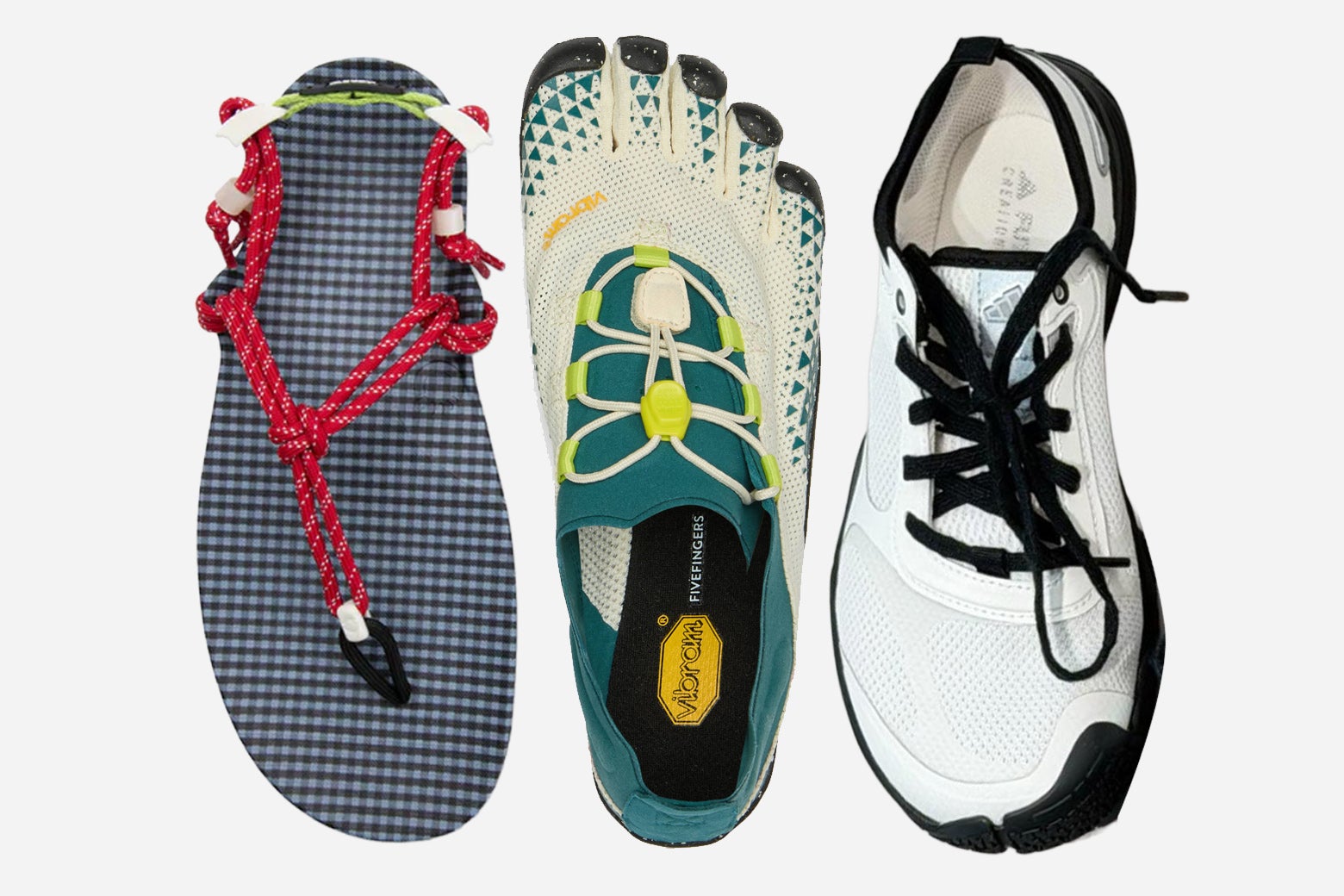
Picture a regular sneaker. What are the characteristics you’ve been told make for a good one? Padding? Arch support? Stabilizers? A heel that’s higher than the toe? A narrow forefoot so it looks cute? Now take away the cushioning, put the heel on the same plane as the toe, make the sole flat and flexible, widen the toe box, and there you have it—the typical barefoot shoe.
The irony, Steven Sashen, the founder of Xero Shoes—a 16-year-old stalwart in the field of minimalist footwear—told me, is that before the great engineering of the American sneaker began in the 1970s, and before the likes of Vibram remade the barefoot shoe movement in its toe-forward image, runners already wore shoes that shared many characteristics with the second sneaker. And, while the minimal shoe may now feel like a throwback for people who live in Western countries, it’s still a normal, default shoe in many other places. As Western runners discovered by reading the 2009 bestseller Born to Run, by journalist Christopher McDougall, Mexico’s Indigenous Tarahumara people have traditionally raced, with extraordinary endurance, in very minimalist huaraches, a kind of sandal often made these days with upcycled tire soles.
Born to Run deserves much of the credit for the Obama-era wave of interest in barefoot shoes. People who read McDougall, or the work of the Harvard evolutionary biologist Daniel Lieberman, around that time became convinced that running injuries could be caused by cushioned running shoes. The problem, they argued, was with the heel-strike gait that modern running shoes encouraged. This initial contact with the ground via the heel, they said, deviated from a lighter and more natural forefoot or midfoot strike, with each touchdown of the heel generating more force for the body to absorb. Enthusiasm for the opposite kind of shoe swelled, and, for a time, it felt as if barefoot shoes were going to be the next big thing. The barefoot styles “have been flying off the shelves,” a shoe store owner in Idaho, interviewed by Footwear News in 2011, said. “If it fits, I suggest you get it. No sooner do we get a shipment and they’re gone. Our customers want them badly.”
But this first flush of 21st-century interest in the barefoot concept deflated a few years later. The problem, as Sashen remembered it, was that in order to reap the benefits of barefoot running, “there was an idea that all you had to do was switch shoes, which isn’t true, and some people were not having great experiences.” Vibram settled a class-action lawsuit brought by customers who claimed that the company’s sales pitch—that their shoes would strengthen feet and reduce injury—was overblown. This was just a settlement, and a relatively small one, but since non-devotees really enjoy making fun of this kind of shoe, you got gleeful headlines like Vox’s “Science, American Legal System Confirm Barefoot Shoes Are Bullshit,” which can’t have helped the category’s reputation.
Sashen believes that the trend also subsided around this time because mainstream shoe companies pulled back on making barefoot shoes, facing a branding conundrum in marketing both barefoot and padded sneakers, and so there were simply fewer barefoot models for people to buy. “They couldn’t tell two stories,” he said. “They couldn’t tell a thick story and a thin story.”
I didn’t come upon barefoot shoes until after the entire Vibram wave receded, after I had sufficiently messed up my feet in my 30s. My story probably isn’t so different from that of the estimated 8 of 10 Americans over the age of 18 who say, per an American Podiatric Medical Association survey, that they have experienced a foot problem: I had spent years, as a grad student, alternating between chasing high-heels authority in the classroom and squeezing my feet into climbing shoes at the bouldering gym. It didn’t help that I was sitting in front of a computer eight to 10 hours a day, creating a weak stiffness in my hips that seemed to flow down my body and pool in my feet. The result: soreness in the arches and on the inside of one ankle that came and went, getting worse with running or after a long day of walking on concrete.
Many people resist transitioning to barefoot shoes because they’re unfashionable, but at the time of these revelations, I was a fortysomething mom working remotely in Ohio. I didn’t give a crap about anything but the promise of rehabilitation. I would bet $20 that I first heard about the minimalist-shoe idea in yoga class. I started creeping around on barefoot social media, and brands began to find me. I first bought a pair of completely flat Mary Janes from the Oregon company Softstar for everyday wear, then some Vapor Glove trail runners—low to the ground, barely there—from Merrell, for walking. Strutting down the street in my Vapor Gloves, trying to feel the ground with each foot and pull it toward me with my glutes and hamstrings, like some TikTok I’d seen told me to do, I experienced moments of revelation. I had block-long stretches of feeling like a panther on the prowl: intentional and smooth, in control.
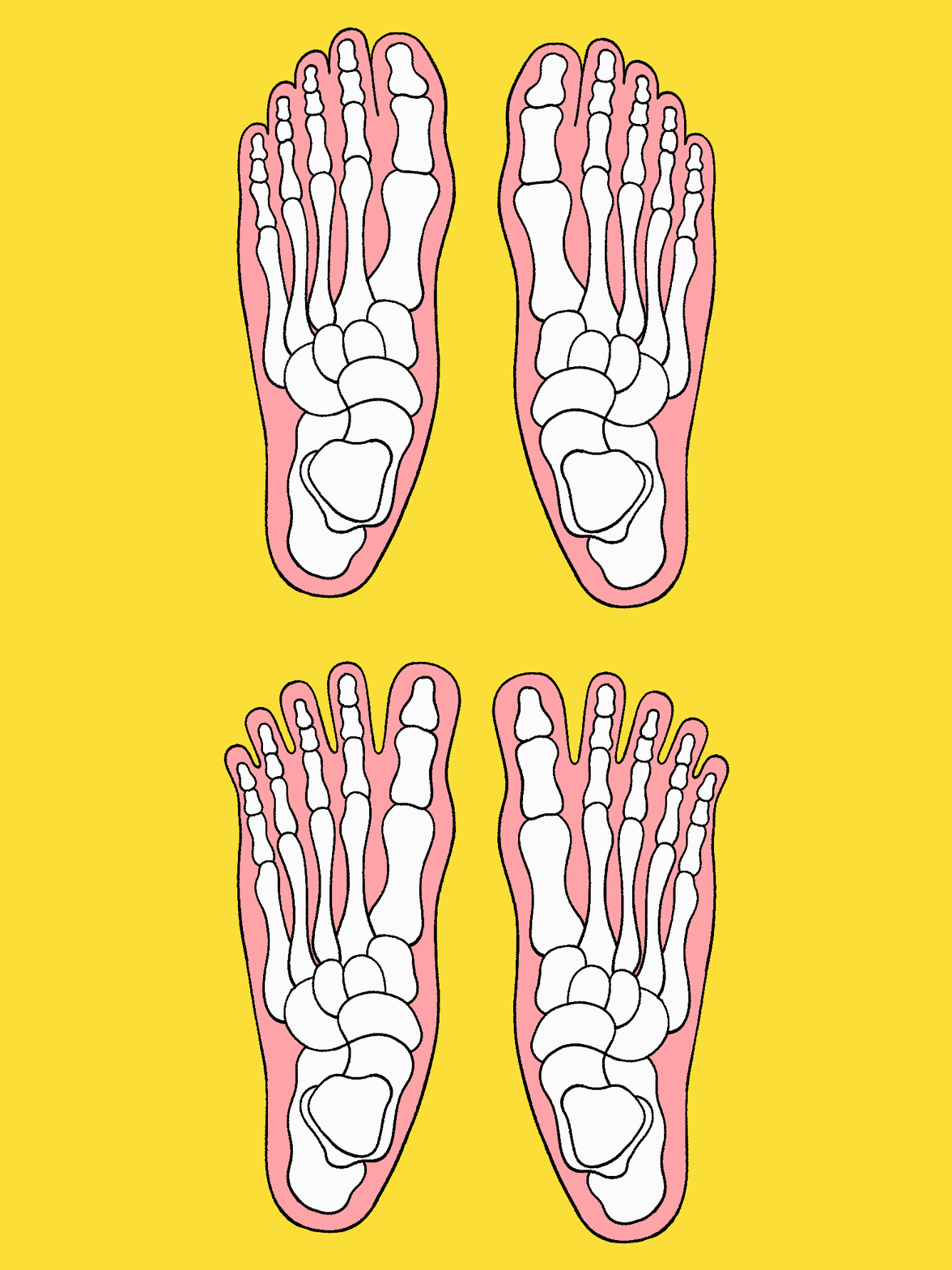
I wanted more. I developed a habit of walking completely barefoot on the bike path on warm days, freaking out my neighbors. I started to put damage on my disposable income, most egregiously by purchasing CorrectToes spacers, which cost $65 and spread your toes apart to encourage better weight distribution, balance, and foot mobility, and made the tops of my feet feel insane—in a good way. (The Barefoot Shoe Expo was the first place I’ve ever been where I saw other people wearing these spacers in the wild.) I bought balls and bands to roll out my feet and exercise individual toes, and downloaded courses full of balance exercises. I went up a shoe size, which is common for barefooters. (The community shares pics online of toe-splay progress). Soon all of my regular shoes were gone, replaced by sneakers and winter boots from Xero, Chelsea boots from Be Lenka, and completely flat, dirt-cheap water shoes from a dubious company on Amazon, for summer hiking and creeking. I threw out most of my old shoes instead of rehoming them. It hurt a little to see so many Chuck Taylors (flat, but far, far too narrow to be recommended by any barefoot-shoer) go in the trash, but I couldn’t sentence my friends to bunions, not now that I knew better.
Yes, I have been self-righteous, and fairly insufferable. I picked it up online. Consuming too much of that “If you wear THESE shoes, you need to STOP!” content has turned me into the kind of person whose reaction to the scenes where Ben Affleck as Phil Knight puts his bare feet up on his desk in the movie Air was to tut-tut at Affleck’s foot, which looks squashed and pointed, as if he’s worn a lot of Nikes. One presenter at a workshop at the Expo joked that after he took off his shoes at a like-minded colleague’s house, the colleague’s child, lightly indoctrinated in his parents’ habits in the way of all kids, observed that the visitor was wearing “the bad socks,” aka normal, non-toe-socks. The minimalist-footwear faithful believe that normal socks are like “mittens for the feet”—constrictive, undermining all of your good work in wearing minimalist shoes. (Wearing regular socks, one barefoot fan wrote on Reddit, is like “fighting with one hand tied behind your back.”)
A few years ago, after seeing a lot of anti–“foot mitten” content online, I couldn’t help it: I invested in a few pairs of Injinji, which take what feels like half an hour to put on, drawing my family’s mockery, but feel amazing. Inevitably, after spending so long obsessing over my feet, I have become the kind of person who, if I wear “the bad socks” by mistake, can feel every inseam.
Now the billion-dollar question: Are barefoot shoes actually good for you?
There’s a commonsense answer that people who love them will give. Over Zoom, Sashen, the Xero co-founder, explained how he pitches minimalist shoes to people who don’t yet believe in them. “I ask people, Which is better, weaker or stronger?” he says. “If I put a cast on this”—he pointed to his elbow—“I couldn’t move it, and all the muscles, ligaments, and tendons get weaker.” What would happen, he asked rhetorically, if you supported all the joints, muscles, ligaments, and tendons in your foot with “something that doesn’t let it move”?
“Which is better: being numb and oblivious to important things, or being aware of important things?” he went on, noting the sensitivity of the foot. Minimalist footwear, Sashen argued, “informs the form,” giving your body information about how to walk.
While that may be true to some people’s experiences, the reality is that scientific data proving the positive value of barefoot shoes is still in the process of accumulation. Part of the issue with arguing that “barefoot is better” is that the positive value of common characteristics of conventional footwear isn’t necessarily proven, either. In a 2025 critical review gathering existing research on minimalist footwear, a group of European biomechanists argued that conventional Western shoes incorporate design features that “interfere mechanically with the body,” and that for people without issues with their feet, there wasn’t proof that these features—cushioning, arch support, structural stiffness—were merited. (As for narrow toe boxes and high heels, marks of nobility in centuries past that have persisted in our shoe design, nobody is going to argue that these are good for you, even if they do look great.)
Even if there isn’t yet a verdict one way or another, though, a growing body of research on the benefits of minimalist footwear offers some hope to barefooters. In 2013, Sarah Ridge, a professor of physical therapy at the University of Hartford, studied groups of people who ran barefoot, in standard running shoes, or in Vibram FiveFingers, transitioning into them by using the company’s advice for how to make the jump (which amounted, in her memory, to “really very little guidance,” as she told me). Ridge and her colleagues found increased bone marrow edema (an inflammatory response associated with injury or infection, and “a manifestation of added stress on the foot,” per the study) in the FiveFingers group, and concluded that people looking to try out minimalist running shoes should make slower and more gradual transitions to the footwear.
Six years later, Ridge and colleagues published a paper with more conclusively positive findings. The research, often cited by barefoot advocates, found that a group of runners wearing minimalist shoes for walking developed stronger intrinsic foot muscles (those muscles that are found entirely inside the foot, rather than connecting to the lower leg) than either a control group or a group assigned to carry out an exercise program. This study design was partially inspired by another finding arrived at in the course of the 2013 FiveFingers study: Although foot strength was not the focus of that research, the investigators found that people who developed more bone marrow edema in that transition into Vibrams had smaller foot muscles when they began the transition, as compared to those who developed less edema. The 2019 study’s results looked at strength. Put together, the two findings suggested something positive: If wearing these shoes could strengthen your feet, and people with stronger feet experienced less bone marrow edema, could wearing minimalist shoes in everyday life help people avoid developing foot problems?
It’s still not totally clear what the strengthening of the intrinsic foot muscles does for a person’s outcomes, clinically speaking, especially for a person with existing foot issues. With fellow professor of physical therapy Irene Davis, Ridge is now studying the use of minimal footwear for plantar fasciitis, operating on the theory that strengthening the foot muscles could transfer some of the force of walking away from the plantar fascia and improve people’s pain. Last year, two other physical therapists published a study finding that older adults who wore minimalist footwear improved their balance and reduced fall risk, with 51.9 percent of a control group and 76.9 percent of the minimal footwear group remaining fall-free during the study’s yearlong duration.
What all this amounts to so far is some good news and many open questions. (Slate’s science editor wants me to tell you that she thinks this is a “very scant” amount of research; meanwhile, I’m preparing my minimalist-shoe PowerPoint presentation for my baby boomer parents as we speak.) For another view, I wanted to talk to a podiatrist outside the barefoot world and asked Jonathan Rose, author of The Foot Book: The Complete Guide to Caring for Your Feet and Ankles, to respond to a list of claims I had heard about minimalist shoes online, like the bad effects of sneakers with an elevated heel, or the idea that flip-flops make your toes clench—received wisdom that could be anecdotal, folkloric, or supported by science, for all Instagram tells you.
For many of my statements, like “People should be able to spread their toes. Spreading toes using foot separators may help with your foot problems,” Dr. Rose’s response was, “This statement is too general,” or “It depends on the patient.” When I asked what his top-level opinion of minimalist footwear was, he said, “Not a big fan.” From his perspective, the science wasn’t resolved in a way that could prove clinical or functional impact, and for some pathologies he sees in patients, a flexible shoe wouldn’t be great.
“There is all this evidence of increased [intrinsic] muscle size, possible decreased ground reaction force with minimalist shoes for barefoot running, increased toe flexor strength, increased ankle dorsiflexion, decreased knee stress, increased ankle stress, decreased stride length, decreased … force on the heel, increased force on the forefoot. But what are the clinical implications of that?” he asked. “Does it rob Peter to pay Paul? You may not injure one structure, but now you’re injuring other structures.”
The lack of standard, scientifically supported guidance for transitioning from regular shoes to barefoot shoes also struck Rose as a problem, as was the low likelihood that a person might stick to such a regimen if offered. (I am good evidence of at least one person who won’t.) “No one’s got the perfect foot,” he said, “so you just have to be careful.”
For a lot of people, the barrier to barefoot entry isn’t so much questions about their efficacy but their aesthetic. Something is probably wrong with my eyes, because I don’t mind the way my feet look in these shoes. I’ve seen people describe the shoes as giving wearers “pancake feet,” “platypus feet,” “duck feet,” and “Flintstone feet,” among other colorful descriptors. “Why do all barefoot shoes look like they were designed by a survivalist with a minimalist Pinterest board? They all have that same boxy, practical, vaguely hobbit-esque vibe, like I just got back from a silent retreat and exclusively pay for things in hemp,” a Redditor, clearly going through it, complained in the r/barefootshoestalk subreddit.
Given this hobbit-foot-sized hurdle, and the fervent purism certain minimalist fans exude, how are barefooters supposed to proselytize their favorite shoes? “How do we spread the message without it feeling like it’s a cult?” asked Anya Jensen, an influencer who also sells barefoot shoe brands, and whose blog, Anya’s Reviews, is everyone’s first recommendationnto newbies, when I asked her what the future was for the category.
Jensen, an ethereal and intense presence, is also the organizer behind the Barefoot Shoe Expo. She told me that she has seen the community change a lot in the decade since she first became interested in minimalist footwear. “The demographic of people at the Expo are lifestyle wearers,” she said. “They’re thinking about comfort and future-proofing feet.” But these consumers alone can’t support all the companies making barefoot shoes. “At the beginning, there were so few options” that people would buy just because they were interested in the type of shoe, Jensen said.
Now, though, with so many competing alternatives on the market, “these companies have to either be growing the community or reaching people outside.” Jensen pointed to companies that could reach both the barefoot and mainstream consumer, like Splay Shoes, which has a skate-shoe line. Black Cicada, another smaller barefoot company, whose founder Woby Lang’s workshop I attended at the Expo, is similarly merging aspects of the barefoot world and conventional sneaker culture. Its offerings combine a wide toe box with some cushion and a thicker rubber outsole in a shoe that has style to it, using fabric to draw the eye from the toes.
“I don’t want to feel the energy returning through my heel all the way to my brain if I improperly plant my heel playing basketball,” Lang told me, explaining his more hybrid approach to shoe design. “I want my feet to not be sore on Day 2 of a weeklong trip in Tokyo.”
It’s a sentiment echoed by others in the world of online barefooters. “I believe that both the conventional footwear industry and the barefoot shoe industry leave many of us behind. Conventional shoes are often made with little regard for what they actually do to our bodies. Barefoot shoe companies assume that everyone should be able to wear thin-soled shoes as long as you’re willing to do the work to transition into them,” a Substacker calling herself Cat wrote in her newsletter Beyond Barefoot. In an argument that barefoot brands should consider making barefoot shoes with thicker soles, she wrote: “If concrete and asphalt didn’t exist, wearing barefoot shoes (or no shoes) would likely be fine for most people today. But since many of us live in unnatural environments and have to walk primarily on manmade surfaces, we should choose footwear that reflects the reality of the world around us—not the reality we wish existed.”
I like that, this reconciliation of what we want versus what we have in front of us. As appealing as the idea of a totally barefoot life may be, my reality is this: I still stare at a computer for eight to 10 hours a day. My toe strength remains pitiful. It’ll always be an uphill battle to get my mom into a wide toe box. (Please, Mom, it’s for your own good.) But ever since I started wearing these shoes, and doing foot exercises when I remember them, my ankle mobility has improved, my squat is deep, and I can actually feel the muscles in the arch of my foot. That’s much more than I could have said back in my high-heels days.
On the last day of the Expo, rolling suitcase packed, I attended a workshop put on by the foot-health education group Foot Collective, where attendees paired up and screened one another for balance. My partner was an extremely game yoga teacher a couple of decades older than I am, and we thought we were doing great, excelling at the first challenge of standing on a single leg with eyes open for 60 seconds. Then came the next exercises in the assessment—“single leg, eyes closed,” “single leg, heel hover, eyes open,” and “single leg, heel hover, eyes closed”—which humbled us completely. The cheerful young presenter talked us through a few practices to help, including ankle pumps, where you move your feet like paddles to improve circulation. Identifying the characteristics of different footwear, he asked the assembled to share shoe examples so he could demonstrate.
“Does anyone have a Hoka?” he asked, asking for a famously popular shoe that represents everything a minimalist-footwear enthusiast should hate. A workshop attendee sheepishly offered one up, right off his foot. The rest of us, involuntarily, went, “Ohhhhhhhh,” laughing like kids in class when a peer gets busted. I was relieved. I met some people with excellent toe splay at the Expo. But I also met Hoka Guy.
After years of wearing barefoot shoes and delivering annoying lectures to friends and family (ask me whether Birkenstocks “count” as barefoot—better yet, don’t), I have a confession to make: My feet still, sometimes, hurt.
For the longest time, I’ve blamed myself. If I were barefooting correctly, wouldn’t I feel like a panther 24/7? But attending the Expo, rather than radicalizing me into even more of a barefoot warrior, has led to me letting go of those beliefs, just a little. Paradoxically, all it took was going to a place where more than 2,000 people sold on barefoot gospel had come together. Online, it can look like everyone is thriving, while never indulging in a millimeter of cushion. In person, the scene looks a lot more like regular people just trying their best to feel better for longer, and attempting not to spend all their hard-earned cash on the many expensive toys for sale on the convention floor (a $359 standing board that felt incredible; a $129 cork cylinder kit, recently revealed to be part of Knicks point guard Jalen Brunson’s training routine, that packs a bunch of resistance bands, rollers, and toe spacers into itself and breaks open to become a balance beam; cute $80 Chelsea boots with rainbow soles that my daughter would love).
I couldn’t stop myself from indulging in a couple of things, though: a $20 pair of great-feeling green toe socks from PedTerra that my husband immediately texted me about after receiving the Shopify notification, and $94 Earth Runners sandals, equipped with a copper plug that promises to connect me to Gaia. I must admit, they don’t seem to be grounding me any more than my other shoes—then again, I guess it’s only been a couple months. But I think they look great. I’ll give them time.