meet your typical
Like many girls her age, she loves to keep up with the latest fashion trends and explore new ways to express herself. Shopping is fun, but it won’t always be this way.
fit 4 a


with Jan Diehm
I remember once being that teen girl shopping in the women’s section for the first time. I took stacks upon stacks of jeans with me to the dressing room, searching in vain for that one pair that fit perfectly. Over 20 years later, my hunt for the ideal pair of jeans continues. But now as an adult, I’m stuck with the countless ways that women’s apparel is not made for the average person, like me.
Children’s clothing sizes are often tied to a kid’s age or stage of development. The idea is that as a young person grows older, her clothes will evolve with her. Youth styles tend to be boxy and oversized to allow room for kids to move and grow. By early adolescence, apparel for girls becomes more fitted. Junior’s styles have higher waistlines and less-pronounced curves compared to adult clothing lines. In short: clothes for tweens are made for tween bodies.
By the time most teenage girls can wear women’s clothes — around age 15 — their options are seemingly endless. But the evolution in clothing sizes that followed girls throughout childhood abruptly stops there.
This is the reality I find myself reckoning with today: Women’s clothing — designed for adults — fits modern teen girls better.
Age: 14-15
Sizes: Women's
Waistline in Inches
Pain is


Few life experiences feel as universal, across generations, as the pains and frustrations of trying to find clothes that fit.
Sizes vary wildly from store to store. Even within a single apparel company, no one size is consistent. There are no regulations or universal sizing standards. Instead each brand is incentivized to make up its own. When size guides change — and they’re always changing — brands are not obligated to disclose updates.
There are also often different sizing structures for every type of garment. “Plus” size means one thing, “curve” means another, and “extended” sizes can be defined as all of the above or something else entirely. Don’t count on any of those sizes to be available to try on in-store, but do brace for return fees if your online order doesn’t fit. Free in-store alterations are largely a thing of the past, while a trip to the tailor’s can cost just as much as the item itself.
The only consistent feature is that the industry at large continues to cling onto the same underlying sizing system that’s been broken for decades. And it’s only gotten worse.
The villain arc of


On top of all these problems, consumers often know the labels for any given size cannot be trusted.
Vanity sizing, the practice where size labels stay the same even as the underlying measurements frequently become larger, is so ubiquitous across the fashion and apparel industry that younger generations have never experienced a world without it.
Cultural narratives around vanity sizing often square the blame on female shoppers, not brands. Newsweek once called it “self-delusion on a mass scale” because women were more likely to buy items that were labeled as sizes smaller than reality. But there’s more to the story.
Vanity sizing provides a powerful marketing strategy for brands. Companies found that whenever women needed a size larger than expected, they were less likely to follow through on their purchases. Some could even develop negative associations with the brand and never shop there again. But when manufacturers manipulated sizing labels, leading to a more positive customer experience, brands could maintain a slight competitive edge.
The dynamic perpetuates an arms race toward artificially deflating size labels. Most shoppers aren’t even aware when size charts change, or by how much. If anything, vanity sizing consistently gaslights women to the point where few are able to know their “true” size. But where would we be today without it?

I once believed that change was inevitable and sizing problems would become a relic of the past. If it wasn’t some scrappy upstart that promised to revolutionize the sizing system, then at least the major fashion conglomerates would be well-placed to modernize and tap the full potential of the plus-size market. But that progress never fully materialized. And I got tired of waiting.
A few years ago, I started learning how to sew. Somehow it felt more practical to make my own clothes than count on meaningful change to happen on its own. Getting started was easier than I thought. The first sewing pattern I ever completed — a boxy, drop-shoulder style that could turn into either a shirt or dress — was free to download. It included a 29-page instruction manual with photos and illustrations documenting every step.
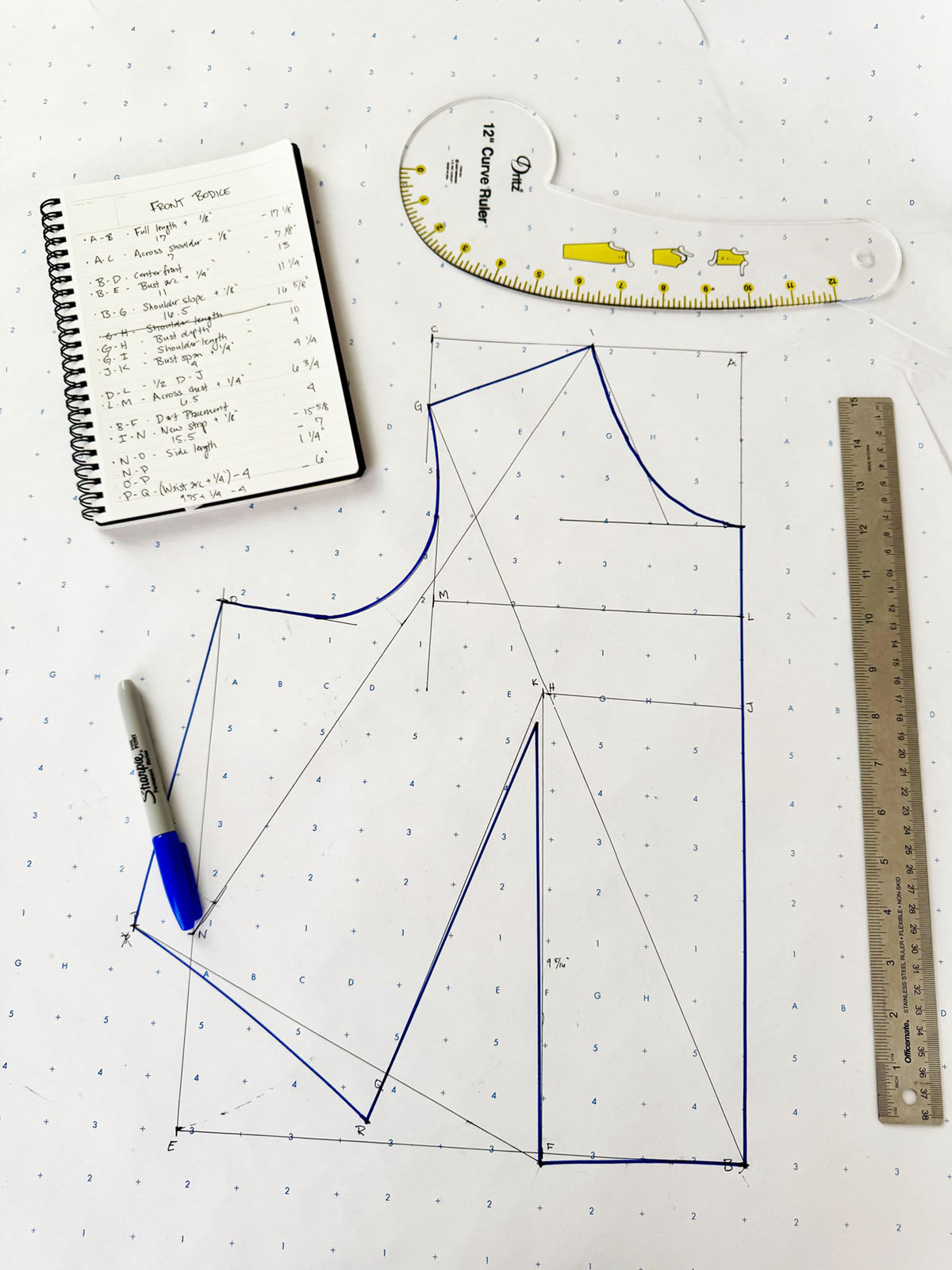
Drafting a custom pattern based on my body measurements and proportions
From there, I started learning how to draft my own sewing patterns from scratch. That’s when I realized the truth behind my sizing struggles: Clothing sizes are optimized for mass production and appeal — not women’s bodies. Nothing represents this more than a size 8.
Fashion designers often use body measurements for a size 8 as a starting point when creating new design samples. Manufacturers then use a mathematical formula to determine each next size up or down the range in a process called grading. The effect is like a Russian doll. Each size up is incrementally larger than the last.
The uniform shape makes it easier for factories to mass-produce garments, however it comes with several tradeoffs. It’s hard to scale up to larger-sized clothing before the proportions become distorted. It also becomes impractical to make multiple versions of a single item to accommodate varying body shapes or heights. That means most women’s clothing is derived from a single set of proportions — a size 8. According to U.S. health data, fewer than 10% of adult women have waistlines that fit the standard sample size or smaller.
I, like the vast majority of women, do not fit the standard mold. Instead I took an old pattern-making textbook often taught in fashion design schools to start making clothes to fit my own unique proportions. I gathered and recorded over 58 different body measurements in order to get started and from there, I could make my own custom base pattern, known as a bodice block or sloper.
Once I compared my personalized sloper to commercial patterns and retail garments, I had a revelation: clothes were never made to fit bodies like mine. It didn’t matter how much weight I gained or lost, whether I contorted my body or tried to buy my way into styles that “flatter” my silhouette, there was no chance that clothes would ever fit perfectly on their own. Finally I understood why.
sizing for





The fashion industry thrives on exclusivity. Luxury brands maintain their status by limiting who is able to buy or even wear their clothes. If few women fit the “ideal” standards, then products serving only them are inherently exclusionary. Size charts become the de facto dividing line determining who belongs and who doesn’t.
This line of gatekeeping is baked into the foundation of virtually all clothing. The modern sizing system in the U.S. was developed in the 1940s based on mostly young, white women. No women of color were originally included. The system was never built to include a diverse cross-section of people, ages, or body types. It has largely stayed that way by design.
In its 1995 standards update, ASTM International admitted that its sizing guidelines were never meant to represent the population at large. Instead body measurements were based on “designer experience” and “market observations.” The goal was to tailor sizes to the existing customer base. But what happens when more than half of all women are pushed to the margins or left behind?
It doesn’t have to be this way. Teenage girls shouldn’t be aging out of sizing options from the moment they start wearing women’s clothes. A woman does not need hourglass proportions to look good, just as garment-makers do not need standardized sizes to produce well-fitting clothes.
There are no rules forcing brands to adopt any particular sizing system. There is no such thing as a “true” size 8, or any size for that matter. If brands are constantly developing and customizing their size charts, then it makes little sense to perpetuate a broken system. Sizes are all made up anyway — why can’t we make them better?
Methodology
To highlight the median body proportions of the adult women in the U.S., we relied on anthropometric reference data for children and adults that is regularly released by the National Center for Health Statistics within the U.S. Department of Health and Human Services.
For this story, we pulled data on the median waistline circumference of women and girls that was gathered between 2021-2023. For girls and women under 20 years old, measurements were recorded in two-year age ranges (ex: 10–11 years, 14–15 years), with a median of 141 participants per age range. For women over 20, measurements were recorded in nine-year age ranges (ex: 20–29 years, 30–39 years) and collectively for all women 20 and older. Each nine-year age range had a median of 465 participants. Overall, measurements were recorded for 3,121 women ages 20 and older. Those who were pregnant were excluded from the data.
HHS also provides a breakdown of measurements within set percentiles for each age range, which includes figures for the 5th, 10th, 15th, 25th, 50th, 75th, 85th, 90th, and 95th percentiles. We then used that percentile data to extrapolate the waistline measurements of all women and girls within each respective age group.
We also compared figures to those recorded by HHS from 1988-1994. There, 7,410 women ages 20 and older participated in the study. Measurements were originally recorded in centimeters, so we converted to inches.
Brands included in the size chart comparisons represent a diverse cross-section of popular apparel brands and retailers in the U.S., including a mix of mass market, fast fashion, premium and luxury labels.
For each brand, we focused on collecting body measurements for “regular” or “standard” size ranges, as well as “plus” sizes when available. Sizing information for “petite,” “tall,” or “curve” clothing lines were not included. Size charts reflect the body measurements for garments categorized as general “apparel.” In a select few cases where that category was unavailable, “dresses” were used as the default garment type.
Within each size range, we focused on collecting three main body measurements: Bust, waist, and hip. Some were presented as a range from minimum to maximum values, while others were single measurements. All numeric U.S. women’s sizing labels and descriptions were recorded, as well as their corresponding alpha sizes, when available.
Size chart data was last manually captured in July 2025 and may not reflect a brand’s current size chart. Brands frequently change their size charts, and more often than not, shoppers aren’t even aware when measurements or sizes are updated.
The standardized size charts refer to ASTM International’s regular release of its Standard Table of Measurements for Adult Female Misses Figure Type. The 1995 release (designated as D 5585-95) reflects sizes 2-20. ASTM updated its standards in 2021 (designated as D5585-21) to include sizes 00-20.
Ransom note letters are from Indieground.