The Forgotten Bombing of LaGuardia Airport
It’s been called “one of the greatest cold cases of the 20th century.” It remains unsolved. But what happened next is almost a worse crime.
Until 6:30 p.m., the evening of Dec. 29, 1975, had been like most others at New York City’s LaGuardia Airport. The main terminal wasn’t terribly crowded. Two flights had arrived in the past hour: one from Indianapolis, the other from Cincinnati. Most everyone had cleared out by then, but there were stragglers.
Among them was Enoch Stamey, 38, who stood just outside the airport’s doors. The gifted artist with an eye for color had just returned from visiting his mother in Raleigh, North Carolina. He was joined by Bynum Patterson, who, like Stamey, had traveled on Eastern Airlines Flight 564. Both awaited cars to take them to Connecticut. Patterson, 37, was a display director for the Bloomingdale’s in White Plains. He, too, had been visiting his mother.
Inside the terminal, Edythe Bull, 72, had missed the bus and was waiting for the next one. Hailing from Brevard, North Carolina, she worked for the nonprofit Keep America Beautiful. Bull was set to begin an around-the-world trip with a friend in Wilton, Connecticut. Milling about, too, was Othelyn Elaine Little, 25, an insurance underwriter from Yonkers, New York. She’d spent Christmas in Durham, North Carolina, with her mother, Bessie.
Nearby, a driver for a limousine service chatted with his dispatcher. “I got my Wantagh passenger,” he said. “Where do you want me to go next?”
The dispatcher heard a sudden roar. “It sounds like a bomb at TWA,” she joked to her co-workers.
She then addressed the driver, Frank Musicaro, a father several times over who was from Long Island. Musicaro had once gotten Cher’s autograph, and loved to tell his children stories of celebrity fares.
“Frankie! Frankie!”
Silence.
“Frankie, are you there? Frankie, are you there?”
The dispatcher could hear a lot of noise, but nothing else. She thought maybe he’d dropped the phone. Then she got a call from another driver: LaGuardia had been bombed. Musicaro and a second driver were buried in the rubble.
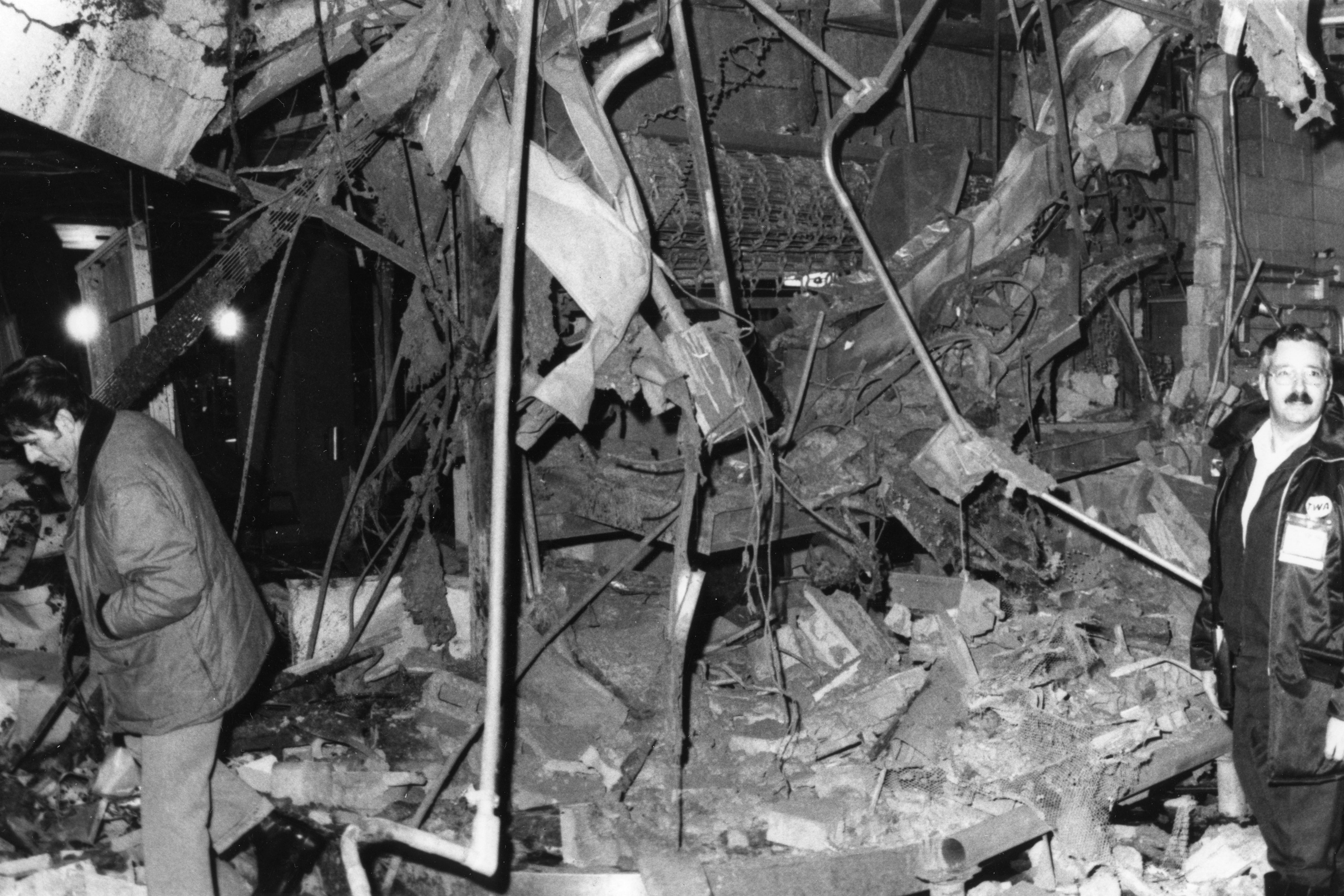
The explosion was immense, commensurate in intensity with 25 sticks of dynamite. It was as if a twister had hit the terminal. A 12-foot-wide hole was torn in the 8-inch-thick concrete ceiling. A football field’s length of plateglass windows were blown out. Pieces of red lockers littered the parking lot. Water geysered from the busted pipes.
All told, an estimated 75 people were injured, and 11—including Stamey, Patterson, Bull, and Musicaro—died as a result of the blast. The violence was such that, within minutes, 175 pints of blood were immediately shipped to city hospitals from the bank on Amsterdam Avenue. Corpses sat on-site in pine boxes before transport to the medical examiner’s office. There was an account of a human head resting on a window ledge, and puddles of blood soaking the island next to the parking lot. “The explosion ripped upwards and outwards,” reported CBS News’ Ike Pappas the next evening, with the deceased “caught in the crossfire of glass and metal that sheared off limbs and tore through bodies.”
It was, recalled the EMS dispatcher on duty that night in Queens, “a horror.”
The tragedy at LaGuardia Airport was the city’s largest mass-casualty act of terrorism since the bombing of Wall Street in 1920. The law enforcement response was swift and enormous, involving hundreds of investigators across multiple agencies, local and federal. At the time, it was considered to be the largest investigation in the history of the New York Police Department.
Now, more than half a century later, it’s as if the bombing never happened. After extensive research, I could not find so much as a marker, on-site or elsewhere, commemorating the lives lost. When I tell people about it—even those old enough to have lived through the event—I’m greeted with shock that such violence could escape their memory. New Yorkers have a shared consciousness; talk to someone who’s lived here long enough, and they’ll tell you stories about Etan Patz’s disappearance or David Berkowitz’s murder spree. The LaGuardia bombing isn’t part of our collective memory.
But it ought to be. In an effort to reconstruct the story of what happened that winter night, I’ve spoken to people close to the event, including survivors, family members of victims, and investigators. No one had contacted them about the bombing for decades, including the investigating agencies. When I began leaving messages for them, one survivor wondered if the phone call was a prank.
I found this neglect hard to fathom. Part of it has to do with what happened after the attack. Despite the massive investigation, the bombing of LaGuardia Airport is, in the words of a reporter who covered it, “one of the great cold cases of the 20th century.” To date, what happened on the day of the explosion and during the subsequent weeks has not been fully explained, or documented. It’s time to merge the disparate threads into a single comprehensive story—one that people won’t forget.
News of the explosion quickly reached the Oval Office. President Gerald Ford was on vacation in Vail, Colorado, but an adviser briefed the new White House chief of staff, Dick Cheney. Hundreds of agents from the Federal Bureau of Investigation’s New York field office had been dispatched to assist the local police. As it happened, one of their own—an agent who’d flown back from spending the holidays in Indianapolis—had a leg blown off and was hospitalized in Queens.
But in the minutes after the explosion, it was, for at least one police aide, an open question whether city officers could even enter property owned by the Port Authority, an agency run jointly by New York and New Jersey. “Are you allowed to go into that?” she asked a patrolman. In a maelstrom, one might think such niggling questions of jurisdiction and their attendant turf wars would be set aside. They weren’t. “We were competing against the New York Police Department,” a retired federal agent told me. “We never got along with the FBI,” recalled a retired NYPD sergeant in turn.
The investigation was headed by NYPD Deputy Chief Edwin Dreher, who had a reputation for solving difficult cases. His colleagues in the Police Intelligence Unit, along with agents from the FBI and ATF, had no choice but to be civil. Anyway, they had a mutual interest—learning more about the explosive mechanism. The rival investigative entities came together in LaGuardia’s American Airlines Hangar 1, where they examined blast debris, including luggage, the lockers, and a timing device and battery parts, all in an effort to reconstruct the red lockers, and the bomb itself.
In the meantime, investigators headed to local hospitals to interview survivors, whose names, along with those of the dead, ran in newspapers across the country.
Robert Dickman, for one, was convalescing at a hospital in Queens. The college freshman had arrived at LaGuardia after a flight from Chicago. He was in town to see a roommate who’d promised to take him to Times Square, but the roommate, who lived in the Bronx, was delayed picking him up, and Dickman would have to hold tight for a couple of hours. To pass the time, he sat near the baggage area used by Trans World and Delta airlines, his back to the lockers about 40 feet away. At the instant of detonation, an exhausted Dickman was drifting in and out of sleep, his feet resting on luggage.
The explosion blew him out of his seat and onto the floor. Standing up as debris fell around him, he waited for the dust and insulation to settle. Then he took in his surroundings. A woman who’d been sitting across from him, directly facing the lockers, wasn’t moving. Dickman made his way out to the sidewalk. There was a woman screaming and a man bleeding severely from his leg. Dickman took the man’s belt and tied it around the wound. Then he saw another man in full military uniform, whom he remembered from inside, having been struck by the man’s white clothing. “The next time I saw him,” Dickman recalled, “he was blown out of the building, across the taxi and rent-a-car desk, and laying on the sidewalk—and his leg was missing.”
Dickman didn’t have much to tell the police. “I’m a Midwestern boy, and I try to mind my own business,” he told me.
Dickman is one of the survivors of the blast to whom I’ve spoken over the last year. There aren’t many still around. I also met Maureen Reinecke, 17 at the time of the bombing, who’d returned home with her mother from a college interview at Chapel Hill. When the bomb went off, she was about 30 feet from the lockers, by the Connecticut Limousine stand. Her mother was outside. “I immediately ducked down, put my hands up, and covered my head,” she said. In an effort to escape the terminal, she pressed on a plateglass door, which shattered on the sidewalk. Reinecke incurred a slight injury to her right hand, but her mother was hit by the blown-out glass. She, too, survived, but was left with scars.
Pam Blaschum, a TWA flight attendant, had been on a flight that arrived early. She was downstairs in operations when she heard a loud noise. When a man from the commissary ran in with an order to evacuate the building, Blaschum went upstairs to find her flying partners. “As I was running through the terminal looking for them,” she told me. “I noticed there was glass everywhere, and people were running, and this one guy ran past me—he had blood all over him.” Later, an FBI agent visited her at home, but she told me she had nothing of use to say.
Also at a geographic remove was Kevin Kroencke, a 20-year-old Army private. Dressed in his green uniform, Kroencke was waiting for a flight back to Fort Riley, in Kansas. A level up from the baggage area, he and his family kept an ear out for the gate announcement. And then, out of nowhere, boom. Despite having been in basic training only eight months, he knew what that meant, and dove for the floor. Then he felt a kick to the ribs and heard his father, a military veteran, saying, “Are you OK? Are you OK? Get up, get up—people are hurt.” He stood up, and noticed that the concrete floor had buckled like a tectonic plate. The private saw a woman on the ground hyperventilating and holding a baby as her husband yelled for help. Kroencke, a medic, approached the woman and attempted to soothe her, concerned that she might lapse into shock. Upon calming the woman, he spotted a man whose leg had been cut by glass. He wrapped the leg to stanch the bleeding.
Then, in a strange turn, Kroencke heard an announcement that his flight was boarding. He went downstairs and found that, in fact, due to the carnage, there would be no flights departing from LaGuardia, which would not reopen until the next day. This presented a new worry: being declared AWOL. As it happened, that particular anxiety was unfounded: Back on the Army installation, everyone had seen him on television.
The bombing of LaGuardia came at a time when airport security was, from today’s vantage, unimaginably lax. This was an era during which “you could just walk onto the tarmac without a ticket,” said Brendan Koerner, author of The Skies Belong to Us. Two years earlier, the FAA had begun to require that all carry-on luggage be X-rayed for weapons and passengers be scanned by a metal detector. A month after that, the country’s 531 passenger-carrier airports introduced law enforcement officers into the screening and boarding process.
The area of LaGuardia by the public lockers, however, was a dead zone for security, either electronic or human. Anyone, whether or not they worked at the airport or had a plane to catch, could walk in and leave an item as big as a suitcase. This remained the state of affairs even after a bomb exploded in a locker at Miami International Airport in October 1975—not three months before the LaGuardia bombing. In the aftermath of that incident, both the FAA and the Port Authority had the power to move the lockers beyond the security barrier. But the FAA’s thinking at the time, a former administrator told me, was that the administration’s “responsibility was to evaluate what kind of threats would exist to aircraft,” and the public lockers were not believed to be among them. Presumably, it wasn’t worth inconveniencing passengers over a bombing that resulted in damage to the airport, but not the planes.
Back in Washington, the Department of Transportation concluded that this laissez-faire attitude had to change, and began high-level discussions with the nation’s aviation executives. The Advisory Committee on Airport Security was formed, largely made up of administrators of senior FAA staff and aviation trade associations. There was concern in that group that its inner workings should be hidden from the public because, as the executive order put it, certain proposed solutions “will be ineffective if commonly known.”
Whatever the group came up with would have considerable ramifications, given the level of traffic at American airports. LaGuardia alone, John McLucas told President Ford, saw 38,844 passengers a day, and nationwide there were more than 1 million. Certainly, the task force members were aware of how many vulnerabilities there were across the aviation system. “Seems above all, that in public discussion, we wish to avoid emphasis of the enormity of the problem,” someone scrawled on a copy of the meeting notes that are now held in the Gerald Ford Presidential Library.
As a result of the task force, McLucas ordered an overhaul: public lockers, of which there were 14,000 total in 140 airports, would be moved to more secure areas. There would be stricter handling of checked baggage, including increased use of X-ray systems. And now, existing X-ray machines would be modified to detect explosives.
In the Oval Office, the investigation in New York City was followed closely. Three weeks after the bombing, President Ford’s acting attorney general informed the national security adviser that debris had now been removed from Hangar 1 and shipped to an Army research facility in New Jersey for further testing by ordnance experts. “They are beginning to put together what appears to be a crude bomb,” as a memo put it. “They haven’t identified what kind of bomb it was, but they do believe that the timing device was made out of an ordinary wind-up clock.”
In truth, despite the considerable effort expended by law enforcement, the investigation went cold nearly as soon as it began. “We’re grabbing for straws, trying to develop something,” an officer told the New York Times within 24 hours of the bombing. Because this was an era when the press often worked hand-in-glove with the police department, the failure wasn’t hidden from the public. Three weeks after the bombing, the Daily News reported that investigators “admit that thousands of hours of painstaking work have not put them on the track of anyone who could be called a likely suspect.” The chief of detectives, Louis Cottell, for his part, made no effort to hide how flummoxed he was by the killer’s refusal to take credit. “Why the hell would someone do this?” he asked. Years later, research would show that many terrorist attacks are neither claimed nor attributed.
The leads (that were made public, at least) never held much promise. Forty minutes after the bombing, a 12-year-old girl called 911 to report that she’d heard two men call the police just before the explosion to discuss “a bomb at the airport.” That was determined to be a hoax. The NYPD combed through its file of men, women, and children who had either been incarcerated for bombmaking or were suspected of it. One of the people worth a look was a middle-aged man named Walter Long, who was suspected of being the so-called Sunday Bomber who had set off a series of explosions around New York City in 1960. The police and FBI took pains to stress that Long was not a suspect in the LaGuardia bombing. Rather, conveyed the Daily News, he was simply “high on their priority list of persons they wish to interrogate.” Long walked into the 10th Street precinct carrying a copy of the newspaper and, after four hours of interviews, was sent home. Another area of inquiry was the idea that the bomber had a grudge against the Port Authority, whose facilities had endured years of threats. That, too, didn’t seem to gain traction.
From the beginning, the victims were scrutinized on the chance they might provide a motive. The FBI agent from Connecticut piqued investigators’ interest, as did another man thought to have ties to the CIA, but that line of inquiry went nowhere. At the time of the explosion, there were approximately 300 people in the vicinity of baggage claim, but there was no evidence to suggest any had been a target. Indeed, that was effectively unknowable because, as the NYPD’s chief of detectives told reporters, they had learned that the bomb could’ve been timed to go off anywhere in the 12 hours prior to actual detonation. In any case, investigators did not believe this was a run-of-the-mill murder.
It would be some months before a worthwhile lead materialized, after the killing of a policeman.
On Friday, Sept. 10, 1976, a Croat named Zvonko Bušić, his wife, Julienne, and three compatriots boarded a plane bound for Chicago. TWA Flight 355, departing from LaGuardia Airport, carried dozens of passengers and crew. About an hour and a half into the flight, as the plane glided over Buffalo, Bušić passed a note to a flight attendant: He and his associates had smuggled five bombs onboard, and the Boeing 727 was now under their control. There was also, he wrote, another explosive left under Grand Central Station in Manhattan, in a coin-operated locker. The note included demands—that their declaration of Croatian independence be published in five newspapers, including the New York Times, and that said declaration be printed on leaflets and dropped over specified international cities—and a threat: If the demands weren’t met, a bomb would detonate “somewhere in the United States.” The note was given to the pilot, who was told to reroute the plane.
The bombs on Flight 355 were fake, made in part of Silly Putty, but the one in locker 5173—left by Bušić earlier that day—was not. With the plane still aloft, the NYPD bomb squad was dispatched to Grand Central.
The bomb, contained in a Dutch oven, was transported to the Bronx, where it was placed in a crater 25 feet deep. An attempt to detonate or defuse the bomb failed, so Officer Brian Murray and three others were lowered into the crater. “It’s a new activator,” said Murray, referring to a remote-controlled device to cut the bomb wires. “We use a new one each time. They cost us 12 bucks.” And then the bomb went off. Murray was killed instantly, the rest wounded. (“He died for nothing,” his widow told a reporter.)
By early Sunday morning, after additional stops in Newfoundland—where a portion of the hostages were released—and Iceland, the plane landed in Paris. The tires were shot out to keep the plane from taking off. On balance, though, the hijacking was a success: Nearly all the newspapers ran the declaration, while TWA paid for leaflets to be dropped by helicopter over New York, Chicago, and Montreal. Neither passengers nor crew were injured. Bušić and his accomplices were taken into custody by Parisian authorities and then sent to the United States.
During questioning, FBI agents asked Bušić for his whereabouts on Dec. 29, 1975. He acknowledged being at LaGuardia Airport approximately an hour prior to the bombing, having returned to New York from Cleveland. Bušić claimed, however, to have no knowledge of, or involvement in, the bombing—and said he had only heard about the explosion after he’d returned home.
Bušić was also questioned by NYPD detective Frank McDarby at an FBI office in New York. During the interrogation, Bušić admitted to the TWA hijacking, sketched the Grand Central bomb, and recounted the ingredients necessary to build it. But he denied intent to hurt or kill anyone.
Edwin Dreher, the NYPD’s deputy chief, then commanded McDarby to ask the Croat about the LaGuardia bombing. As recounted years later in the New York Times, Bušić, when confronted with the events of 1975, began to sweat. He echoed the story he’d told the FBI—that he’d learned of the bombing from someone at his apartment—but then said he’d heard about it during a cab ride. The detective noted the inconsistency, which Bušić attributed to not sleeping for “four or five days.”
Before further questions could be asked, a federal agent barged in and said Bušić had to appear before a federal judge. The interrogation was over.
In short order, the hijackers were charged with Officer Murray’s death in Manhattan and federal air piracy charges in Brooklyn. A grand jury investigated their ties to LaGuardia bombing, but ultimately—despite Bušić’s admitted presence at the airport just prior to the incident—there would be no charges. Investigators, reported the Times, downplayed the possibility that the five Croats had been involved in the attack. An NYPD spokesman said that a link between the crimes was being investigated, but “at this point we have nothing concrete.”
The next year, the hijackers were convicted on federal charges. Bušić was released in 2008 and died five years later. His wife Julienne was released in 1989 and died in May. “It was an incredible coincidence, but that’s all it was,” said Neil Herman of Bušić’s presence at the airport on Dec. 29, 1975. Herman had been a federal agent for barely a year, then, having begun his career the day Richard Nixon resigned the presidency. At the time of the bombing, he was at a bar on the Upper East Side. A cab took him over the Queensboro Bridge, but he hit traffic. Herman walked the last half-mile to the airport, where he saw water from iced-over pipes soaking the crime scene. He’d witnessed terrorism up close, during the investigation of the Fraunces Tavern bombing, but had not seen anything of this magnitude.
Looking back on the LaGuardia tragedy, Herman sees it as an epochal event that was not, at the time, understood for what it was: a glimpse of the future. As far as Herman is concerned, he said, there’s a line to be drawn from the 1972 Munich Olympics to LaGuardia to the Brinks robbery of 1981 to the Lockerbie bombing of 1988—all the way to Sept. 11, 2001. “This was,” he says, “a transgression of escalation of terrorism over a 30-year period.”
In 1983, several years after the formation of the FBI’s Joint Terrorism Task Force, Herman was reassigned to investigate the case. Despite the additional efforts, he found nothing of substance to link Bušić—or anyone else—to the bombing.
The press, which had covered the bombing with such energy, eventually lost interest. There were no known advances in the investigation. Also, a string of murders committed by an employee of the United States Postal Service began monopolizing coverage. “Son of Sam just mesmerized everybody for a long period,” recalled Michael Oreskes, then a reporter for the Daily News, whereas “LaGuardia was a one-time thing that then nobody could explain, nobody could figure out.”
By the two-year anniversary of the bombing, the full-time task force of 120 investigators—who had interviewed nearly 5,000 individuals and pursued leads in 38 states and three countries—had dwindled to several detectives. “After all these months, the investigators are left with 12 metal file drawers full of information, much of it useless,” wrote Newsday.
In the years since, reporters have occasionally revisited the bombing, often assisted by Edwin Dreher. (Dreher, who died not long ago, was haunted by the case, and took the file home upon his retirement in 1983.) But these scattered stories are the exceptions. Even in our true-crime-saturated culture, the story of the bombing of LaGuardia Airport remains little-known. There’s nothing about it in New York City’s municipal archives or the stacks of the Queens Historical Society. Near as I can tell, the bombing has not been the subject of a book or documentary. It says something about the degree to which it’s been forgotten that when I began contacting people connected to the event in the lead-up to the 50th anniversary, they all were surprised to hear from a reporter.
None of the agencies I contacted for this story replied to my inquiries about the status of the investigations—which, as with all unsolved homicides, officially remain open. But one wonders if there simply isn’t much to say about a case that went cold within months. The agencies may also view the bombing as unsolvable—given the lack of witnesses and physical evidence—and therefore not worth discussing.
Among survivors, I encountered palpable frustration at the lack of resolution, dearth of attention from law enforcement, and the ease with which the bloodshed left the headlines.
“This was a freaking major event that happened, and nothing ever really came of it,” Kevin Kroencke said.
“There was, at first, anticipation and hopeful excitement that we could put a finger on who, what, where, and why,” said Robert Dickman. “But today, it’s just indifference and disappointment that, you know, our intelligence hasn’t been able to come up with anything.”
“It’s definitely frustrating to think that this country just stopped the investigation,” Maureen Reinecke told me. “It just fell by the wayside.”
But the story hasn’t disappeared for everyone.
Henry Little, then 20, drove his older sister, Othelyn, to the airport after she visited Durham for the holidays. She spent an extra day in North Carolina to miss the Sunday rush back to New York. In a matter of hours, the Littles heard about the bombing and drove up to Queens. A cousin who happened to be an auxiliary police officer was let onto the scene. He found Othelyn in the rubble. Her brother John identified her body.
Henry and I talked about Othelyn, how she participated in the Civil Rights Movement at a young age and was beloved by those who knew her. How, to this day, no one has been held responsible for her homicide. “We always pray for answers,” he said, “but in our prayers, if we don’t get answers, we have to accept the reality of noncommunication.”