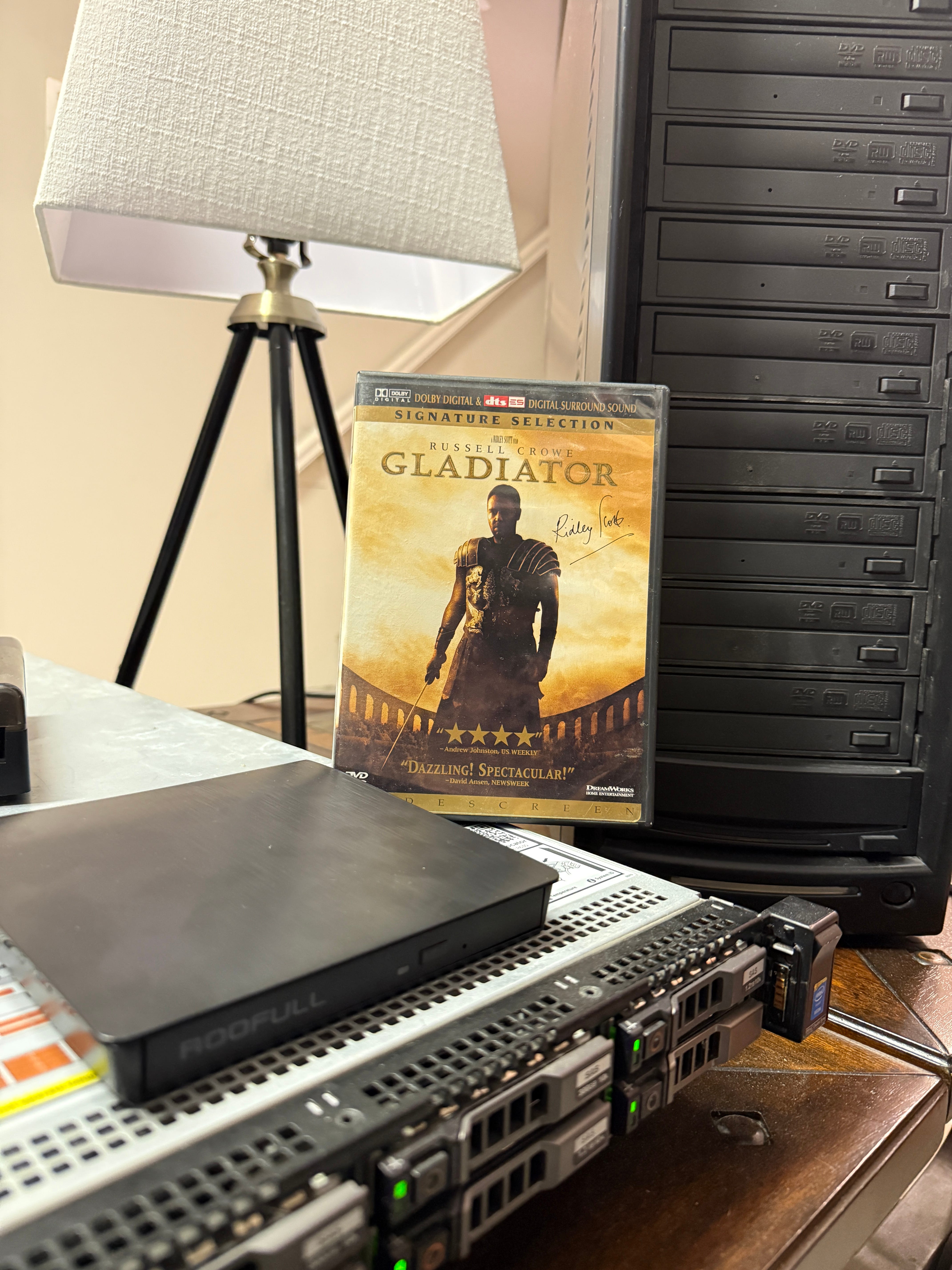
I just wanted to see if I could do it.
The disc was Gladiator, a two-disc set that has been on my shelf for years. The plan was small, more curiosity than project: pull the disc into the computer, see if it would let me copy it, and if it worked, burn a fresh copy onto a blank DVD. The kind of thing every kid with a Dell tower in 2003 spent an entire weekend trying to figure out.
In 2026 the entire workflow takes about an hour. The cheap hardware costs less than a sandwich. The software is free.
There was also a practical reason. I own a Vinpower SharkCopier, a 1:11 DVD duplicator (eleven blank DVDs in eleven burners, one master in a dedicated read drive, all driven by a small LCD on the front panel). It is the kind of hardware you buy when you intend to make a lot of discs. The duplicator industry, by the way, is not dead. Churches still press their own sermon DVDs in the basement. Indie filmmakers still ship festival screener DVDs and direct-to-fan special editions. AV departments at small colleges still run runs of training videos. School districts still mass-produce graduation footage. The market for “I have one master and I need fifty copies of it by Sunday” is small but durable, and it is the market the SharkCopier was built for. Vinpower still sells current models. Their competitors do too.
The Vinpower throws Error 209 the moment you put a CSS-protected source disc in the master tray. The firmware will not duplicate a copy-protected disc, ever, under any circumstance. There is no setting to override, no firmware downgrade, nothing. So the only way to make copies of a Hollywood DVD with the Vinpower is to first strip the CSS off the source somewhere else, burn one clean master from the stripped image, and feed that clean master back into the duplicator (which will gladly clone a disc that has no copy protection).
That meant I needed a separate consumer drive. So I bought one off of Amazon. Two day shipping, twenty two dollars, no-name brand, USB 3.0, plug and play, came in a cardboard box smaller than a hardcover book. The ripping software was MakeMKV (free, perpetual beta, every release re-licensed). The CSS encryption layer that Hollywood spent the entire 1990s defending in federal court was bypassed transparently in the background by a library called libdvdcss, written by a Norwegian teenager in 1999, now bundled inside every modern media player on every operating system.
The whole stack, the thing that an entire industry deployed lawyers and federal prosecutors to suppress at the start of this century, arrived at my door in forty eight hours from a website I also use to buy paper towels.
I knew all of this going in. I have been around long enough to remember what this used to cost (in time, in legal risk, in lawsuits filed against teenagers, in DMCA threat letters). What I did not expect, when I opened up File Explorer and looked at the disc as a raw filesystem while the rip was running, was how much was on it. The video files were chopped into chunks of exactly one gigabyte each. There were folders full of stuff that had nothing to do with the movie. There was a drmworks folder that did not announce itself as DRM. There was an installer. There was an autorun.inf. There were two parallel runtime trees, one for Mac and one for Windows, full of binaries from a company I had never heard of.
The disc had way more on it than I expected. Once I started pulling threads, every thread led somewhere stranger.
Every DVD pressed between roughly 1998 and 2005 was secretly carrying a second payload, and almost nobody talks about it anymore because the companies that built it have been bankrupt for twenty years. This is the story of what I found on a single disc from my own shelf.
Before I get to the main thread, a short detour. While I was waiting for the Amazon drive to ship, my second instinct was to try the optical drive in my Dell PowerEdge R630 server. The server has a slimline DVD-ROM drive on the front bezel. I had it passed through to a Proxmox container running MakeMKV, libdvdcss, libaacs, Jellyfin, and the rest of a complete optical-archival stack. The whole thing took an afternoon to build and felt very clever.
The PowerEdge refused to read the disc.
Not failed to decrypt. Not stalled on a bad sector. The drive looked at the inserted commercial DVD and reported back to the operating system: Incompatible medium installed. SCSI sense code 02/30/00.
This is firmware-level refusal. The drive’s controller is checking whether the inserted disc is “appropriate for a server-class drive” and deciding the answer is no. Server-grade Dell/PLDS drives ship with deliberately restricted firmware that reads recovery media, OS install discs, and data CDs, but actively refuses commercial DVD-Video discs at the hardware layer before any software ever sees the bytes.
The drive in your laptop does not do this. The cheap drive I had ordered off Amazon does not do this. A consumer drive’s firmware is, in the technical sense, dumb. It sees a disc, it reports the contents, it lets the OS handle whatever happens next. The server drive is the unusual one.
This is worth pausing on. We have a strange world now where the cheap consumer hardware is more capable than the expensive enterprise hardware, specifically because the enterprise vendor put effort into making theirs less capable. The same logic produced printers that refuse third-party ink and tractors that refuse third-party repair tools. It is a kind of inverted progress. Pay more, get less. Pay less, get the actual thing.
So now I had two pieces of expensive hardware refusing to read the same disc. The Vinpower duplicator, refusing because of CSS at the firmware level. The Dell server drive, refusing because of “is this an appropriate disc for a server” at the firmware level. Both vendor-imposed restrictions. Both bypassed, when the Amazon package finally arrived two days later, by a twenty two dollar consumer drive whose firmware did not pretend to know what should and should not be allowed.
I unplugged the server drive, plugged in the Amazon drive, and the consumer hardware read the same disc with no complaints. Cost differential between what worked and what did not, summed: about a thousand dollars worth of refusing hardware versus the price of a sandwich for compliant hardware.
I selected the main title in MakeMKV, started the rip, and walked away.
Forty minutes later I came back to a failure log. The drive had hit a physical read error at byte offset 2,708,467,712, retried sixteen times, and given up. I cleaned the disc with a microfiber cloth (radial wipes, center to edge, the way you are supposed to). Tried again. Failed at byte offset 2,708,580,352. The two error positions were one hundred twelve thousand bytes apart. Same spot on the disc. The defect was not a smudge. It was permanent damage in the dye layer, fifty megabytes wide, untouchable by anything short of buying another copy.
I gave up on Disc 1 and switched to Disc 2.
This is where the trip got interesting.
Disc 2 of a two-disc set is the bonus features disc. Documentaries, deleted scenes, behind-the-scenes featurettes, scoring sessions, production stories, trailers. The bonus disc on my Gladiator set is genuinely the bonus disc. It ripped cleanly through MakeMKV in about thirty minutes and produced seven separate MKV files, one per featurette, totaling about six gigabytes:
The “Strength and Honor” production documentary
Hans Zimmer’s scoring session footage
A “treasure chest” montage of behind-the-scenes additional footage
Deleted scenes with director commentary
A series of HBO First Look-style featurettes
Photo galleries
Trailers
This is the legitimate bonus content for the 2000 Ridley Scott film. The disc is not mislabeled, it is exactly what the case says it is, and the contents are exactly the production extras that DreamWorks and Universal shipped with the original two-disc release.
There is one curious branding artifact. When I pulled the first thirty seconds of VIDEO_TS.VOB (the menu domain file at the root of the DVD’s video folder) using ffmpeg, I expected to find an FBI warning and studio logos. What came back was a silent thirty second loop of the Artisan Entertainment logo cycling over and over. Disc 2 of the Gladiator set, opening with the bumper of an entirely different distributor.
This is not necessarily a sign of mislabeling. Artisan Home Entertainment, a New York based distributor active until its 2003 bankruptcy and 2004 absorption by Lions Gate, handled DVD authoring and post-production work for many titles whose theatrical distributors used different brand names. The Artisan logo on the bonus disc menu may be a credit for the authoring house, a co-distribution mark for a specific re-release, or a holdover from a partnership arrangement nobody outside the studio bookkeeping department remembers. The actual content under the menu is unambiguously Russell Crowe Gladiator material. The Artisan bumper is a footnote on a pressed disc that has been sitting in a case on my shelf for years, surfaced only because I extracted the file directly with ffmpeg and bypassed the menu navigation that would have skipped past it.
Disc 2 has, of course, the same payload of dead bonus-app infrastructure as Disc 1. Same PCFriendly installer. Same drmworks folder. Same autorun.inf waiting to launch the same dead phone-home. Both discs are normal commercial DVDs from the era. They both came with the standard 1998-to-2005 secondary payload pressed onto them. Once I started looking at that payload, the actual movie became the smaller mystery.
Open any DVD on any operating system and you will see the same two folders at the top level: VIDEO_TS and AUDIO_TS. The second one is always empty (it is the legacy DVD-Audio format that nobody adopted). The first one holds the actual movie.
Inside VIDEO_TS you find a structured collection of files split into “title sets.” A title set is a logical grouping (the main movie is usually one title set, each bonus feature is another). For each title set there are three file types:
.IFOfiles (information files) hold the table of contents, chapter markers, audio track definitions, subtitle stream definitions, and navigation logic..BUPfiles are byte for byte backups of the IFO files. The DVD spec mandates this redundancy. If the IFO is unreadable, the player falls back to the BUP automatically..VOBfiles (video object files) hold the actual MPEG-2 video, AC3 or DTS audio, and subpicture data. The spec caps each VOB file at exactly one gigabyte, which is why long movies are split across multiple VOBs even though the disc itself can hold seven gigabytes.
This format was finalized in 1995 and has not meaningfully changed since. A VIDEO_TS folder created in 1996 plays in a 2026 set top DVD player, a 2026 PC running VLC, a 2026 PlayStation 5, and probably whatever shows up in 2046 still capable of reading optical media. There are very few thirty year old digital formats with this kind of forward compatibility. PDF is one. JPEG is another. MP3 maybe. The list is short.
The VIDEO_TS layer is the part that still makes sense in 2026. It is the part that works.
The other folders on the disc are where the archeology starts.
When I listed the root of the disc, I found this:
E:\
├── AUDIO_TS\        (empty, legacy)
├── VIDEO_TS\        (the actual movie)
├── COMMON\          (cross-platform bonus assets)
├── MAC\             (Mac-specific bonus runtime)
├── WIN\             (Windows-specific bonus runtime)
├── drmworks\        (DRM library files)
├── PCFriendly       (the bonus app binary, no extension)
├── PCFriendly_Read_Me
├── install.exe      (the installer)
├── autorun.inf      (Windows autoplay launcher)
├── disc.id          (small token identifying the disc)
└── readme.txt
Most of those folders and files have nothing to do with playing the movie. They are the remains of a project called PCFriendly, also branded as InterActual Player, a Windows application that early-2000s DVD studios bundled on every disc.
The pitch was: you put the disc into your PC, Windows would auto-launch install.exe via the autorun.inf file, and you would be prompted to install the InterActual Player runtime. Once installed, the player would do things a normal DVD player could not. It would pull “web-enhanced” bonus content over your dialup connection. It would link out to studio websites with deleted scenes and trivia trackers. It would offer real-time text overlays of director commentary. It would let you download movie posters as desktop wallpaper. It would phone home to the studio’s bonus content servers, identifying the specific disc you owned (via the disc.id file in the root) and pulling tailored content for that title.
In 2001, this was supposed to be the future of home entertainment. The DVD was just the first half of the experience. The PC bonus content was where the studios figured the value would migrate.
The project failed for several reasons that are obvious in retrospect:
The bonus content was, almost universally, terrible.
The installer had the security profile of a 1999 Windows shareware app, which is to say, it wanted administrator rights, registered shell extensions, installed an ActiveX-based Flash runtime, and modified registry hives most users could not name.
Web links rotted within two years. By 2004 most of the “web-enhanced” features pointed at dead servers.
The companion players were comically bad. Slow startup, frequent crashes, weird font rendering, a UI designed for 800x600 screens.
Microsoft removed MPEG-2 codec support from Windows starting with Windows 8 in 2012, which broke a lot of the player runtimes outright.
Almost nobody actually put DVDs in their PC. The PC was for Napster. The DVD was for the living room TV.
InterActual Technologies, the company that built PCFriendly, went bankrupt around 2007. Sonic Solutions absorbed the remains. Sonic was acquired by Rovi in 2010. Rovi rebranded as TiVo Corporation in 2016. TiVo merged with Xperi in 2020. The PCFriendly trademark, codebase, server infrastructure, and signing certificates have not been actively maintained since at least 2012. The endpoints those installers were designed to phone home to do not exist.
But the installer is still on the disc. Every disc. By the millions.
Inside the drmworks folder are library files (.dll for Windows, .bundle for Mac) that the PCFriendly app links against at runtime. These libraries are licensed from a Japanese company called DRMworks Co., Ltd., founded in Tokyo in 2003.
DRMworks specializes in optical media protection. Their schtick is more aggressive than CSS. CSS is plain encryption. DRMworks is sabotage. The company’s technology embeds deliberate read errors and structural booby-traps into pressed discs, designed to:
Cause naive ripping software to crash or produce corrupted output.
Confuse the file system parser so that the DVD looks larger than it actually is, overflowing buffers in older ripping tools.
Insert “phantom” VOB files that real DVD players ignore but rippers try to read, hitting protected sectors that return garbage.
Cross-link IFO navigation pointers in ways that make the disc structurally impossible to copy without specialized handling.
This kind of protection is informally called “anti-rip” rather than “encryption,” because it is not trying to keep you from watching the movie (any DVD player can navigate around the booby traps with the right firmware logic). It is trying to keep you from making a clean digital copy.
DRMworks was specifically active in the early 2000s Japanese market for J-pop and anime DVDs, where the studios were desperate to slow down the (already enormous) Asian piracy market. The company’s libraries showed up in some Western releases as well, particularly on bonus features and PC-app components, where the studios wanted to protect the bonus material (proprietary Flash files, server tokens, scripted overlays) more than the movie itself.
That is what the drmworks folder on this disc is doing. It is not protecting the movie. The movie is protected by standard CSS in VIDEO_TS. The drmworks folder is protecting the bonus features inside the dead PCFriendly app, which has not run successfully on any modern operating system since approximately 2014, and whose servers have been unreachable since approximately 2012.
Twenty year old anti-piracy code, defending bonus content nobody can access, on a disc that turned out to be the wrong movie anyway. There is a kind of cosmic irony here that I do not have the literary range to fully convey.
I did not run install.exe on this disc. I am not going to. But I read the readme and looked at the sibling files, and the behavior is well documented in 2003-era reverse-engineering writeups that have been quietly circulating on archived forums for two decades.
When you ran the installer in its heyday:
It checked the
disc.idfile to identify which movie you owned.It contacted an InterActual server (the hostnames were variants of
interactual.comandpcfriendly.com, both of which now resolve to dead IPs or unrelated parked domains).It downloaded a manifest of available bonus content for that specific title.
It registered an ActiveX control with Internet Explorer for in-browser playback of bonus videos.
It installed a shell extension so that double-clicking the disc opened InterActual Player rather than Windows Media Player.
It created a Run key in
HKEY_CURRENT_USER\Software\Microsoft\Windows\CurrentVersion\Runso a background service could check for new bonus content periodically.It silently phoned home on every subsequent launch with a request that included your disc ID, the installer version, and your operating system fingerprint.
That last bit is the one that makes the modern eye twitch. Every time someone in 2003 watched a bonus feature on their PC, the player was reporting back to InterActual which disc was being viewed, what version of the software was running, and what OS they were on. This was not framed as telemetry. It was framed as “checking for updates.” It was, by today’s privacy standards, an extremely chatty piece of software.
The infrastructure on the receiving end no longer exists. The installer on this disc, if you ran it on Windows 11 in 2026, would launch (autorun is disabled, but the EXE still runs if you double-click it), do its disc identification, attempt to phone home, get back DNS failures or HTTP 404s, and silently log the failure. It would still install its shell extensions. It would still register its Run key. It would still install fonts and registry entries that have been deprecated for fifteen years. The installer is not malicious in the traditional sense. It is just ancient. It does not know that its world has ended.
Here is what I keep coming back to.
In 1999, a Norwegian fifteen year old named Jon Lech Johansen reverse-engineered the CSS encryption used to protect every commercial DVD. He published the resulting decryption code, called DeCSS, online. Within months the DVD Copy Control Association sued him. Within a year the United States DMCA had been weaponized to threaten anyone hosting the source code. The MPAA argued that DeCSS distribution was a federal crime. The Electronic Frontier Foundation defended the case. A New York federal court ruled in 2000 that even linking to DeCSS source code was illegal under the DMCA’s anti-circumvention provisions. The case went to the Second Circuit. The Second Circuit affirmed. People got subpoenaed. T-shirts with the seven line DeCSS source printed on the front were briefly considered legally dangerous.
In 2026, I plugged in a twenty two dollar drive from Amazon, opened a free piece of software called MakeMKV, and ripped a CSS-protected disc in forty minutes. The CSS layer was bypassed transparently and silently. The software did not pause to acknowledge it. There was no warning, no consent dialog, no licensing stipulation. The decryption code that was once a federal lawsuit now ships inside VLC, the most installed media player on Earth, on the system path of every Linux distribution, in the brew formula list on macOS, and in an Amazon listing called “Verbatim Slim Portable DVD Writer.”
The technology did not change. The law did not change either, technically. DMCA Section 1201 is still on the books. Circumventing CSS is, on paper, still a federal violation. What changed is enforcement. The MPAA stopped prosecuting individuals around 2008. The studios pivoted to streaming, where DRM is enforced by the platform layer (Widevine, FairPlay, PlayReady) and the question of “is this user circumventing CSS” became as quaint as asking whether they were jaywalking.
It is hard to overstate how much fight there was over this twenty five years ago. There were congressional hearings. There were criminal referrals. The Recording Industry Association of America was suing twelve year olds. Norwegian prosecutors raided Johansen’s father’s apartment looking for evidence of his son’s “computer crimes.” And the entire content of those prosecutions is now: a free download. A library bundled with a media player. A line item in the dependency tree of every Linux distribution.
I am not making a moral argument. I am pointing at a fact. The thing that an entire industry deployed lawyers, lobbyists, federal prosecutors, and international treaties to suppress is now an unremarkable line of code that gets compiled into a hundred million binaries every year. The war was lost so completely that nobody remembers it as a war.
Speaking of remembered things.
Every commercial VHS and DVD I watched between roughly 1985 and 2005 opened with the same screen. Black background. White text. Sometimes a navy blue and gold seal. The text said:
WARNING: Federal law provides severe civil and criminal penalties for the unauthorized reproduction, distribution, or exhibition of copyrighted motion pictures (Title 17, United States Code, Sections 501 and 506). The Federal Bureau of Investigation investigates allegations of criminal copyright infringement.
The wording varied slightly by studio. The Universal version was the one I memorized. There was a longer “Interpol” warning that played in some international releases. Disney had its own variant with a different seal. The point of all these warnings was the same: piracy was a federal crime, the FBI was watching, and you should be afraid.
These screens are still on every disc I rip. They are still on the disc I am writing about right now. (Or they would be, on Disc 1, if the bad sector had not killed that rip; the screens almost certainly play on Disc 2 also but I extracted from the wrong portion of VIDEO_TS.VOB and got a menu loop instead, which is a separate forensic embarrassment.)
But here is the question I cannot stop asking: does anybody care about these warnings anymore? Has anyone, in 2026, been federally prosecuted for ripping a DVD they bought? When was the last time the FBI’s actual copyright unit even pursued an individual under Title 17?
The answer, as far as I can determine from public records, is: roughly never. The FBI’s anti-piracy enforcement, which was significant in the 2000s and very significant against organized commercial piracy operations, has not pursued individuals over consumer-scale ripping in any meaningful way for at least a decade. The civil suits that the RIAA and MPAA used to file against individual file sharers stopped being filed around 2008 because the public relations cost outweighed the deterrence value. The DMCA notice-and-takedown system handles most of what is left. Streaming killed personal-collection piracy not by enforcement but by convenience.
The FBI warning is a fossil. It is a piece of legal-aesthetic theater that is still pressed onto every disc because the studios still own the rights to put it there and the muscle memory of “we always did it this way” is strong. But functionally, in terms of describing actual enforcement reality in 2026, the warning is no more accurate than a 1955 tornado drill poster in a school basement. It describes a state that used to exist.
I want to be careful here, because the FBI’s actual copyright work continues. Counterfeit goods enforcement, organized piracy rings, large-scale infringement operations, and corporate IP theft cases all still happen. But the FBI prosecuting you personally for backing up your own DVDs is not a thing in 2026, has not been a thing for at least fifteen years, and was probably never as much of a thing as the warning made it seem.
The warning is still scary. It is still on the disc. It is still played. It is the only piece of the original 2001 anti-piracy stack that has even nominal continuity into the present.
CSS is broken. PCFriendly is dead. DRMworks’s tech protects nothing anyone can reach. The FBI warning still plays. That is, somehow, the surviving artifact.
I started this project because I wanted to watch a movie. The project I ended up doing was an archeological dig.
A used DVD pressed in 2001 contains, in order of how alive each layer is in 2026:
The actual video, in DVD-Video format. Fully alive. Plays on everything.
The CSS encryption. Defeated, openly, by free software available everywhere. Was a federal lawsuit twenty five years ago.
The PCFriendly bonus app. Completely dead. Servers gone, codebase abandoned, runtime broken on every modern OS.
The DRMworks anti-rip libraries. Protecting nothing reachable. The thing they were defending no longer exists.
The FBI warning. Still played, still scary in tone, no longer reflective of any actual enforcement reality.
Every disc on your shelf, in your parents’ basement, in the dollar bin at Half Price Books, in the cardboard boxes at every estate sale, is carrying this exact stack. Most of it is dead. The video still plays. That is the inheritance.
There is something almost touching about how much effort went into the dead layers. People had careers building PCFriendly. Companies got valuations writing DRMworks libraries. Lawyers wrote thousand page briefs about CSS. The DOJ pursued teenagers. The MPAA bought congressional ads. And all of it has settled into the same forgotten silt at the bottom of the stack, while the part everyone said could never survive on its own (just the video, just the format, just VIDEO_TS) is the only thing that still works.
I am going to keep ripping. The bonus disc came across cleanly. The movie disc has a physical defect at the 2.7 GB mark that no amount of cleaning will fix, so I will track down a fresh copy on eBay for four dollars and run it through the same pipeline. Burn one CSS-stripped master, hand it to the Vinpower, get back eleven copies in fifteen minutes. The pipeline that does all of this is, in 2026, free except for twenty two dollars of hardware that arrived from Amazon in two days. The protection that resisted it is, in 2026, vapor.
The same pipeline, run by a church AV team, presses sermon DVDs every week. Run by an indie filmmaker, presses festival screeners. Run by a hobbyist, makes copies for friends. The duplication hardware is still being sold and still being bought. The protection layer the studios fought for so hard is the only piece of the original 2001 stack that does not work anymore.
The disc still says the FBI is watching.
Written 05-05-2026. Both discs are still on my desk. The bonus disc rip is sitting in seven MKV files in a folder called BOOOOTLEG. The movie disc has a scratch I cannot fix.