University of Manchester physicists have helped find the first evidence of an extremely rare particle decay at CERN’s Large Hadron Collider, bringing scientists closer to exploring an unknown world where new particles and forces of nature could be hiding.

Key findings
- Scientists have found the first evidence for an extremely rare particle decay known as ‘Bd to mu mu’.
- The decay is predicted to happen only once in around 10 billion beauty particles and has taken more than 40 years to find.
- The result has a statistical significance of 3.2 sigma, enough to constitute evidence, but not enough to claim the gold standard of discovery
- Manchester researchers played key roles in the construction and leadership of the upgraded LHCb experiment that made the result possible.
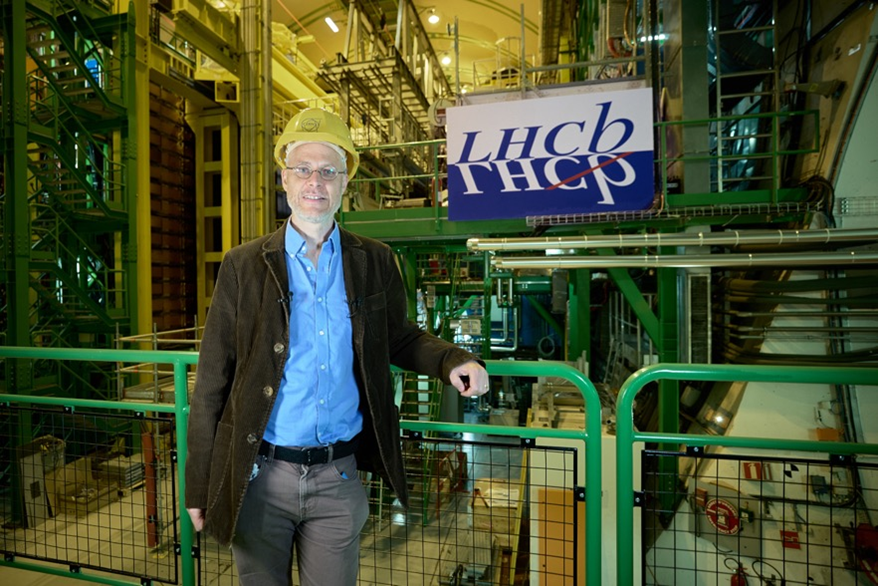
Prof Chris Parkes with the LHCb experiment.