Harry Sekulich, Archie Mitchell,Business reportersand Theo Leggett,Business Correspondent

 Getty Images
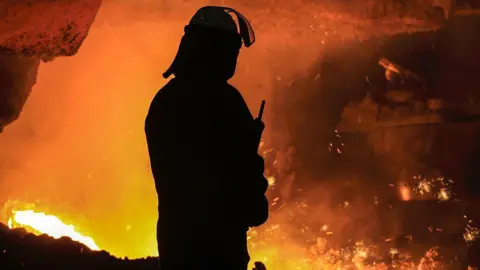
British Steel has been taken into public ownership in a move the government said would protect jobs and safeguard "a vital national capability".
The future of the steelworks, which employs roughly 2,700 people in Scunthorpe and supports many other industries in north Lincolnshire, has been dogged by uncertainty over recent years.
The UK government had taken control of British Steel's operations in Scunthorpe last year, though it was still owned by China's Jingye Group, limiting the government's ability to decide on its future strategy.
Nationalisation buys the government time and gives it the power and freedom to decide on the future of the plant, while keeping the blast furnaces going.
Ultimately it is unlikely the government will want to remain in charge of a business that is costing it more than a million pounds a day.
The nationalisation came after Parliament on Wednesday passed legislation allowing the government to bring the steel industry into public ownership under circumstances where it met a public interest test.
Jingye is seeking compensation for nationalisation, having previously said the business was losing £700,000 a day. The BBC has been unable to get a response from Jingye to Thursday's announcement.
Business Secretary Peter Kyle told the BBC the government will need to cover the running costs "for the immediate future".
He said an independent assessor would determine whether Jingye should be compensated for the nationalisation based on the value of the company.
"But let me be really clear, there is an alternative here - that we let this business go bust," he said.
"If that business disappears, we will lose the ability for primary steel production in our country, we will become entirely dependent on global supply."
Unite general secretary Sharon Graham welcomed news of the nationalisation, saying it needed to be "the first step in a journey to transform our steel industry".
"We need serious investment on the ground across the industry to create jobs and make Britain a leading producer of green steel."
Blast furnaces are designed to run continuously. Allowing them to cool can cause serious damage, and extensive work is required to restart them. Even a planned refurbishment can cost tens of millions of pounds.
The remaining furnaces at Scunthorpe are very old. The one called Queen Anne opened in 1954, while Queen Bess has been producing steel since 1938.
Both are approaching the end of their operational lives, so restarting them once cooled would have been financially prohibitive for a company that was already losing a great deal of money.
The government wanted to keep them open as they are the UK's last remaining source of "virgin", or new, steel directly produced from iron ore.
If the plant stopped producing virgin steel, the UK would become the only member of the G7 group of leading economies without the ability to make it.
Steel output elsewhere in this country relies on electric arc furnaces (EAFs), which recycle scrap metal into new products.
Although the government's long-term strategy is for all domestically produced steel to come from EAFs, which are cheaper and much less carbon-intensive to run, it does not want to lose production at Scunthorpe yet.
The plant produces types of steel that are not yet made anywhere else in the country, much of it needed by Network Rail and the construction industry.
The fear had been that losing this output would be disruptive and make the country too reliant on imports. So the decision was made that Scunthorpe should be kept open until alternatives are available.
There are also jobs to consider. As well as those directly employed by British Steel at Scunthorpe, the plant supports thousands more in the supply chain.
The plant is an economic anchor in North Lincolnshire, but abrupt closure of the furnaces could have put many jobs at risk.
Simon Boyd, managing director of Reid Steel, a structural steel manufacturer in Dorset, said the nationalisation "had to be done".
Boyd, whose company buys thousands of tonnes from British Steel each year, told the BBC's Today programme Jingye had been "sabotaging the infrastructure" at the company and the government "had to step in".
He said the government would need to invest heavily in British Steel and would not see a return for 10-20 years.
But he said it "now belongs to the British people". A bid to sell it on to private investors would have required government support, and in the past has been seen to "benefit the private companies and not the British people", he added.

