Unsolved Problem by Fields Medalist Breached by Two High School Students

Source: htx.com
30 points by soltanov 6 hours ago on hackernews | 51 comments

marsbitPublished on 2026-09-14Last updated on 2026-09-14

Abstract

In a remarkable breakthrough, two high school students from Oak Park High School, Aayush Bathija and Prince Rohatgi, with guidance from UCLA postdoctoral researcher Daniel Soskin, have solved an open problem related to the theory of Lorentzian polynomials—a field pioneered by Fields Medalist June Huh. Their 75-page paper, "Bounded Ratios for Lorentzian Polynomials," is now available on arXiv. The research investigates the constraints on coefficient ratios within Lorentzian polynomials, extending prior work that characterized bounded ratios for quadratic polynomials to polynomials of arbitrary degree. The core challenge was determining which coefficient ratios have a universal upper bound across all polynomials in the class and identifying the optimal bounds. The students heavily utilized AI assistants, specifically Claude Opus 5 and GPT-5.6 Sol, for computational exploration, proof idea generation, and editing. They emphasize that while AI provided helpful suggestions, some were misleading, and all calculations and arguments were independently verified. This achievement is particularly notable as it follows a recent open letter signed by 25 Fields Medalists, including June Huh, expressing concerns about AI's impact on mathematical rigor. The students' work demonstrates how AI can lower barriers to entry, enabling talented pre-university researchers to engage with advanced mathematical frontiers.

  • #AI
  • #arXiv
  • #Collaboration
  • #Fields Medal
  • #High School
  • #Lorentzian
  • #Mathematics
  • #Polynomials
  • #Proof
  • #Research

Can you believe it?

They haven't even started university, yet their research has connected with the work of a "Fields Medalist".

Just today, stunning news spread through the UCLA mathematics community—

Two high school students, Aayush Bathija and Prince Rohatgi, under the guidance of a postdoctoral researcher, have solved a problem that mathematician June Huh never managed to crack.

Even more eye-catching is that this proof was completed with heavy assistance from AI!

One was Claude Opus 5, the other GPT-5.6 Sol.

Currently, the paper titled "Bounded Ratios for Lorentzian Polynomials" has been published on arXiv, spanning 75 pages.
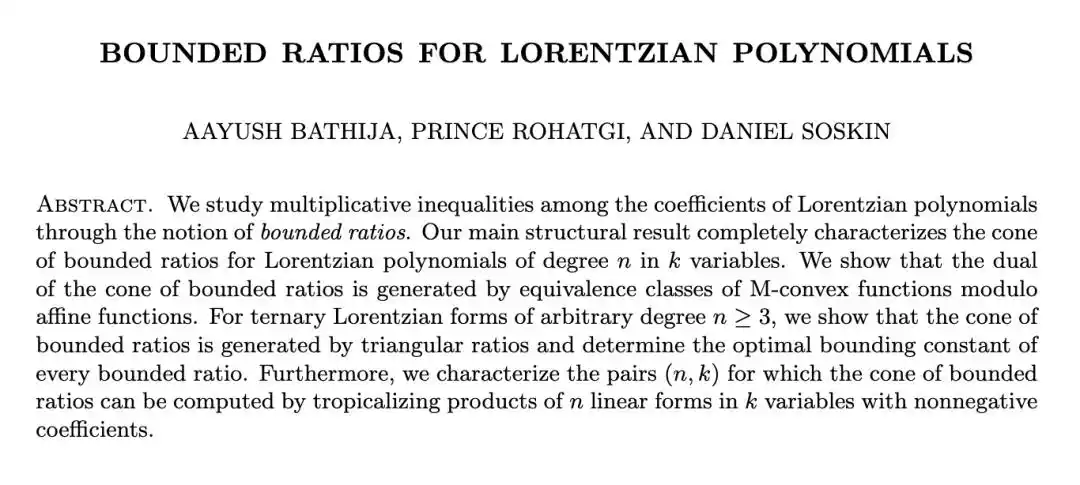
Paper: https://arxiv.org/pdf/2609.05341

The names of the two high school students and one postdoc are written right there in the author list.

The high school students' mentor, UCLA Postdoctoral Fellow Daniel Soskin

So, what problem exactly did they solve in this research?

To clarify this, we must first start with the work of Fields Medalist June Huh.

What Did They Actually Solve?

June Huh is Korean and won the Fields Medal in 2022.

His journey is quite legendary: he dropped out of high school to become a poet before switching to pure mathematical research, winning the Fields Medal at the age of 39 (the Fields Medal is only awarded to individuals under 40).
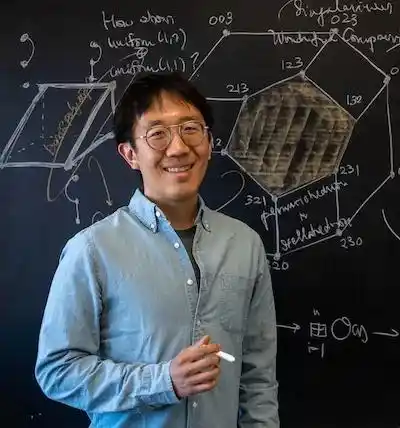
In 2020, the theory of "Lorentzian polynomials" that he and his collaborators established was one of his important representative works.

The name might sound unfamiliar, but "polynomials" are something everyone encountered in middle school. The numbers in front of each term are the coefficients.

The special feature of "Lorentzian polynomials" is that there are strict mathematical constraints between these coefficients; they cannot be paired arbitrarily.

This theory connects problems in combinatorics with geometry and inequalities between coefficients.

This research inquires about precisely how strong these constraints are.

For example, if you multiply some coefficients and divide by others, you get a ratio.

As long as the polynomial satisfies the specified conditions, does this ratio have an "impenetrable ceiling"?
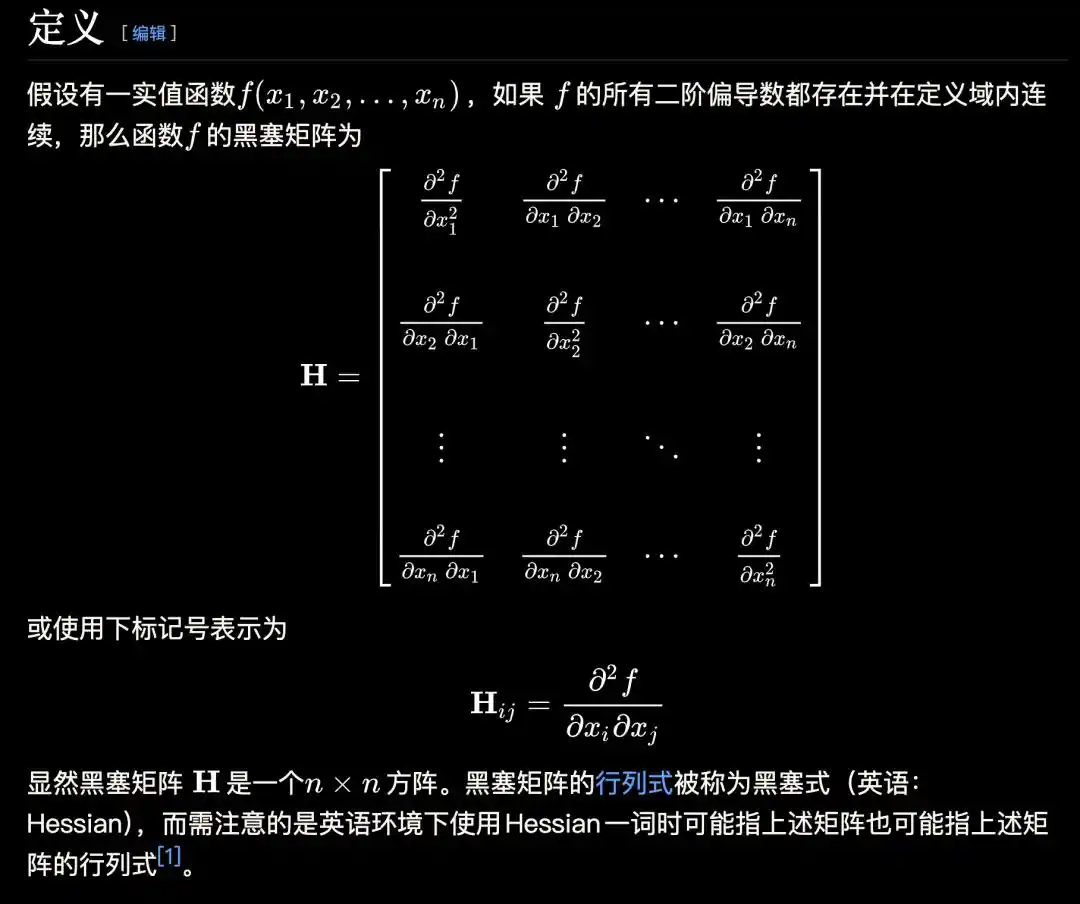
Do you still remember the definition of the classic Hessian matrix from advanced calculus?

Calculating the ratio for a specific set of coefficients is not difficult. The real challenge is: facing an infinite variety of polynomials that meet the conditions, determining which ratios always have an upper bound and which can increase indefinitely.

If there is an upper bound, we must further ask: How low can this upper bound be pushed to obtain the most precise answer?

Previously, June Huh and his collaborators had characterized which ratios have upper bounds for quadratic Lorentzian polynomials and had found the optimal upper bounds for the case of three variables.

But this path was not yet complete.

Moving from quadratic to cubic, quartic, and even arbitrary degrees, do the old rules still hold?

The higher the degree, the more complex the relationships between coefficients become. Conclusions that hold in the quadratic case cannot be directly transferred.

This is the gap where the two high school students entered—

advancing the research on coefficient ratios to higher degrees, clarifying which ratios always have bounds, and further seeking the most precise upper limits.

The paper's core formula, the "Main Structural Theorem," extends the relevant conclusions from previous quadratic Lorentzian polynomials to arbitrary degrees. It shows that whether a coefficient ratio has a uniform upper bound can be completely determined using a set of discrete convexity conditions.

Reading this far, you just need to remember one question: How high can these constrained coefficients push the ratio?

Next, we'll use a simple example to explain this "ceiling" clearly.

Lorentzian Polynomials: "Balance Constraints" Between Coefficients

First, look at a polynomial:

Here a, b, c are all positive numbers. Writing the middle term as 2b is to make the subsequent relationship cleaner.

In this simplest case, it is a Lorentzian polynomial precisely requiring:
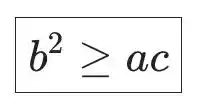
In other words: If the coefficients at both ends are large, the coefficient in the middle cannot be too small. This is an introductory example of the log-concave property embodied by the Lorentzian structure.

For example, if a=4, c=9, then b must be >=6. You cannot arbitrarily change b to 1 and still expect it to remain in this polynomial family.

When there are more variables and higher degrees, these constraints become more complex, requiring various derivative results to collectively satisfy specific conditions. The formal definition involves a matrix describing curvature, which in the strict case has an eigenvalue structure with "one positive, the rest negative." The name "Lorentzian" corresponds to this positive-negative structure. However, simply remembering that "the coefficients are subject to a complete set of interrelated constraints" is enough to understand the main thread of this article.

Transforming the previous inequality slightly:
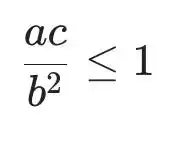
This is called a "bounded ratio": no matter how you choose coefficients that meet the conditions, this ratio cannot exceed 1.

But in reverse:
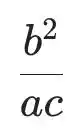
there is no uniform upper bound.

For instance, fix a=c=1, let b continuously increase, still satisfying the Lorentzian condition, but the inverse ratio can become arbitrarily large.

Naturally, one would ask:

Facing more complex polynomials, when multiplying and dividing different coefficients, which combinations have an upper bound, and which do not?

This paper aims to systematically answer this question, with the previous quadratic example belonging to the existing foundational case.

Two High School Students, Teamed Up with AI, Cracked It

The two students who wrote this paper, Aayush Bathija and Prince Rohatgi, both attend Oak Park High School in California.

They are also members of the UCLA Olga Radko Math Circle (ORMC).

Aayush is a sophomore and an AIME qualifier. Prince is currently a junior, also having made AIME, and serves as a main instructor for AMC 10/12 (equivalent to high school freshman) competition classes within the math circle.

In the past, for a high school student to even touch a "Fields Medal-level" field, they would need at least 5-8 years of university and doctoral training.

But this time, under the guidance of UCLA mathematics postdoctoral fellow Daniel Soskin, they directly teamed up with AI to wage a brilliant blitzkrieg.

https://circles.math.ucla.edu/circles/index.shtml

The core of their problem-solving was deeply embedding AI and formal computational tools into the central workflow of mathematical discovery.

The overall core idea of the proof can be understood as: To check whether a ratio might run out of control, first study how it changes under extreme conditions.

Transforming Complex Numerical Values into Simple Exponents

Let t approach 0, with the three coefficients taking values:

Then:
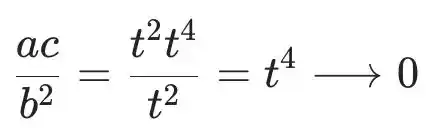
In reverse, it's t^-4, which tends towards infinity.

The most useful point here is: Multiplication and division become addition and subtraction of exponents. The sign of the exponent directly tells us whether the ratio will shrink or explode.

This idea of extracting the "dominant power" is related to the "tropicalization" method used in the paper. Existing Lorentzian polynomial theory tells us: legitimate power patterns are governed by a discrete convexity rule called M-convexity.

You can think of it as a mathematical rule for "which rates of change can appear simultaneously."

A key step in the paper is to prove: If a ratio can increase indefinitely, a path with this power characteristic can be found to expose the runaway.

Therefore, checking these paths can be upgraded into a complete criterion. The proof uses tools from semi-algebraic geometry like curve selection lemmas.

And don't forget, all this sophisticated talk was accomplished by two high school students with the help of AI.

Claude and ChatGPT, Participated in "Proof Idea Generation"

In the paper's acknowledgments, the authors lay their cards on the table—

Claude Opus 5 and GPT-5.6 Sol were the core tools for this proof.
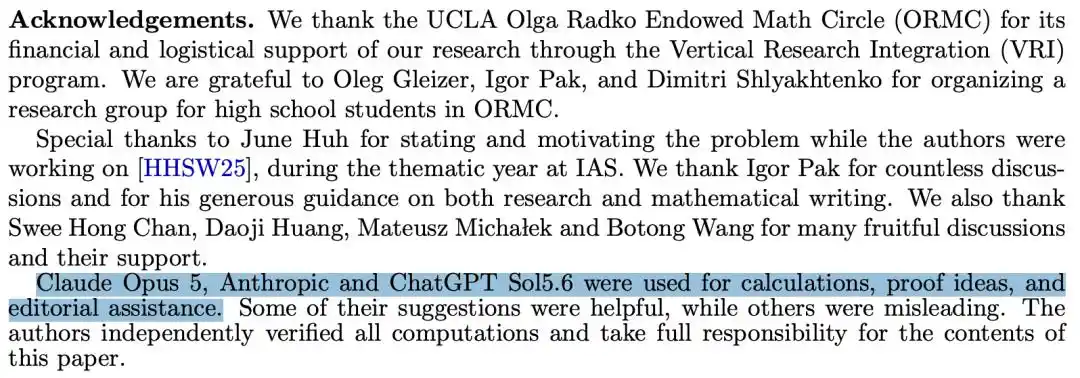
They were used for computation, proof idea generation, and editing assistance. Among these, "proof idea generation" is especially crucial.

This means the models' use has deepened into research exploration: facing an unsolved problem, searching for possible derivation paths that might hold.

However, the authors also clearly wrote the other side: Some suggestions were helpful, others were misleading.

They stated they have independently verified all calculations and take full responsibility for the paper's content.

These few sentences outline the actual boundaries of this collaboration: AI can provide ideas, researchers need to screen, scrutinize, and turn valuable clues into arguments that can withstand scrutiny.

When the model gives a seemingly beautiful answer, the research is not over. Whether conditions are complete, derivations are valid, edge cases are missed—all must be further questioned.

AI has entered the exploration phase, but rigorous verification remains the prerequisite for valid results.

The mentorship of the postdoctoral advisor and the support of the ORMC research program are thus particularly important. The two students were able to access genuine open problems and conduct research under professional guidance. AI was embedded into this collaboration, assisting with computation and idea exploration.

Fields Medalists Collectively Call for a Halt, But It Can't Be Stopped

Dramatically, just one day before this research was announced, the mathematics world was rocked by a major uproar.

Twenty-five Fields Medalists from around the world jointly signed an open letter, issuing the strongest warning: "AI is destroying mathematics itself!"
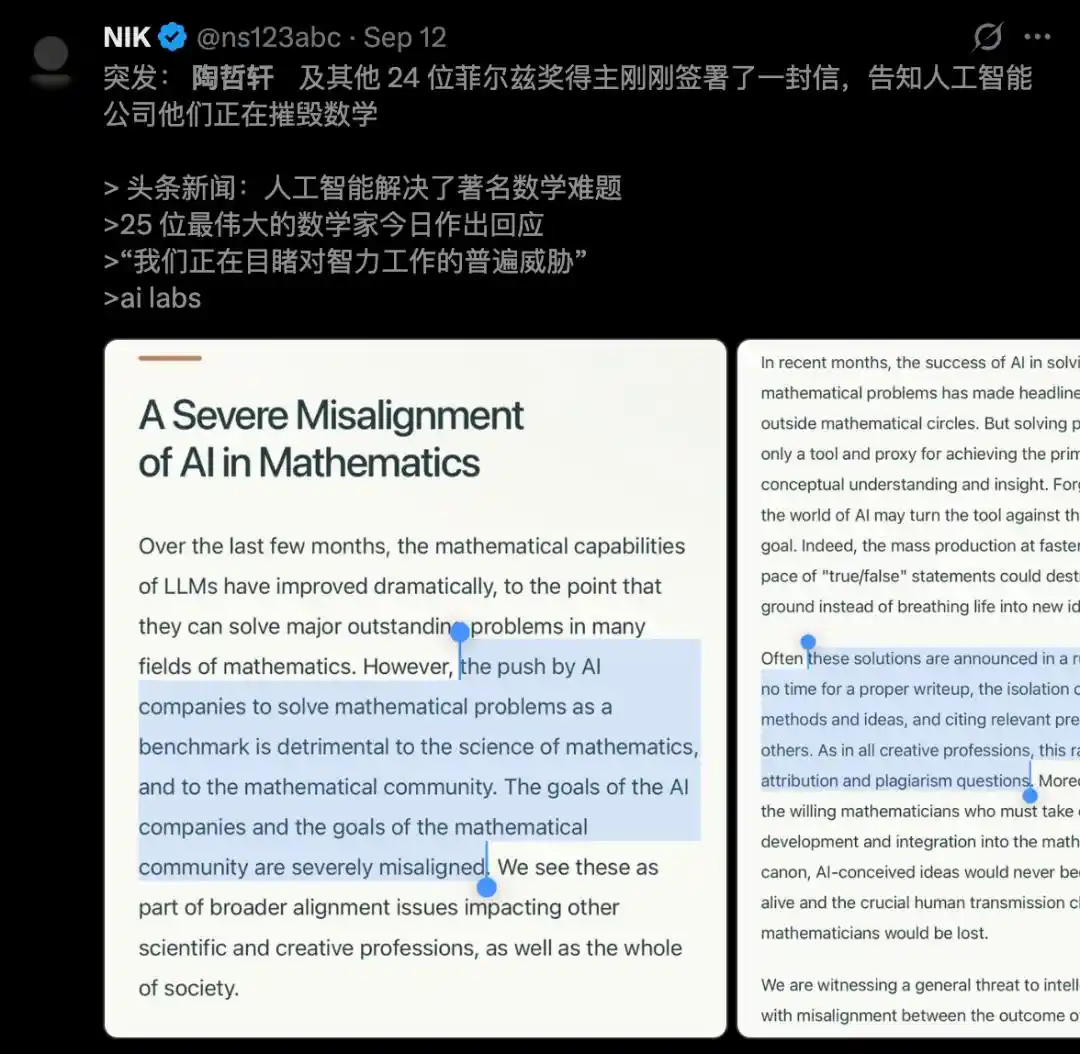
June Huh himself was one of the signatories.
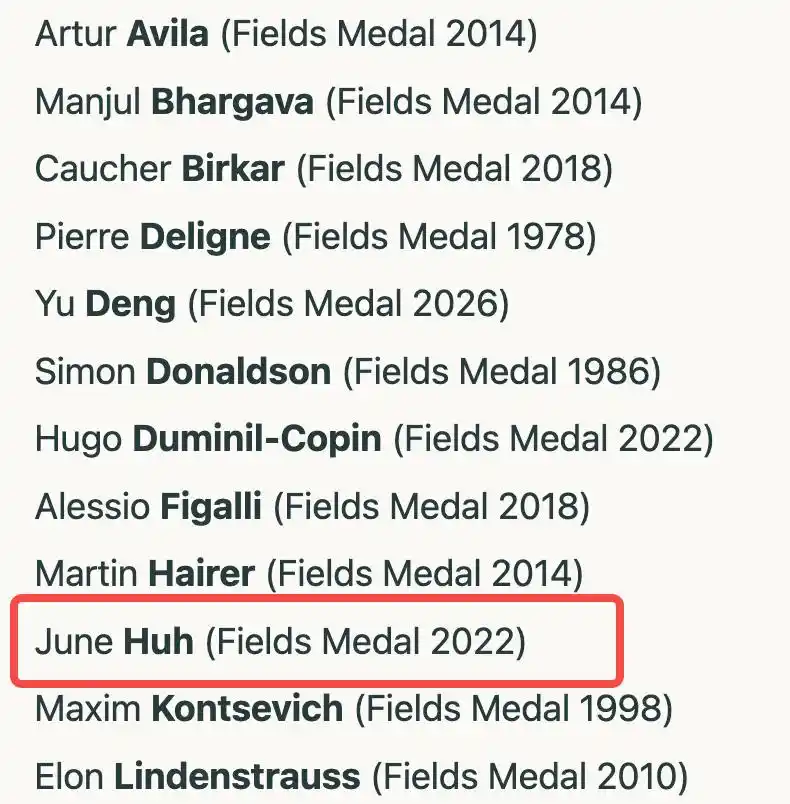
Partial list

Who would have thought that two high school students, using AI assistance, produced results in June Huh's own research direction.

The 25 Fields Medalists' concern is that the rigor of pure mathematical research and the purity of scientific inquiry might be crushed by computational power and algorithms.

But the story of Aayush and Prince presents another side—

After AI lowers the research threshold, what's being unleashed is not just "problem-solving speed," but also more people's eligibility to enter the field.

An AIME-qualified high school student, guided by a postdoc, using AI assistance, touched a path a Fields Medalist hadn't finished walking.

Five years ago, this was almost impossible.

The frontiers of mathematics no longer belong only to those who have spent over a decade just to reach the doorstep.

Whether this is good or bad, the mathematical community will debate for a long time. But the door has already been pushed open a crack.

References:

https://circles.math.ucla.edu/circles/index.shtml

https://arxiv.org/pdf/2609.05341

This article is from WeChat Official Account "新智元" (ID: AI_era), authors: Taozi, Mark

Related Questions

QWho are the main high school students mentioned in the article and what is their achievement?

AThe main high school students mentioned are Aayush Bathija and Prince Rohatgi. They achieved a proof, with significant AI assistance, that advances the work on bounded ratios of Lorentzian polynomials, a problem left open by Fields Medalist June Huh. Their 75-page paper is posted on arXiv.

QWhat are Lorentzian polynomials, and what specific problem did the research address about them?

ALorentzian polynomials are a special class of polynomials whose coefficients are not independent but are governed by a set of interrelated mathematical constraints, linked to geometric and combinatorial properties. The research addressed the problem of determining which ratios of these coefficients have a universal upper bound and finding the optimal, lowest possible bounds for these ratios, extending the theory from quadratic to higher-degree polynomials.

QWhich AI models were used as core tools in this research, and how were they utilized?

AThe core AI tools used were Claude Opus 5 and GPT-5.6 Sol. They were utilized for computations, exploring proof ideas, and editorial assistance. However, the authors noted that some AI suggestions were helpful while others were misleading, and they independently verified all calculations, taking full responsibility for the paper's content.

QWhat is the broader context within the mathematical community regarding the use of AI in research, as mentioned in the article?

AThe article mentions that just before this research was publicized, 25 Fields Medalists, including June Huh, signed a joint open letter expressing a strong warning that AI is 'destroying mathematics itself.' They are concerned about the potential erosion of the rigor and purity of mathematical research. This high school students' work presents a contrasting narrative, showing AI can lower barriers to entry and enable new participants in advanced research.

QWhat role did the UCLA Olga Radko Math Circle (ORMC) and the postdoc Daniel Soskin play in this story?

AThe UCLA Olga Radko Math Circle (ORMC) provided the environment where the high school students Aayush Bathija and Prince Rohatgi were members. Postdoctoral researcher Daniel Soskin from UCLA served as their mentor, guiding them in this research project. His supervision and the ORMC's support were crucial in allowing the students to work on an authentic open problem and rigorously validate their AI-assisted findings.

Related Reads

"20CM" Limit Up: Another Star Secondary New Stock on the STAR Market?

On September 14th, the STAR Market's recently listed stock, Gaokai Technology, surged and hit the 20% daily limit, reaching a new all-time high of 324.41 yuan. The stock opened slightly higher and quickly rose to the limit-up price, closing with a full 20% gain. Its turnover reached approximately 1.128 billion yuan. Gaokai Technology went public on August 25, 2026, with an IPO price of 61.36 yuan. Its first-day closing price of 235.00 yuan represented a massive 282.99% surge from the IPO price. Following the recent 20% rise, the stock has gained about 4.29 times relative to its IPO price. The company, Jiangsu Gaokai Precision Fluid Technology Co., Ltd., is a national-level specialized and sophisticated "Little Giant" enterprise. It is a leader in China's precision fluid control sector, focusing on R&D, production, and sales of key control components. Its core products include flow control, dispensing/packaging, and precision coating systems, serving industries such as semiconductors, consumer electronics, and new energy. Financially, Gaokai has shown rapid growth. From 2023 to 2025, its operating revenue increased from 226 million yuan to 511 million yuan, with net profit attributable to parent shareholders rising sharply. In the first half of 2026, revenue grew 35.46% year-on-year to 327 million yuan, while net profit surged 95.07% to 106 million yuan. The stock's strong performance reflects market interest in semiconductor supply chain components and import substitution themes, as well as pricing for the growth potential of new listings. However, with a high trailing P/E ratio of approximately 175.79 and a relatively short trading history, investors should be mindful of potential volatility risks.

"20CM" Limit Up: Another Star Secondary New Stock on the STAR Market?

marsbit18m ago

The Essence of the Engels’ Pause is 'Social Sarcopenic Obesity'

The article argues that the concept of "Engels' Pause"—a historical period during the British Industrial Revolution where wages stagnated despite productivity gains—is experiencing a modern resurgence with AI and automation. However, the author contends the core issue is not merely a problem of wealth distribution (a "cake-sharing" problem), but a deeper systemic ailment termed "social sarcopenic obesity." This condition describes an economy that gains "fat"—measured as GDP, profits, and capital stock—while losing "muscle," which is the vitality of society itself, including community organization, collective action, social trust, and individual agency. Key mechanisms causing this muscle atrophy include administrative overreach, market and algorithmic substitution for human interaction, and a narrative that workers are replaceable by machines, which undermines their bargaining power. The author warns against the Western path of addressing wage-productivity decoupling primarily through redistributive welfare ("blood transfusion"), which treats symptoms but allows social muscles to atrophy further, leading to issues like low fertility and political polarization ("social atrophy trap"). China, the article states, is institutionally committed to avoiding the original "Engels' Pause" through policies like "two synchronizations" (aligning income with economic growth and labor remuneration with productivity). Its real challenge is to avoid the subsequent Western trap and forge a third path: fostering social vitality ("muscle growth") alongside economic development. This requires shifting social policy from providing a safety net ("transfusion") to "investing in people" ("protein") and, crucially, to enabling social "weight-bearing"—empowering communities, labor organizations, and individuals. The prescription is "economic weight loss, social muscle gain." Concrete proposals include making "two synchronizations" a hard policy constraint, conducting "social impact assessments" for major industrial policies, and promoting initiatives where "funding follows organization," such as community-based childcare and eldercare. Other measures involve integrating labor into profit-sharing structures, fostering collective bargaining in the platform economy, leveraging public computing power to prevent monopoly "rents," directing AI to augment (not replace) care work, and strengthening social muscles at the county level. The goal is to build an economy with high order and high vitality, preventing growth from consuming the very social foundations that sustain it.

marsbit23m ago

The Essence of the Engels’ Pause is 'Social Sarcopenic Obesity'

marsbit23m ago

How Does a Failed BTC Treasury Company Navigate the Delisting Process?

The article examines the failure and delisting process of Satsuma, a UK-listed Bitcoin treasury company (DAT). After accumulating 1,199 BTC at a high average cost, Satsuma's strategy faltered as Bitcoin's price fell, leading to significant asset devaluation and a 99% stock price plunge. Facing liquidity pressure and shareholder demands, a July 2026 shareholder vote overwhelmingly approved a plan to liquidate the company. The five-step delisting process involved: 1) passing special resolutions to return capital and cancel the listing, 2) determining eligible shareholders, 3) selling all remaining 669 BTC, 4) obtaining court approval for the capital return scheme, and 5) final delisting and cash distribution to shareholders by late September. As the first DAT to complete a full "liquidate BTC → return capital → delist" cycle voluntarily, Satsuma's case provides a blueprint for how struggling cryptocurrency treasury companies can execute an orderly exit, highlighting that the ability to unwind is as critical as the ability to accumulate assets.

marsbit24m ago

How Does a Failed BTC Treasury Company Navigate the Delisting Process?

marsbit24m ago

Bitcoin-Managing Companies Experience Balance Shift: One Halts Trading, Another Continues Buying, and a Third Fully Liquidates Its Bitcoin Assets!

A major shift in holdings is underway among Bitcoin-managing companies. Strateg, a leading institutional holder, paused its Bitcoin purchases for a week after a period of active buying. It currently holds 845,050 BTC and instead used $139.3 million from its cash reserves to buy back preferred shares. Strateg estimates it can meet its financial obligations for approximately 3.9 years with its remaining dollar assets. In contrast, another firm, Strive, purchased 469 BTC last week at an average price of $77,954, bringing its total holdings to 25,000 BTC. Meanwhile, NYSE-listed KULR Technology has fully exited its Bitcoin position. The company sold its remaining 764 BTC between August 20 and September 11, 2026, at an average price of $76,633, grossing approximately $58.6 million. This sale brings its Bitcoin assets to zero, marking a complete departure from its previous investment strategy.

cryptonews.ru34m ago

Bitcoin-Managing Companies Experience Balance Shift: One Halts Trading, Another Continues Buying, and a Third Fully Liquidates Its Bitcoin Assets!

cryptonews.ru34m ago

Fed Decision Window, BTC & HYPE Chan Theory Structure and Trading Strategy Analysis | Guest Analysis

This week's focus is on the Federal Reserve's interest rate decision, expected to heighten short-term market volatility. Technically, Bitcoin's rebound from July lows has entered a phase of range-bound consolidation and testing of key levels. Price action is wrestling around the critical 364-day moving average, indicating a tug-of-war between bulls and bears. **Bitcoin (BTC) Analysis:** The primary bullish development is BTC reclaiming the 182-day moving average and testing the 364-day moving average, a key "bull/bear" demarcation line after ~300 days. Price is currently consolidating within a 75,500–82,850 USD range, supported by the 30-day MA and pressured by the 364-day MA. Two main scenarios are outlined for the Fed decision window: 1. **Pre-announcement Rally:** A bounce leading into the event, potentially breaking resistance temporarily, but with limited upside and risk of a post-news "bull trap" pullback. 2. **Pre-announcement Consolidation/Decline:** Sideways or weak action near support, followed by a potential sharp post-news sell-off. A downside spike could present a buying opportunity for a rebound targeting 82,500 USD. **BTC Trading Strategy:** Adopt a wait-and-see approach early week. Post-Fed, implement short-term strategies (using 30% capital) based on price action at key levels: * **Plan A (Long):** Consider a long position if price stabilizes above the second major support zone (67,300–69,100 USD) with confirming signals. * **Plan B (Short):** Consider a short position if price rallies to the 82,850–84,500 USD resistance zone and shows signs of rejection. Mid-term strategy remains on hold, awaiting a confirmed pullback to the breakout level of the "long/short channel." **Hype (HYPE) Analysis:** HYPE's rally from early August appears to have concluded, forming a clear momentum divergence (bearish) upon reaching its all-time high. Price has broken below key $80 support, confirming a shift to a corrective phase. **HYPE Trading Strategy:** Previous long positions from 50–52 USD were exited near 80 USD. Given the Fed event, the recommendation is to remain in cash and monitor. Key will be the strength of any rebound from the 76–77 USD support zone to gauge the correction's duration. **General Risk Management:** Immediately set a stop-loss on entry. Trail the stop to breakeven at +1% profit, then lock in profits by moving the stop-loss incrementally with each further 1% gain. *Disclaimer: Market conditions change rapidly. This analysis is for informational purposes only and not investment advice. Trading carries significant risk.*

marsbit52m ago

Fed Decision Window, BTC & HYPE Chan Theory Structure and Trading Strategy Analysis | Guest Analysis

marsbit52m ago