European Commission again attempting to increase pressure on Russia - snap analysis
Jennifer Rankin
Brussels correspondent
After a period of doubts about the EU’s ability to introduce meaningful new sanctions on Russia, the European Commission is again attempting to increase the pressure.
The European Commission president, Ursula von der Leyen, has revived a proposal to ban Russian soldiers from entering EU territory, as part of a package of restrictions on Russian banking (16:04), energy (16:05) and sports (16:06, 16:07, 16:09) announced today, the 22nd round of sanctions against the Kremlin’s war machine.
A few months ago it was not certain there would be any substance to a 22nd package.
During painful negotiations over the 21st package in July, one existing sanction (on the transfer of liquified natural gas) was diluted and EU member states delayed a plan to ban ex-combatants from entering the bloc, amid opposition from France and Italy, two countries that have handed out large numbers of tourist visas. Then September saw two oligarchs removed from the EU sanctions list.
Von der Leyen concluded in the same month that the EU should focus on closing loopholes. “What is needed is not necessarily new sanctions, but above all the enforcement of existing sanctions,” she said in her state of the union speech.
But since then, Russia has intensified its bombardment of Ukraine exacting a terrible price in lives. And there have been more hostile acts in the EU blamed on Russia, such as the attempted assassination of a US-Ukranian rapper in Denmark attributed to Russian intelligence services, the thwarted Leipzig airport drone attack, and a spate of deadly drone strikes in the Black Sea.
The latest announcement shows that sanctions hawks are in the ascendancy, such as Estonia, which has championed the cause of banning Russian ex-combatants from EU territory, as well as prohibiting Russians from competing in sports events under their national flag.
This does not mean the latest package is guaranteed to pass intact – sanctions still have to be agreed by 27 member states unanimously – but the argument that the EU does not need new measures is less and less convincing for top policymakers in Brussels. The calculus has changed.
And, on that note, we will be closing the blog for today.
The European Commission has presented its 22nd package of sanctions on Russia in a bid to “keep pressure” on Russia and “strike harder” at its ability to fund the war in Ukraine (16:03).
The package includes measures on Russian banking (16:04), energy (16:05) and sports (16:06, 16:07, 16:09).
The latest announcement shows that sanctions hawks are in the ascendancy as the EU grows frustrated with Russia’s continiuing strikes on Ukraine (16:46).
Elsewhere,
German chancellor Friedrich Merz said it was “a mistake” that the Nato summit in Bucharest in 2008 did not accept the proposal to accept Ukraine as a Nato member, as he backed Emmanuel Macron’s call to revisit the idea of allowing Ukraine to join the alliance (15:53).
Merz and Nato’s Rutte both condemned the latest security incidents in Estonia, Finland and Poland (15:41, 15:45, 15:46).
“We are all targeted … and we are in this for the long term,” Rutte warned, as he called for increased defence spending (11:47).
Russia has accused Estonia of acting “on the verge of unleashing open war,” putting forward unsubstantiated allegations of activities that were repeatedly denied by the Estonian authorities (13:50, 15:16, 15:36).
Earlier,
Ukraine’s president Volodymyr Zelenskyy has claimed responsibility for sinking a Russian warship at a Libyan naval base on Sunday, saying it was part of Kyiv’s response to Russia’s continuing aggression (9:50, 9:56, 10:21).
If you have any tips, comments or suggestions, email me at jakub.krupa@theguardian.com.
I am also on Bluesky at @jakubkrupa.bsky.social and on X at @jakubkrupa.
European Commission again attempting to increase pressure on Russia - snap analysis
Jennifer Rankin
Brussels correspondent
After a period of doubts about the EU’s ability to introduce meaningful new sanctions on Russia, the European Commission is again attempting to increase the pressure.
The European Commission president, Ursula von der Leyen, has revived a proposal to ban Russian soldiers from entering EU territory, as part of a package of restrictions on Russian banking (16:04), energy (16:05) and sports (16:06, 16:07, 16:09) announced today, the 22nd round of sanctions against the Kremlin’s war machine.
A few months ago it was not certain there would be any substance to a 22nd package.
During painful negotiations over the 21st package in July, one existing sanction (on the transfer of liquified natural gas) was diluted and EU member states delayed a plan to ban ex-combatants from entering the bloc, amid opposition from France and Italy, two countries that have handed out large numbers of tourist visas. Then September saw two oligarchs removed from the EU sanctions list.
Von der Leyen concluded in the same month that the EU should focus on closing loopholes. “What is needed is not necessarily new sanctions, but above all the enforcement of existing sanctions,” she said in her state of the union speech.
But since then, Russia has intensified its bombardment of Ukraine exacting a terrible price in lives. And there have been more hostile acts in the EU blamed on Russia, such as the attempted assassination of a US-Ukranian rapper in Denmark attributed to Russian intelligence services, the thwarted Leipzig airport drone attack, and a spate of deadly drone strikes in the Black Sea.
The latest announcement shows that sanctions hawks are in the ascendancy, such as Estonia, which has championed the cause of banning Russian ex-combatants from EU territory, as well as prohibiting Russians from competing in sports events under their national flag.
This does not mean the latest package is guaranteed to pass intact – sanctions still have to be agreed by 27 member states unanimously – but the argument that the EU does not need new measures is less and less convincing for top policymakers in Brussels. The calculus has changed.
'Russia’s dangerous and reckless actions in Europe are unacceptable,' Finland says as it summons Russian ambassador
Meanwhile, Finland has summoned the Russian ambassador to condemn recent attacks on civilian targets in Ukraine and incidents in Europe.
“Finland has summoned the Russian Ambassador. We strongly condemn Russia’s illegal war of aggression and its escalating strikes against civilian targets in Ukraine. We stand in solidarity with Denmark, Poland and our other European partners.
Russia’s dangerous and reckless actions in Europe are unacceptable. A Russian helicopter is also suspected of violating Finnish airspace on Saturday 21 November.
Ukraine has the right to defend itself against Russia’s illegal aggression. Russia must end its war of aggression against Ukraine.”
If you’re wondering what it means in practice…
The EU’s accompanying release says that the ban on Russian sportspeople means that “Member States notably should consider refusing Schengen visas to Russian athletes competing in sporting events where Russian national symbols such as the flag, anthem, or uniforms are used.”
“The guidelines call as well for specific attention to be given to individual artists participating in cultural events, who are sponsored by the Russian authorities and who can use their visibility in favour of Russia’s war of aggression.”
EU to 'ban Russian teams, athletes competing under Russian flag'
The EU will also introduce “bans on Russian teams and athletes competing under the Russian flag,” von der Leyen says.
“We propose to ban the display of official Russian symbols.
We will also restrict financial flows from Russian sponsors to European based sports and cultural associations, and we will introduce restrictions on Russians holding posts in governing bodies of European based sports federations.
Summing up the announcement, von der Leyen says:
“Our position is clear. We’re giving Ukraine the strength to secure a peace. And Russia, every reason to choose it.”
EU to block Europeans from taking senior governing roles in Russia
Von der Leyen also says the EU will “prohibit Europeans from continuing to occupy posts in the governing bodies of companies in Russia.”
“There cannot be business as usual in our economic relations with Russia.”
EU to propose visa ban for Russian ex-combatants
Von der Leyen says the EU will also “propose a visa ban for Russian ex-combatants.”
“We have recently seen an escalation in non-conventional kinetic activities of Russian operatives in Europe. And this ban is a part of our response.
Russian ex-combatants pose a security risk to Europe. They cannot be allowed to wander freely across our countries. Therefore, entry into the European Union will be off limits.”
EU expanding energy sanctions against Russia
On energy, the EU is “expanding the energy services ban so that no European company can help Russia build, operate or repair its energy infrastructures and notably its refineries,” von der Leyen said.
“For the first time, this ban also covers electricity services on the Russian shadow fleet. We are listing over 70 more ships and we are proposing to ban all tanker vessels, which are, in short, in Russia.”
EU sanctions 'extend transaction bank' and 'crack down on crypto, payment networks'
On financial services, the new measures “extend the transaction ban to some 60 Russian banks,” which will be removed from the Swift system.
“And we’re cracking down on the crypto and payment networks. We will focus on Russia, but also include third countries that help Russia to evade our sanctions.
This is a major focus of our new package and an important area where we want to align efforts with international partners, and this is the reason why we have also launched a crypto sanctions taskforce to support this work.”
New sanctions package intended to 'keep pressure' on Russia and 'strike harder' at its ability to fund war
Presenting the new measures, von der Leyen says:
“The aim is to keep pressure on Russia to end their war of aggression in Ukraine, and we will continue to propose new sanctions until Russia shows genuine intent for lasting peace in Ukraine.
With this package, we are increasing the pressure in three ways:
We’re striking harder at Russia’s way to finance its war by targeting its banks and crypto platforms.
We’re further isolating Russia.
We’re shutting the door to its participation to European sports and cultural events. We’re tightening our visa rules, sports and cultural events. We’re tightening our visa rules, and we’re doubling down on enforcement.”
EU announces 22nd package of sanctions against Russia
Meanwhile in Brussels, the European Commission president Ursula von der Leyen is just announcing the EU’s 22nd package of sanctions against Russia.
I will bring you all the details shortly.
Merz says it was 'mistake' for Nato not to admit Ukraine in 2008
Meanwhile, Merz has gone as far as to say that it was a “mistake” that the Nato summit in Bucharest in 2008 did not accept the proposal to accept Ukraine as a Nato member.
“If Ukraine had become a member of Nato [then], this war would have possibly probably been prevented,” he said.
He also backed France’s Macron’s suggestion that the time is right to revisit the issue, saying it is “logical and coherent” in the context of potential peace talks.
“It corresponds to the security guarantees Ukraine needs, and we want to give Ukraine these guarantees after the end of the war. These guarantees should be similar to Article Five guarantees, so the security guarantees are quite close to Nato accession, and I cannot imagine a future for Ukraine without such security guarantees that it urgently needs,” he said.
And it ends the press conference.
Rutte and Merz also were asked about Estonia and the risk of escalation with Russia.
He didn’t really answer the question directly, but instead repeated his earlier comment that the idea of rolling Nato back to its pre-1997 borders was not going to happen.
“What could not happen is that we are forced to roll back Nato to the 1997 borders, or that we should have others to decide on our posture, others thanthe allies themselves.”
On Ukraine talks, he says the real negotiations with Moscow “still have to start,” but he praised the US attempts to make it happen.
Merz offered a brief comment on this, too, saying the reported Russian plans are “not new,” but “this doesn’t make it less shocking,” as he stressed “it shows how much Russia is ready to escalate.”
On broader eastern flank security, Merzsaid “we need to strengthen Nato’s defence at its borders,” adding he would raise the issue at this week’s European Council in Brussels.
Nato faces 'significant' threats, but 'doing what's needed' to deter aggression, Rutte says
In his statement, Nato’s Rutte praised Germany at length for playing its role in the alliance.
Speaking on the current security situation, he said:
“Let’s be clear out on this. The threats we face are significant, but we are doing what’s needed to ensure that we remain ready and able to deter aggression and defend our free societies.”
In the Q&A, he returned to the Polish incident last week, largely repeating his earlier line (12:29).
He was also asked about reported Russian plans to launched a nuclear-armed satellite.
“Nato is … assessing our, deterrence and defence situation, … but I can assure you, we will always make sure that we defend every inch of Nato territory. And that includes making sure that we are safe when it comes from, to the space element.”
Nato ready to defend every inch of its territory, Merz says after Russian security incidents
German chancellor Friedrich Merz has said that Europe is “ready to negotiate” with Russia on Ukraine, but stressed the importance of broader issues on security for Europe, demanding Russia “stop these dangerous provocations immediately.”
Speaking alongside Rutte, Merz specifically condemned the recent violations of Polish airspace, and the separate incident in the Baltic Sea, praising Finland’s reaction over the weekend.
He said: “Poland can build on our full solidarity and if necessary, Nato will, of course, defend every inch of allied territory”.
On the Baltic Sea, he said:
“None of us know one of us has an interest in an escalation in the Baltic Sea region. Stability and security in that area of utmost importance, and especially freedom of navigation must not be put at risk.”
Merz stressed that Nato is working towards “a stronger and more European” alliance, but “we do not do this to threaten anyone.”
“We do this to defend our freedom, our security and our prosperity, and to defend it in the future, to and protect these in the future.”
Jakub Krupa
Talk about timing: Germany’s chancellor Friedrich Merz and Nato’s Mark Rutte are just appearing at a press conference together in Berlin.
I will bring you the key lines here.
Jakub Krupa
It needs to be said that there is no evidence, at least available to us, that would confirm Russia’s version of events on most points covered in their statement.
Estonia has repeatedly denied on the record pretty much everything that Russia is alleging in its statement.
Moscow accuses Estonia of acting 'on verge of unleashing open war with Russia'
Russia has accused Estonia of acting “on the verge of unleashing open war” claiming it was “tacitly providing its airspace for Ukrainian drones” to attack Russia and, erm, made “hasty accusations lacking any evidence” against Moscow.
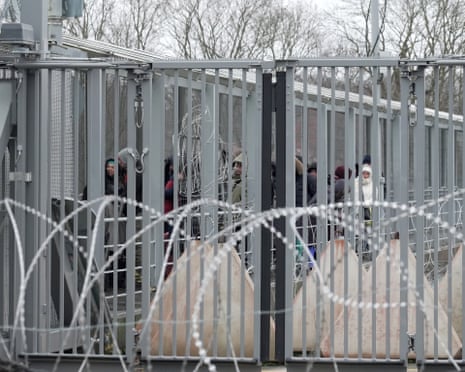
People standing behind concrete blocks on a bridge over the Narva River at the border crossing point with Russia in Narva, Estonia. Photograph: Janis Laizans/Reuters
Estonia, just like other Baltic countries, has repeatedly denied any suggestions they allowed for Ukrainian drones to operate from its territory.
“Tallinn apparently isn’t seriously considering the consequences of such a move. Closing the state border would primarily deal another blow to the Estonian economy and would boomerang on both Tallinn itself and its EU and Nato allies,” Russia said in a statement.
The statement blamed Estonia’s decision as “the latest anti-Russian stunt,” saying it “adds to the numerous hostile actions undertaken by this Baltic state in recent years.”
In a particularly worrying part of the statement, Russia also once again attacked Estonia for what it said were “repressive measures” against Russian-speaking residents – a point repeatedly denied by Estonian authorities.
“The head of the Estonian diplomatic mission was informed that such an unjustified policy of cultivating comprehensive hostility towards our country will continue to have a destabilising effect on the situation in the region and negatively impact both the well-being of Estonian residents and the already dire economic situation of this Baltic country,” it said.
The statement concluded with the Russian side “reserving the right to take comprehensive political and diplomatic measures aimed at protecting Russia’s national interests and the legitimate rights of its citizens.”