Rubenstein Center Scholarship
No room in the White House is more famous or photographed than the Oval Office. For many Americans, it is synonymous with the presidency, representing ideals of American democracy and liberty while projecting executive power to the world; however, this was not always the case. In fact, the Oval Office has only existed for about half of the 225-year history of the White House. The story of the design, creation, and evolution of the Oval Office reveals much about the changing nature of the White House and the presidency, as well as its connections to broader American culture and media.
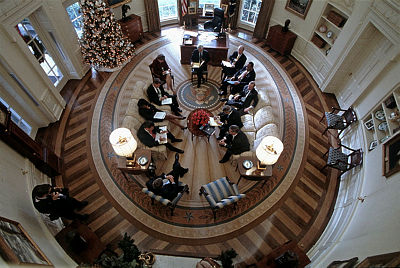
A meeting held in the Oval Office in 2001 under President George W. Bush.
George W. Bush Presidential Library and Museum/NARA
When initial White House construction concluded in 1800, there was no Oval Office. In fact, the West Wing, where the Oval Office now sits, also did not exist. There was only the Executive Mansion, often referred to today as the Residence, which served as both the home and office for the president, as a living quarters for first families, and as a workplace for staff. Each president chose their own space inside the house for their respective office; for example, Thomas Jefferson used the spacious State Dining Room. Today, it is used primarily for dinners, receptions, and other events, but were you to visit in the first decade of the nineteenth century, you might find President Jefferson working at his desk, surrounded by maps, potted plants, and a cage for his pet mockingbird. The majority of nineteenth-century presidents, including Abraham Lincoln, preferred a more intimate room on the Second Floor now dubbed the Lincoln Bedroom.1
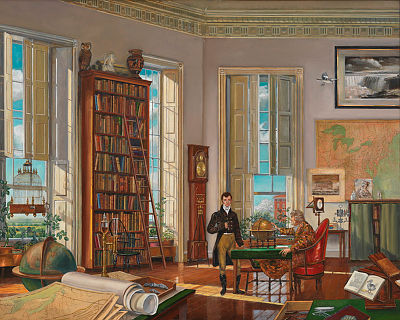
This modern painting by Peter Waddell (2008) depicts President Thomas Jefferson in his office in what is now the State Dining Room. “A Bird that Whistles: In Jefferson’s Cabinet, 1803.”
Peter Waddell for the White House Historical Association
By the time Theodore Roosevelt became president in 1901, the presidency had outgrown the scarce office space on the Second Floor. The number of workers on the president’s staff expanded gradually over the years, culminating in Roosevelt’s team, which was larger than his predecessors. Roosevelt also had six children and fitting everyone in the Residence was a challenge. To solve this problem, President Roosevelt ordered a renovation of the Residence, as well as the construction of the East and West Wings in 1902, with the former serving as a visitor entrance and reception area and the latter functioning as office space for executive office staff. The West Wing also included a small rectangular-shaped office for the president – there was no oval-shaped room in the initial layout – but Roosevelt, like many presidents, also kept an office in the Residence, which he used for most meetings.2

First Lady Edith Roosevelt drew this layout of the upper floor of the Residence in 1901 in an attempt to ensure the building could fit everyone in the family and on the staff. Evidently, it was not enough, for President Roosevelt ordered the construction of the East and West Wings in 1902 to create more working space at the White House.
Houghton Library, Harvard University
Roosevelt viewed the West Wing as a temporary office space which could be removed when no longer needed, but his successor, William Howard Taft, decided to make the West Wing permanent. Taft also ordered an expansion of the West Wing and hired architect Nathan C. Wyeth to design it.3 Wyeth’s plans did away with Roosevelt’s small, rectangular-shaped office in favor of a larger, oval-shaped room in the center of the southern wall to serve as the president’s office.
Why the oval shape? Wyeth wanted to convey a sense of grandeur and elegance befitting the presidency, which he thought the unique oval dimensions achieved. “I have endeavored to show a dignified treatment in keeping with the high purpose it [the Oval Office] is to serve,” said Wyeth.4 Wyeth was also inspired by the other oval-shaped rooms in the Executive Mansion – the Blue Room, Yellow Oval Room, and Diplomatic Reception Room – which were part of Irish-born architect James Hoban’s original 1792 design for the White House. President George Washington, who approved Hoban’s plan, liked oval-shaped rooms as he believed they facilitated social gatherings to meet the president, known in the eighteenth and nineteenth centuries as “levees.” The tradition of levees started in the royal courts of Europe and involved visitors gathering to meet a leader in a carefully scripted manner. In President Washington’s case, visitors could come to the President’s House every Tuesday afternoon to file into a room where Washington stood; after bowing and greeting the president, guests stood in a circle so that others could do the same, then departed. President Washington never used the White House for this purpose, as he left office before construction was complete. However, he did host these levees at his house in Philadelphia, which served as the Executive Residence until the capital moved to Washington, D.C. in 1800; he even ordered the construction of a semi-circular wall to one of the rooms in his Philadelphia house to facilitate these events. His successor, John Adams, hosted some levees at the White House. However, levees quickly fell out of fashion in the United States since many Americans saw them as aristocratic and ill-suited for a democratic nation. But the oval-shaped rooms in the White House today stand as a reminder of their original intended purpose.5

This modern-day illustration depicts a party hosted by President James Madison and First Lady Dolley Madison in the Elliptical Salon, known today as the Blue Room. President George Washington approved of oval-shaped rooms for the president’s residence as he believed the shape facilitated events involving the president and the public. Peter Waddell, “The Splendid Mrs. Madison: In the Elliptical Saloon, 1810-1814."
Peter Waddell for the White House Historical Association
Construction on the expanded West Wing and Oval Office began in the summer of 1909. By October, it was ready for President Taft.6 In its earliest days, the Oval Office did not possess the panache or fame that it does now. President Taft often worked there, but initially reserved most ceremonies and bill signings for the Executive Mansion because it was a more historic space. In 1912, however, President Taft held a small ceremony in the Oval Office where he signed legislation admitting New Mexico as the forty-seventh state of the Union and invited a photographer to capture the event. This bill signing set a precedent for the Oval Office as the location for significant moments in American history that the president wanted covered by the media.7
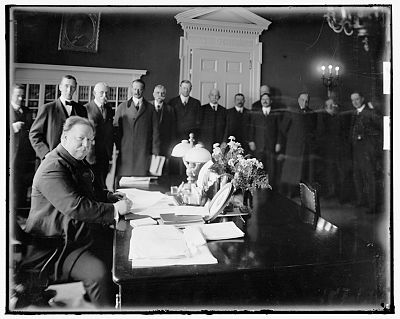
On January 6, 1912, President Taft held a ceremony in the newly-built Oval Office to sign the bill recognizing New Mexico as the 47th state in the Union. He invited reporters and photographers to ensure the moment was captured by the media.
Library of Congress
Subsequent presidents used the office with greater frequency, until 1929 when a fire broke out in the West Wing on Christmas Eve. The blaze began when papers in the attic of the West Wing caught fire, due either to a blocked chimney vent or faulty electric wiring. Though firefighters quickly put out the fire, it caused significant damage to the West Wing and Oval Office. It took four months until President Herbert Hoover and his staff were able to reoccupy the space.8
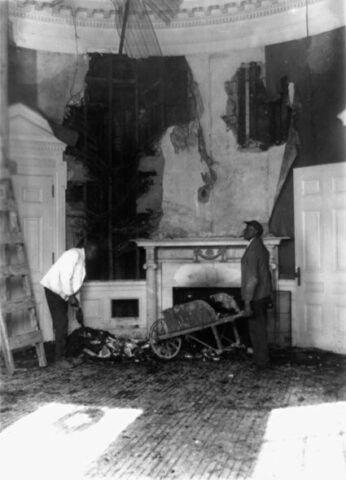
Workers remove rubble from the Oval Office after the Christmas Eve fire in 1929.
Library of Congress
By the time Franklin D. Roosevelt became president in 1933, the Oval Office was repaired from the fire damage and firmly established as a workspace for the president, where he could separate himself from the living quarters of the Residence and be close to his staff and aides working in the West Wing. But Roosevelt’s time as president led to one of the biggest changes in the history of the Oval Office: its movement to a new location. In order to fight the Great Depression, President Roosevelt rapidly expanded the size of the federal government. President Roosevelt’s staff was nearly twice as large as his predecessor, Herbert Hoover, leading one of Roosevelt’s advisors to complain that the office space in the White House was “extremely overcrowded.”9 To alleviate the crowding, Roosevelt ordered the expansion of the West Wing in 1934. Designed by architect Eric Gugler, the new West Wing added a second floor and subterranean level, and the entire footprint of the building doubled in size. Gugler also added ramps to the West Wing to facilitate President Roosevelt’s use of a wheelchair. As part of the redesign, Gugler shifted the location of the Oval Office from the center of the south side of the building to the southeast corner overlooking the Rose Garden, where it sits to this day. The new location placed the Oval Office closer to the Residence by connecting it to the West Colonnade, under which a president can travel directly from the Residence to the Oval Office – the famous “forty-five second commute.” The remodeling was completed in 1934, at which point Roosevelt began using the Oval Office on a regular basis.10
-
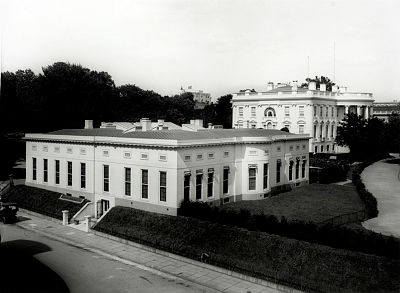
1 of 2
This photograph taken during William Howard Taft’s presidency captures the original location of the Oval Office in the center of the south-facing wall of the West Wing, before President Franklin D. Roosevelt had it moved to the southeast corner in 1934.
National Archives and Records Administration
-
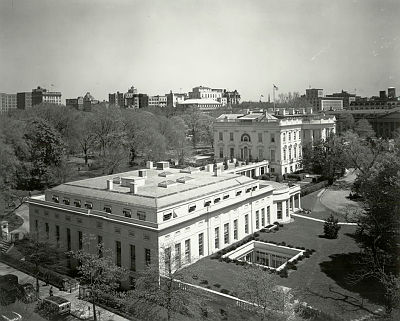
2 of 2
This 1935 photograph by Theodor Horydczak shows the Oval Office after it moved to its present location overlooking the Rose Garden. The photograph also shows a sunken courtyard revealing the subterranean level of the West Wing, but the courtyard was filled in during World War II.
Library of Congress
The press popularized the term “Oval Office” during FDR’s presidency. Upon its initial construction in 1909, the space was labeled simply the “President’s Office” or “Executive Office.” Newspaper articles occasionally used the term “oval” but only when providing a physical description of the space or distinguishing it from other office spaces the president used. For example, a 1914 newspaper article described a visitor meeting President Woodrow Wilson “in the oval shaped office where grave affairs of state are daily discussed,” while another article ten years later described guests greeting President Calvin Coolidge in the “beautiful green-carpeted white-walled oval office of the Chief Executive.”11 President Roosevelt’s accelerated pace of executive orders and bills to fight the Great Depression led to more media coverage of him than his presidential predecessors. He also deliberately cultivated a mutually beneficial relationship with the media to advance his agenda. To meet the demand from the press for information on the slew of presidential actions, Roosevelt held press conferences twice weekly in the Oval Office. For most of his day-to-day work, Roosevelt used a study on the Second Floor of the Residence, but he used the newly-reconstructed Oval Office more as a media space where he posed for photographs, met with foreign dignitaries, and held press conferences. Though not the first president to give press conferences, he was the first to do so regularly from the Oval Office. He also increased the number of reporters. Twice a week, dozens (and sometimes hundreds) of reporters crammed into the Oval Office “packed tight as if in a sardine container,” as one attendee stated, and stood around the desk behind which President Roosevelt sat fielding questions one at a time.12
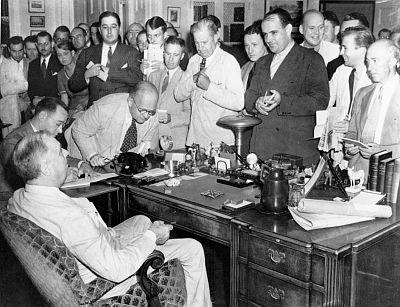
In this black and white photograph, President Franklin D. Roosevelt meets with members of the press in the Oval Office as they gather around the President’s desk for a press conference.
Franklin D. Roosevelt Presidential Library and Museum/NARA
With the American people eager to hear what new initiatives President Roosevelt was planning to combat the Great Depression, newspapers regularly reported on the Oval Office press conferences and disseminated articles about them throughout the country. By 1940, as U.S. involvement in World War II became more likely, media attention on President Roosevelt and his semi-weekly Oval Office press conferences grew even more. Shortly after the U.S. entered World War II in December 1941, British Prime Minister Winston Churchill visited President Roosevelt and stayed at the White House for about three weeks to coordinate military strategy and demonstrate solidarity between the two nations. During Churchill’s highly-publicized stay, he joined Roosevelt during an Oval Office press conference to field questions about their plans for the war. When President Roosevelt encouraged his British counterpart to stand while answering so that every reporter could hear him, Churchill - who routinely displayed a good sense of humor - stood on top of his chair “and smiled impishly,” causing the crowd of journalists to roar with laughter and applause. By the 1940s, newspaper articles were occasionally capitalizing “Oval Office” for the first time, indicating its solidification as an accepted and official term for the space as well as the growing fame of the office.13
The rise of television in the 1960s increased Americans’ visible access to the Oval Office, which solidified both its name and iconic status. Presidents used the Oval Office as a stage to speak to the American people about some of the most historic and eventful moments of the decade. In 1963, President John F. Kennedy delivered a televised address to the nation from the Oval Office, warning about the build up of nuclear missiles in Cuba in what became known as the Cuban Missile Crisis. When astronauts Neil Armstrong and Buzz Aldrin of the Apollo 11 mission landed on the moon in 1969, President Richard Nixon spoke to them over the phone in a conversation widely covered by the media. “Hello, Neil and Buzz,” said Nixon. “I am talking to you by telephone from the Oval Room at the White House, and this certainly has to be the most historic telephone call ever made from the White House."14

This photograph by White House photographer Cecil Stoughton depicts President John F. Kennedy in the Oval Office with his children Caroline and John Jr. (“John John”). President Kennedy and his family captured the attention of the media and the American public like few presidents before or since, and in so doing, helped turn the White House and Oval Office into icons.
John F. Kennedy Presidential Library and Museum/NARA
While the Oval Office has retained its iconic status, the furnishings and decor have changed much over its history. When Taft first occupied the room, he decorated it with olive green wallpaper paired with cream-colored wood trimmings.15 Subsequent presidents maintained the color scheme until 1923 when President Warren G. Harding ordered the wallpaper removed and the walls painted cream white, establishing the precedent that each occupant of the Oval Office could change the design. In addition to paint, carpet, drapes, and other design elements, presidents can select artwork, furniture, and objects either from the White House Collection or their own private collections, to suit their tastes and preferences. For example, President John F. Kennedy surrounded himself with model ships and other nautical elements, a nod to his coastal New England roots and his service in the U.S. Navy during World War II.16 His successor, Lyndon B. Johnson, wanted the Oval Office to feel more like his native Texas so he bedecked the walls with paintings of southwestern themes on loan from the Smithsonian.17 Some of the redecorating between administrations occurs on Inauguration Day, in the few hours between when the former president leaves the White House and the new one arrives. This allows the Oval Office to be ready for work the minute the new president moves in, though some in-coming presidents leave the Oval Office as it was and instead make adjustments throughout their term.
-
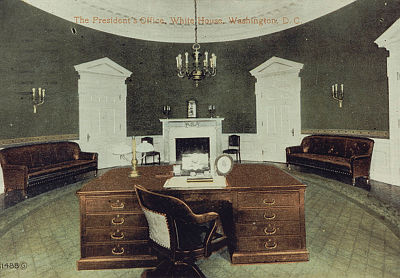
1 of 8
As seen in this post card from 1909, the original Oval Office had green wallpaper and carpeting, which remained until 1923 when President Warren Harding painted the walls cream white. Today, the design of the Oval Office often changes with each new president.
White House Historical Association/White House Collection
-
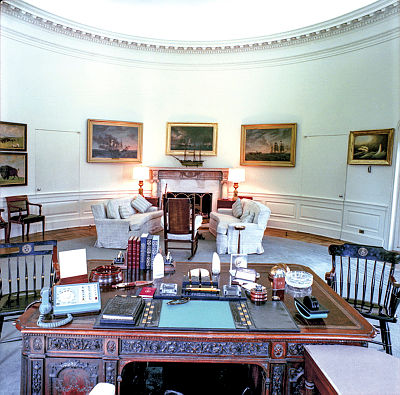
2 of 8
This photograph of the Oval Office after it was redecorated by interior decorator and socialite Sister Parish was taken by Robert L. Knudsen on August 14, 1961, during the John F. Kennedy administration. Parish created a nautical theme for the Oval Office by using both recently acquired and loaned seascapes as well as ship models from President Kennedy’s personal collection. Before 1909, the president's office was located in the Executive Mansion. During the William H. Taft administration, the West Wing doubled in size from the 1902 renovation and included a presidential oval office. In 1934, during the Franklin D. Roosevelt administration, the West Wing was expanded and renovated, with the Oval Office relocated to the West Wing’s southeast corner.
John F. Kennedy Presidential Library and Museum/NARA
-
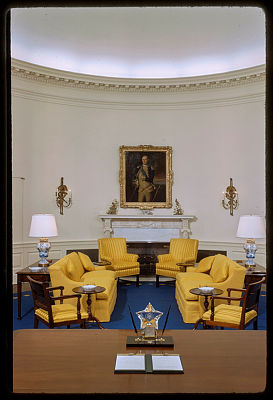
3 of 8
This photograph of the Oval Office was taken in June 1972 by Joseph H. Bailey during the Richard M. Nixon administration. Nixon preferred working in smaller spaces including in his office at the Eisenhower Executive Office Building (EEOB) across the street from the West Wing and used the Oval Office mostly for meetings and ceremonial events. Hanging above the fireplace is Charles Wilson Peale's portrait of President George Washington.
White House Historical Association
-
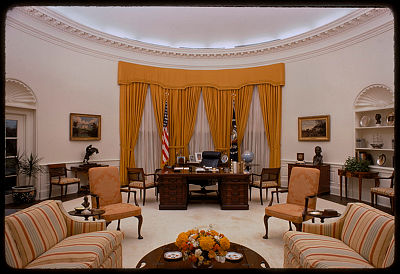
4 of 8
This photograph of the Oval Office was taken in February 1975 by Joseph H. Bailey during the administration of Gerald R. Ford. Like his predecessor President Nixon, President Ford used the Oval Office mostly for meetings and ceremonial events, rather than everyday routine work. Ford thought the Oval Office was "too grand and luxurious for some of the mundane work."
White House Historical Association
-
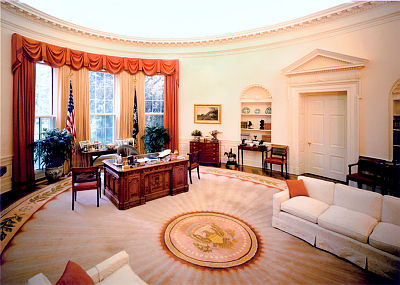
5 of 8
This photograph of the Oval Office was taken around 1983 during the Ronald Reagan administration. Much of the artwork in Reagan's Oval Office had a western motif, including several small bronze sculptures of saddles by Paul Rossi, as well as miniature sculptures of horses.
White House Historical Association
-
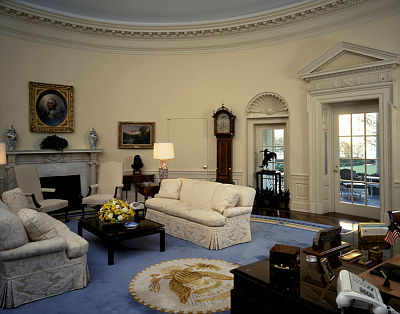
6 of 8
This photograph depicts the Oval Office during George H.W. Bush’s presidency. “The Oval Office was marvelous,” said Bush after his presidency ended. He used the office nearly every day. In warmer months, he would often sit outside on the small patio, visible towards the right of the photograph, to eat lunch or sit in the sun.
White House Historical Association
-
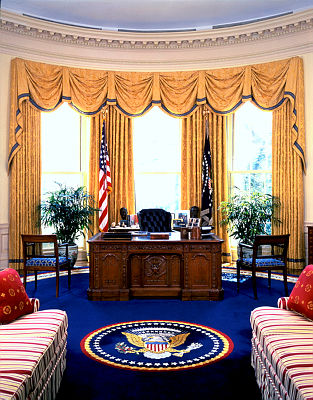
7 of 8
This circa 1995 photograph depicts the Oval Office under President Bill Clinton. The rug depicts the Seal of the President of the United States.
White House Historical Association
-
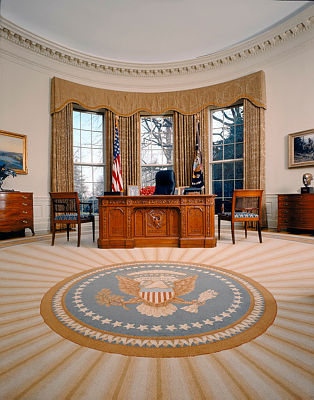
8 of 8
This color photograph depicts the Oval Office, located in the West Wing of the White House, during the administration of President George W. Bush. In the center of the photograph is the Resolute desk that has been used by many presidents in their office. The desk was made from the oak timbers of the British ship H.M.S. Resolute and sent as a gift to President Rutherford B. Hayes from Queen Victoria in 1880. Beyond the desk are Bush family photographs. The sculpture to the left is Frederic Remington's modeled 1895, cast 1903 bronze sculpture The Bronco Buster. To the right is Nison H. Tregor's 1957 bronze bust of President Dwight D. Eisenhower.
White House Historical Association
Even the Resolute Desk has moved in and out of the Oval Office over the years. Gifted to President Rutherford B. Hayes by Queen Victoria in 1880, the desk was made from oak salvaged from the British vessel HMS Resolute. While nearly every president since Hayes has used the Resolute Desk somewhere in the White House, it was not kept in the Oval Office until President Kennedy ordered it placed there (it had previously moved between several rooms in the White House). Following his death in 1963, the Resolute Desk became part of a traveling exhibition and then was put on display at the Smithsonian until 1977 when President Jimmy Carter requested its return to the White House. From that point, it has remained in the Oval Office except during part of George H.W. Bush’s presidency, who preferred using the desk he had while vice-president.18
In the age of television and constant media coverage, presidents often redecorate the Oval Office not just to suit their design taste, but also as a subtle means of advancing their political interests and agenda. Appearances in the Oval Office surrounded by hand-picked furnishings and artwork can send a message to the American people or the world, reinforcing the image the president wishes to cultivate of themselves. For example, President Ronald Reagan added a rug to the Oval Office with sun beams emanating from the Presidential Seal, a reference, perhaps, to his “Morning in America” refrain; the sun beams were surrounded by olive branches, intended to echo his work to end the Cold War between the United States and Soviet Union. President Barack Obama added a bust of Martin Luther King, Jr. which marked the first time art depicting the likeness of a Black person was showcased in the Oval Office. President Obama displayed the bust of King next to one of President Abraham Lincoln, who oversaw the abolition of slavery. Together, both busts served as a subtle reminder of Obama’s historic status as the first African-American president.19
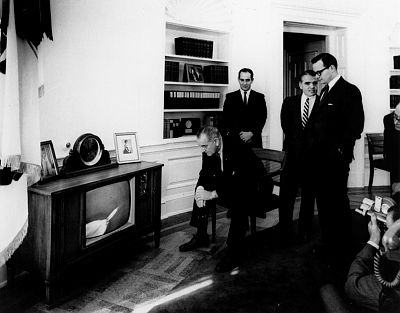
Presidents have also incorporated different technologies into the Oval Office to enhance their ability to govern. During World War II, Franklin Roosevelt added one of the more unique items that ever sat in the room: a massive, 750-pound globe gifted to him by the U.S. Army. Roosevelt used the globe to follow troop movements and military strategy. Chief of Staff of the Army George Marshall and British Prime Minister Winston Churchill also had identical globes.20 Roosevelt also installed a recording device in the Oval Office as a means of taking notes from his meetings and conversations. Each subsequent president used similar recording systems in the Oval Office, culminating in the presidency of Richard Nixon when missing tape recordings during the Watergate investigation ultimately led to his resignation. His successor, Gerald R. Ford, ordered all recording equipment removed; so many hidden wires and instruments had accumulated in the office over the years that the walls had to be replastered and repainted.21 As televisions became more common, President Lyndon B. Johnson had three TVs installed in the Oval Office alongside ticker-tape and teletype machines that printed news bulletins so that he could stay abreast of media coverage.22
-
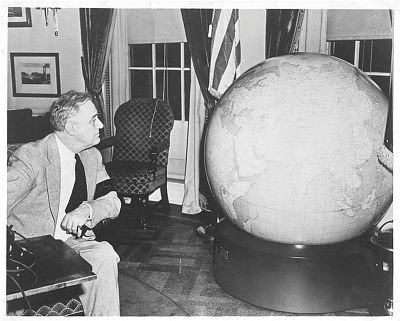
1 of 3
This black and white photograph shows President Franklin D. Roosevelt examining a large globe presented to him by the U.S. Army. The president wears a black armband and appears to be studying Europe and North Africa. The globe was over 50 inches in diameter and weighed roughly 500 pounds. Two identical globes were made at the same time by the Weber Costello Company of Chicago Heights, Illinois. One of the other globes was gifted to British Prime Minister Winston Churchill.
Franklin D. Roosevelt Presidential Library and Museum/NARA
-

2 of 3
In this photograph, taken in the Oval Office circa 1963 by Yoichi Okamoto, President Lyndon B. Johnson speaks over the telephone while watching live news coverage on three television sets he had installed in the office. Next to the television cabinet sits a wire service that printed a running stream of ticker tapes with the latest news.
Lyndon B. Johnson Presidential Library and Museum/NARA
-
3 of 3
In this photograph, taken on January 29, 1964 by Abbie Rowe of the National Park Service, President Lyndon B. Johnson watches the launch of the fifth Saturn I rocket in the Oval Office with special assistants Jack Valenti and Bill Moyers seen standing to the right of the president. The nineteen-ton second stage of the vehicle became the heaviest satellite ever orbited at that time. The Saturn rockets would become integral to the U.S. space program and the Apollo missions that landed the first humans on the moon.
National Archives and Records Administration
Just as presidents are free to design the space as they see fit, they are also free to use the office as much or as little as they like. While every president since Taft has used the Oval Office to some degree, some have used it more than others. Jimmy Carter, for example, treated it as his every-day office. “I got up quite early in the morning to go to the Oval Office and read the secretary of state’s nightly report, the local newspapers, and my paperwork,” reported Carter in an interview describing his daily routine while president. George H.W. Bush similarly used the Oval Office on a daily basis, and often sat outside on the adjacent patio during warm days. Other presidents preferred to use more intimate spaces as their daily office, including the small study next door, and reserved the Oval Office for formal meetings, televised addresses, or receptions. Richard Nixon, for example, liked to do most of his daily work in the Eisenhower Executive Office Building (EEOB) across the street from the West Wing. His successor, Ford, also preferred smaller office spaces and viewed the Oval Office as “too grand and luxurious for some of the mundane work.” Whether presidents use it as their primary office space or not, all have recognized the advantages the Oval Office brings for significant events that will be covered by the media, whether it be televised addresses to the nation or meetings with foreign dignitaries and celebrities.23
-

1 of 3
This photograph of President Richard M. Nixon meeting with American musician Elvis Presley in the Oval Office was taken by Oliver F. Atkins on December 21, 1970. White House staff member Egil Krogh is seen looking on at right. By this time, presidents had learned to use the Oval Office as a space for meetings and events that they knew would garner media attention, thus helping to reinforce the association between the president and the office.
Richard Nixon Presidential Library and Museum/NARA
-
2 of 3
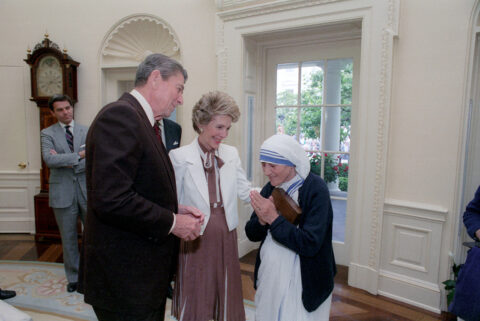
President Ronald Reagan and First Lady Nancy Reagan speak with Mother Teresa in the Oval Office on June 20, 1985. During her visit to the White House, President Reagan presented Mother Teresa with the Presidential Medal of Freedom.
Ronald Reagan Presidential Library and Museum/NARA
-
3 of 3
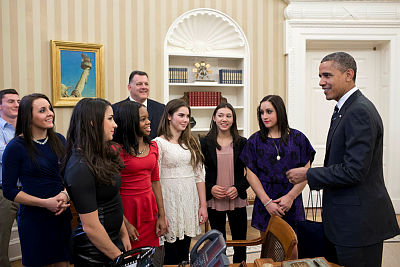
In this photograph, taken by Pete Souza, President Barack Obama welcomes members of the 2012 U.S. Olympic gymnastics teams to the Oval Office. President Obama welcomed the team members on November 15, 2012. From left to right: Steven Gluckstein, Savannah Vinsant, Aly Raisman, Gabby Douglas, Steve Penny, McKayla Maroney, Kyla Ross, and Jordyn Wieber.
Official White House Photo by Pete Souza
Today, the Oval Office, like the White House, is synonymous with the presidency, a nearly timeless symbol of American democracy and ideals. But the prestige and fame it holds obscures the fact that its roots lay in a practical need for more office space to relieve crowded conditions in the White House. Practical though its roots may be, the oval design was intended from the start to represent the “dignified” and “high purpose” of the presidency, in the words of the architect.24 While the decor has widely varied by presidency, the room itself has certainly achieved those lofty goals.
You Might Also Like
-
-
Collection
An Unlikely Friendship: The United States and Britain
It seems unlikely that the United States would form a long-lasting friendship with Great Britain after declaring independence in 1776, but these two nations once deeply embroiled in arguments over sovereignty grew to be close allies. This tight friendship didn't come without significant obstacles. Several decades after stunning revolutionary success over the Crown, British soldiers again descended on American soil, setting
-
-
-
Collection
Celebrating America's 250th Anniversary
Although the White House was completed 25 years after the founding of the United States, Presidential and White House history are deeply connected to the American story. Several Founding Fathers went on to become president; Independence Day has been celebrated at the White House since Thomas Jefferson himself was in office; and America's Centennial and Bicentennial were both marked at the
-
Podcast
Making the Official White House Christmas Ornament
Featuring Hamilton Davison and Dave Marquis
-
Podcast
White House History and the Waldorf Astoria New York
Featuring David Freeland and Jasmin Howanietz
-
-
-
Podcast
History Revealed: The Kennedy Gravesite
Featuring James L. Felder, Elinor Crane, and Alan Price
-
-
Collection
The 2025 White House Christmas Ornament
Every year since 1981, the White House Historical Association has had the privilege of designing the Official White House Christmas Ornament. These unique collectibles — honoring individual presidents or specific White House anniversaries — have become part of the holiday tradition for millions of American families. In this collection, explore the history behind our 2025 design and learn more about White House State Dinners. Buy