
 Serenity Strull/ Madeleine Jett/ BBC
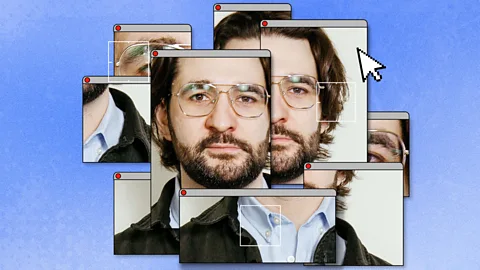
I asked experts if I'm real. Bad news. Even my aunt wasn't sure if I was a deepfake. AI is so convincing that a sitting prime minister struggled to prove he's alive. You might be next.
I called up my aunt Eleanor a few days ago and asked her to help with an experiment. "It's for an article," I said. I had explained I was going to call her back and she'd either be talking to the real me or an AI deepfake. Could someone who's known me my whole life tell the difference?
At first, my aunt wasn't buying that any AI was involved. "Well, it sounds like you," she said. "I think a real person uses a lot more inflection than I would expect an AI-generated voice to use." That might be true, I told her, but AI is getting pretty advanced. There was a long pause. "I was like 90% sure," she said, hesitating. "But that sounded more artificial."
When we talk about deepfakes, the typical concern is about you getting tricked. Rightly so. AI fakery has been used to scam people out of large sums of money, spread misinformation and even attempt to sway elections. But what if the shoe was on the other foot? What if someone accuses you of being a deepfake? How do you prove you're real?
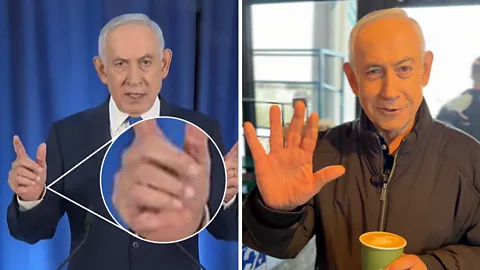
That's a question Israeli prime minister Benjamin Netanyahu had to ask himself this month. He posted a video where a trick of the light made it look like he might have a glitchy sixth finger on his right hand, once a clear giveaway of AI deepfakes. The internet exploded with rumours that Netanyahu had died in a missile strike and Israel was covering it up. Days later, the prime minister posted a follow up video from a coffee shop, where a smiling Netanyahu held his hands up to demonstrate he had the ordinary number of fingers.
This, experts tell me, is the first time the leader of a major world power has openly tried to prove they're not AI – and it failed, miserably.
As you read this, a large number of people are still convinced Netanyahu is dead (and they'll tell you I'm part of the conspiracy for saying otherwise). But his proof-of-life videos made some very basic mistakes. Could I do any better? Is it still possible to prove you're not a robot? I called the experts to find out, and I'll give you a preview: things aren't good.
He's not dead, folks
This actually happened to me in the wild. A few weeks ago, I wrote an article about an underused Google privacy setting. I got so worked up that I shared a link to the setting in my family group chat and urged everyone to click on it. But my mom was immediately suspicious. Good call, this was weird behaviour. I think I had too much coffee.
"How do I know this is really Tom and not some weird scammer?" she wrote. "Say something a scammer couldn't say." I had to think, but eventually I landed on a nickname my parents used when I was a kid. She was satisfied, but this is a lot more challenging when you're dealing with people who don't know you. Let's say you're Benjamin Netanyahu, for example, and the audience is the whole world.
 Israeli Government Press Office
Every expert I asked said Netanyahu's videos are unambiguously real. Jeremy Carrasco, co-founder of Riddance, an independent publication focused on AI-generated media, didn't take long to reach that conclusion. "In short, they're all real, and they are all just showing normal things that happen in videos," Carrasco says. The supposed sixth finger, for example, is light reflecting off Netanyahu's palm he says. It looks weird if you hit pause at the right moment, but that's all it is.
"Six fingers is not an AI thing anymore," Carrasco says. The best AI tools stopped adding extra fingers years ago and a model capable of producing everything else in the video wouldn't make that mistake. Other signs rule out deepfakes, too. At one point, Netanyahu bumps the microphone, producing a sound that interrupts the audio of his voice. Carrasco says this sort of continuity is incredibly difficult for AI tools to pull off. (Watch my colleagues on BBC Verify break down the false AI claims about Netanyahu in this video.)
Netanyahu's follow-up coffee shop video is real too, says Hany Farid, a digital forensics professor at the University of California, Berkeley and co-founder of GetReal Security, which works to mitigate the threat of AI deepfakes. His team ran voice analysis, frame-by-frame face detection, careful inspection of light and shadows and more. "There's no evidence that this is AI-generated," Farid says.
That wasn't enough. Netanyahu even posted a third video, but sceptics' minds were made up. But now let's talk about you and me. If Netanyahu can't prove he's real, can anyone?
'It's over'
As we worked through my interview questions I stopped and asked Farid if there was anything I could do, right now, to prove to him that I wasn't an AI.
His answer was simple: No.
"There are things I could do to probe the system and make it less likely," Farid says. "If you were a full-blown agentic AI, I wouldn't hear you typing. And I can see a shadow in the background that's pretty physically consistent as you move, and a reflection in your glasses." There were other signs, too like the way I kept looking down as I took notes, something a deepfake wouldn't bother with. "But at the end of the day, you're in New York. I'm in Berkeley, California," he says. "We're on a video call. The reality is that you could be faking this."
Without taking additional steps before or after our call, Farid says there's nothing I could do to make him 100% certain I was the real Tom Germain. "No," he says. "It's over."
Keeping Tabs
Thomas Germain is a senior technology journalist at the BBC. He writes the column Keeping Tabs and co-hosts the podcast The Interface. His work uncovers the hidden systems that run your digital life, and how you can live better inside them.
Woolley was just as hard to convince. "I could call the BBC and ask someone to double check that that you called me", but that would take too long to figure out while we're on the phone, he says. "For the average person, and even for people who are savvy to technological manipulation, it is very difficult to verify that someone is real," says Woolley. For he knows, I'm just another robot.
The solution the world's leading experts have landed on is one your grandparents could have come up with: codewords. You, your family, business partners and anyone else you communicate with about important subjects need to come up with a secret phrase that no-one else knows you can use in an emergency to verify each other's identities. Think of it like a convoluted form of the multi-factor authentication we all use to login online.
"My wife and I have a codeword that we use if we ever get an unusual call," Farid says. "We haven't needed to use it yet, but sometimes I ask just to test her to make sure we don't forget it."
This isn't a hypothetical concern. Deepfake scams, which use AI to convince victims they're talking to someone else, have become a key method for criminals. According to the American Association of Retired Persons (AARP), AI-enabled scams rose 20-fold between 2023 and 2025. Victims range from everyday people to big businesses. The British engineering firm Arup reportedly lost $25m (£18.7m) when attackers used a deepfaked version of the company's chief financial officer to trick an employee.
And the problem is only growing.
Bizzaro land
"In the first days of Ukraine, you saw a few deepfakes, super clumsy, not particularly convincing," he says, referrring to the conflict that has followed Russia's fullscale invasion of Ukraine in 2022. "Fast forward to the early days of Gaza, there's lots of fake content. It was better, pretty good. By the time we get to Venezuela? Bizarro land. I saw way more fake content than I did real content. And Iran took it to a whole new level."
In Netanyahu's case, it didn't help that his team used a fancy camera and filmed with a narrow depth of field, meaning a nice sharp foreground and soft blurry background – which is exactly how AI videos tend to look, Carrasco says. But by the time Netanyahu posted his coffee shop clip, our world was already saturated with fake content, raising suspicions that are hard to overcome under any circumstances. Netanyahu's fingers, hallucinated or otherwise, are just the latest wave in an AI flood that's been rising for years.
This chaos has a name: researchers call it the "liar's dividend". It's expensive to prove something is real, but casting doubts is free. "People, including people in positions of power, can argue that genuine content – genuine evidence of them doing something – is fake," says Samuel Woolley, chair of disinformation studies at the University of Pittsburgh in the US.
Politicians and others can use the spectre of AI as a shield, crying deepfake to dismiss real evidence. But it's a double-edged sword, and that same atmosphere of distrust is coming back to bite them. "The very politicians that pushed for this lack of moderation are now, in many ways, paying the consequences," Woolley says.
More like this:
• The number one sign you're watching an AI video
• I hacked ChatGPT and Google in 20 minutes
• People are selling your home address online. This privacy tool will help
Back on the phone with my aunt Eleanor, reality was bending. It turns out she'd heard the codeword advice and she actually had one for her kids and her husband, but I wasn't in the loop. "I've read a lot of stories like that, where they talk about voices being cloned from YouTube videos," she said. "That concerns me. It's terrifying."
She read me some jokes she found on Facebook to test whether my reaction felt authentic. I laughed, which helped a bit, but she couldn't be totally confident. We started talking about the sweater she's planning to knit me, but when I said I was thinking I might prefer black over the gold colour we'd talked about, this seemed like another red flag. "That sounds more robotic. I expected you to say that you wanted another gold sweater." Later, I told her the truth. I wasn't using AI, it was the real me. But on the call, the whole thing seemed to distress her a little bit.
"I can't be sure," she said as we got off the phone. "But I love you, kid."
--
For more technology news and insights, sign up to our Tech Decoded newsletter, while The Essential List delivers a handpicked selection of features and insights to your inbox twice a week.
For more science, technology, environment and health stories from the BBC, follow us on Facebook and Instagram.