Coal makes a bit of a comeback, if only by accident.
Solar panels have gotten so cheap that it's possible to spend more on their support system while still turning a profit. Credit: Bilanol
On Tuesday, the US Energy Information Administration released full-year data on how the country generated electricity in 2025. It’s a bit of a good news/bad news situation. The bad news is that overall demand rose appreciably, and a fair chunk of that was met by additional coal use. On the good side, solar continued its run of astonishing growth, generating 35 percent more power than a year earlier and surpassing hydroelectric power for the first time.
Shifting markets
Overall, electrical consumption in the US rose by 2.8 percent, or about 121 terawatt-hours. Consumption had been largely flat for several decades, with efficiency and the decline of industry offsetting the effects of population and economic growth. There were plenty of year-to-year changes, however, driven by factors ranging from heating and cooling demand to a global pandemic. Given that history, the growth in demand in 2025 is a bit concerning, but it’s not yet a clear signal that the factors that will inevitably drive growth have kicked in.
(These factors include things like the switch to heat pumps, the electrification of transportation, and the growth in data centers. While the first two of those involve a more efficient use of energy overall, they involve electricity replacing direct use of fossil fuels, and so will increase demand on the grid.)
The story of the year is how that demand was met. If demand grows more slowly, the additional 85 terawatt-hours generated by expanded utility-scale and small solar installations would have easily met it. As it was, the growth of utility-scale solar was only sufficient to cover about two-thirds of the rising demand (or 73 percent if you include wind power). With no new nuclear plants on the horizon, the alternative was to meet it with fossil fuels.
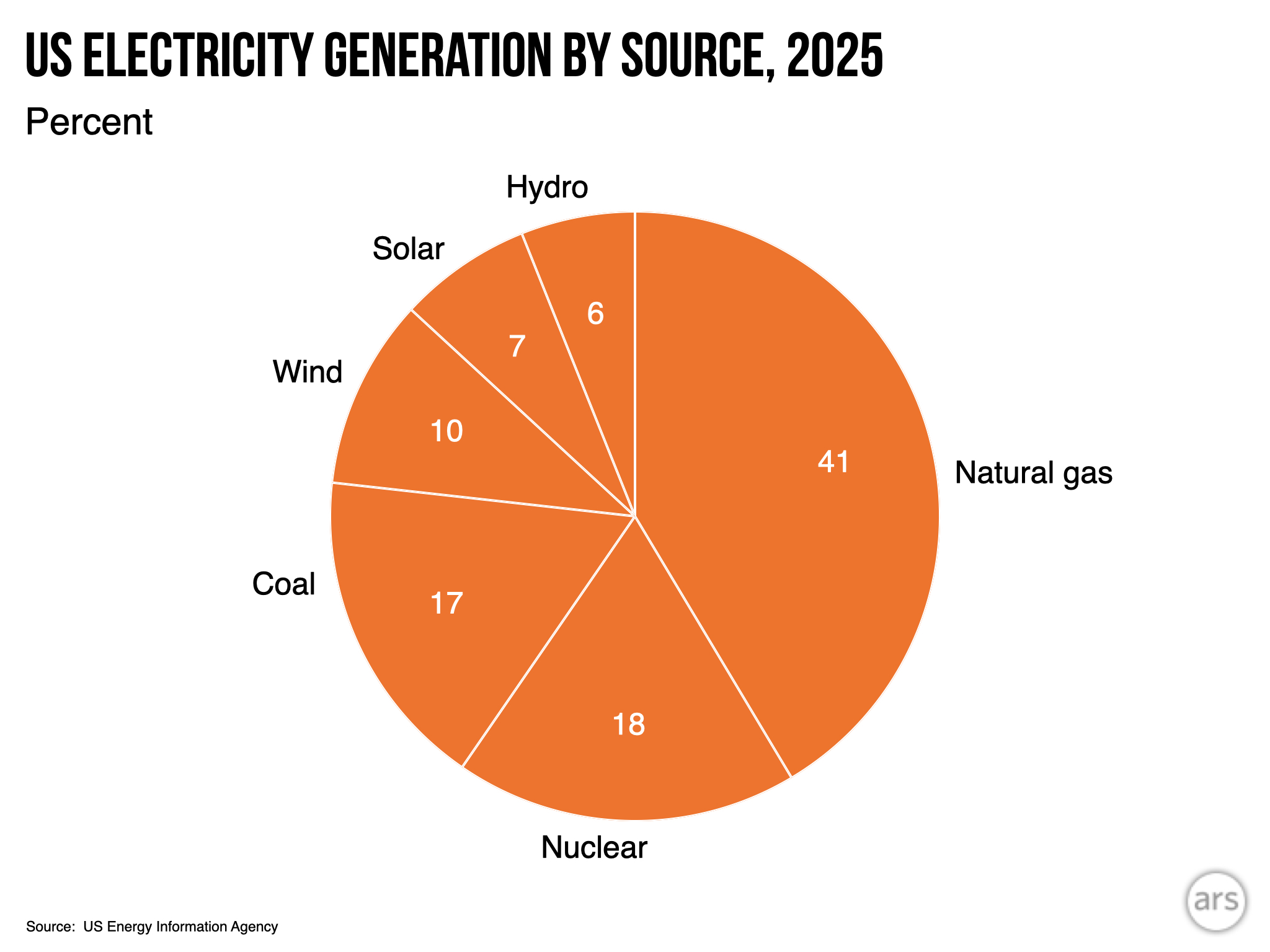
Hydropower has become the first energy source to be passed by solar power. It won’t be the last.
Credit: John Timmer
Hydropower has become the first energy source to be passed by solar power. It won’t be the last. Credit: John Timmer
And the fossil fuel market has gotten increasingly complicated. In the recent past, every increase in demand would have been met by additional natural gas generation, given the abundance of local production. But high demand and increased tariffs have led to rising costs and long delays for the hardware that generates electricity by burning natural gas. President Trump also reversed Biden’s block on new facilities that export natural gas in liquid form, meaning the local market is increasingly competing with international sales, raising prices.
Coal has thus been more economically viable than in years past, and electricity generated from burning it rose by 13 percent. Chris Wright, the secretary of energy, has also ordered a number of coal plants slated for closure to remain available. It’s unclear whether many of them are generating power, since they wouldn’t be slated for closure if demand could be met more economically without them operating. The administration has probably had a stronger impact on coal use by its promotion of natural gas exports.
The net result of the above policies? Coal, solar, and wind all produced more power in 2025. Demand rose by more than any of these sources did individually, but by less than their total increase—the excess went toward displacing natural gas.
What’s coming next?
While the Trump administration has been hostile to renewable energy, there’s only so much it can do to fight the economics. A recent analysis of planned projects indicates that the US will see another 43 GW of solar capacity added in 2026—far more than the 27 GW added in 2025. That will be joined by 12 GW of wind power, with over 10 percent of that coming from two of the offshore wind projects that the administration has repeatedly failed to block. The largest wind farm yet built in the US, a 3.6 GW monster in New Mexico, is also expected to begin operations in 2026.
That means wind and solar are well-positioned to outpace hydropower as they provide an ever-larger share of US electricity. It’s also likely to keep them ahead of any increase in coal power that occurs next year. Combined with hydropower, the growth in wind and solar should push renewable energy to nearly a quarter of the US electricity mix, barring a massive increase in demand.
Another major factor that will boost renewables is the rapid expansion of battery storage, which reduces the risk that excess solar power goes to waste. Often, the two are co-located so that the batteries can use the same transmission infrastructure after solar stops producing. The EIA foresees 24 GW of new battery capacity being added to the grid, much of it being installed in California and Texas. Of the 6.3 GW of new natural gas generation expected in 2026, 2.8 GW are expected to be combustion turbines, which are often used to compensate for the variability of renewable power.
The US is near a key pivot point, with wind and solar nearly (but not quite) growing fast enough to offset a significant rise in demand, and is likely to reach that point within the next few years. And grid operators are building the sort of support facilities that will blend in well with a future dominated by renewables. Unfortunately, market dynamics are causing a rise in coal use that is likely to offset trends that would otherwise reduce our carbon emissions.

John is Ars Technica's science editor. He has a Bachelor of Arts in Biochemistry from Columbia University, and a Ph.D. in Molecular and Cell Biology from the University of California, Berkeley. When physically separated from his keyboard, he tends to seek out a bicycle, or a scenic location for communing with his hiking boots.