Good Gore
For years, I looked away from the grossest scenes in the year’s scariest movies. Could I teach myself to watch them differently?
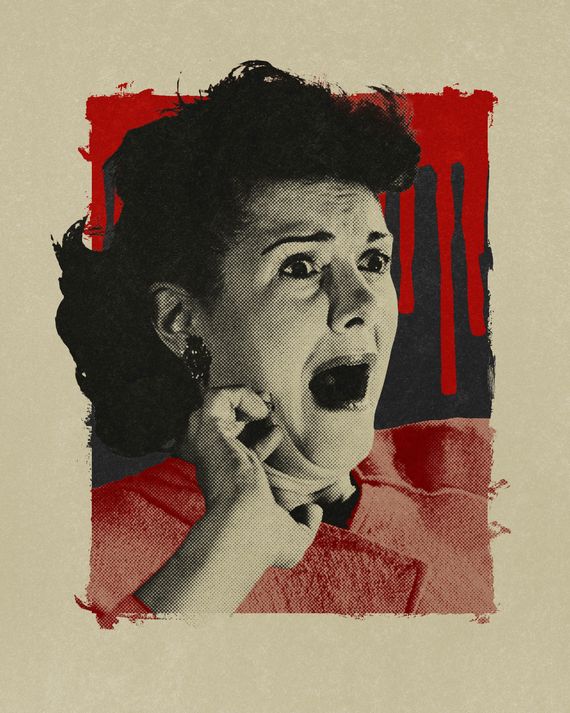
Photo-Illustration: Vulture; Photos: Getty
Photo-Illustration: Vulture; Photos: Getty
For me, there are two types of movies and TV shows: ones I watch with my eyes open and ones I watch with my eyes closed. Okay, there’s maybe a third type: ones I watch with my eyes open, but only through my fingers splayed across most of my face. I am squeamish, incredibly so, about guts and gore onscreen, and I’ve been this way since I was a kid. When my parents watched ER, I would run into the next room the second gaping wounds and exposed bones appeared, waiting for the camera’s focus to return to the situationship driving the narrative that week. If I did happen to catch sight of a geyser of blood, my stomach would drop, my arms would go heavy, and my head would slink down. Reflexively, I could not see it.
This adolescent squeamishness has persisted into my adult life, which has been mostly okay. I am neither a doctor nor a crime-scene investigator nor an embalmer. But I am a writer who peddles in pop culture, wherein a show featuring Noah Wyle administering treatment to disturbed innards seems to always exist. When I first started out, it was easy enough for me to stay in my lanes (experimental film, British spy shows, Taylor Swift), avoiding the bloody terrain of both horror movies and medical procedures, the two main genres of gore. Then Ari Aster’s head-spinning (-rolling?) debut feature, Hereditary, premiered. That year, and seemingly each year after, it felt like the biggest cultural moment was something yucky. There were more Aster movies, more horror: Longlegs, The Substance, Sinners, Weapons. At a wedding earlier this year, beloved friends of mine — people whose job descriptions are not “watching as much film and television as possible” — kept asking me about Obsession, a movie I’d gone out of my way to avoid. (“But I have seen Dry Leaf,” I’d tell them, to silence.) “Do you watch The Pitt?” people ask me. “I start episodes of The Pitt,” I tell them, and at some point — maybe it’s a flash of mangled limbs, maybe it’s the degloving — I feel sick and leave the room.
I would like to get over my squeamishness for these reasons: first, the unbearable FOMO. Everyone is watching and discussing gory stuff without me, and they’re loving it, which says to me that either everyone is a desensitized sadist while I am a polite empath or that everyone is an adult who can suspend disbelief and I am a baby who cannot. I’d also like to get over my squeamishness on professional grounds. Being too afraid to watch critically acclaimed films and series — immediately, instead of months or years after they’ve released and I’ve been able to work up my nerve; or in their entirety, instead of in pieces, some of which get disregarded because my nerve never actually got worked up — might be a career killer. (There are only so many blogs to pitch on Dry Leaf.) But is it possible to change a fundamental part of my perception? Could I grow to tolerate blood and guts onscreen, or even grow to love it, as so many of my gorehound friends and co-workers do? Probably not, I thought stubbornly. But maybe, my editor prodded.
Before I attempt full squeamishness rehabilitation, I decide I should first understand exactly what it is about gore (which we will heretofore define as the graphic display of any blood, guts, or significant bodily damage) that prompts me to look away. Is it the mere presence of fluids and organs, or do they need to be presented in a particular way in order to pull whatever primal lever exists in my brain? Like any good woman in STEM, I opt to run a sample test to see if I can confirm that question on my own: I would watch Obsession, a horror movie that I know to involve a notorious head-bashing scene. In doing so, I could clock the scenarios that lurch my stomach and also produce a baseline of squeamishness that can hopefully be improved upon as I embark on future screenings.
“Obsession is not even scary” is what many people tell me when I explain my methodology. To be clear, scariness has never been my issue. If a film were to have 1,000 jump scares but no blood spatter whatsoever, I’d be in hog heaven. (A current example of this would be Paranormal Activity on Broadway, which I loved!) I believe it is the appearance, even when announced in advance, of gruesome injury that sends me heaving away, not the threat of harm, which can be implied to happen offscreen or can linger above chaotic violence as an anxious possibility. Psychological torment? I can take it. The act of having to look at crushed skulls? I cannot.
Obsession’s physical violence first fizzles up when Nikki (Inde Navarrette) takes a glass bottle to her own head at a party. That part is not pleasant, but I white-knuckled it through the indulgent spurts of burgundy blood, which never devolved into any actual face splitting. Later, however, when Bear (Michael Johnston) meets his cool co-worker Sarah (Megan Lawless) for a clandestine late-night chat in her car, Nikki smashes the car window and then smashes Sarah’s face, again and again and again. The scene is awful and goes on longer than one might expect. I make it through about half a second before I have to look away. When I look back, thinking the slaughter is over, the camera is hovering over Sarah’s decimated face, a mash of pulp and what is left of her eyes. I have nightmares about it later that night.
In retrospect, my anguish is twofold: My stomach lurches when there is gore onscreen, period. But it feels most lurched when I also witness the act that produced the bodily damage. In other words, blood and guts need only to be present for me to feel fear, but when, say, human-on-human violence produces that gore, my fear is amplified.
This could be a result of something the National Institutes of Health calls blood-injection-injury phobia (otherwise known as BII phobia, not to be confused with biphobia, which wreaks havoc on other parts of this city), the term for an irrational fear not just of seeing blood but of receiving injections and witnessing injuries or medical procedures. I am skeptical of this explanation, as I have always complied with vaccine recommendations. But the vasovagal response it produces — the sensation of feeling like I could faint — is somewhat familiar. The most common treatment for BII phobia is simply applied tension. “It might sound counterintuitive,” explains Dr. Kelly Knowles, a clinical psychologist who completed her Ph.D. at the EARL (Emotion & Anxiety Research Laboratory) Lab at Vanderbilt with Dr. Bunmi Olatunji, “but applying muscle tension — clenching, applying pressure — can actually help raise your blood pressure and prevent that dip to level back out.”
But Dr. Knowles, one of several experts I will incessantly bother in the course of this story, raises an interesting idea: My squeamishness might not be a fear, exactly. It could be better explained as disgust, which like fear is a negative emotion that causes us to withdraw from scenarios to stay safe but prompts different bodily responses. Whereas fear speeds up your heart, disgust slows it down, which can divert blood away from your stomach and toward your core muscles, creating a “hollow” or “sinking” feeling in your abdomen. That is, more often than not, my body’s primary response to gore onscreen. And whereas fear can often involve capital T-trauma, my disgust could date back to a moment so small that I don’t remember it. “Disgust reactions can be acquired more easily than a lot of other emotions. If you’ve ever had a rough night of drinking and then you say, ‘I can’t have tequila anymore,’ that’s a single trial of learning a disgust reaction,” Dr. Knowles explains. “It makes sense because evolutionarily, if we ate something that was going to cause us to throw up, our ancestors would have had to learn they shouldn’t eat that.”
The catch: “It takes a lot of conscious effort to undo that, especially if you’ve got some sort of biological predisposition to be more sensitive to disgust. There’s no one-and-done treatment,” Dr. Knowles adds, “or else I wouldn’t have a job.”
Like any good journalist, I am oppositional, defiant, and, unfortunately, on a deadline. (I have given myself approximately two months to tackle a lifelong condition.) After speaking with Dr. Knowles, I remember a charmingly drunk stranger who once told me he quit smoking after a single session of hypnosis — a one-and-done treatment I suddenly feel compelled to try. So I turn to a warm and composed Brooklyn-based hypnotherapist named Kim.
Before meeting, I have only cartoon-level familiarity with hypnosis — the kind that involves pendulums, spirals in eyes, a lot of handclaps. I admire that Kim is serious without being too woo-woo and is equipped with the right amount of skepticism about my mission. She doesn’t necessarily see my aversion to gore as a bad thing. In fact, in her view, whatever sensitivity I have is not because I lack something but because I possess too much — an abundance of empathy, perhaps, for the skewered victims of ghouls.
Our session happens over Zoom. Through slow-paced, soft-spoken conversations, Kim says she will take me down the recesses of my subconscious without swinging pocket watches. She asks me to share memories of both fear and discomfort with blood and guts, but she is not searching for any kind of trauma and is instead trying to get a sense of how I generally process gore. I am resistant to this kind of mental probing and spend the first third of our session fixated on what I look like sitting in front of a laptop with my eyes closed. (Dumbass.) But about 20 minutes into our 80-minute session, I begin to feel calmer and more self-possessed. My hands, which are clasped in my lap, feel heavy, which Kim warned they might.
Kim seems to echo some of what Dr. Knowles suggested, that my squeamishness is not something to be instantly obliterated but is something that, with time, I could learn to control. We work in metaphor: There is a highway in my mind, and onscreen carnage is prematurely sending me to off-ramps. Thankfully, those ramps could be bulldozed, or at least repaved in different, more productive and comforting directions. All in all, Kim’s method has me thinking more about literal pavement, concrete and bricks than innards or spatter, which is certainly, albeit temporarily, soothing. It wasn’t exposure therapy (zero “picture these fake intestines; now imagine you love them!” mandates); I would describe it more like a sensory-deprivation tank. Coddled into homeostasis, I found encouragement in place of answers. I could, Kim nudged me, rebuild ways of thinking in a visual way. But it would not be immediate.
Before I open my eyes again, I am convinced my swivel chair has spun me around in the room, but when I come to, I have not budged an inch. “Drink water,” Kim advises, which I initially think is a general recommendation for my squeamishness and later learn is intended to prevent a posthypnotic headache.
To state the obvious: Not all gore is created equal. I don’t just mean there’s a difference between that which is rendered through practical effects and that which is CGI. There’s a spectrum of realism either way, with some bodies being destroyed in a devastatingly grounded manner and others in a fantastically pyrotechnic style. The latter is what Saturday Night Live’s Sarah Sherman refers to as “schlock.” “I’m talking about when the blood is candy-apple red,” she tells me, recalling the spatter appeal of movies like Hellraiser, Child’s Play, and Re-Animator.
Now that I’ve situated my squeamishness as “I can’t even make it through Obsession” and have been encouraged by a psychologist and hypnotherapist to believe I can raise my own tolerance levels with effort, I settle on a Kim-approved tactic: Reframe how I perceive gore in my own head, not as a reflection of actual bodily harm but as something else — perhaps a tool for people who are trying to tell a good story? In other words, I decide speaking to the effects artists and genre actors about how and why they create the scenes they create could help repave my highway.
Sherman is my entrée into this world, a person whose penchant for body horror has come to define her Garbage Pail Kids–esque stand-up (the poster for her special Sarah Sherman: Live + in the Flesh features the comic with one of her eyes dangling out of her head, an image I can’t bear to look at for too long). Sherman appears in Jane Schoenbrun’s horror film Teenage Sex and Death at Camp Miasma as a victim who takes a handful of arrows to the chest and throat, and on Don Mancini’s Chucky TV show, she got to choose how she died. “I said, ‘Facial mutilation, please,’ and so a chandelier falls and slices my face off,” she explains, beaming with pride.
For Sherman, the thrill of early Peter Jackson films or the work of Brian Yuzna is the artistry of those gore effects. “Screaming Mad George, may he rest in peace,” she says of the makeup artist behind works like A Nightmare on Elm Street 3: Dream Warriors, Society, and Bride of Re-Animator, among others, “was making straight-up art. His work is beautiful. Can it really be so scary if you think about it as art?” I try to keep this in mind when, after speaking with Sherman, I watch Hellraiser, a film that features a creature composed of muscle systems without skin and a rotating tower of flesh. “Frank’s transformation,” Sherman says of the sexual deviant at the film’s center, “is gore on paper, but sculpture in practice.” I find myself occasionally entranced and bemused by the Cenobites. All the artful maiming, draining, and stabbing of the human body that goes on in Hellraiser does not send my heart rate soaring, but it still profoundly disgusts me and causes both stomach dropping and head turning, which may signal some progress or none at all.
Through Sherman’s work, I’m introduced to the makeup artist Eris Deo, whose Instagram grid is a monument to melting faces, headless necks, and blood spatter. “One of my biggest and earliest inspirations was Stan Brakhage movies, specifically one called The Act of Seeing with One’s Own Eyes,” she explains. Brakhage’s 1971 silent documentary features graphic autopsy footage shot on film. “The human body is so kind of gross on its own and I remember that movie really affecting me in showing how weird and abstract we are,” Deo says. “When you start from that point, then it can be like, What if there’s an extra eye here? What if this part of you started to melt?” In her mind, gore and body horror were not so much the end of something but the possibility of something new and transformational.
In the pursuit of further abstraction, I decide to watch James Gunn’s directorial debut film, Slither, about a small rural town infested with alien slugs. A brash and unfriendly man played by Michael Rooker gets impregnated, for lack of a better word, and becomes a giant slug, wreaking havoc on his small town, killing livestock and guzzling raw meat. The film is a marvel of practical effects, and I try to think of it this way when a woman explodes into a tsunami of blood-colored worms that crawl into the mouths of the local police force. I’m not enjoying what I’m seeing, but I am keeping my eyes open — retreating only once, when Rooker’s half-slug, half-man crumples into a pile of intestines and skin.
I’ve been thinking about something Deo said for a few days now. As a person, she does get squeamish at the sight of bodies in blenders onscreen. “It’s surgery I find scariest. That’s what makes me squeamish to think about. There’s something unnatural about the concept of ‘saving a life.’”
I know someone tasked with saving lives, an emergency-room physician and friend of a friend who works in an ER in Seattle (just like Grey’s Anatomy). We’ll call him Dr. K, for privacy reasons. Dr. K is handsome and charismatic and, despite having one of the most important jobs a person can have, has always been quick to respond when one of us texts him about a random ailment. “It’s funny you say that,” he replies when I tell him I’m reaching out to talk about being squeamish in the face of onscreen gore, “because I’m the exact same way.”
This seems impossible, given his line of work. “My work in the ER does not bother me, because there’s a mind-set involved. That’s my job. But I actively avoid scary movies. I actively avoid gore movies,” he explains. Is there anything about his work that he’s squeamish about? “Poop,” he says, with a laugh. “I could never be a nurse! But blood and gore, not so much.” I imagine that he endured some sort of hospital-provided training to overcome any squeamishness he experienced early in his career. “No, all they teach you to do is sit down if you’re going to faint,” Dr. K says, which is not helpful for me, as I’m usually already sitting when I’m watching a horror movie.
For Dr. K, any kind of movie or TV watching he does outside of work needs to be pure escapism, so he avoids all violence and gore. But it’s not as easy a task as it once was. “My partner and I turned off The Substance,” he tells me, seeming completely repulsed by the memory. His negative reaction isn’t surprising when you take into perspective the fact that he deals most directly with the nonfictional violence and gore of our real society. But he takes his opinion a step further. “I think it’s a reflection of our illness as a society that people are actively making the choice to see that kind of shit,” he adds.
Indeed, even the real slaughter hounds agree that something that was once a niche passion is showing up in more and more mainstream places. I think back to something else Deo said when we spoke. “Not to gatekeep, but it feels very indicative of where we are as a society that Art the Clown” — the ostensible lead monster from the Terrifier movies, a franchise so gory it made headlines for the amount of audience members who vomited — “is in Fortnite,” she told me. Even as I continue my experiment to actively meet gore where it is, I can’t shake the feeling that gore is coming anyway, ax in hand, for my jugular.
In a moment of panic, I reach out to leading contemporary scream queen Maika Monroe. She, like Dr. K, experiences gore up close on a frequent basis, having worked on everything from Adam Wingard’s viscerally violent The Guest to the shocking creature-picture Significant Other. She’s understandably busy appearing in most great horror films made since It Follows (her next, Victorian Psycho, comes out November 13) but agrees to respond to one quick question over email. “What was the most disgusting thing you’ve witnessed on the set of a horror movie?” I ask her, hoping that even the slightest explanation would help with my abstraction and that I could then experience that scene with the degree of removal I needed.
“It might seem like an obvious example, but the classic moment when Nic Cage as Longlegs is smacking his head against the interrogation table,” she says. “It was truly one of the more disgusting things I have seen on set. Between takes they would come in to reset parts of the lip that were falling off. Teeth were hanging everywhere. The nose was completely smashed in. It was foul!!” When I watch Longlegs, about a Satanic serial killer (Cage) and the clairvoyant detective (Monroe) assigned to catch him, I try not to focus on the disintegrating lips and tumbling teeth and instead think about how horrifying this moment was to Cage’s colleague at the time, who was just trying to complete another day at her job. And here I am, at home, also trying to complete another day at my job. She couldn’t look away, but I can, and I do.
To experience the horror canon of movies made between the 1970s and the present day is to notice a distinct change in one thing: the color of blood. The “candy-apple red” of the schlock days is no longer popular. “If you saw that kind of fire-engine-red blood these days, it’d look like it was glowing,” prosthetics designer Steve Newburn tells me.
Newburn is a veteran of the industry, having worked with the likes of Aster, Guillermo del Toro, and Eli Roth. “It’s funny,” he notes, “these days, every production we go into, the color of blood becomes a big question. ‘We want to do blood tests,’ they say. ‘We want to see all the color samples.’ And they all land on the exact same thing.” The exact same thing is a product by a Canadian company called Mind Warp, which promises to “up your gore game” with “locally made, wardrobe friendly blood products.” “It’s a very natural color,” Newburn says of Mind Warp’s blood, “but slightly darker” than the real thing.
I watched Hereditary, one of Newburn’s films, mid-afternoon five years after it was released, having read both the Wikipedia page for the film and the IMDb Parents Guide several times over. I found the experience excruciating and deeply unsettling. I absorbed the film’s bloody finale, in which Toni Collette’s Annie decapitates herself, with my head tucked into my knees, processing none of it. When Alex Wolff’s Peter throws himself out the window to free himself from the horrors, I felt relief.
But Newburn says that part of the reason why a film like Hereditary is so frightening, and why the finale feels so violent, is because of what comes before it, which is largely not. “Ari is very, very, very specific in creating an overall aura.” Newburn proceeds to tell me about another excruciatingly violent scene in Hereditary and paints an even more upsetting version of what ended up onscreen. “When Charlie loses her head, we built a whole mechanical puppet to have the head come off. It was all shown, it was all shot. And then Alex Wolff looks in the back seat, and the whole back end of the car is splattered in gore and blood,” Newburn tells me. “Ari took that out in favor of lingering on Alex. People get desensitized when it’s just buckets and buckets of blood.”
That kind of restraint is what makes a movie like Chris Nash’s In a Violent Nature one of the most gruesome stories to watch. Any time I told a friend Nash’s film was on my watch list for this piece, their face would crumple. “That’s not something you should see,” one warned me. The movie involves an infamous kill — a girl, yoga, a hook? That’s all I knew going into the slow cinema-slasher hybrid, in which the viewer stays with the killer as he trudges through the Ontario wilderness to stalk and murder his prey. I watch the big kill as best I can: A woman is impaled by a hook that tears open a hole in her stomach. The killer then wrests his hook out of the hole (I’m still watching) and sticks it in the crown of her head (I am hanging on) and then snaps her neck so that her head can be pulled through the hole in her stomach (I tap out). There is a wry kind of humor to the scene — this woman being a yoga-type person, and this pose being the ultimate forbidden body position — but it bears all the anti-schlock markers of a dark-blooded contemporary horror movie. I barely make it through the movie’s other violent kills (head smashing, limb chopping, various decapitations), though because Nash’s film is so elegantly paced, I’m at least able to enjoy long stretches of downtime between each bloody set piece.
I hop on a call with Nash a few weeks after a surprise showing of In a Violent Nature: Part 2 at this year’s Fantastic Fest in Austin (ahead of the movie’s February 12, 2027, release). “As someone who’s worked in the prosthetics industry, I know you can never really hit realism,” he says of his movie’s approach to gore. “I’m always seeing the seams and the goofiness and how things move and wiggle in a really rubbery way. It’s more about creating the impression something is happening, not trying to make it as realistic as possible.” He points to a moment in the yoga kill that he believes holds the scenario together: “The actual last shot of the entire film was this little overhead close-up of when her neck is bent down, and her vertebrae pops through the back of her neck.” I remember the moment clearly, as it made me turn and face my couch. “One little thing like that can set the stage for an audience way more than a big bloody mess.”
In general, Nash doesn’t see himself as a gorehound. “When I look at gore, that’s a realm of existential horror for me — when I look at anything that reminds me that our bodies are our sanctuary and our prison at the same time.” I think back on the disgusting yoga kill, which for about .03 seconds had me imagining how a head bent down and back toward a stomach is a really good stretch. I remain jealous of Nash and Deo and Sherman and Newburn, who can’t help but admire the craft when they watch gore. I’ve attempted to take the information I’ve gleaned from interviews and apply them to the hypnosis tactics passed on to me by Kim — both while I’m watching movies and when I’m not — and I’m only occasionally able to stay on the highway.
In desperation, I ask Nash if there are any other craft details in films that might help me — any other specific aspects of props or design à la too-dark blood that could, in the moment, remind me that what I’m looking at is art, not life. “In the industry, we have something called a Nurney,” Nash explains, “where you paint a latex sheet and then you distress that sheet after it dries. When liquid latex touches itself, it forms an immediate bond. When you distress it with your fingertips until it’s almost like a spiderweb pattern, and then you cover that with a talcum powder and it becomes this spongy, very easily rip-able thing. When we pigment it with red, it looks very organ-y. A Nurney doesn’t exist in human biology. But they look amazing.”
On the wall of the Meat Hook in Williamsburg hang several tools and weapons that have flashed across my screen over the past several weeks — hook, bone saw, knife, other kind of knife, cleaver, chain — all organized and clean and ready to be used for their actual purpose. It’s delivery day at the shop, which means a few pigs, a lamb, and a cow will arrive soon, and I’ll be there to meet them.
If I tried hypnosis, I should try exposure therapy, and the safest and most effective environment for it seemed to me and my editor to be a butcher shop. (Ambulances and operating theaters are as hard to get into as you think.) Butchers Tristen, Hannah, and Linda have agreed to give me a tour around the back of the shop, poking into the freezer (an errant drop of frozen blood adhered to the floor) and down into the basement, where the sausage is literally made. With ample restaurant and farm experience between them, none of them confess to any obvious squeamishness, though like any good service-industry employees, they worry about human accidents on the job. Tristen nods toward an industrial stand mixer used for bread. “When I have squeamish nightmares,” he says, “it’s about somebody’s hand going in there while that’s still running.”
When the animals arrive, sheathed in plastic and in cardboard boxes, I catch the errant trotter of a pig reaching up over the edge of the container, like a hand calling out for help. When the bodies are inside, the butchers work quickly and without flinching to section off the day’s delivery. The animals have been drained of blood, but pockets of hemoglobin will still occasionally burst or ooze. At one point, a sticky white string winds up tangled on Hannah’s hand. “Oh, that’s spinal cord,” she says, wiping it off the way you or I might clear dust off a shelf. As customers pour into the shop, I watch the butchers rip leaf lard from the inside of a pig and crack the spine of a lamb as a couple politely requests chicken thighs and a mom pushing a stroller grabs some pork. “The other week, a woman came in and wanted some chicken bones for stock,” Tristen tells me, “and when I offered her chicken spines, she winced. I was like, You know what chicken stock is made of, right?” “Not that long ago, this was work that everyone had to do themselves in their front yards,” Hannah explains. “I think being squeamish about it is a bit of a privilege, to be honest.”
Tristen beckons me over to look at the bisected front half of a pig. “Do you want to touch a pig brain?” he asks, pointing at a white-ish gray mass that sits, well, inside the skull of the pig. Though the Meat Hook employees have strong stomachs (and even stronger backs: Those animals, though bloodless, are heavy and hard to maneuver), none of them confess a taste for the delicacy known as sweetbreads. A lifelong omnivore myself, I have no interest in either eating or touching the brain. “It used to be the thing I was most grossed out by,” Tristen tells me. “I’d force myself to touch it until I got used to it.” So I poke at the brain with my index finger, which has the gooey softness of unbaked focaccia dough. I am not afraid of it, or even sickened, more curious and sympathetic. There were thoughts in there once, as there are sometimes in my own brain, which deep down is just goo, too.
The next week, I take myself to go see Zach Cregger’s Resident Evil, the type of outing I never would have thought possible two months ago. It’s a movie that, even based on its safe-for-all-audiences trailer, has everything I’m most squeamish about: zombies, people mutating into creatures, entrails, splatter. “That movie is just straight fun. It’s a romp! It’s Looney Tunes!” Sherman assured me when I told her I wanted to work up the strength to see it alone. I try to keep that attitude in mind, holding all my lessons — about disgust and repaved roads, body abstraction and the infinite potential of art, unreal latex props and the many shades of red, the illnesses of society and the ignorance of meat consumers — tightly.
I watch the film with my eyes open. I do not feel faint. In fact, I do not look away at any point, even as my stomach continues to lurch. I am grossed out, to be sure, oftentimes extremely grossed out. I flinch when heads shoot off necks. I instinctively raise my splayed fingers to my face when I see the bottom half of a body with intestines spilling out, and I keep it there for a good 20 minutes after, just in case. For every realistic image in Resident Evil, there are several more absurdly grotesque ones, like a perpetually somersaulting leg monster and a gargantuan sewer creature that explodes into bloody rats. (It reminds me of the woman in Slither who explodes into slugs; maybe those two characters can one day meet and explore each other’s bodies.) Resident Evil is about transporting a MacGuffin from Point A to Point B, yes, but it eventually becomes a movie about resigning yourself to the disgusting inevitability of the human form and the horrible things that can happen to it. I make it through the entire thing.
I think back to my initial conversation with Kim. In attempting to repave my highway, I don’t feel I have abandoned my empathy or desensitized myself to gore, which I still find repulsive. If anything, I feel a kind of expansion of thought — a newfound curiosity about bodily transformation and the theater of play that isn’t as pure as Sherman or Deo’s, but it’s there. When I feel myself becoming fixated on how grotesque it would be to have your head coming out of your abdomen, I have created some space to marvel at the wildly fake contortion a team of filmmakers and artists brought to screen. When I cringe at the massacre of Hereditary, I can’t help but also wonder about the buckets of blood sitting off to the side and why. Each thought anchors me in a way it didn’t before. Maybe I’m not enjoying horror the same way people who suspend disbelief do, but I am more regularly withstanding it. (I still can’t watch The Pitt, which hopefully affirms Dr. Knowles’s job security.)
And if all other techniques fail, I can search desperately around the screen until I find a Nurney, that latex-y, organ-y mass of webbing that is meant to tear and stretch like the human body, only not. I’m certain I catch sight of one in Resident Evil amid the gallons of blood, the color of which is just a little bit darker than the drop of blood on the floor at the Meat Hook.