Iconic Australian frog found to have rare color-shifting iridescent skin
Blue is one of nature’s rarest colors. When it does appear, it is usually created by microscopic structures that bend and scatter light rather than by blue pigments themselves.
Now, scientists have discovered that one Australian frog, the green and golden bell frog, Ranoidea aurea, takes this optical trick a step further.

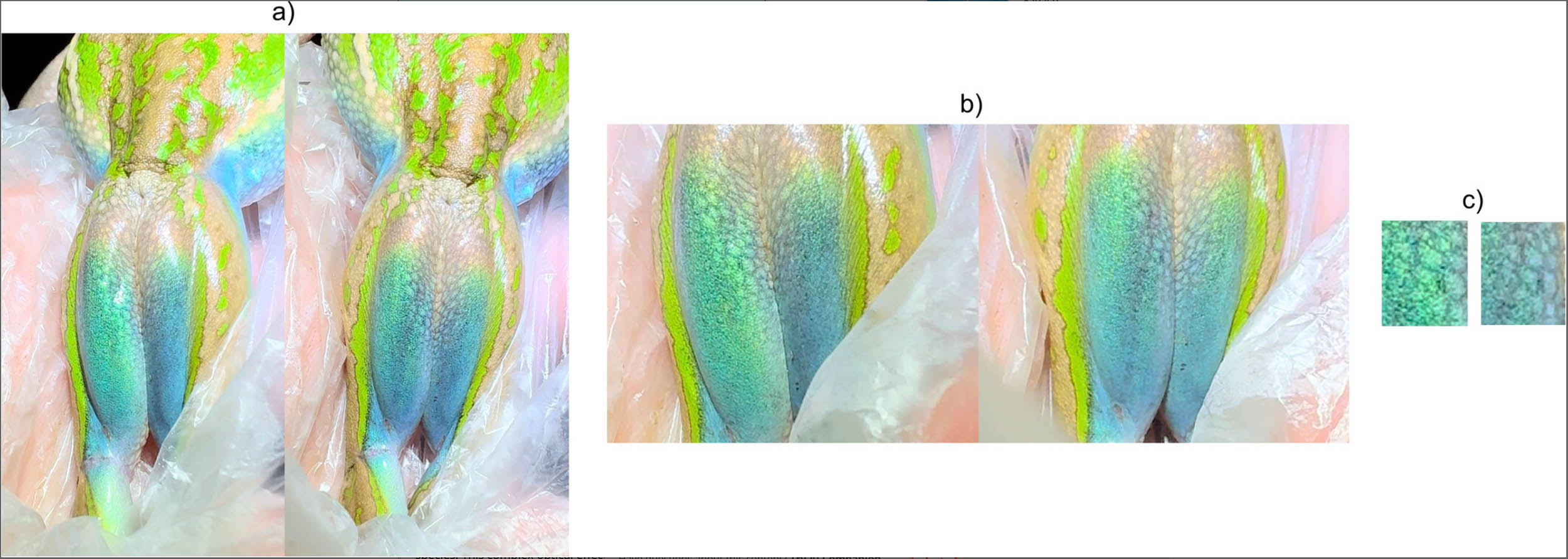
It produces a patch of skin that shifts from blue to green depending on the angle from which it is viewed.
Dr. John Gould, a conservation biologist at the University of Newcastle (UON) captured the effect on camera.
His new paper records one of the clearest cases of iridescence ever seen in any amphibian.
Meaning of iridescence
“Iridescence occurs when color changes according to the angle from which it is viewed,” Gould said.
The best-known examples are found far outside the frog world. Butterfly wings behave this way, along with beetle shells and the feathers of many birds.
“Two people standing in different locations can look at the same patch of tissue at the same time and see different colors. It’s a remarkable optical effect, but it’s very rarely documented in amphibians.”
“Given the green and golden bell frog is such a well-known Australian species, our finding highlights how much remains to be discovered in the animal kingdom.”
Examining Ranoidea aurea
The evidence came from simple gear rather than a lab full of optics. Gould filmed the frogs at night using a phone camera and a headlamp for light.
He rotated each animal slowly so its legs passed through a range of angles. Still frames from the clearest video were then sampled pixel by pixel to record the colors reflected back.
A nearby patch of green skin kept its color no matter the angle. That steady region gave him a built-in comparison against the shifting blue thigh.
Each color was logged as a hex code, the same shorthand used to set shades on a screen. Those codes turned a fleeting shimmer into hard numbers that anyone can check.
Blue skin on the thigh
Gould captured three adult bell frogs across separate nights on Kooragang Island in New South Wales. All of them, male and female alike, showed the same shifting coloration.
The inner thigh ran from a deep ocean blue to a pale sky blue when the skin faced the lens head on. At a slanted angle that same skin turned turquoise, then a soft blue-green.
The outer thigh and back never shifted at all. Those regions kept a matte pea-green marked with gold and light brown flecks.
The shift covered the entire inner thigh, not just a few scattered spots. Two thighs on the same frog could even read as different colors at once.
Nature’s optical trick
Very few blues in nature come from pigment. Most appear when tiny structures inside a tissue split and redirect light, a process called structural coloration.
Frogs build their blues and greens with reflective crystal platelets stacked inside special skin cells called iridophores.
For a long time researchers assumed this blue came from light bouncing off structures scattered at random.
“True iridescence only occurs when these microscopic structures are ordered, as opposed to completely random, similar to what we see in butterfly wings,” Gould said.
“The presence of iridescence in this frog shows the blue color isn’t being produced through random scattering alone. Instead, it indicates that ordered reflective platelets are responsible for creating the structural blue color.”
Not all skin shimmers
One question still hangs over the finding. The outer thigh and back also make structural color, yet neither region ever shifts with angle.
Green skin in frogs carries ordered platelets too, though many species stack them in a curved arc, a little like seats rising in an amphitheater.
That shape throws back one dominant color across many directions. The green then holds steady from every side.
The blue thigh platelets, by contrast, are thought to lie flatter and more parallel to the skin.
That flatter arrangement lets the reflected color slide as the viewing angle moves. The result is the shimmer that plays across the thigh.
A startling flash
The blue patch usually stays out of sight. It flashes into view when the frog leaps or kicks out its legs, a trick biologists call flash coloration.
“The blue inner thigh is already thought to play an important role in anti-predator defense. Our findings suggest that iridescence may enhance that visual signal, making it even more conspicuous and attention-grabbing when the frog moves.”
The very motion that reveals the patch also causes its color to shift. A sudden burst that seems to change hue mid-leap could startle a predator just long enough for an escape.
Still full of surprises
The green and golden bell frog is no obscure species. It ranks among Australia’s better-known and more closely watched frogs.
That such a familiar animal still hid an optical trick shows how incomplete our understanding of animal coloration remains. Many other frogs have never been checked for a shift like this one.
The bell frog has been photographed for decades. Its shifting blue flash simply went unrecorded until now.
Discovery lies ahead
“People are often surprised to learn that frogs produce structural colors at all,” he also noted.
His search of the scientific literature turned up 24 papers that mentioned iridescence in amphibians. Only two of them noted an actual color shift, and a single paper included color photographs.
“This study demonstrates that amphibian skin can be far more complex than we previously appreciated and suggests there may be other examples of iridescence waiting to be discovered.”
The study is published in the journal Austral Ecology.
—–
Like what you read? Subscribe to our newsletter for engaging articles, exclusive content, and the latest updates.
Check us out on EarthSnap, a free app brought to you by Eric Ralls and Earth.com.
—–